Surge Irrigation - Agriculture Notes
Surge irrigation, also known as surge flow, is the intermittent application of water to an irrigation furrow. Water is normally applied in a continuous flow for the duration of the irrigation set time. Surge irrigation was initially investigated as a method of reducing runoff during irrigation. It was discovered that when water was applied intermittently rather than continuously, it moved faster to the end of the field. Surge irrigation is a type of furrow irrigation in which the water supply is pulsed on and off at predetermined intervals. Wetting and drying cycles reduce infiltration rates, resulting in faster advance rates and higher uniformities than continuous flow. In this article, we will discuss Surge Irrigation which will be helpful for UPSC exam preparation.
|
Table of Contents |
Surge Irrigation
What is Irrigation & Irrigation System?
- Irrigation is the process of artificially applying water to crops in order to meet their water requirements.
- Irrigation can also be used to provide nutrients to crops.
- Irrigation is typically used in areas where rainfall is irregular, dry periods are expected, or drought is predicted.
- There are various types of irrigation systems that supply water uniformly to the entire field.
- Groundwater, from springs or wells, surface water, from rivers, lakes, or reservoirs, and even treated wastewater or desalinated water can be used for irrigation.
- Irrigation provides the necessary moisture for growth and development, germination, and other related functions.
- The frequency, rate, amount, and time of irrigation differ for different crops, as well as depending on soil type and season.
- Summer crops, for example, require significantly more water than winter crops.
- Farmers must protect their agricultural water source to reduce the risk of contamination.
- As with any groundwater removal, irrigation water users must exercise caution to avoid pumping groundwater out of an aquifer faster than it is being recharged.
- It is regarded as a basic infrastructure and a necessary input for agricultural production.
- The primary goal is to maintain agricultural output while using as little water as possible, as well as to maintain landscapes and re-vegetate disturbed soils.
- Irrigation is frequently studied in conjunction with drainage, which is the natural or artificial removal of surface and subsurface water from a specific area.
|
|
|
|---|---|
| Micro irrigation | Drip Irrigation |
| Sprinkler Irrigation | Tank Irrigation |
| Well and Tube Well Irrigation | Sub Irrigation or Seepage Irrigation |
| Canal Irrigation | Furrow Irrigation |
What is Surge Irrigation?
- Surge irrigation is the intermittent application of water to improve the uniformity of distribution along a furrow.
- It operates on the premise that dry soil absorbs water faster than wet soil. When soil becomes wet, it seals due to the consolidation of soil particles at the surface.
- When water is reintroduced into a wet furrow, the wetting front moves quickly past the wetting zone and into dry soil. Dry soil slows progress at the wetting interface.
- This phenomenon enables faster advancement through the field with less deep percolation and improved application uniformity.
- Surge irrigation is the practice of delivering irrigation flows into individual long furrows in an intermittent fashion of predetermined ON-OFF time cycles with the irrigation design duration.
- During the ON time, the waterfront advances into the furrow over a certain length, and during the subsequent OFF time, the water applied partially saturates the soil and the infiltration rate on the advanced length is reduced.
- When water is delivered during the next ON time, the waterfront advance is accelerated due to the reduced intake rate, and it eventually reaches the tail end of the long furrow within 30-50% of the irrigation design duration.
- This process of ON/OFF water supply and cutoff results in extremely low deep percolation and runoff losses.
- As a result, high uniformity of soil moisture distribution within the effective root zone is achieved throughout the furrow length, resulting in improved irrigation efficiencies of more than 85% to 95%.
- Furthermore, because of the series of long furrows emanating from a single head channel, the criss-cross ridges and feeder channel of division are eliminated, limiting land loss to only 5%.
How does Surge Irrigation work?
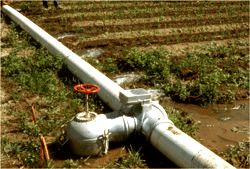
- Surge irrigation employs a surge controller butterfly valve located in the centre of the top of the field, with gated pipe leading out of the valve in both directions along the top of the field.
- In fields with some side slope, the surge valve can be placed in the field's corner and extra pipe used to distribute the water.
- The valve operates by oscillating water from one side of the valve to the other at predetermined intervals.
- The alternating flow of water on each side of the valve causes an intermittent wetting and soaking cycle in the irrigated furrow.
- Soil particles settle to the bottom of the furrow, reducing the soil's water intake rate.
- With a lower intake rate, the water can advance down the furrow faster, giving the field a more uniform water application while requiring less water for adequate irrigation.
Advantages of Surge Irrigation
- Surge Irrigation can lower irrigating costs by using less water and requiring less labour to irrigate.
- Surge irrigation reduces total irrigation water used, excess water infiltration, and runoff water losses.
- Surge irrigation aids in reducing sediment loss from furrow-irrigated fields.
Disadvantages of Surge Irrigation
- One of the major disadvantages of surge irrigation is the cost of switching irrigation systems.
- When a field needs to be re-leveled and the surface irrigation system needs to be redesigned, the benefits of the surge are definitely worth considering.
- Surge valves have controllers that allow the grower to select the duration of the irrigation oscillations from one side of the field to the other.
Conclusion
Surge flow has been used to reduce irrigation runoff in some cases by using short-duration cycles after the water has reached the end of a field. This helps to maintain high water application uniformity and improve overall irrigation performance. Another advantage of surge irrigation, unrelated to improved irrigation system performance, is that the surge valve can be used to improve irrigation system management without requiring a significant increase in labor.
|
|
|
|---|---|
| Agriculture Notes | Different Types of Irrigation and Irrigation Systems |
| Crop Rotation | Watershed Management |
| Crop and its Classifications | Cropping |
| Farming Systems | Organic Farming |
| Sustainable Agriculture | Integrated Farming System |
| Important Cropping Patterns in India | Major Crops of India |
| WEEDS | Soil |
FAQs
Question. What is surge irrigation?
Answer: Surge irrigation is an advanced irrigation method where water is applied in a series of intermittent pulses or surges, rather than continuously, to the field. This technique involves turning the water on and off at regular intervals, allowing the soil to absorb the water more efficiently. The pulses of water move across the field in waves, infiltrating the soil and providing moisture to the crops. Surge irrigation is typically used in fields with relatively flat terrain and is more water-efficient than traditional continuous irrigation systems.
Question. How does surge irrigation work?
Answer: Surge irrigation works by releasing water in controlled bursts or pulses into the field, usually through furrows. The water is allowed to flow down the furrows in surges, with breaks between each surge to allow the soil to absorb the water more effectively. This process reduces water wastage through evaporation and runoff, making it a more efficient method of irrigation compared to conventional systems. The pulses also help improve water infiltration into the soil, ensuring that crops receive adequate moisture while preventing waterlogging.
Question. What are the benefits of surge irrigation?
Answer: The main benefits of surge irrigation include:
- Improved water efficiency: By allowing the soil to absorb water more effectively, surge irrigation reduces water wastage due to runoff and evaporation.
- Reduced waterlogging: The intermittent flow of water helps prevent water from accumulating in the field, reducing the risk of waterlogging and promoting better root health.
- Cost-effective: Surge irrigation systems can be more cost-effective than other advanced irrigation methods like drip or sprinkler systems, especially for farmers with limited resources.
- Enhanced soil infiltration: The pulses of water help improve soil infiltration, ensuring that water reaches the root zone more effectively.
Question. What are the disadvantages of surge irrigation?
Answer: Despite its benefits, surge irrigation has some disadvantages:
- Requires flat terrain: Surge irrigation is most effective on flat or gently sloping fields. Steep or uneven terrains can hinder the uniform distribution of water.
- Labor and management intensive: Surge irrigation systems require proper management to ensure that the pulses are timed effectively and that the water reaches all parts of the field. It also requires labor for setting up and monitoring the system.
- Limited crop suitability: It is best suited for row crops like cotton, maize, and vegetables, and may not be effective for crops that require more uniform water distribution.
- Infrastructure requirements: Surge irrigation may require the installation of specialized infrastructure, including valves and control systems, which can be costly for small-scale farmers.
Question. Where is surge irrigation commonly used?
Answer: Surge irrigation is commonly used in regions with flat terrain and in areas where water conservation is crucial. It is particularly effective for row crops such as cotton, maize, and other vegetables. This method is used in countries with large-scale agriculture, such as the United States, Australia, and India, particularly in regions with water scarcity issues or where efficient water use is necessary.
MCQs
- Surge irrigation involves water being applied:
A) Continuously without breaks
B) In pulses with intervals between each pulse
C) Through sprinklers
D) Through drip lines
Answer: (B) See the Explanation
Surge irrigation involves applying water in pulses with breaks in between, allowing the soil to absorb water more efficiently.
- What is the main advantage of surge irrigation over continuous irrigation?
A) Higher water consumption
B) Reduced risk of waterlogging
C) Requires less labor
D) More expensive setup
Answer: (B) See the Explanation
Surge irrigation helps reduce the risk of waterlogging by allowing the soil to absorb water in intervals, preventing excessive accumulation of water in the field.
- Which of the following crops is best suited for surge irrigation?
A) Rice
B) Wheat
C) Cotton
D) Paddy
Answer: (C) See the Explanation
Surge irrigation is particularly effective for row crops like cotton, which benefit from efficient water infiltration through pulses.
- Surge irrigation is most effective on:
A) Steep, uneven terrain
B) Gently sloping or flat terrain
C) Crops requiring constant moisture
D) Crops that need deep watering
Answer: (B) See the Explanation
Surge irrigation is most effective on flat or gently sloping fields, as it requires uniform water distribution across the surface.
- Which of the following is a disadvantage of surge irrigation?
A) It is suitable for all types of crops
B) It requires specialized infrastructure
C) It is a highly labor-intensive method
D) It does not require water management
Answer: (B) See the Explanation
Surge irrigation requires infrastructure like valves and control systems to manage water flow, which can be costly to set up.
GS Mains Questions and Model Answers
Q1: Discuss the advantages and disadvantages of surge irrigation as a method of water management in agriculture.
Answer: Surge irrigation is an efficient method of water management, offering several key advantages. The most notable benefit is its water efficiency, as the pulses of water allow the soil to absorb moisture more effectively, reducing wastage through runoff and evaporation. This method helps prevent waterlogging, which can damage crops, and improves soil infiltration, ensuring that water reaches the root zones where it is needed. Surge irrigation is also relatively cost-effective compared to other advanced systems like drip or sprinkler irrigation, making it a viable option for farmers with limited resources.
However, surge irrigation also has its disadvantages. It requires relatively flat terrain, which can limit its applicability in hilly or uneven regions. Additionally, it is more labor-intensive and requires proper management to ensure that the pulses are timed effectively. The infrastructure needed for surge irrigation, including control systems and valves, can also increase the initial setup cost. Furthermore, it is not suitable for all crops, particularly those that require uniform water distribution, and may not be the best option for crops like rice that need continuous flooding.
Overall, while surge irrigation offers significant benefits in terms of water efficiency and cost-effectiveness, it requires careful management and appropriate conditions to maximize its effectiveness in water-scarce regions.
Q2: How does surge irrigation contribute to water conservation and sustainable agriculture?
Answer: Surge irrigation contributes to water conservation by reducing the amount of water wasted through evaporation and runoff. Traditional irrigation methods, such as flood irrigation, often result in substantial water losses, particularly in hot climates where evaporation is high. Surge irrigation mitigates this by delivering water in intermittent pulses, allowing the soil to absorb the water more effectively. This controlled application helps maintain optimal moisture levels in the soil, reducing water wastage and promoting efficient use of available water resources.
In addition to water conservation, surge irrigation supports sustainable agriculture by improving soil health. The intermittent flow of water ensures that the soil is not over-saturated, which can lead to waterlogging and root diseases. By promoting better water infiltration, surge irrigation helps maintain the structure of the soil and encourages healthy root growth, which is essential for crop productivity. Moreover, the reduced risk of waterlogging helps prevent soil erosion, further supporting long-term agricultural sustainability.
Overall, surge irrigation plays a significant role in sustainable water management by minimizing waste and ensuring that water is used efficiently, which is crucial in regions facing water scarcity and for long-term agricultural sustainability.
Q3: Analyze the role of surge irrigation in enhancing crop productivity and its challenges in implementation.
Answer: Surge irrigation plays an important role in enhancing crop productivity by providing water to the crops in a controlled and efficient manner. By applying water in pulses, it ensures that the moisture is evenly distributed across the field, which is critical for crops that rely on consistent soil moisture for optimal growth. This method helps to minimize the risk of over-irrigation, which can lead to waterlogging and reduced oxygen levels in the soil, both of which can stunt crop growth. The intermittent pulses of water allow the soil to absorb moisture more effectively, promoting healthier roots and more vigorous crop development.
However, there are several challenges in implementing surge irrigation. One of the primary issues is the requirement for flat or gently sloping land, as the system works best when the water can flow evenly along furrows. In areas with uneven terrain, the method may not be as effective, limiting its applicability. Surge irrigation also requires proper management to ensure that the pulses of water are applied at the right intervals and that the system is monitored carefully to avoid inefficiencies. Furthermore, setting up a surge irrigation system involves the installation of control infrastructure, which can be costly for small-scale farmers. Additionally, surge irrigation is not suitable for all types of crops, especially those that require more uniform water distribution, such as paddy rice. Despite these challenges, surge irrigation remains a valuable tool for improving water use efficiency and crop productivity, especially in regions where water resources are limited.
Previous Year Questions on Surge Irrigation
1. UPSC CSE 2020
Question: "Discuss the advantages and disadvantages of surge irrigation and its potential role in water conservation in agriculture."
Answer: Surge irrigation is an effective method for water conservation in agriculture due to its efficiency in reducing water wastage. The key advantage of surge irrigation lies in its ability to minimize water loss through evaporation and runoff, as water is applied in controlled pulses, allowing the soil to absorb moisture more effectively. This system is particularly beneficial in regions facing water scarcity, as it maximizes the use of available water resources. Additionally, surge irrigation helps reduce the risk of waterlogging and improves soil infiltration, ensuring that water reaches the root zones of crops. Its cost-effectiveness also makes it accessible to small-scale farmers, especially in areas with limited access to advanced irrigation systems.
However, surge irrigation has certain disadvantages, such as the need for flat terrain, which limits its applicability in regions with uneven or hilly land. Moreover, the method requires careful management to ensure that water is applied at the correct intervals, which can increase labor and operational costs. The initial setup for surge irrigation can also be expensive due to the need for specialized infrastructure like control systems and valves. Despite these challenges, surge irrigation plays a significant role in water conservation and sustainable agriculture, particularly in water-scarce regions.
2. UPSC CSE 2019
Question: "Evaluate the effectiveness of surge irrigation in enhancing agricultural productivity and conserving water resources."
Answer: Surge irrigation is an effective method for both enhancing agricultural productivity and conserving water resources. By delivering water in pulses, it allows for more efficient water use, minimizing wastage and ensuring that the soil absorbs moisture effectively. This system improves water infiltration, which promotes healthier root growth and enhances crop yields, particularly for row crops such as cotton, maize, and vegetables. Surge irrigation’s ability to reduce waterlogging also helps to maintain soil health, preventing erosion and ensuring that crops receive optimal water supply without harming the soil structure.
In terms of water conservation, surge irrigation helps reduce evaporation losses, which are common in traditional flood irrigation systems. The intermittent flow of water ensures that moisture is provided when needed without excessive use, making it a valuable tool in areas with limited water resources. Despite some challenges, such as the need for flat land and initial infrastructure costs, surge irrigation remains an important method for sustainable water management, contributing to both improved crop productivity and conservation of water resources.
Download the PREPP App and attempt FREE IAS Exam Mock Tests and get complete study material!

Full Test - 04: UPSC CSE Prelims CSAT (Paper-II)
Full Test - 03: UPSC CSE Prelims CSAT (Paper-II)
UPSC CSE Prelims 2026 CSAT Paper 2 Question Paper (24-May-2026)
UPSC CSE Prelims 2026 GS Paper 1 Question Paper (24-May-2026)

17 February 2025 | The Hindu Must Read Articles | Current Affairs

16 February 2026 | The Hindu Must Read Articles | Current Affairs

13 February 2026 | The Hindu Must Read Articles | Current Affairs









Comments