Furrow Irrigation - Agriculture Notes
Furrow irrigation is a type of surface irrigation system. During the planting and cultivation process, furrows are formed in rows, and gravity and water are efficiently applied to allow the plant to grow. Water can infiltrate through furrow irrigation and reach the crop's root. In comparison to other surface irrigation systems, this irrigation method uses very little water. In this article, we will discuss Furrow Irrigation which will be helpful for UPSC exam preparation.
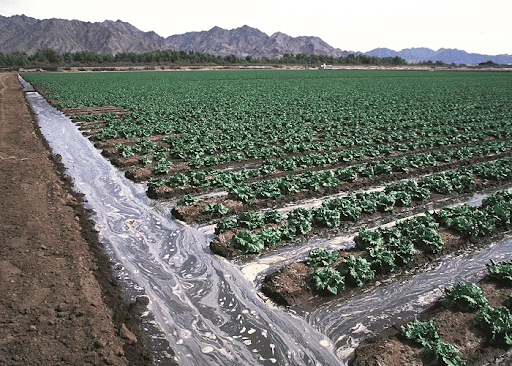
Furrow Irrigation
What is Irrigation & Irrigation System?
- Irrigation is the process of artificially applying water to crops in order to meet their water requirements.
- Irrigation can also be used to provide nutrients to crops.
- Irrigation is typically used in areas where rainfall is irregular, dry periods are expected, or drought is predicted.
- There are various types of irrigation systems that supply water uniformly to the entire field.
- Groundwater, from springs or wells, surface water, from rivers, lakes, or reservoirs, and even treated wastewater or desalinated water can be used for irrigation.
- Irrigation provides the necessary moisture for growth and development, germination, and other related functions.
- The frequency, rate, amount, and time of irrigation differ for different crops, as well as depending on soil type and season.
- Summer crops, for example, require significantly more water than winter crops.
- Farmers must protect their agricultural water source to reduce the risk of contamination.
- As with any groundwater removal, irrigation water users must exercise caution to avoid pumping groundwater out of an aquifer faster than it is being recharged.
- It is regarded as basic infrastructure and a necessary input for agricultural production.
- The primary goal is to maintain agricultural output while using as little water as possible, as well as to maintain landscapes and re-vegetate disturbed soils.
- Irrigation is frequently studied in conjunction with drainage, which is the natural or artificial removal of surface and subsurface water from a specific area.
|
|
|
|---|---|
| Micro irrigation | Drip Irrigation |
| Sprinkler Irrigation | Tank Irrigation |
| Well and Tube Well Irrigation | Sub Irrigation or Seepage Irrigation |
| Canal Irrigation | Surge Irrigation |
What is Furrow Irrigation?
- Furrow irrigation involves digging trenches or "furrows" between crop rows in a field.
- Farmers direct water down the furrows (often using only gravity), and it seeps vertically and horizontally to replenish the soil reservoir. The flow to each furrow is individually controlled.
- Furrow irrigation is ideal for broad-acre row crops like cotton, corn, and sugar cane. It is also used in the horticultural industries of citrus fruits and tomatoes.
- Furrow irrigation is one of the oldest irrigation methods because it is inexpensive and low-tech, making it particularly appealing in developing countries or areas where mechanised spray irrigation is unavailable or impractical.
- While furrow irrigation may not be the "hottest" new way to water crops, it is one of the most cost-effective and low-tech options for farmers, which is why millions continue to use it.
Types of Furrow Irrigation
- Straight furrow irrigation: This type of furrow irrigation is used on flat land.
- The straight furrows are developed in a straight line as a small channel parallel to the field's boundary line.
- It is used for all types of soil except sandy soil because graded furrow irrigation requires lateral water spread, which is difficult to achieve in sandy soil.
- More human labour is required in this irrigation.
- Contour furrow Irrigation: This furrow irrigation system is used when straight furrow irrigation is impractical.
- Furrow irrigation is a small, graded, wrapped channel in contour. This water is spread towards a sloping field rather than downslope.
- Furrows are formed on sloping beds, and pipelines or irrigation systems are laid out on that grade in accordance with contour slopes and curves.
- It is one of the most effective ways to save water during irrigation.
- Because of the unstable contour slopes, it is mostly used on all types of soils rather than very sandy soil.
- The only difference is that the contour furrow must be managed on a regular basis.
- Corrugated furrow irrigation: Corrugated (zig-zag) furrows are very small and closely spaced channels.
- This method is also used for flat or slightly levelled surfaces.
- It is classified based on its size and shape.
- The size of the corrugated furrow is smaller in this method, and many lines of the corrugated furrow are developed parallel to the field boundary, through which water is spread in all the fields and to the plants or crops in a row.
- It is best suited to low rainfall areas with high crop density.
Factors to Consider Regarding Furrow Irrigation
Soil
- The aggregating capacity of the soil is the most important factor to consider when selecting soils for furrow irrigation construction.
- Simply put, the less soft it becomes when it comes into contact with water, the better it is for furrow irrigation.
- Because water regulation will be absent, sandy soils are the least suitable.
- Clay, loamy, and silty soils are excellent candidates for furrow irrigation.
Plants
- Furrows in a house's backyard in a patch of vegetable garden are a very common sight.
- As a result, we can safely assume that furrow irrigation is ideal for the majority of crops and vegetables.
- It is a very useful process when the roots require regulated contact with water but contact with the stem or other parts would be harmful.
- Growing row crops such as wheat, maize, and paddy, as well as some fruits and, of course, most vegetables, can all benefit from this method.
Slopes
- Sloping for furrow irrigation is not done very well. However, it must be slightly adjusted depending on the type of soil present.
Uses of Furrow Irrigation
- Furrow irrigation is used when crops are grown in rows such as the tree and horticulture industries.
- It is used when surface irrigation is required with efficient water use and a limited budget for irrigation equipment.
- It will be used when we have more labour on the initial development of the furrow irrigation system.
- Contour furrow irrigation is also used in hilly areas where the slope is graded.
Advantages of Furrow Irrigation
- Irrigation of bulk crops is possible using this system.
- This irrigation system will reduce time waste and make it more cost-effective.
- Investing in a system and its equipment requires a small amount of capital.
- Because gravity irrigation saves water, it is very cost-effective.
- Over irrigation causes water supply to runoff, which can be collected at the field's end and reused.
- The use of chemical pesticides can be reduced with this irrigation system.
- More crop yield will be ensured if proper shape and size furrows are designed as needed.
- This method allows us to increase crop yield while using less water.
Disadvantages of Furrow Irrigation
- Maintaining water is necessary because overflowing water can occur and soil infiltration is reduced.
- It is not suitable for all types of soil, such as sandy soil, because it has a high infiltration rate but cannot be spread laterally.
- Due to furrow irrigation, salt in the water accumulates at the soil's edge between the two furrows.
- As a result, salt accumulation in the soil can be redistributed after each crop yield re-plowing.
- The furrow irrigation system restricts crop irrigation movement.
- Furrow development and creation require more human labour.
- Damages should be repaired on a regular basis.
- Not suitable for many crops that require a different irrigation system.
Crops Suitable for Furow Irrigation
- Furrow irrigation is suitable for a wide range of crops, particularly row crops.
- Furrow irrigation should be used for crops that would be damaged if water covered their stem or crown.
- Furrow irrigation is also suitable for the cultivation of tree crops.
- One furrow alongside the tree row may be sufficient in the early stages of tree planting, but as the trees grow, two or more furrows can be constructed to provide adequate water.
- A special zig-zag system is sometimes used to improve water spread.
- Furrow irrigation can be used to irrigate the following crops:
- row crops like maize, sunflower, sugarcane, and soybean
- crops that would suffer from flooding, such as tomatoes, vegetables, potatoes, and beans;
- citrus and grapefruit trees;
- broadcast crops, such as wheat.
Difference Between Flood and Furrow Irrigation
| Flood Irrigation | Furrow Irrigation |
|---|---|
| Flood irrigation is a type of surface irrigation that is far less efficient than any other method. | Furrow irrigation is another surface irrigation method that increases crop yields significantly. |
| Water is applied to the field in this method, and the excess will percolate or runoff, while some will infiltrate and meet the plant root. | Water is applied to the furrow between the rows of crops using a tube or syphon pipe in this method. |
| Some crops receive too much water and others receive insufficient water as a result of this irrigation system. | This irrigation system provides crops with an efficient amount of water while wasting very little. |
| This irrigation system necessitates less human labour. | When compared to flood irrigation systems, more human labour is required. |
Conclusion
Furrow irrigation can be a very cheap and efficient solution in a world where water is becoming increasingly scarce. With techniques like alternate irrigation and furrow irrigation designs, this system is sure to save both water and erosion. This irrigation system appears to be very cost-effective for a developing country and has proven to be more promising in terms of yields.
|
|
|
|---|---|
| Agriculture Notes | Different Types of Irrigation and Irrigation Systems |
| Crop Rotation | Watershed Management |
| Crop and its Classifications | Cropping |
| Farming Systems | Organic Farming |
| Sustainable Agriculture | Integrated Farming System |
| Important Cropping Patterns in India | Major Crops of India |
| WEEDS | Soil |
FAQs
Question: What is furrow irrigation?
Answer: Furrow irrigation is a method of irrigation in which water is supplied to crops through small channels or furrows that are dug between crop rows. The water flows along these furrows, soaking into the soil and providing moisture to the plants' roots. This method is commonly used for row crops like corn, cotton, and vegetables and is considered a surface irrigation technique.
Question: How does furrow irrigation work?
Answer: In furrow irrigation, a series of shallow furrows are created along the crop rows. Water is then applied at the top of the furrows, and gravity causes it to flow down the furrow towards the end. As the water flows, it infiltrates the soil, providing moisture to the crops' root zones. This method is particularly effective in areas where water is not readily available and is used for crops that are planted in rows with space for the water to spread.
Question: What are the advantages of furrow irrigation?
Answer: Some of the advantages of furrow irrigation include:
- Efficient water use: It minimizes water wastage by delivering water directly to the plant roots.
- Reduced evaporation: Since water flows along the ground, evaporation losses are lower compared to overhead irrigation systems.
- Cost-effective: Furrow irrigation is relatively inexpensive to set up, especially for farmers who already have the necessary land and equipment.
- Simple and effective: It is an easy method to implement and can be adapted to many types of crops and terrains.
Question: What are the disadvantages of furrow irrigation?
Answer: Despite its advantages, furrow irrigation also has some disadvantages:
- Labor-intensive: It requires labor to dig and maintain the furrows, which can be time-consuming.
- Waterlogging: If water is not properly managed, excess water can accumulate in the furrows, leading to waterlogging and root diseases.
- Limited to certain crops: Furrow irrigation is most effective for row crops and may not work well for crops that require uniform water distribution across the entire field.
- Soil erosion: In some cases, the flow of water in the furrows can cause soil erosion, particularly on slopes or with high water flow rates.
Question: Where is furrow irrigation commonly used?
Answer: Furrow irrigation is commonly used in areas where surface water is available or where the terrain is flat enough for the furrows to be effective. It is widely used in regions that grow row crops, such as in parts of the United States, India, and Australia. This method is especially beneficial for areas with limited access to advanced irrigation systems or where water conservation is crucial.
MCQs
- Which of the following is the primary method used in furrow irrigation?
a) Sprinkler system
b) Drip system
c) Water flowing in furrows between crop rows
d) Water sprayed over plants
Answer: (c) See the Explanation
Furrow irrigation involves water flowing in furrows dug between crop rows, which allows the water to infiltrate the soil and irrigate the crops.
- What is one of the key benefits of furrow irrigation?
a) It requires minimal labor
b) It minimizes water wastage by delivering water directly to the plant roots
c) It is suitable for all types of crops
d) It uses the least amount of water
Answer: (b) See the Explanation
Furrow irrigation is effective in minimizing water wastage, as it delivers water directly to the plant roots, reducing evaporation and runoff.
- Which of the following is a disadvantage of furrow irrigation?
a) It can lead to soil erosion
b) It has no water loss
c) It is suitable for all types of crops
d) It requires little maintenance
Answer: (a) See the Explanation
Furrow irrigation can lead to soil erosion, especially when the water flow is high or the furrows are poorly managed.
- Furrow irrigation is most effective for which type of crops?
a) Fruit trees
b) Row crops
c) Rice paddies
d) Orchards
Answer: (b) See the Explanation
Furrow irrigation is most effective for crops that are planted in rows, such as vegetables, cotton, and corn.
- Which of the following is an essential factor in the success of furrow irrigation?
a) Sufficient rainfall
b) Proper furrow design and water management
c) Use of chemicals in the water
d) Regular harvesting
Answer: (b) See the Explanation
The success of furrow irrigation depends on proper furrow design and efficient water management to ensure water reaches the plant roots without causing waterlogging or erosion.
GS Mains Questions and Answers
Q1: Discuss the advantages and disadvantages of furrow irrigation as a method of water management in agriculture.
Answer: Furrow irrigation offers several advantages as a water management technique in agriculture. One of the main benefits is that it minimizes water wastage by delivering water directly to the root zones of plants. This method reduces evaporation losses compared to overhead irrigation systems, making it more efficient in dry regions. Additionally, furrow irrigation is relatively inexpensive to set up and operate, making it accessible to farmers in areas with limited resources. It also allows for effective water distribution across crop rows, ensuring that water is available to the plants where it is needed.
However, there are some disadvantages to furrow irrigation as well. One of the main challenges is that it can be labor-intensive, requiring manual labor to dig and maintain the furrows. It is also not suitable for all types of crops, as it works best for row crops and can be ineffective for crops that need uniform water distribution. Another issue is that poor water management can lead to waterlogging, which can harm crops and lead to soil erosion. Moreover, the method is less effective on sloped land, as water may not flow evenly across the field. Despite these drawbacks, furrow irrigation remains a popular and efficient method of irrigation in many regions where water conservation is important.
Q2: How does furrow irrigation contribute to water conservation in agriculture?
Answer: Furrow irrigation contributes to water conservation in agriculture by reducing water wastage and ensuring more efficient use of available water resources. Unlike methods such as flood irrigation, which can result in significant evaporation and runoff, furrow irrigation delivers water directly to the crop root zones. This targeted application of water helps ensure that the plants receive adequate moisture while minimizing the loss of water to the atmosphere. By allowing water to flow slowly along furrows, it also ensures that the water is absorbed into the soil gradually, reducing the risk of waterlogging and runoff. Additionally, furrow irrigation allows for precise control over the amount of water delivered to each crop, enabling farmers to adjust the irrigation rates according to the crop’s needs, further promoting water conservation.
Q3: Analyze the environmental and economic impacts of using furrow irrigation in agriculture.
Answer: Furrow irrigation has both environmental and economic impacts on agriculture. Environmentally, it is more water-efficient compared to other traditional irrigation methods like flood irrigation, as it reduces water wastage through evaporation and runoff. By delivering water directly to the plant roots, furrow irrigation helps conserve water in regions where water resources are limited. However, if not managed properly, it can lead to soil erosion, particularly on slopes or in areas with high water flow, which may result in the loss of fertile soil and degrade the land. Additionally, improper water management can cause waterlogging, which harms soil health and negatively impacts crop yields.
Economically, furrow irrigation can be a cost-effective option for farmers, especially in areas where more advanced irrigation systems are not feasible due to high costs. It requires less investment in infrastructure compared to drip or sprinkler systems, making it accessible to small-scale farmers. However, the method can be labor-intensive, as it requires manual work to dig and maintain the furrows. This increases labor costs, particularly in regions where labor is expensive. Overall, furrow irrigation can lead to improved crop yields and water savings, but it requires careful management to avoid environmental issues such as soil erosion and waterlogging.
Previous Year Questions on Furrow Irrigation
1. UPSC CSE 2020
Question: "Discuss the significance of furrow irrigation in water management for crops and its sustainability in agricultural practices."
Answer: Furrow irrigation plays a significant role in water management by reducing water wastage and targeting the delivery of water directly to the crops. This system minimizes evaporation and runoff compared to methods such as flood irrigation, making it highly efficient in water-scarce regions. Furrow irrigation is particularly beneficial for row crops and is a cost-effective solution, especially for small-scale farmers who cannot afford more advanced irrigation systems. However, to maintain sustainability, it is essential to manage water flow properly to prevent waterlogging and soil erosion. If managed effectively, furrow irrigation can provide long-term benefits for water conservation, while also improving crop yields and ensuring that water is used more efficiently in agriculture.
2. UPSC CSE 2019
Question: "Evaluate the role of furrow irrigation in agricultural productivity and its challenges in modern farming."
Answer: Furrow irrigation plays a vital role in enhancing agricultural productivity by efficiently supplying water to crops, particularly in areas where advanced irrigation systems are not available. This method ensures that water is directly applied to the plant roots, minimizing evaporation and runoff. As a result, it conserves water and promotes better crop growth. The simplicity and low cost of furrow irrigation make it accessible for small farmers, enabling them to increase yields in water-scarce regions. The method faces several challenges, including the need for proper land leveling and furrow maintenance to prevent waterlogging and soil erosion. Additionally, the labor-intensive nature of the system can be a challenge, particularly for large-scale farming. Despite these challenges, with proper management, furrow irrigation remains a crucial tool for improving agricultural productivity and ensuring efficient water use in farming practices.
Download the PREPP App and attempt FREE IAS Exam Mock Tests and get complete study material!

Full Test - 04: UPSC CSE Prelims CSAT (Paper-II)
Full Test - 03: UPSC CSE Prelims CSAT (Paper-II)
UPSC CSE Prelims 2026 GS Paper 1 Question Paper (24-May-2026)
UPSC CSE Prelims 2026 CSAT Paper 2 Question Paper (24-May-2026)

17 February 2025 | The Hindu Must Read Articles | Current Affairs

16 February 2026 | The Hindu Must Read Articles | Current Affairs

13 February 2026 | The Hindu Must Read Articles | Current Affairs









Comments