Sprinkler Irrigation - Agriculture Notes
Sprinkler irrigation is a versatile method of applying water that simulates the effects of rainfall. Pumping is used to distribute water through a network of pipes. Sprinklers provide efficient coverage from small to large areas and can be used on any terrain. It is also adaptable to nearly all irrigable soils because sprinklers come in a variety of discharge capacities. An irrigation sprinkler (also known as a water sprinkler or simply a sprinkler) is a device used to irrigate (water) agricultural crops, lawns, landscapes, golf courses, and other areas. They are also used for cooling and dust control. In this article, we will discuss Sprinkler Irrigation which will be helpful for UPSC exam preparation.
|
Table of Contents |
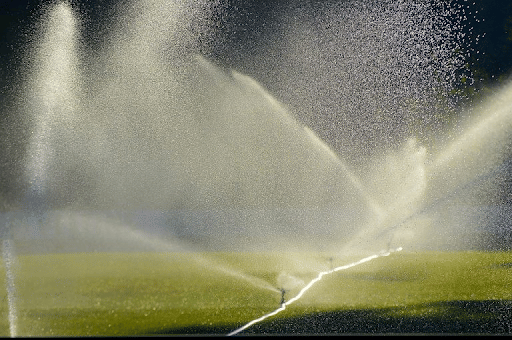
Sprinkler Irrigation
What is Irrigation & Irrigation System?
- Irrigation is the process of artificially applying water to crops in order to meet their water requirements.
- Irrigation can also be used to provide nutrients to crops.
- Irrigation is typically used in areas where rainfall is irregular, dry periods are expected, or drought is predicted.
- There are various types of irrigation systems that supply water uniformly to the entire field.
- Groundwater, from springs or wells, surface water, from rivers, lakes, or reservoirs, and even treated wastewater or desalinated water can be used for irrigation.
- Irrigation provides the necessary moisture for growth and development, germination, and other related functions.
- The frequency, rate, amount, and time of irrigation differ for different crops, as well as depending on soil type and season.
- Summer crops, for example, require significantly more water than winter crops.
- Farmers must protect their agricultural water source to reduce the risk of contamination.
- As with any groundwater removal, irrigation water users must exercise caution to avoid pumping groundwater out of an aquifer faster than it is being recharged.
- It is regarded as basic infrastructure and necessary input for agricultural production.
- The primary goal is to maintain agricultural output while using as little water as possible, as well as to maintain landscapes and re-vegetate disturbed soils.
- Irrigation is frequently studied in conjunction with drainage, which is the natural or artificial removal of surface and subsurface water from a specific area.
What is Sprinkler Irrigation?
- In the sprinkler irrigation technique, water is sprinkled into the air and allowed to fall on the ground surface as if it rained. The spray is created by forcing water through small orifices or nozzles.
- It is suitable for the majority of the row, field, and tree crops. Water can be sprayed on top of or beneath the crop canopy.
- Sprinkler irrigation will not be appropriate if the site is known to be windy most of the time.
- Pumping is commonly used to generate pressure. The amount of irrigation water required to refill the crop root zone can be applied almost uniformly at the rate to suit the infiltration rate of the soil by properly selecting nozzle sizes, operating pressure, and sprinkler spacing.
- Sprinklers are suitable for most soil types, but they work best in sandy soil. These are suitable for watering lawns, gardens, and agricultural fields.
- Except for paddy and jute, almost all crops in agriculture are suitable for sprinkler irrigation systems.
- Dry crops, vegetables, flowering crops, orchards, and plantation crops such as tea and coffee are all suitable and can be irrigated using sprinkler irrigation techniques.
Components of Sprinkler Irrigation
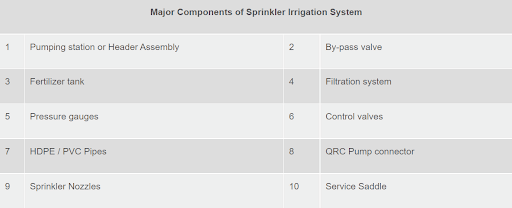
Components of Sprinkler Irrigation System
Working on Sprinkler Irrigation
- The sprinkler breaks up the water into droplets ranging in size from 0.5 to 4 mm. The pressure and nozzle size of the sprinklers control the drop size.
- The average rate of water sprayed onto crops is measured in millimetres per hour.
- The rate of application is determined by the size of the sprinkler nozzles, the operating pressure, and the distance between the sprinklers.
- The maximum allowable infiltration rate for the soil type must not be exceeded by the application rate.
- Excessive application rates cause water loss, soil erosion, and surface sealing.
- Crops or plants may be damaged if there is insufficient moisture in the root zone after irrigation.
- Water pressure is the force with which the water flows out of the sprinkler. The pressure of water is measured in pounds per square inch (psi).
- Sprinklers are thus designed to function at specific pressure levels, which are recommended as their operating pressure. The distribution of water will be affected if the pressure is higher or lower than the recommended level.
- When the pressure is low, the water drops grow larger and are unable to irrigate crops located far from the system.
- When the pressure is high, the droplets are smaller and the crops are not irrigated evenly. It can also harm sprinkler heads.
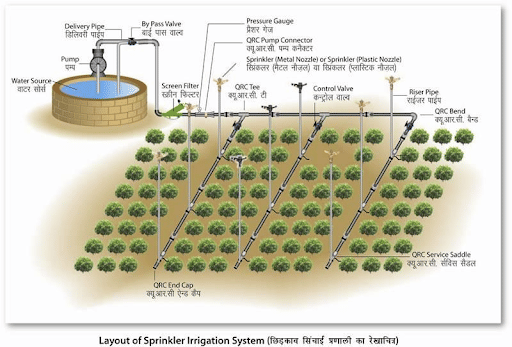
Layout of Sprinkler Irrigation System
Types of Sprinkler Irrigation System
Centre Pivot
- Most field crops can be irrigated using a centre pivot. It is made up of a single sprinkler lateral that is supported by a series of towers.
- It is fixed at one end and rotates around a fixed central point known as the 'pivot point.'
- The central pivot machine is controlled by the control panel attached to the pivot point.
- A drive unit or drive tower touches the ground and contains the components required for the machine to move.
- The towers are self-propelled and rotate around a pivot point installed in the centre of the irrigated area.
- The long pipes that connect the drive units are referred to as 'spans.'
- The main water line, sprinklers, and a supporting structure support the weight between the towers.
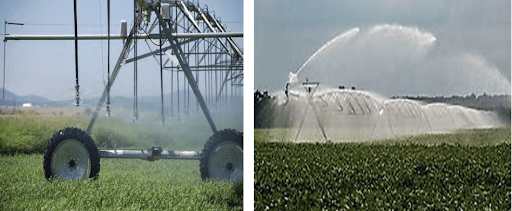
Centre Pivot
Towable Pivot
- Towing pivots are similar to centre pivots. However, in this case, the pivot is being towed away by a tractor.
- The pivot has three or four wheels in the centre that allow it to be moved from one location to another by pulling it with the tractor.
- It enables farmers to carry out mechanised irrigation in a cost-effective manner.
- It is simple to irrigate fields because the machine can be towed from one field to another in a short period of time.
Rain Gun
- A rain gun is used to create a mist of water or a fog beam. It has a discharge rate of less than 175 lph. It is used to irrigate trees and other crops that are far apart.
- Citrus fruits, mango, guava, avocado, and other fruit tree crops can be irrigated with a rain gun.
- Rain guns are appropriate for field crops such as groundnuts, onions, potatoes, sugarcane, cotton, and plantation crops such as coffee and tea.
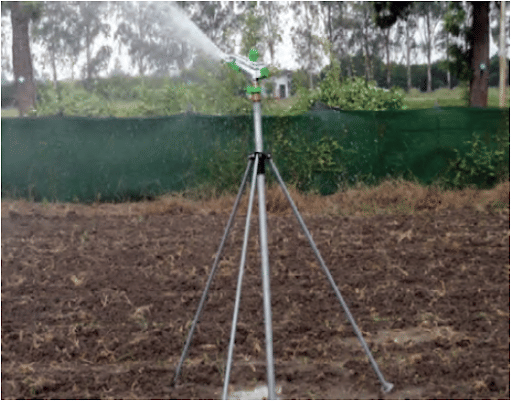
Rain Gun
Impact Sprinkler
- The force of outgoing water propels this sprinkler in a circular motion, and at least one of its arms extends from the head.
- A spring repeatedly pushes the sprinkler arm back into the water stream.
- When the arm strikes the water stream, it scatters it and reorients it, allowing for a uniform watering area around the sprinkler.
- Impact sprinklers are ideal for closely spaced field crops such as potato, leafy vegetables, cotton, oilseeds, pulses, cereals, fodder crops, and so on.
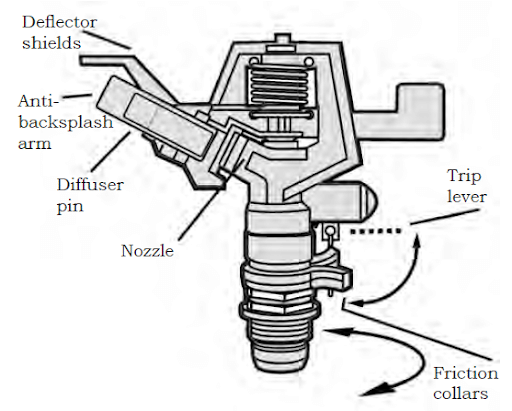
Impact Sprinkler
Pop up Sprinkler
- An inlet, body, cap, wiper seal, riser, nozzle, and radius adjustment screw comprise a pop up sprinkler.
- This type of sprinkler is portable and simple to install, making it ideal for irrigating lawns, seasonal flowers, and planting beds.
Linear Move Sprinkler
- In construction, a linear move sprinkler irrigation system is similar to a centre pivot system, except that neither end of the lateral pipeline is fixed.
- It is made up of a series of suspended towers that move laterally in the direction of rows. The entire line moves perpendicular to the lateral down the field.
- A flexible hose or open ditch pickup is used to deliver water to the continuously moving lateral. Both the centre pivot and linear move systems can apply water with high efficiency.
- Water efficiency refers to reducing water waste by measuring the amount of water needed for a specific purpose versus the amount of water delivered or used.
- Such a system necessitates a significant capital investment but is not labour intensive.
Advantages of Sprinkler Irrigation
- Eliminates water conveyance channels, reducing conveyance loss.
- Except for heavy clay, it is suitable for all types of soil.
- Water savings of up to 30% - 50%
- Suitable for irrigation where the plant population per unit area is very high.
- Assists in increasing yield.
- Reduces soil compaction.
- System mobility makes system operation easier.
- Suitable for undulating terrain.
- It saves land because no bunds are required.
- The use of soluble fertilisers and chemicals is possible.
- Frost protection and microclimate modification.
- Reduces labour costs.
Disadvantages of Sprinkler Irrigation
- In this technique, the initial cost of implementation is high.
- High operating costs are incurred as a result of the energy required for pumping, labour, and a relatively large investment in equipment: sprinklers and pipes.
- Distribution and application efficiency are poor in high-wind and high-temperature conditions.
- When the temperature rises above 95 degrees F, highly saline water causes leaf burning.
- Sprinkler irrigation is not cost effective when lands have already been levelled and developed for surface or other irrigation methods.
- During irrigation, there is a loss of water due to evaporation from the area.
- The unavoidable wetting of foliage in field crops increases disease sensitivity.
- Clogging can be caused by debris and sediments.
Conclusion
Sprinkler irrigation was developed initially for home lawn care and garden water use. However, while spray irrigation technology was developed for personal use, it is such a useful technology that it has quickly become one of the most common types of irrigation systems in agriculture. Farmers quickly recognised the benefits of consistent, high-pressure water delivery for their irrigation systems. Sprinklers are appropriate for use in all types of gardens, landscaping, and fields because they provide adequate coverage for small to large blocks of land. Sprinklers are adaptable and suitable for use on nearly all types of irrigable soils due to the wide range of discharge capacities available. Sprinkler systems, on the other hand, can quickly clog due to sediments or rains, and large systems have high capital investment costs.
|
|
|
|---|---|
| Agriculture Notes | Different Types of Irrigation and Irrigation Systems |
| Crop Rotation | Watershed Management |
| Crop and its Classifications | Cropping |
| Farming Systems | Organic Farming |
| Sustainable Agriculture | Integrated Farming System |
| Important Cropping Patterns in India | Major Crops of India |
| Weeds | Soil |
FAQs
Question: What is sprinkler irrigation, and how does it work?
Answer: Sprinkler irrigation is a method of irrigation where water is sprayed onto crops in a manner similar to rainfall. This is achieved using a system of pipes, pumps, and sprinklers that distribute water across the field. The water is pressurized and released through small nozzles or sprinklers attached to pipes, which are usually positioned above or on the ground. The sprinklers create a mist or spray of water droplets that evenly covers the crops, ensuring that the plants receive adequate moisture. This method is especially useful in areas with uneven topography or where surface irrigation may be inefficient or impractical.
Question: What are the advantages of sprinkler irrigation?
Answer: Sprinkler irrigation offers several advantages: 1. Efficient water use: Sprinkler systems minimize water wastage by applying water directly to the plant root zone in a controlled manner. 2. Suitable for uneven terrain: It can be used in areas with uneven land, where traditional surface irrigation may not be effective. 3. Uniform distribution: The water is evenly distributed, reducing the risk of over-watering or under-watering specific areas of the field. 4. Reduces soil erosion: Unlike flood irrigation, sprinkler irrigation minimizes soil erosion because water is applied gently. 5. Adaptability: It is suitable for a wide range of crops, including vegetables, fruits, and cereal crops, and can be used in both small and large-scale farming.
Question: What are the disadvantages of sprinkler irrigation?
Answer: While sprinkler irrigation offers various benefits, there are some disadvantages: 1. High initial cost: The setup cost of a sprinkler irrigation system, including pipes, pumps, and nozzles, can be relatively high. 2. Energy consumption: The system requires pumps to pressurize the water, which may lead to high energy costs, especially in areas where electricity is expensive or scarce. 3. Water wastage in windy conditions: In areas with high winds, water droplets can be blown away, reducing the efficiency of the system. 4. Maintenance requirements: Regular maintenance is required to ensure that sprinklers do not clog, and the system remains functional. 5. Limited use in certain climates: In regions with high humidity or frequent rainfall, sprinkler irrigation may not be as effective or necessary.
Question: How does sprinkler irrigation contribute to water conservation in agriculture?
Answer: Sprinkler irrigation is highly effective in conserving water compared to traditional irrigation methods such as flood or furrow irrigation. It reduces water wastage by targeting the plant root zone directly, avoiding runoff and evaporation. The controlled application ensures that water is delivered when and where it is needed, preventing over-irrigation. This system also reduces waterlogging and soil erosion, further promoting sustainable agricultural practices. By utilizing water more efficiently, sprinkler irrigation helps conserve precious water resources, particularly in regions experiencing water scarcity or drought conditions.
Question: How can sprinkler irrigation be optimized for different crops and climates?
Answer: To optimize sprinkler irrigation for different crops and climates, several factors need to be considered: 1. Crop requirements: Different crops have varying water needs. The system can be adjusted by changing the sprinkler size, spacing, and application time to meet the specific needs of each crop. 2. Climate conditions: In dry and arid climates, the irrigation schedule can be adjusted to water the crops early in the morning or late in the evening to minimize evaporation loss. 3. Soil type: Sandy soils may require more frequent but lighter irrigation, while clay soils may require less frequent irrigation but in larger quantities. 4. Water pressure: The pressure at which water is delivered can be adjusted based on local conditions, such as wind speed and temperature, to ensure that water is efficiently absorbed by the crops. 5. Automation: Advanced sprinkler systems can be automated with sensors and controllers to monitor soil moisture and adjust irrigation levels, ensuring the system is used efficiently and water is conserved.
MCQs
1. Which of the following is a major advantage of sprinkler irrigation?
A) High water wastage
B) Suitable for flat terrain
C) Efficient water use
D) Requires no maintenance
Answer: (C) See the Explanation
Explanation: One of the major advantages of sprinkler irrigation is its efficiency in water use, as it minimizes wastage by directly targeting the plant root zone.
2. What is a significant drawback of sprinkler irrigation?
A) High water consumption
B) High initial cost
C) Increased soil erosion
D) Requires no energy
Answer: (B) See the Explanation
Explanation: A significant drawback of sprinkler irrigation is its high initial setup cost, which includes the installation of pipes, pumps, and sprinklers.
3. How can sprinkler irrigation contribute to water conservation?
A) By wasting more water
B) By delivering water directly to the roots
C) By flooding fields
D) By reducing crop yield
Answer: (B) See the Explanation
Explanation: Sprinkler irrigation conserves water by delivering water directly to the root zone of plants, minimizing runoff and evaporation.
4. Which of the following crops can benefit from sprinkler irrigation?
A) Rice
B) Wheat
C) Sugarcane
D) All of the above
Answer: (D) See the Explanation
Explanation: Sprinkler irrigation is versatile and can be used for a wide range of crops, including rice, wheat, and sugarcane, depending on the system’s setup.
5. How does sprinkler irrigation differ from flood irrigation?
A) It applies water over a large area
B) It targets the plant root zone
C) It uses less water
D) It does not require pumps
Answer: (B) See the Explanation
Explanation: Unlike flood irrigation, sprinkler irrigation targets the plant root zone directly, ensuring efficient water distribution and reducing water wastage.
GS Mains Questions and Model Answers
Q1: Discuss the advantages and disadvantages of sprinkler irrigation in the context of Indian agriculture.
Answer: Sprinkler irrigation offers several advantages in Indian agriculture, particularly in regions facing water scarcity or where traditional irrigation methods are inefficient. One of the key benefits is the efficient use of water, as it applies water directly to the crops, reducing evaporation and runoff. Sprinkler systems are also versatile and can be used in a variety of soil types and crop varieties, including vegetables, cereals, and fruits. They are particularly beneficial in areas with uneven terrain where surface irrigation may be difficult. However, there are disadvantages, such as the high initial cost of installation and the need for electricity to operate the pumps. Additionally, sprinkler systems may not be effective in areas with high winds, as water droplets can be blown away. Regular maintenance is also required to prevent clogging of the sprinklers. Despite these challenges, sprinkler irrigation remains a valuable tool for improving water efficiency and crop yields in India.
Q2: How can sprinkler irrigation be optimized for water conservation and improved crop yield?
Answer: To optimize sprinkler irrigation for water conservation and improved crop yield, it is important to tailor the system to the specific needs of the crops and the local climate. One effective approach is to install moisture sensors that can monitor soil moisture levels and automatically adjust the irrigation schedule, ensuring that water is applied only when necessary. The pressure and spacing of the sprinklers should also be adjusted based on the type of crop and soil characteristics to maximize water distribution and reduce waste. In addition, using advanced technologies like drip irrigation in conjunction with sprinklers can further improve water conservation by delivering water directly to the root zone. Proper maintenance, such as cleaning the sprinklers regularly and checking for leaks, is also essential for maintaining system efficiency and maximizing crop yield.
Q3: Evaluate the potential of sprinkler irrigation in addressing the challenges of water scarcity in India.
Answer: Sprinkler irrigation has the potential to address the challenges of water scarcity in India, particularly in regions with limited access to water resources or where traditional methods like flood irrigation are inefficient. By reducing water wastage through targeted delivery, sprinkler systems ensure that crops receive the right amount of water without excessive runoff or evaporation. This can lead to significant water savings, especially in arid and semi-arid regions. Moreover, sprinkler irrigation is adaptable and can be used for a variety of crops, making it a versatile solution for water conservation. However, challenges such as the high initial cost of installation and the need for energy to run pumps must be addressed to ensure that sprinkler irrigation is accessible to small-scale farmers. Government subsidies, awareness programs, and the promotion of low-cost systems can help make sprinkler irrigation more feasible for widespread use, helping India address its growing water scarcity issues.
Previous Year Questions on Sprinkler Irrigation
1. UPSC CSE Prelims 2020:
Question: Which of the following irrigation methods is most efficient in water use?
A) Surface irrigation
B) Drip irrigation
C) Sprinkler irrigation
D) Flood irrigation
Answer: (C)
Explanation: Sprinkler irrigation is highly efficient in water use as it minimizes evaporation and runoff by delivering water directly to the plant root zone.
2. UPSC CSE Mains 2021 (GS Paper 3):
Question: "Evaluate the role of sprinkler irrigation in improving agricultural productivity in India. What are the potential challenges in its implementation?"
Answer: Sprinkler irrigation plays a crucial role in improving agricultural productivity in India by efficiently using water and increasing crop yields. The system is adaptable to various crops and soil types, which is especially important in regions with limited water resources. By reducing water wastage and improving crop growth, sprinkler irrigation can help farmers achieve higher productivity. However, challenges such as the high initial setup cost, energy consumption, and the need for regular maintenance need to be addressed for widespread implementation. With proper subsidies, government support, and technological advancements, sprinkler irrigation has the potential to revolutionize water use in agriculture and contribute to enhanced productivity.
Download the PREPP App and attempt FREE IAS Exam Mock Tests and get complete study material!

Full Test - 04: UPSC CSE Prelims CSAT (Paper-II)
Full Test - 03: UPSC CSE Prelims CSAT (Paper-II)
UPSC CSE Prelims 2026 GS Paper 1 Question Paper (24-May-2026)
UPSC CSE Prelims 2026 CSAT Paper 2 Question Paper (24-May-2026)

17 February 2025 | The Hindu Must Read Articles | Current Affairs

16 February 2026 | The Hindu Must Read Articles | Current Affairs

13 February 2026 | The Hindu Must Read Articles | Current Affairs









Comments