Soil Profile - Agriculture Notes
The soil, the highest layer of the earth's crust, is mostly made up of rock and minerals that sustain life. A vertical cross-section of the soil made up of layers that run parallel to the surface is called a soil profile. Soil horizons are the name for these strata. When soil is created, it settles into several vertical levels. Each layer is composed differently. This article will explain to you about Soil profile which will be helpful in preparing the Agriculture Syllabus for the UPSC Civil Service exam.
|
Table of Contents |
What is Soil?
- Soils are a thin layer that covers the majority of the Earth's land surface.
- This thin layer is a basic natural resource that has a significant impact on every other component of the ecosystem.
- Soils are made up of three main ingredients: minerals of various sizes, organic materials derived from the skeletal remains of dead plants and animals, and open space that can be filled with water or air.
- A good soil for growing most plants should have about 45% minerals (composed of sand, silt, and clay), 5% organic matter, 25% air, and 25% water.
- The chemical and physical properties of soils vary greatly.
- Leaching, weathering, and microbial activity all work together to create a wide variety of soil types.
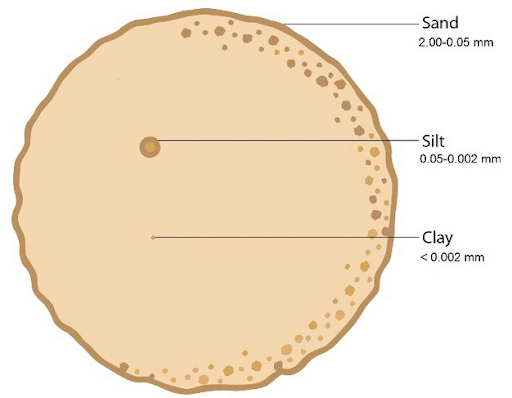
Components of Soil
What is Soil Profile?
- A soil profile is a vertical section of the soil that shows the various layers from the surface to the unaffected parent material.
- The order of these layers, which are referred to as horizons, makes up the soil profile.
- The colour and size of the soil's particles make it simple to identify the different soil layers.
- The Parent Rock, the topsoil, and the subsoil are the three primary layers of soil.
- The soil profile contains five master horizons. Because not all soil profiles contain all five horizons, soil profiles differ from one location to the next.
- The depth, colour, texture, and chemical makeup of each layer vary. A horizon is the name given to each stratum of soil.
- Internal activities like leaching or capillary movements/upward motions of materials & water help to shape horizons.
- The soil profile also aids in determining the soil's role.
- It aids in distinguishing one soil sample from another based on characteristics such as colour, texture, structure, and thickness, as well as chemical composition.
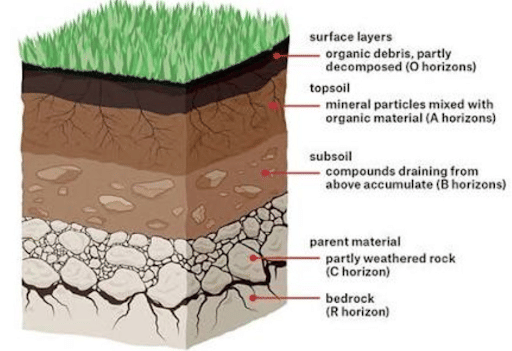
Soil Profile
Layers of Soil
- The capital letters O, A, B, C, and E have been found by soil scientists (also known as pedologists) to be an intriguing approach to identify the soil profile model.
- Each of the aforementioned layers has distinct qualities that set them apart from one another.
- It is sometimes observed that this layer erodes as a result of numerous environmental variables, such as excessive rain or wind, which can erode the top layer and remove all soil minerals.
- The surface horizon, subsoil, and substratum—the three main soil surfaces made up of A, B, and C—are depicted in the soil profile diagram.
- The surface of the soil has an organic mineral covering (O). The soil receives all of the natural minerals from this surface.
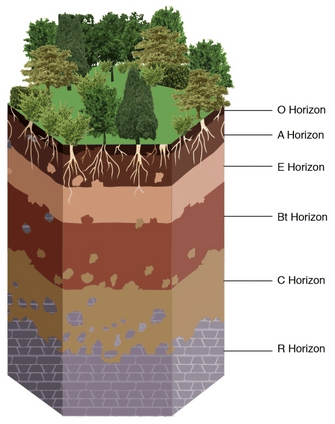
Layers of Soil
O-Horizon
- The O-Horizon soil contains organic components that can degrade, such as dried leaves, tiny boulders, downed trees, and other organic stuff.
- It contains about 20 and 30 per cent organic materials.
- Due to the presence of organic debris, the soil is often black or dark brown in colour.
- It is most noticeable in forested areas where there is an accumulation of tree debris.
A-Horizon
- The A-Horizon Layer, also known as the Humus Layer, is made up of organic material.
- The A horizon is a surface horizon composed primarily of minerals (sand, silt, and clay) with trace quantities of organic materials.
- The topmost layer of soil is made up of dark decomposed materials known as humus.
- Humus enriches the soil with nutrients, making it more fruitful. It also keeps the soil alive.
- This horizon is mostly the surface layer of many grasslands and agricultural soils.
- This layer is soft and may retain more water than any other layer because it boosts the soil's water retention capacity.
- This layer contains many living creatures, such as beetles and worms.
E-Horizon
- The letter E symbolises the master horizon, which lies underneath all soil strata.
- The E horizon is a severely leached subsurface horizon. The process by which soluble nutrients are lost from the soil as a result of precipitation or irrigation is known as leaching.
- It is exclusively found in wooded areas.
- The dirt is a pale colour.
- The letter E stands for the eluviated horizon. This is where the dissolved particles from the A- Horizon migrate.
B-Horizon
- B-Horizon is also known as subsoil due to its presence underneath the topsoil.
- It is the layer of soil that absorbs all of the rainfall that runs through the topsoil. It collects rain for later use.
- It contains humus, albeit in fewer amounts than the A-horizon, organic materials, and soluble minerals.
- It is a depositional site for minerals that have leached from the layer(s) above.
- This stratum is often hard and compact due to its high mineral content.
C-Horizon
- A layer of soil that exists under the B-Horizon and comprises less weathered rocks or parent rocks.
- It does not include any organic material.
- It is the least worn horizon.
- It is an unconsolidated, loose parent material, also known as saprolite.
R-Horizon
- The R-Horizon stratum contains partially weathered or unweathered rocks.
- It is often referred to as the soil's foundation or base layer.
- This stratum contains manganese, granite, limestone, and basalt.
Conclusion
Soil is a natural body of mineral and organic constituents differentiated into horizons of variable depth that differ in morphology, physical makeup, chemical properties and composition, and biological characteristics, as well as from the underlying parent material.
FAQs
Question: What is a soil profile?
Answer: A soil profile is a vertical cross-section of the soil that shows its different layers or horizons. Each layer has distinct physical, chemical, and biological characteristics. The main horizons in a soil profile are O (organic matter), A (topsoil), B (subsoil), C (parent material), and R (bedrock).
Question: What are the main horizons of a soil profile?
Answer: The main horizons of a soil profile are: - O Horizon: Organic matter such as decomposed leaves. - A Horizon: Topsoil, rich in minerals and organic material. - B Horizon: Subsoil, with minerals leached from the topsoil. - C Horizon: Parent material, less weathered. - R Horizon: Bedrock, the solid rock layer beneath the soil.
Question: How does the soil profile affect plant growth?
Answer: The soil profile affects plant growth by influencing water retention, nutrient availability, and root penetration. For example, the topsoil (A horizon) is rich in nutrients and organic matter, which supports healthy plant growth, while the subsoil (B horizon) helps with water retention.
Question: What is the significance of the A horizon in agriculture?
Answer: The A horizon, or topsoil, is crucial in agriculture as it contains the most organic matter and nutrients necessary for plant growth. This layer supports the majority of root systems and is the most fertile part of the soil profile.
Question: How does soil formation occur over time?
Answer: Soil formation occurs over long periods through the processes of weathering, organic decomposition, and the activity of organisms. Factors like climate, parent material, topography, and time contribute to the development of different soil layers or horizons, creating a complete soil profile.
MCQs
1. Which of the following horizons contains the most organic matter?
A) O Horizon
B) A Horizon
C) B Horizon
D) C Horizon
Answer: A See the Explanation
Explanation: The O Horizon contains the most organic matter, including decomposed plant and animal materials. This layer is essential for nutrient cycling in the soil.
2. What is the primary characteristic of the C Horizon in a soil profile?
A) Rich in organic matter
B) Composed of weathered parent material
C) Contains bedrock
D) Full of plant roots
Answer: B See the Explanation
Explanation: The C Horizon is primarily composed of weathered parent material, and it shows the least amount of weathering compared to the other soil layers. It is found beneath the subsoil (B Horizon).
3. Which horizon in a soil profile is most crucial for plant root development?
A) O Horizon
B) A Horizon
C) B Horizon
D) R Horizon
Answer: B See the Explanation
Explanation: The A Horizon, or topsoil, is most crucial for plant root development due to its high organic matter content and nutrient availability.
4. The process of soil formation is influenced by all of the following factors EXCEPT:
A) Climate
B) Parent Material
C) Topography
D) Human Activity
Answer: D See the Explanation
Explanation: While human activity can impact soil through practices like farming, it is not a natural factor in the soil formation process. Natural factors such as climate, parent material, and topography play crucial roles in soil development.
5. Which horizon is also known as bedrock in a soil profile?
A) O Horizon
B) A Horizon
C) R Horizon
D) B Horizon
Answer: C See the Explanation
Explanation: The R Horizon is also known as bedrock. It is the solid rock layer beneath the soil and provides the parent material for the overlying soil layers.
GS Mains Questions and Answers
Q1: Discuss the significance of different soil horizons in supporting agricultural productivity.
Answer: The various horizons of a soil profile play distinct roles in supporting agricultural productivity. The O Horizon, rich in organic matter, helps improve soil fertility by providing nutrients through decomposition. The A Horizon, or topsoil, is the most fertile layer where plants anchor their roots and absorb nutrients essential for growth. The B Horizon, or subsoil, provides additional minerals leached from the topsoil and plays a role in water retention, which is vital for crops in dry periods. The C Horizon consists of weathered parent material, contributing to the mineral content of the upper layers over time. Together, these layers form a system that supports healthy plant growth and ensures long-term agricultural sustainability.
Q2: Analyze the impact of soil degradation on soil profile and agricultural sustainability.
Answer: Soil degradation significantly alters the soil profile and poses a threat to agricultural sustainability. Degradation processes such as erosion, deforestation, and overgrazing strip the topsoil (A Horizon) of its nutrients, leading to reduced fertility and poor crop yields. The loss of organic matter in the O Horizon affects soil structure, making it less capable of retaining water and nutrients. In extreme cases, the soil profile may become shallow, exposing the subsoil (B Horizon), which is less fertile and unsuitable for most crops. Soil conservation techniques, such as contour plowing and crop rotation, are essential to maintain the integrity of the soil profile and ensure agricultural sustainability in the long term.
Q3: Examine the process of soil formation and its relevance to sustainable land management practices.
Answer: Soil formation is a slow process that takes place over thousands of years through the breakdown of rocks and the accumulation of organic material. Factors such as climate, parent material, topography, and biological activity influence this process. Understanding soil formation is critical for sustainable land management practices, as it highlights the importance of preserving topsoil and preventing soil erosion. Practices like afforestation, cover cropping, and reduced tillage help protect the upper horizons (O and A) of the soil profile, ensuring that nutrients and organic matter are conserved. Sustainable land management practices that take soil formation into account are key to maintaining healthy soil and supporting long-term agricultural productivity.
Previous Year Questions on Soil Profile
1. UPSC CSE Prelims 2021:
Question: Which horizon of a soil profile is typically richest in organic matter?
A) O Horizon
B) B Horizon
C) C Horizon
D) R Horizon
Answer: A
Explanation: The O Horizon is typically the richest in organic matter, consisting of decomposed leaves, plants, and other organic materials, which play a critical role in nutrient cycling and soil fertility.
2. UPSC CSE Mains 2020 (GS Paper 3):
Question: "Soil conservation is vital for sustainable agriculture." Discuss with reference to the importance of maintaining a healthy soil profile.
Answer: Soil conservation is critical for sustainable agriculture, as it ensures the preservation of the soil profile’s key layers, particularly the topsoil (A Horizon) and organic layer (O Horizon). These layers are essential for supporting plant growth, providing nutrients, and retaining moisture. Erosion, deforestation, and unsustainable farming practices can degrade the soil profile, leading to the loss of fertility and poor crop productivity. Techniques such as contour plowing, crop rotation, and afforestation help maintain a healthy soil profile and protect agricultural land from degradation. By conserving the soil, farmers can ensure long-term productivity and resilience against climate change.
Download the PREPP App and attempt FREE IAS Exam Mock Tests and get complete study material!

Full Test - 04: UPSC CSE Prelims CSAT (Paper-II)
Full Test - 03: UPSC CSE Prelims CSAT (Paper-II)
UPSC CSE Prelims 2026 CSAT Paper 2 Question Paper (24-May-2026)
UPSC CSE Prelims 2026 GS Paper 1 Question Paper (24-May-2026)

17 February 2025 | The Hindu Must Read Articles | Current Affairs

16 February 2026 | The Hindu Must Read Articles | Current Affairs

13 February 2026 | The Hindu Must Read Articles | Current Affairs









Comments