System of Rice Intensification (SRI) - Agriculture Notes
The System of Rice Intensification calls for cultivating rice with as maximum amount of organic manure as is practical, beginning with young seedlings planted individually at a wider spacing in a square pattern; intermittent irrigation that keeps the soil moist but not overwatered; and regular inter-cultivation with weeders that aggressively aerate the soil. SRI is not a predetermined, standardized technological approach. It is more of a set of concepts or a methodology for effectively controlling and preserving resources by altering how land, seeds, water, nutrients, and human labor are used to enhance productivity from a few well-tended but sparsely distributed seedlings. This article will explain the System of Rice Intensification (SRI) which will be helpful in preparing the Agriculture Syllabus for the UPSC Civil Service exam.
|
Table of Contents |
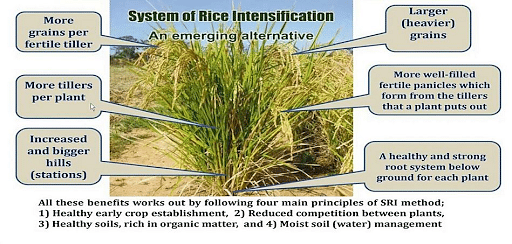
System of Rice Intensification
What is System of Rice Intensification (SRI)?
- The System of Rice Intensification (SRI) was established in Madagascar in the 1980s, and numerous nations throughout the world have used it since then, including India.
- It claims to conserve 15 to 20% of groundwater and enhance rice yield, which is now stagnant.
- It produces the same or more than conventional rice production while using less water, seed, and pesticides.
- The overall result is a significant reduction in investments in external inputs.
- The guiding principle of the SRI system is "More with Less".
SRI - Methodology
- Ploughing: Ploughing is done first to prepare the field.
- Transplanting: Before transplanting, it should be laser leveled to ensure adequate water management and efficiency for a healthy crop stand.
- Irrigation: Then irrigation is provided to the field, which is less than that of a well-irrigated area but not as much as traditional techniques.
- Rope Meter: Then, with the use of a rope meter, 10-12 day old nursery plants (young paddy plants) are transplanted in lines with soil particles surrounding the roots with minimal disruption to the roots.
- The goal of constructing lines is to create a favorable environment for rice plant growth and development by spacing them out.
- To prevent a time gap between uprooting and planting, which should not be more than 30-40 minutes.
- So that the roots do not dry out, seedlings or nurseries should be positioned near the main field.
- Unlike Direct Seeding of Rice (DSR), which is only ideal for medium to heavy textured soils, SRI is good for all types of soil, even less fertile soil, where the number of seedlings can be doubled.
- In the SRI approach, just 2 kg seed is needed to produce a nursery for one acre, compared to 5 kg seed in the old method.
SRI - Critical Factors and Practices
| Season |
|
| Varieties |
|
| Nursery Area & Seed Rate |
|
| Main Field Preparation |
|
| Transplanting |
|
| Plant Spacing |
|
| Nutrient Management |
|
| Water Management |
|
| Weeder Usage |
|
SRI - Requirement of Constant Flooding after Nursery Transplantation
- Fields are kept under flood-like conditions in traditional sowing from the day of transplanting until the crop turns 35-40 days. Then, until a few weeks before harvest, fields are filled every week.
- On the other hand, SRI does not require continual flooding but rather a periodic watering.
- The roots of the plants should not be deprived of oxygen due to floods.
- Water is introduced to the field when the surface soil develops hairline cracks, and irrigation is administered to keep soil moisture near saturation at first.
- The intervals between irrigations will vary depending on the field conditions.
- During a study in Gurdaspur district fields where Pusa 1121 was planted, it was discovered that 50 lakh liters of groundwater were consumed, compared to 62 lakh liters for the same variety in a puddled technique field.
SRI - Weed Management
- In Direct Seeding of Rice (DSR), where weeds are a major issue and weedicides are sprayed simultaneously at the time of sowing.
- In SRI, which allows for greater weed growth due to alternate wetting and drying of fields, the weeds are incorporated into the soil by operating a cono-weeder between rows made at the time of sowing, which adds nutrients to the crop like green manures.
- 10-12 days after planting, the first weeding is undertaken. Depending on the need, more weedings can be done at 10-15 day intervals till the crop reaches the panicle stage.
- Through a process of soil aeration, each wedding improves production.
- It is recommended that weeding and irrigation be done at the same time for smoother and simpler functioning of the cono-weeder.
SRI - Advantages
- Increased water availability at the landscape level or for other consumption demands since SRI management can cut irrigation water use by up to 50%.
- Reduced agrochemical usage leads to improved soil and water quality.
- Organic matter additions to soils and residues from bigger root systems result in an increase in soil carbon reservoirs.
- Reduced methane emissions from rice paddies due to non-flooded rice paddy conditions; thus far, despite the need for additional study, no offsetting rise in nitrous oxide emissions has been seen.
- Rice cultivar biodiversity can be increased if local types become more productive and hence more appealing to farmers to produce.
- Seed requirement is reduced because a single seedling is planted at a wider spacing. SRI requires only 7-8 kg of seed per hectare. This is especially useful for hybrids, where seed costs are very high.
- Nursery area reduction.
- Nursery duration is being reduced.
- Increased tillering - 30 tillers per plant is not difficult to achieve.
- SRI plants require more force to uproot than conventional plants due to their extensive root growth.
- Grain filling has improved with larger panicles and higher panicle weight.
- Because the soil is only kept moist during the vegetative growth phase and only a small amount of water is used during the reproductive phase, SRI results in water savings of 35 to 40% when compared to conventional methods.
- SRI provides a good growth environment for rice plants, resulting in stronger tillers and extensive root growth that is less susceptible to lodging.
- Since SRI plants are stronger, pest and disease incidence is lower.
- While chemical fertiliser increases yield in SRI, resource-poor farmers can still use locally available organic manures to maintain higher yields while lowering the cost of externally purchased inputs.
- SRI is associated with higher grain yields than the conventional method.
- Field rodent damage has been reduced.
- Increased net profit.
SRI - Limitations
- Increased weed growth, if left unchecked, will result in a significant loss of yield.
- If organic inputs in the soil structure are maintained, it can be sustainable.
- In addition, scientists and farmers must undertake more research by performing experiments on small plots of land at first, and accurate study records must be kept.
- In Telangana, a large area was brought under SRI to conduct a study, and the results are quite encouraging in terms of water saving, lower input costs, and improved plant growth, adding that to save water.
- A large area was brought under SRI to conduct a study, and the results are quite encouraging in terms of water saving, lower input costs, and improved plant growth.
- Water control practises must be strictly enforced.
- Initially, the SRI method necessitated a larger workforce.
- Transplanting requires more skill.
- Weeds pose a greater threat than traditional transplanting.
- SRI is not suitable for large-scale production because it is labour intensive.
- Farmers' traditional mindset.
- Inadequate understanding of technology.
- Lack of critical implements such as markers and weeders.
- The transplanting labourers' lack of cooperation.
Conclusion
The System of Rice Intensification (SRI) economic feasibility has been observed and tested by governmental and non-governmental organizations all around the world. Due to this method's success, it has already been adapted for use with other crops, including wheat and sugarcane. Small-scale, marginal farmers enthusiastically embraced this SRI strategy for high output. SRI is anticipated to reach its peak in terms of output and global coverage by 2030.
|
|
|
|---|---|
| Agriculture Notes | Tillage |
| Farming Systems | Sustainable Agriculture |
| Organic Farming | Integrated Farming System |
| Factors determining cropping pattern in India | Major Crops of India |
Updated: System of Rice Intensification (SRI) in Agriculture
FAQs
Question: What is the System of Rice Intensification (SRI)?
Answer: The System of Rice Intensification (SRI) is an innovative agricultural method aimed at increasing rice yield while reducing water usage, improving soil health, and minimizing input costs. It focuses on using fewer seeds, transplanting younger seedlings, and maintaining optimal spacing between plants for better growth.
Question: How does the SRI method differ from conventional rice farming?
Answer: SRI differs from conventional rice farming by emphasizing fewer seeds per unit area, early transplantation of seedlings, and wider spacing between plants. It also reduces the need for flooded fields, uses organic compost, and integrates a series of water-saving techniques to increase rice productivity sustainably.
Question: What are the key benefits of adopting the SRI method?
Answer: The key benefits of SRI include increased rice yield, improved soil fertility, reduced water consumption, and decreased dependence on chemical fertilizers. It promotes sustainable farming practices and enhances the resilience of rice crops to adverse climatic conditions such as drought.
Question: Is SRI method suitable for all types of rice crops?
Answer: While SRI can be applied to most rice varieties, it is most effective with traditional varieties and those that are genetically suited to early transplantation and wider spacing. Its effectiveness may vary depending on soil conditions, water availability, and climate.
Question: How does SRI reduce water usage in rice cultivation?
Answer: SRI reduces water usage by promoting intermittent irrigation rather than continuous flooding. It uses less water by maintaining the soil in a moist but non-saturated state, which also encourages better root development and overall plant health.
MCQs
1. Which of the following is a key principle of the System of Rice Intensification (SRI)?
A) Continuous flooding of fields
B) Use of high seed density
C) Wider spacing between rice plants
D) Limited irrigation
Answer: (C) See the Explanation
The key principle of the SRI method is wider spacing between rice plants, which allows each plant to access more sunlight, air, and nutrients. This method promotes healthier plants and higher yields with reduced input costs.
2. How does the SRI method affect water consumption in rice cultivation?
A) It increases water usage
B) It decreases water usage
C) Water usage remains unchanged
D) It requires more water than traditional methods
Answer: (B) See the Explanation
SRI significantly decreases water usage by reducing the need for continuous flooding. Instead, intermittent irrigation is used, allowing for more efficient water management and less overall water consumption compared to traditional rice farming methods.
3. What is the main advantage of using younger seedlings in the SRI method?
A) It reduces the growth period of the plants
B) It leads to higher seedling mortality
C) It allows for better root development
D) It increases the requirement for water
Answer: (C) See the Explanation
Using younger seedlings in SRI allows for better root development. The younger plants are more resilient and adaptable, leading to stronger plants that can better absorb nutrients and water, improving overall growth and yield.
4. How does the System of Rice Intensification (SRI) contribute to sustainability?
A) By reducing the use of pesticides
B) By increasing the use of chemical fertilizers
C) By improving soil fertility with organic inputs
D) By requiring large amounts of water
Answer: (C) See the Explanation
SRI promotes sustainability by improving soil fertility through the use of organic inputs such as compost and manure. It reduces dependence on chemical fertilizers, enhances water efficiency, and supports the long-term health of the agricultural ecosystem.
5. What is one of the main challenges of adopting the SRI method?
A) High seed density requirement
B) Use of chemical fertilizers
C) Labor-intensive initial setup
D) Over-reliance on water
Answer: (C) See the Explanation
One of the main challenges of adopting SRI is the labor-intensive initial setup, particularly the transplantation of younger seedlings and the maintenance of optimal spacing between plants. While this requires more labor, the benefits in terms of yield and water conservation are significant.
GS Mains Questions and Model Answers
Q1: Discuss the role of the System of Rice Intensification (SRI) in addressing water scarcity in India.
Answer: The System of Rice Intensification (SRI) plays a crucial role in addressing water scarcity in India by reducing the water requirements for rice cultivation. Traditional rice farming relies on continuous flooding, which consumes vast amounts of water. In contrast, SRI uses intermittent irrigation, significantly lowering water consumption while maintaining high crop yields. By using younger seedlings, optimizing plant spacing, and employing efficient water management practices, SRI makes rice cultivation more sustainable. This method is particularly important in regions experiencing water shortages, making rice farming less water-intensive and more resilient to climatic changes like droughts.
Q2: What are the environmental benefits of using the System of Rice Intensification (SRI)?
Answer: SRI offers multiple environmental benefits, including a reduction in water consumption through efficient irrigation practices. By using less water and avoiding continuous flooding, it helps conserve water resources, particularly in drought-prone areas. Additionally, SRI promotes organic farming by reducing the need for chemical fertilizers and pesticides, which in turn improves soil health and reduces pollution from runoff. The method also encourages biodiversity by fostering healthier ecosystems in rice fields. Overall, SRI contributes to sustainable agricultural practices that minimize environmental degradation and promote ecological balance.
Q3: Analyze the socio-economic impacts of adopting SRI in rural India.
Answer: The adoption of the System of Rice Intensification (SRI) in rural India has significant socio-economic impacts. By reducing the need for water and chemical inputs, SRI helps lower the cost of cultivation, which can directly benefit smallholder farmers who struggle with high input costs. It also increases rice yields, improving food security and income for farmers. The labor-intensive nature of the method may initially pose challenges, but it provides opportunities for rural employment. Furthermore, the environmental benefits of SRI—such as sustainable land use and reduced water consumption—contribute to long-term agricultural resilience, which supports the livelihoods of rural communities in India.
Previous Year Questions on System of Rice Intensification
1. UPSC CSE Prelims 2022:
Question: Which of the following is an advantage of using the System of Rice Intensification (SRI)?
A) Increased water usage
B) Reduced seed requirement
C) More chemical fertilizers required
D) Larger land area required for cultivation
Answer: (B)
Explanation: One of the key advantages of SRI is reduced seed requirement, as fewer seeds are used per unit area compared to conventional methods. This contributes to cost savings and better resource utilization.
2. UPSC CSE Mains 2021:
Question: Examine the potential of the System of Rice Intensification (SRI) to address challenges related to water scarcity in India’s agriculture.
Answer: SRI addresses water scarcity by promoting efficient irrigation methods and reducing water usage in rice cultivation. By focusing on intermittent irrigation and minimizing flooding, SRI uses less water while enhancing productivity. The method is particularly beneficial in water-stressed regions of India.
Download the PREPP App and attempt FREE IAS Exam Mock Tests and get complete study material!

Full Test - 04: UPSC CSE Prelims CSAT (Paper-II)
Full Test - 03: UPSC CSE Prelims CSAT (Paper-II)
UPSC CSE Prelims 2026 GS Paper 1 Question Paper (24-May-2026)
UPSC CSE Prelims 2026 CSAT Paper 2 Question Paper (24-May-2026)

17 February 2025 | The Hindu Must Read Articles | Current Affairs

16 February 2026 | The Hindu Must Read Articles | Current Affairs

13 February 2026 | The Hindu Must Read Articles | Current Affairs









Comments