Soil Terracing - Agriculture Notes
Terracing is a soil conservation technique used to keep rainwater runoff from collecting on sloping ground and causing catastrophic erosion. Terraces are made up of ridges and channels that run over the hill. A terrace is a portion of sloping plane that has been carved into a succession of increasingly receding flat surfaces or platforms that resemble steps for more successful farming. Terracing is the name given to this form of landscaping. Farming on steep or mountainous terrain is usually done with graduated terrace steps. This article will explain to you about Soil Terracing which will be helpful in preparing the Agriculture Syllabus for the UPSC Civil Service exam.
|
Table of Contents |
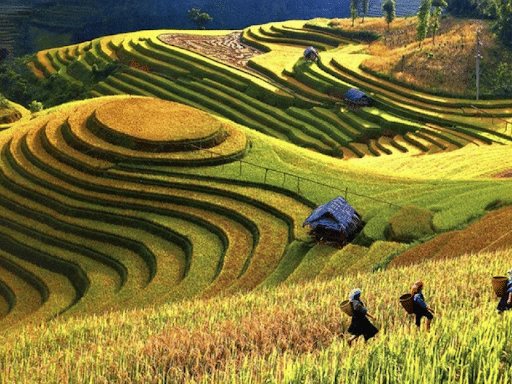
Soil Terracing
What is Soil Terracing?
- Terraces are topographic changes that need soil displacement to build. They are most effective in deep soils, such as loess soils.
- Terrace systems that are not appropriate for the local environment might be worse than no terraces at all.
- Terrace systems are extremely successful at reducing rill erosion, eliminating ephemeral gully erosion, reducing sediment production, conserving soil moisture, protecting landscape quality, and increasing property value.
- All terracing techniques enable farmers to retain or remove water while also reducing the slope of the hill.
- In reality, the goal of terrace farming is to intercept water in a defined channel and remove it through the use of either erosion-resistant ditches or subterranean pipe outlets.
- This demonstrates the effectiveness of terracing in preventing erosion and contributing to soil conservation.
What is Terrace Farming?
- Terracing is an agricultural practise that involves rearranging farmland or converting hills into farmland by building specific ridged platforms.
- Excavating and moving topsoil to form farmed areas and ridges is an essential (and distinguishing) feature of terracing agriculture.
- When the upper platforms are full, water flows down to the lower ones. As a result, the amount of water is distributed more or less evenly, rather than just at the bottom of the hill.
- Terrace farming is an effective and sometimes the only solution for steep farmlands. Its benefits are numerous.
- Terrace farming has far-reaching implications beyond cultivating sites that would otherwise be unsuitable for agriculture.
- Terrace farming also helps to conserve soil by preventing soil erosion.
- Nowadays, the technology allows for the cultivation of a variety of crops, and their management is made easier by online agricultural software.
- Depending on the soil infiltration qualities, agricultural terracing farms are either flat or slanted.
Types of Terraces
- Depending on the soil infiltration properties, agricultural terracing farms are either level or tilted. They are levelled if soil infiltration is adequate. Outlets are not usually required.
- In farming, the most common terracing types are broad-base, narrow-base, and grassed back-slope. Their choice is determined by the slope of the hill.
Broad Base Terrace Farming
- Terrace cultivation is suitable for the gentlest hills, and it encompasses all slopes.
- As a result, they should accommodate machinery needs, with terrace spacing typically equal to the number of machinery swaths.
- It is forbidden to cross the ridges; instead, the equipment is supposed to move between the terraces via designated passages.
- Broad-base terracing can be used on slopes of up to 8%.
Grassed Back Slope Terrace Farming
- Perennial terracing is demonstrated by the farming type. The back slope cover is a perennial grass, as the name implies.
- The back slope, unlike the main part, is not cultivated in the given terrace farming technique.
- Typically, the main part consists of soil taken from the downhill side upwards, with additional levelling for farming.
Narrow Base Terrace Farming
- Another example of perennial terracing is this terrace, which has permanent vegetation on both the front and back sides. These areas are not farmed.
- The earth is usually moved downhill, as with the grassed back slope.
- Despite this, this is the steepest terracing type, requiring less earth for platforms than others.
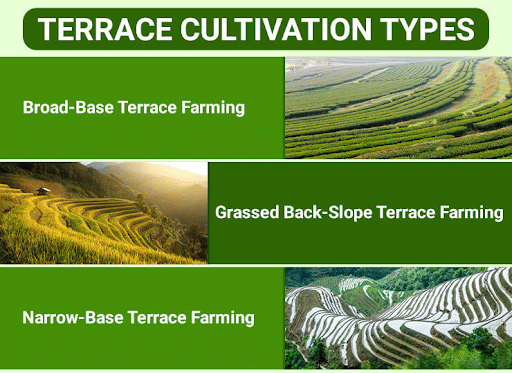
Types of Terraces
Terrace Farming Systems
Bench Terracing
- Farming bench systems resemble benches or steps across a slope, with flat or nearly flat farmed platforms spaced at regular intervals.
- Such regular arrangement is time-consuming and implies significant soil disturbance.
- The slopes can be made of earth, covered in perennial vegetation, or fortified with stones.
- Bench terracing is most commonly used in agriculture for growing rice because it allows for water retention.
- As a result, such a terracing layout is inappropriate in situations such as:
- crops which are sensitive to waterlogging;
- lands are prone to sliding; and
- frequent rains characterise weather patterns in the area.
Contour Terracing
- These terracing systems, like contour strip farming, follow the relief contour. Terraces are made up of point rows and grassy waterways.
- Despite the fact that such platforms require less effort to set up, they are difficult to use for farming activities due to space irregularities.
Parallel Terracing
- Parallel constructions make farming activities easier, so they should be kept as parallel as possible.
- If the slope prevents this, they are constructed through land-leveling operations. It makes machinery movement easier, but it is labor-, cost-, and time-consuming.
- In this case, it may be preferable not to treat those areas and instead leave them as perennial cover or grass waterways.
Soil Terracing and Conservation of Soil
- Terracing helps to keep soil cover and fertility by preventing water from washing away topsoil and minerals.
- Terrace farming is an effective method of soil protection. It does, however, need frequent inspection and maintenance.
- For effective terrace farming, it is critical to inspect the ridges and grass cover and improve where appropriate.
- Terracing prevents the formation of soil-eroding rills because water flows down through designated outlets.
- Terraces, in fact, break the slope, dividing one large slope into several smaller ones, making it less steep and the gravitational force of water less destructive.
- However, terracing is not the only way to prevent soil erosion. Furthermore, vegetation on the front and back slopes reduces the risk of water and wind destruction.
- Terrace farming promotes soil fertility and land production by reducing soil erosion and having a high water retention capacity.
- Irrigation is used on rice terraces not just to deliver water to paddy crops, but also for a variety of other uses.
- Aside from protecting terraced paddy fields, the unusual technique of year-round irrigation serves several important functions, including water storage, maintaining suitable soil conditions for rice growth, and providing a habitat for a variety of edible aquatic species.
Benefits of Terrace Farming
- Increases sloped field farmability and productivity.
- Contributes to water conservation by slowing and reducing runoff and improving rainwater harvesting.
- Reduces rill formation to prevent soil erosion.
- Improves soil conservation.
- Reduces sedimentation and pollution in the water.
- Boosts food production by preparing hilly land for farming.
- Increases ecosystem diversity.
Terrace Farming - Limitations
- Specialised machinery for pushing and levelling the soil is required.
- High labour and material costs.
- Land disturbance that frequently necessitates additional treatment.
- Hiring trained personnel to set up terraces.
- Preliminary soil analysis is required to be done (slipping soils are not suitable).
Conclusion
All terracing techniques enable farmers to retain or remove water while also reducing the slope of the hill. In fact, the goal of terrace farming is to intercept water in a designated channel and remove it through the use of constructed erosion-resistant ditches or subsurface pipe outlets. This demonstrates the effectiveness of terracing in preventing erosion and contributing to soil conservation. It does, however, necessitate regular inspection and maintenance. Thus, for effective terrace farming, it is critical to inspect the ridges and grass cover and improve where necessary.
FAQs
Question: What is soil terracing?
Answer: Soil terracing is an agricultural method used to prevent soil erosion on slopes. It involves constructing platforms or steps across hillsides, which reduce water runoff, allowing better water absorption into the soil. This method is widely used in hilly and mountainous regions to improve farming efficiency.
Question: What are the types of terraces used in agriculture?
Answer: There are several types of terraces:
- Broad-base terrace: Suitable for gentle slopes and allows mechanized farming.
- Narrow-base terrace: Designed for steep slopes with limited soil movement.
- Grassed back slope terrace: Features grass cover to reduce erosion on back slopes.
- Bench terracing: Resembles steps, ideal for water-retaining crops like rice.
- Contour terracing: Follows land contours, reducing soil erosion effectively.
Question: How does terracing prevent soil erosion?
Answer: Terracing prevents soil erosion by slowing down water runoff on slopes. It divides the slope into smaller, flatter areas, reducing the gravitational force on water, allowing it to infiltrate the soil. This protects the fertile topsoil and maintains land productivity.
Question: What are the benefits of terrace farming?
Answer: The key benefits include:
- Prevention of soil erosion by controlling water flow.
- Improved water retention, especially in rainfed regions.
- Enhanced productivity on sloped lands.
- Preservation of soil fertility through reduced degradation.
Question: What are the limitations of terrace farming?
Answer: Limitations include:
- High initial construction costs.
- Labor-intensive setup and maintenance.
- Challenges in using machinery on steep terraces.
- Improperly managed terraces can lead to issues like landslides.
MCQs
- What is the primary purpose of soil terracing in agriculture?
A) Increase crop yield
B) Prevent soil erosion
C) Increase soil acidity
D) Reduce water evaporation
Answer: (B) See the Explanation
Soil terracing is specifically designed to prevent soil erosion by slowing down water runoff and enhancing water absorption into the soil.
- Which type of terrace is used for gentle slopes?
A) Grassed back slope terrace
B) Broad-base terrace
C) Narrow-base terrace
D) Bench terracing
Answer: (B) See the Explanation
Broad-base terraces are ideal for gentle slopes and support the use of machinery in farming operations.
- What is a major benefit of bench terracing?
A) Reduces water retention
B) Slows down the erosion of soil
C) Increases water runoff
D) Requires little maintenance
Answer: (B) See the Explanation
Bench terracing is designed to slow soil erosion by creating flat, stepped platforms that reduce water flow and protect the soil.
- Which of the following is not a type of terrace farming?
A) Contour terracing
B) Parallel terracing
C) Vertical terracing
D) Bench terracing
Answer: (C) See the Explanation
Vertical terracing is not a common type of terrace farming; the most recognized types include contour and bench terracing.
- How does terracing help conserve soil moisture?
A) By increasing water runoff
B) By decreasing water retention
C) By slowing down water flow and promoting absorption
D) By preventing sunlight exposure
Answer: (C) See the Explanation
Terracing slows water flow, allowing it to penetrate the soil and be absorbed, thereby conserving moisture.
GS Mains Questions and Model Answer
Q1: Discuss the role of soil terracing in sustainable agriculture and soil conservation.
Answer: Soil terracing prevents soil erosion and enhances soil fertility, particularly on sloping terrains. It enables sustainable agriculture by:
- Reducing water runoff and conserving topsoil.
- Improving water retention, making it suitable for rainfed farming.
- Increasing agricultural productivity on steep lands.
While beneficial, terracing requires significant investment and regular maintenance, posing challenges in regions with limited resources.
Q2: Explain the types of terraces used in agriculture and their suitability for different landscapes.
Answer: Types of terraces and their suitability:
- Broad-base terrace: Ideal for gentle slopes and mechanized farming.
- Narrow-base terrace: Suitable for steep slopes with limited soil movement.
- Bench terracing: Effective for water-intensive crops like rice on steep terrains.
- Contour terracing: Built along land contours to conserve water and reduce erosion.
Each type caters to specific topographical and agricultural needs, enhancing productivity and soil conservation.
Q3: Analyze the benefits and challenges of terrace farming in maintaining soil health.
Answer: Terrace farming improves soil health by:
- Preventing erosion and retaining topsoil.
- Enhancing moisture retention and nutrient preservation.
However, it faces challenges like high construction costs, labor-intensive maintenance, and mechanization difficulties. Proper planning and management are essential to maximize its benefits.
Previous Year Questions on Soil Terracing
1. UPSC CSE 2021
Question: Discuss the role of soil terracing in preventing soil erosion and its significance in sustainable agriculture.
Answer: This question highlights soil terracing as a soil erosion prevention method and its broader role in improving agricultural sustainability, emphasizing water management and topsoil conservation.
2. UPSC CSE 2020
Question: Explain the different types of terraces used in agriculture and their role in soil conservation.
Answer: This question focuses on the various types of terraces, such as broad-base and bench terracing, and their effectiveness in preserving soil fertility and preventing erosion on sloped lands.
Download the PREPP App and attempt FREE IAS Exam Mock Tests and get complete study material!

Full Test - 04: UPSC CSE Prelims CSAT (Paper-II)
Full Test - 03: UPSC CSE Prelims CSAT (Paper-II)
UPSC CSE Prelims 2026 CSAT Paper 2 Question Paper (24-May-2026)
UPSC CSE Prelims 2026 GS Paper 1 Question Paper (24-May-2026)

17 February 2025 | The Hindu Must Read Articles | Current Affairs

16 February 2026 | The Hindu Must Read Articles | Current Affairs

13 February 2026 | The Hindu Must Read Articles | Current Affairs









Comments