Podzolization - Agriculture Notes
Podzolization is a type of severe leaching that results in the eluviation of iron and aluminium sesquioxides. The process is more common in locations where precipitation exceeds evapo-transpiration. The minerals are extracted using a process called leaching. When organic material is broken down, nutrients are released, but organic acids are also produced. Chelating agents are what these organic acids are. Many podzol soils grow beneath coniferous woods because the evergreen nature of pine trees generates a very thin litter layer that inhibits humus synthesis. This article will explain to you about Podzolization which will help prepare the Agriculture Syllabus for the UPSC Civil Service exam.
|
Table of Contents |
What is Podzolization?
- The podzolization process is a complicated soil formation process in which organic matter is decomposed and iron and aluminium ions are liberated through the weathering of different minerals from organo-mineral complexes and transported from the top regions of the soil profile.
- The downward movement of aluminium and iron elements is what causes podzolization.
- It travels deeper into the soil and deposits. The podzol's eluvial horizon gets bleached and turns ash-grey as a result of this process.
- The complexes are built up of cemented sesquidoxes and/or organic compounds and travel down with the percolating water to the illuviated horizons, which are normally brown or tinted red or black when they aggregate.
- It occurs in tandem with the buildup of organic materials from the surface areas in the deep portions of the profile.
- It is a soil formation process that results in the formation of Podzols and Podzolic soils.
- The inverse of calcification is podzolization. The calcification process concentrates calcium in the lower part of the B horizon, whereas podzolization leaches calcium carbonates from the entire solum.
- The other bases, as well as calcium, are removed, and the soil becomes noticeably acidic. In fact, the process is essentially an acid leaching process.
- This process is characterised by high acidity, which promotes delayed organic growth.
- Because the medium is filled with insoluble elements such as iron and aluminium, it produces acidic nature chemicals, causing severe modification of the mineral phase.
- As a result, organic substances often transfer them to lower sections.
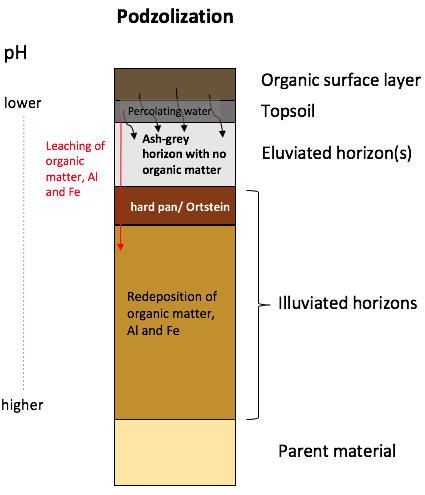
Podzolization
Podzolic Soil
- Podzolic soil, also known as podzol or less soil, is a kind of soil that forms in a broadleaf forest and is characterised by average leaching and is very vulnerable to compaction.
- Podzols are found all throughout Scotland and are often linked with acid parent material, semi-natural health or coarse grassland plants, and coniferous woods.
- They are found in any topographic position where aerobic conditions prevail and water may readily percolate through the upper portion of the profile.
- Podzols may be found in the Himalayas' mid-altitudinal zone.
- This acidic, low-humus soil may be found in Assam, Darjeeling, Kashmir, Uttaranchal, and Himachal Pradesh.
- This soil in the Himalayan area is used to cultivate maize, barley, wheat, and temperate fruits.
- A variety of podzol sub-groups have been discovered based on geography, climate, and vegetation.
- Iron Humus Podzol
- Peaty Podzol
- Alpine Podzol
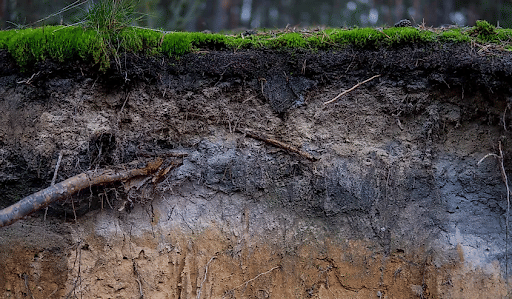
Podzolic Soil
Podzolic Soil - Characteristics
- The podzols' first distinguishing trait is that they are infertile soils.
- Their sand content and low moisture level make them unsuitable for cultivation.
- Fertilisation is strongly advised when using podzols for agricultural purposes.
- As demonstrated by their low pHs, podzols are very acidic.
- Podzols are deficient in important soil nutrients such as phosphate.
- This type of soil is also prone to aluminium toxicity, which impedes plant development.
Favourable Conditions of Podzolization
- Ideal climatic conditions: It thrives in humid and cold environments.
- Sandy materials contain limited supplies of weatherable minerals. As a result, they typically prefer the podzolization process because it facilitates water percolation.
- Vegetation that produces acid: Acid-producing vegetation, such as coniferous pines, is required.
- Sesquioxide Leaching and Translocation: As hummus and Sesquioxide become mobile, they leach out of the higher horizon and deposit in the lower one. The horizon appears bleached grey and ashy as iron and aluminium move around.
- Sesquioxide is an oxide in which oxygen is present in a three-to-two ratio to another element.
Conclusion
Podzols are infertile, highly acidic soils that look like white or grey ash. They are found in the soil's subsurface layer as evidence of minerals that have leached into a lower stratum. Podzols are typically found in boreal and mountainous areas. The profile's spectacular micromorphology, with abundant coverings of organic matter on the sand grains in horizon Bh, reflects evidence that the podzolization process has developed in a soil.
FAQs
Q1: What is Podzolization?
Answer: Podzolization is a soil formation process where leaching of organic matter and minerals leads to the development of distinct soil horizons, commonly found in cold, moist climates.
Q2: Which climatic conditions promote Podzolization?
Answer: Podzolization primarily occurs in cold and humid climates, such as boreal forests, where low temperatures and abundant moisture facilitate organic matter accumulation and mineral leaching.
Q3: What are the main characteristics of Podzol soil?
Answer: Podzol soils are acidic, nutrient-poor, and characterized by distinct layers, including a leached upper layer (A horizon) and a lower layer enriched with iron, aluminum, and organic matter (B horizon).
Q4: How does Podzolization affect agricultural practices?
Answer: Due to its low fertility and high acidity, Podzol soil is generally unsuitable for intensive agriculture without significant soil amendments like liming and fertilization.
Q5: What are the environmental impacts of Podzolization?
Answer: Podzolization leads to nutrient leaching and soil acidification, which can limit vegetation growth and affect forest ecosystems, contributing to biodiversity changes over time.
MCQs
- In which climatic region is Podzolization most likely to occur?
a) Tropical Rainforests
b) Boreal Forests
c) Desert Regions
d) Grasslands
Answer: (B) See the Explanation
- Which element is commonly leached from the upper horizons in Podzolization?
a) Phosphorus
b) Iron
c) Potassium
d) Magnesium
Answer: (B) See the Explanation
- What is the pH nature of Podzol soils?
a) Neutral
b) Alkaline
c) Acidic
d) Highly Basic
Answer: (C) See the Explanation
- Which of the following is a key agricultural challenge associated with Podzol soils?
a) Excessive water retention
b) High salinity
c) Low nutrient availability
d) Rapid decomposition of organic matter
Answer: (C) See the Explanation
- How can farmers improve the productivity of Podzol soils?
a) Regular irrigation
b) Deep plowing
c) Liming and fertilization
d) Flooding the soil
Answer: (C) See the Explanation
GS Mains Questions and Model Answers
Q1. Discuss the process of Podzolization and its environmental significance.
Answer: Podzolization is a soil-forming process in which organic acids from decaying vegetation leach minerals from the upper horizons to the subsoil, forming distinct soil layers. This process typically occurs in cold, moist climates like boreal forests. Podzol soils are acidic and nutrient-poor due to the leaching of essential minerals. Environmentally, Podzolization affects forest ecosystems by limiting plant diversity to acid-tolerant species. It also contributes to groundwater contamination through nutrient leaching. While Podzol soils support limited agriculture, their role in regulating ecosystems and acting as carbon sinks makes them environmentally significant.
Q2. Evaluate the impact of Podzolization on forest ecosystems and biodiversity.
Answer: Podzolization plays a critical role in shaping forest ecosystems, especially in boreal and temperate regions. The acidic nature of Podzol soils limits the types of vegetation that can thrive, favoring acid-tolerant plant species. This process influences forest composition, affecting biodiversity by restricting nutrient availability to trees and shrubs. Over time, ecosystems dominated by Podzol soils may develop reduced species diversity. However, they also serve as important carbon reservoirs, contributing to global carbon cycling. Understanding the ecological implications of Podzolization helps in the conservation of these ecosystems.
Q3. Explain the agricultural limitations of Podzol soils and suggest ways to improve their productivity.
Answer: Podzol soils present several agricultural challenges due to their high acidity, low nutrient content, and poor water retention. The leaching process removes essential minerals like calcium and magnesium, leaving the soil nutrient-deficient. These conditions make Podzol soils unsuitable for intensive farming without interventions. To improve productivity, farmers can apply lime to neutralize soil acidity and use organic or chemical fertilizers to replenish nutrients. Crop rotation and green manuring practices can further enhance soil health. While these measures can improve Podzol soil productivity, they require continuous management to sustain agricultural output.
Previous Year Questions on Podzolization
1. UPSC CSE 2020
Question: Analyze the role of soil formation processes like Podzolization in shaping regional ecosystems.
Answer: Soil formation processes like Podzolization have a profound impact on regional ecosystems. In areas where Podzolization occurs, such as boreal forests, the soil becomes acidic and nutrient-poor due to the leaching of minerals. This affects the types of vegetation that can thrive, promoting acid-tolerant species and limiting biodiversity. Podzolized soils also influence the hydrological cycle by altering water infiltration and storage capacities. The process plays a role in carbon sequestration, with organic matter accumulating in the upper soil layers. However, it can also contribute to groundwater contamination through nutrient leaching. The ecological dynamics shaped by Podzolization are essential for understanding biodiversity patterns and ecosystem services in these regions.
2. UPSC CSE 2019
Question: How does the process of Podzolization affect sustainable agricultural practices?
Answer: Podzolization presents significant challenges to sustainable agriculture due to its impact on soil fertility. The leaching of minerals like calcium, magnesium, and potassium results in nutrient-deficient and acidic soils, making them unsuitable for most crops without extensive amendments. Sustainable agricultural practices in regions with Podzol soils require continuous inputs such as lime to neutralize acidity and fertilizers to replenish nutrients. Organic farming techniques, including crop rotation and the use of cover crops, can help improve soil health over time. However, maintaining productivity on Podzol soils requires balancing ecological sustainability with the need for agricultural output. Integrating agroforestry practices may also offer a solution by enhancing soil structure and reducing nutrient loss.
Download the PREPP App and attempt FREE IAS Exam Mock Tests and get complete study material!

Full Test - 04: UPSC CSE Prelims CSAT (Paper-II)
Full Test - 03: UPSC CSE Prelims CSAT (Paper-II)
UPSC CSE Prelims 2026 GS Paper 1 Question Paper (24-May-2026)
UPSC CSE Prelims 2026 CSAT Paper 2 Question Paper (24-May-2026)

17 February 2025 | The Hindu Must Read Articles | Current Affairs

16 February 2026 | The Hindu Must Read Articles | Current Affairs

13 February 2026 | The Hindu Must Read Articles | Current Affairs









Comments