Soil Structure - Agriculture Notes
Soil structure explains the organisation of soil in the solid components of the soil as well as the pore space that exists between them. The configuration of soil pores between them is influenced by how individual soil granules clump, bond together, and aggregate. Water and air circulation, biological activity, root development, and seedling emergence are all influenced by soil. There are several forms of soil structure. This article will explain to you about Soil structure which will be helpful in preparing the Agriculture Syllabus for the UPSC Civil Service exam.
|
Table of Contents |
What is Soil Structure?
- Structure is one of the distinguishing features of a soil horizon. A soil horizon has only one structure, but different horizons within a soil may have different structures.
- The type of structure that develops at each depth is influenced by all soil-forming factors, particularly climate.
- The granular and crumb structure is typically found near the soil surface in the A horizon.
- The structure of the subsoil, particularly the B horizon, is subangular blocky, blocky, columnar, or prismatic.
- Platy structure can be found on the surface or in the subsoil, whereas single grain and structureless structure are typically associated with the C horizon.
- Soil Structure is the arrangement of soil separated into units known as soil aggregates.
- The structure of a soil is determined by the arrangement of soil particles into various shapes.
- Soil structure refers to the visible clods and aggregates, as opposed to soil texture, which is felt.
- Soils with poor structure produce low yields and are difficult to manage owing to a narrow range of soil moisture for tillage operations.
- The arrangement of pores and fissures (porosity) within a matrix of solid materials is referred to as soil structure (soil particles and organic matter).
- The pores and fissures are formed when solid materials bond and aggregate.
- Water holding capacity, infiltration, permeability, root penetration, and respiration are all determined by the number, distribution, and arrangement of pores.
- Only about half of soil is solid. The rest is pore space. The action takes place in these areas. Water is kept there. There are organisms there. There, organic matter and nutrients accumulate.
- Small pores within the aggregates serve as storage and shelter. Liquids, gases, roots, and organisms travel through the larger pores (and fissures) between the aggregates.
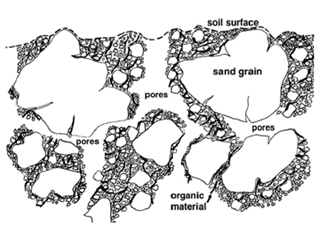
Close up of Soil Structure
- Poor soil structure can cause drainage issues owing to the clogging of soil pores, resulting in a reduction in the rate at which water can permeate and drain through the soil.
- When wet, compaction can cause decreased aeration, especially in heavier textured soils like Ferrosols, resulting in limited quantities of soil accessible for root development.
- The disintegration of aggregates and dispersion of clay material as a result of fast soaking is frequently associated with the loss of soil structure under irrigation.
Soil Aggregates (Peds)
- Mineral particles (clay, silt, sand) and organic matter combine to form peds. The electrical charges on the surfaces of minerals and organic matter hold peds together.
- Despite their small size, clay particles have a large surface area. For example, the surface area of a tennis court is equal to the surface area of a teaspoon of black cracking clay soil.
- Strong peds are more likely to form in clays and soils with a lot of organic matter.
- Soils with little or no organic matter, such as sandy soils, frequently have little or no ped development.
- Peds are classified according to their shape, which can be blocky, columnar, massive, single grain, or platy.
- Aggregates are significant in soil because they affect bulk density, porosity, and pore size.
- When compared to pores between aggregates and between single soil particles, pores within an aggregate are quite small.
- This balance of large and small pores promotes soil aeration, permeability, and water retention.
- Root growth and the addition of organic material promote aggregate formation.
Grades of Soil Structure
The grade of the structure is defined as the degree of aggregation, which expresses the difference between cohesion within aggregates and adhesion between aggregates. Because these properties vary with soil moisture content, structure grade should be determined when the soil is neither unusually moist nor unusually dry. The following are the four major structure grades:
- Structureless: It possesses no discernible aggregation or definite orderly arrangement of natural lines of weakness.
- Weak Structure: It is poorly formed, with indistinct aggregates that are barely visible in place.
- Moderate Structure: It is well formed from distinct aggregates that are moderately durable and visible in undisturbed soil but not distinct.
- Strong Structure: It is well formed from distinct aggregates that are long-lasting and visible in undisturbed soil.
Class of Soil Structure
The average size of individual aggregates is described by a class of structure. Typically, five distinct classes can be identified based on the type of soil structure from which they originate. They are as follows:
- Very Fine/Very Thin
- Fine/Thin
- Medium
- Coarse/Thick
- Very Coarse/Very Thick
Types of Soil Structure
- Soil structure is categorized by type (form), class (size) of peds, and aggregate grade (cohesion strength).
- Pore structure and the ease with which air, water, and roots flow through the soil are determined by the form, size, and strength of aggregates.
Granular Structure
- Individual particles of sand, silt, and clay are grouped in small, nearly spherical grains to form granular and crumb structures.
- Water easily circulates through such soils. They are most commonly found in the soil profile's A-horizon.
- The granular structure is most frequent in surface soil layers, particularly those rich in organic materials.
- Granular structures have the greatest amount of pore space of any structure.
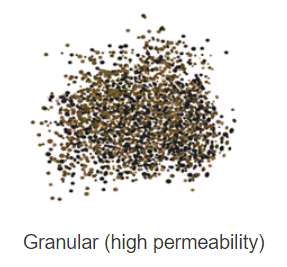
Granular Structure
Columnar Structure
- Prismatic and columnar structures are made up of soil particles that have formed vertical columns or pillars separated by tiny but distinct vertical cracks.
- Water circulates more slowly, and drainage is inadequate. They're most common in the B-horizon, where clay has accumulated.
- Columnar structure is frequently observed in soils with high salt levels due to the dispersing effects of sodium, which degrades soil structure and effectively seals the soil to air and water movement.
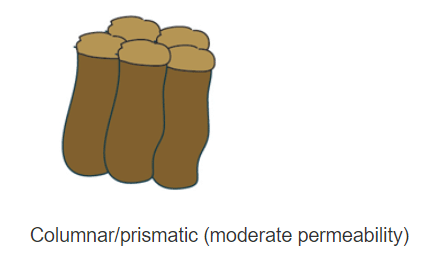
Columnar Structure
Blocky Structure
- Soil particles cling together in nearly square or angular blocks with more or less sharp edges to form blocky and subangular blocky structures.
- Large blocks indicate that the soil resists water penetration and movement.
- They're most common in the B-horizon, where clay has accumulated.
- The units might be either blocklike or polyhedral. They are surrounded by flat or slightly rounded surfaces that are castings of neighbouring peds' faces.
- Blocky structural units are often roughly equidimensional but graded to prisms and plates.
- If the faces cross at relatively acute angles, the structure is defined as angular blocky, and subangular blocky if the faces are a mixture of rounded and plane faces with primarily rounded corners.
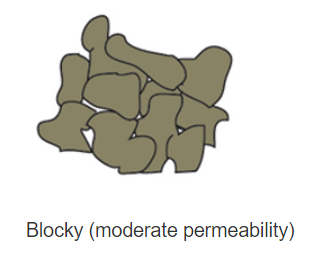
Blocky Structure
Platy Structure
- Soil particles aggregated in thin plates or sheets piled horizontally on top of one another form a platy structure.
- Plates frequently overlap, reducing water circulation significantly.
- The platy structure has the fewest pore spaces and is typical in compacted soils.
- The units are plate-like and flat.
- They are usually horizontally orientated.
- It is commonly found in forest soils and is a component of A-horizon.
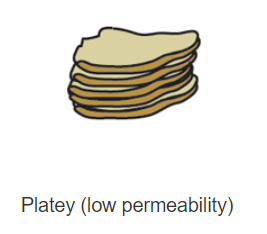
Platey Structure
Massive Structure
- Some soils, such as single grain soils (like loose sand with little to no attraction between the grains of sand) and enormous soils, lack genuine structure (large cohesive masses of clay).
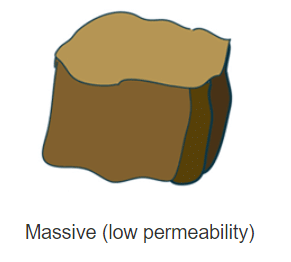
Massive Structure
Importance of Soil Structure
- The advantages of improving soil structure for plant growth, particularly in an agricultural setting, include:
- reduced erosion due to increased soil aggregate strength and decreased overland flow;
- improved root penetration and access to soil moisture and nutrients;
- improved seedling emergence due to reduced surface crusting;
- increased water infiltration, retention, and availability due to increased porosity.
- A good soil structure is used to assess a soil's ability to perform well (or poorly) with regards to following parameters:
- Porosity (to represent aeration, water storage capacity, plant wilting point and drainage).
- Permeability (to represent infiltration, drainage and respiration).
- Aggregation and bonding (to represent how the solids group together and the construction materials used).
- Soil tenacity (to represent toughness and resilience of structures).
- Tillage, friability, and trafficability (to represent how soils behave with mechanical disturbance).
Factors Affecting Soil Structure
Climate
- Climate has a significant impact on the degree of aggregation as well as the type of structure.
- Primary particle aggregation is very low in arid regions.
- Aggregation is greater in semi-arid regions than in arid regions.
Organic Matter
- Organic matter improves the structure of both sandy and clay soils.
- In the case of sandy soil, the sticky and slimy material formed by decomposing organic matter and the associated microorganism cements the sand particles together to form aggregates.
- It modifies the properties of clay by reducing its cohesive power in the case of clayey soil. This contributes to the crunchiness of the clay.
Tillage
- Cultivation tools shatter large clods into smaller fragments and aggregates.
- A good granular and crumby structure requires an optimal moisture content in the soil.
- If the moisture content is too high, drying will result in large clods.
- Some of the existing aggregates will be broken down if it is too low.
Plant Roots
- A large number of granules remain attached to roots and root hairs, assisting in the formation of crumb structure.
- Plant root secretions may also act as cementing agents, holding soil particles together.
- Plant roots that decay can cause granulation due to the production of sticky substances.
Soil Organism
- Small animals that burrow in the soil, such as earthworms, moles, and insects, are the primary agents involved in the aggregation of finer particles.
Fertilizers
- Fertilizer, such as sodium nitrate, destroys granulation by decreasing aggregate stability.
- A few fertilizers, such as calcium ammonium nitrate, aid in the development of good structures.
Wetting and Drying
- When dry soil is wetted, the soil colloids swell as a result of the water absorption.
- Shrinkage-induced strains in the soil mass cause cracks, which break it up into clods and granules of varying sizes as it dries.
Conclusion
Soil structure illustrates how soil is organized in its solid components as well as the pore space that occurs between them. A well-structured soil easily breaks up into peds with a distinct shape (granular or blocky) and size (1–60mm). A good structure allows water to soak into the soil and excess water to drain away. It also allows air to circulate through the soil. Plant growth and nutrient supply are dependent on soil, air, and water. Poor soil structure can lead to drainage problems due to blockage of soil pores, which reduces the rate at which water can permeate and drain through the soil.
FAQs
Question. What is soil structure in the context of agriculture?
Answer: Soil structure refers to the arrangement and organization of soil particles into aggregates or clusters, which affect how water, air, and nutrients move through the soil. It is a key factor in determining soil fertility, water retention, drainage, and root development. Soil structure influences how well plants can grow and how efficiently farmers can manage irrigation, fertilization, and crop cultivation. Soils with good structure allow better root penetration, greater water holding capacity, and improved soil aeration, all of which enhance agricultural productivity.
Question. What are the different types of soil structure?
Answer: Soil structure can be classified into several types based on the arrangement of soil particles:
- Granular Structure: This type of structure is common in surface soils and is characterized by small, rounded aggregates. It allows for good water infiltration and root penetration.
- Blocky Structure: Typically found in subsoils, this structure consists of angular blocks and is often associated with clayey soils. It can restrict root growth and water movement.
- Platy Structure: This structure features thin, flat plates of soil that can form when soils are compacted. It limits water infiltration and root growth, leading to poor crop yields.
- Prismatic Structure: Found in soils with heavy clay content, prismatic structure is characterized by vertical columns or prisms. It can lead to slow water movement and restricted root growth.
- Columnar Structure: Similar to prismatic, but with rounded tops, columnar structures occur in saline soils and can lead to poor drainage and reduced agricultural productivity.
Question. Why is soil structure important for agriculture?
Answer: Soil structure plays a crucial role in determining soil’s ability to support plant growth. Good soil structure provides several benefits for agriculture:
- Improved Water Infiltration and Drainage: Well-structured soils allow water to move freely, preventing both waterlogging and drought conditions.
- Better Root Penetration: A soil with good structure allows plant roots to grow deeper and access nutrients more effectively.
- Enhanced Nutrient Availability: Soils with good structure maintain better levels of nutrients and organic matter, which are essential for plant growth.
- Increased Soil Aeration: Good soil structure ensures that air can circulate in the soil, which is necessary for healthy root function and microbial activity.
Question. How does soil compaction affect soil structure and agricultural productivity?
Answer: Soil compaction occurs when soil particles are pressed together, reducing pore spaces in the soil. This leads to several problems for agriculture:
- Reduced Water Infiltration: Compacted soil restricts the movement of water, leading to poor drainage and waterlogging.
- Limited Root Growth: The reduced space for air and water limits root penetration, hindering plant growth and nutrient absorption.
- Lower Oxygen Levels: Compaction reduces the availability of oxygen in the soil, which can stunt plant growth and reduce microbial activity.
- Decreased Crop Yield: Overall, soil compaction leads to poor soil fertility, lower productivity, and reduced crop yield.
Question. What are some methods to improve soil structure for better agricultural productivity?
Answer: Improving soil structure is essential for sustaining agricultural productivity. Some methods to improve soil structure include:
- Adding Organic Matter: Incorporating compost, manure, or cover crops can help improve soil structure by enhancing aggregation and increasing soil porosity.
- Reducing Tillage: Excessive tillage can break down soil aggregates, leading to soil compaction. Conservation tillage practices help preserve soil structure.
- Crop Rotation and Diversification: Growing different crops in a rotating pattern helps improve soil structure by encouraging different root systems and preventing soil erosion.
- Use of Mulch: Mulching helps improve soil structure by protecting the surface from erosion, reducing water evaporation, and adding organic matter to the soil.
- Soil Aeration: Using tools like aerators or subsoilers to break up compacted soil can improve air and water movement in the soil, promoting root growth and microbial activity.
MCQs
- Which of the following is a benefit of good soil structure in agriculture?
A) Poor root penetration
B) Limited water infiltration
C) Improved nutrient availability
D) Increased soil compaction
Answer: (C) See the Explanation
Good soil structure allows for better nutrient retention and movement, which enhances the availability of nutrients for plants.
- Which type of soil structure is characterized by small, rounded aggregates?
A) Blocky Structure
B) Platy Structure
C) Granular Structure
D) Prismatic Structure
Answer: (C) See the Explanation
Granular structure is characterized by small, rounded aggregates that allow for good water infiltration and root penetration.
- Which of the following is a consequence of soil compaction?
A) Better root growth
B) Improved water drainage
C) Decreased oxygen levels in the soil
D) Increased microbial activity
Answer: (C) See the Explanation
Soil compaction leads to reduced pore spaces, which decreases the availability of oxygen in the soil, affecting plant roots and soil organisms.
- What method can improve soil structure by increasing organic matter?
A) Use of chemical fertilizers
B) Reduced tillage
C) Adding organic compost
D) Planting monoculture crops
Answer: (C) See the Explanation
Adding organic compost improves soil structure by increasing soil aggregation, water retention, and nutrient content.
- Which of the following structures restricts water infiltration and root growth?
A) Granular Structure
B) Platy Structure
C) Prismatic Structure
D) Columnar Structure
Answer: (B) See the Explanation
Platy structure consists of thin, flat plates of soil, which can lead to restricted water infiltration and poor root growth.
GS Mains Questions and Model Answers
Q1: Discuss the impact of soil structure on agricultural productivity and suggest measures to improve soil structure in degraded lands.
Answer: Soil structure significantly impacts agricultural productivity by affecting water infiltration, root growth, and nutrient availability. Soils with poor structure, such as compacted or platy soils, can lead to problems like waterlogging, poor drainage, restricted root growth, and low nutrient availability. These issues reduce crop yields and soil fertility. To improve soil structure, farmers can adopt practices such as:
- Adding organic matter like compost and manure to increase soil aggregation and porosity.
- Conservation tillage to minimize soil disturbance and prevent compaction.
- Crop rotation and planting cover crops to improve soil health and structure.
- Proper irrigation management to avoid waterlogging and reduce surface crusting. These measures help restore soil fertility, increase water retention, and improve the overall structure of degraded lands, leading to higher productivity.
Q2: Examine the relationship between soil compaction and crop productivity in India, and discuss strategies to mitigate its effects.
Answer: Soil compaction is a significant problem in Indian agriculture, especially in regions with intensive farming practices and overuse of machinery. Compacted soils restrict root growth, decrease water infiltration, and reduce soil aeration, leading to poor crop productivity. The effects of soil compaction are particularly pronounced in rice and wheat farming, where fields are often ploughed repeatedly and machinery is used excessively. To mitigate soil compaction, India can adopt the following strategies:
- Reduce tillage and practice minimum tillage or no-till farming to preserve soil structure and avoid further compaction.
- Use organic amendments like compost and green manures to improve soil aggregation and reduce the effects of compaction.
- Implement subsoiling to break up compacted layers deep in the soil, allowing for better water and root penetration.
- Educate farmers about the importance of soil health and the long-term benefits of avoiding excessive tillage and overuse of machinery.
Q3: Evaluate the role of soil structure in sustainable agriculture and its importance in India’s agrarian economy.
Answer: Soil structure plays a vital role in sustainable agriculture by ensuring the health of the soil and its capacity to support crop production. In India, where agriculture is the primary livelihood for a large portion of the population, soil structure is directly linked to food security and economic stability. Healthy soil with good structure enhances water retention, nutrient availability, and root development, which are essential for maintaining high crop yields. However, poor soil structure, resulting from excessive tillage, monoculture farming, and overuse of chemical inputs, leads to soil degradation, reducing agricultural productivity. For sustainable agriculture, it is crucial to adopt practices that improve soil structure, such as crop rotation, organic farming, and agroforestry. By investing in soil health, India can ensure long-term agricultural productivity, mitigate climate change impacts, and improve the livelihoods of its farming communities.
Previous Year Questions on Soil structure
1. UPSC 2020
Question: Analyze the impact of soil degradation on agricultural productivity and discuss measures to improve soil structure.
Answer: This question required an analysis of how soil degradation, including compaction and erosion, affects agricultural productivity, and what measures could be implemented to improve soil structure through organic farming, conservation tillage, and crop rotation.
2. UPSC 2019
Question: Discuss the role of soil structure in sustaining agricultural practices in India.
Answer: The question required a discussion of the importance of soil structure in sustaining agricultural productivity in India, addressing challenges like soil erosion, degradation, and the role of sustainable farming techniques to improve soil health and productivity.
Download the PREPP App and attempt FREE IAS Exam Mock Tests and get complete study material!

Full Test - 04: UPSC CSE Prelims CSAT (Paper-II)
Full Test - 03: UPSC CSE Prelims CSAT (Paper-II)
UPSC CSE Prelims 2026 GS Paper 1 Question Paper (24-May-2026)
UPSC CSE Prelims 2026 CSAT Paper 2 Question Paper (24-May-2026)

17 February 2025 | The Hindu Must Read Articles | Current Affairs

16 February 2026 | The Hindu Must Read Articles | Current Affairs

13 February 2026 | The Hindu Must Read Articles | Current Affairs









Comments