Gleization - Agriculture Notes
Soil gleization is a soil formation process caused by a lack of oxygen (in an anaerobic environment), which results in the production of a gley horizon in the soil profile. This process is heavily dependent on poor drainage conditions caused by low topographic elevation land depressions, continual water recharge with water-logged conditions, impermeable soil parent materials, and a lack of aeration. This article will explain to you about Gleization which will help prepare the Agriculture Syllabus for the UPSC Civil Service exam.
|
Table of Contents |
Gleization Process
- 'Glei' is a Russian word that denotes blue, grey, or green clay.
- Gleization is a soil formation process that results in the creation of a glei (or gley horizon) in the bottom section of the soil profile above the parent material as a result of poor drainage (lack of oxygen) and waterlogged conditions.
- These types of soils are known as hydro orphic soils.
- The process is not particularly dependent on climate (high rainfall as in humid regions) but often on drainage conditions.
- Poor drainage conditions are caused by:
- Lower topographic position, such as depression land, where water is always at or near the surface.
- The parent material of impervious soil.
- Aeration is lacking.
- Iron compounds are reduced to soluble ferrous forms under these conditions.
- Iron reduction is primarily biological, requiring both organic matter and anaerobically respiring microorganisms.
- Ca, Mg, Fe, and Mn are more soluble, and the majority of the iron exists as Fe++ organo complexes in solution or as a mixed precipitate of ferric and ferrous hydroxides.
- This is what causes the typical bluish to greyish horizon with mottling of yellow and/or reddish brown colours.
- These together result in the accumulation of a sticky, compact layer of blue-grey or grey colour at the bottom of B-horizon.
- This process is called 'gleization' and the soil is called 'glays'.
- Gleization is a common soil pedogenic regime that occurs in moist, cool, and cold climates.
- The pedogenic regime occurs in poorly drained environments but not in saline environments.
- The low temperature in such conditions slowed bacterial activity, resulting in the buildup of organic materials in the surface layers.
- Organic matter decomposition is hindered due to wet or saturated environmental conditions, resulting in the buildup of peat layers.
- Overlapping layers compress peat layers, releasing a colloidal substance that produces a glei horizon with sticky material.
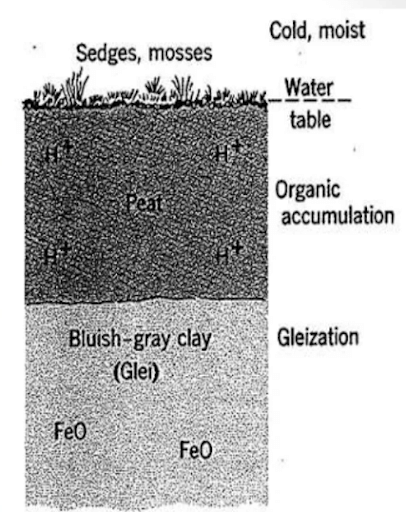
Gleization
Conclusion
Gleization is a soil formation process that results in the creation of a glei (or gley horizon) in the bottom section of the soil profile above the parent material. Gleying takes place in waterlogged anaerobic conditions when iron compounds are reduced and either removed from the soil or segregated out as mottles or concretions. Marshy wetlands frequently have gleyed soils. This soil is unsuited for agriculture.
FAQs
Q1: What is gleyization in agriculture?
Answer: Gleyization is a soil formation process that occurs under waterlogged conditions, leading to the development of gley soils. It is characterized by the reduction of iron and other minerals, causing the soil to take on a bluish-grey or greenish color due to prolonged saturation and anaerobic conditions.
Q2: What causes gleyization in soils?
Answer: Gleyization is primarily caused by poor drainage and prolonged water saturation of the soil, leading to anaerobic conditions. It often occurs in areas with high water tables, marshy landscapes, or during prolonged rainy seasons.
Q3: How does gleyization affect crop growth?
Answer: Gleyization can negatively impact crop growth by creating anaerobic conditions that restrict root development, limit oxygen availability, and reduce nutrient uptake. This can lead to poor plant health, stunted growth, and reduced yields.
Q4: Where are gley soils commonly found?
Answer: Gley soils are commonly found in low-lying areas, marshes, wetlands, river valleys, and regions with a high water table. They are prevalent in areas with poor drainage and excessive water retention.
Q5: Can gleyization be managed to improve soil productivity?
Answer: Yes, gleyization can be managed through practices such as improving drainage, using raised beds, planting water-tolerant crops, and applying organic amendments to enhance soil structure and aeration. Proper water management can help reduce waterlogging and its negative effects on soil and crops.
MCQs
- What is the main cause of gleyization in soils?
A) Excessive use of fertilizers
B) Prolonged waterlogging and poor drainage
C) High temperatures and low rainfall
D) Over-cultivation of land
Answer: (B) See the Explanation
- Which color is typically associated with gley soils?
A) Red and yellow hues
B) Bluish-grey or greenish color
C) Pure black
D) White and sandy hues
Answer: (B) See the Explanation
- Gleyization primarily occurs in which type of landscape?
A) High-altitude mountains
B) Arid deserts
C) Low-lying, poorly drained areas
D) Rocky terrains
Answer: (C) See the Explanation
- How does gleyization impact soil conditions for plant growth?
A) Improves aeration and root development
B) Enhances nutrient availability
C) Creates anaerobic conditions that hinder plant growth
D) Increases the soil's permeability
Answer: (C) See the Explanation
- Which practice is most effective in managing gley soils for agriculture?
A) Applying excessive chemical fertilizers
B) Improving soil drainage
C) Avoiding crop rotation
D) Allowing continuous waterlogging
Answer: (B) See the Explanation
GS Mains Questions and Model Answers
Q1: Discuss the process of gleyization and its impact on soil properties.
Answer: Gleyization is a soil-forming process that occurs under conditions of prolonged water saturation, leading to the reduction of iron and other minerals in the soil. This process creates anaerobic conditions, resulting in soils with bluish-grey or greenish hues. Gleyization affects soil properties by reducing aeration, altering nutrient availability, and creating conditions that are unfavorable for many crops. It often leads to compaction, poor root penetration, and limited microbial activity, ultimately impacting soil fertility and productivity. Effective management strategies, such as improving drainage and using water-tolerant crops, can help mitigate these negative effects.
Q2: What are the causes and management strategies for gleyized soils in agriculture?
Answer: The primary causes of gleyization are poor drainage, high water tables, and prolonged waterlogging in low-lying or marshy areas. This leads to anaerobic conditions that impact soil health and crop productivity. Management strategies include improving drainage through ditches or raised beds, using cover crops to enhance soil structure, and selecting crops that are tolerant to wet conditions. Adding organic matter can also improve soil aeration and microbial activity, reducing the adverse effects of waterlogging.
Q3: How does gleyization affect agricultural productivity, and what steps can be taken to enhance soil health in gleyized areas?
Answer: Gleyization can reduce agricultural productivity by creating waterlogged, anaerobic conditions that restrict root development and nutrient uptake. This leads to poor plant health and reduced crop yields. To enhance soil health in gleyized areas, farmers can implement drainage systems, use organic amendments, and adopt conservation practices such as crop rotation and cover cropping. Improving soil aeration and structure can mitigate the negative impacts of gleyization, allowing for better water management and plant growth.
Previous Year Questions on Gleization
1. UPSC CSE 2020
Question: Analyze the environmental and agricultural challenges posed by gleyized soils.
Answer: Gleyized soils pose several environmental and agricultural challenges due to prolonged waterlogging, which leads to anaerobic conditions and reduced soil fertility. These conditions hinder root growth, reduce microbial activity, and limit the availability of nutrients like iron and nitrogen. In agriculture, this results in lower crop yields and difficulty in cultivating water-sensitive crops. Managing gleyized soils requires improved drainage systems, organic amendments, and crop selection strategies that promote soil aeration and resilience to waterlogging.
2. UPSC CSE 2019
Question: Explain the significance of soil drainage management in areas affected by gleyization.
Answer: Effective soil drainage management is crucial in areas affected by gleyization to alleviate waterlogging and create aerobic soil conditions conducive to plant growth. Proper drainage systems, such as ditches and raised beds, can reduce excess water accumulation, improving soil structure and aeration. This, in turn, enhances root development, nutrient uptake, and overall soil productivity. By mitigating the adverse effects of gleyization, farmers can improve crop yields and promote sustainable agricultural practices.
Download the PREPP App and attempt FREE IAS Exam Mock Tests and get complete study material!

Full Test - 04: UPSC CSE Prelims CSAT (Paper-II)
Full Test - 03: UPSC CSE Prelims CSAT (Paper-II)
UPSC CSE Prelims 2026 GS Paper 1 Question Paper (24-May-2026)
UPSC CSE Prelims 2026 CSAT Paper 2 Question Paper (24-May-2026)

17 February 2025 | The Hindu Must Read Articles | Current Affairs

16 February 2026 | The Hindu Must Read Articles | Current Affairs

13 February 2026 | The Hindu Must Read Articles | Current Affairs









Comments