Laterization - Agriculture Notes
Laterization is a sort of weathering process that converts rock to laterite. The final product has a wide range of grade, thickness, chemistry, and ore mineralogy. Tropical weathering is another name for lateralization. Chemical and physicochemical changes are included. Laterization is the reversal process of podzolization in that it removes silica from the higher layers instead of sesquioxides, allowing sesquioxides to accumulate in the solum. The process takes place in tropical rain forests with warm and humid (tropical) climates, and basic parent materials that are suitable for such soils. This article will explain to you about Laterization which will be helpful in preparing the Agriculture Syllabus for the UPSC Civil Service exam.
|
Table of Contents |
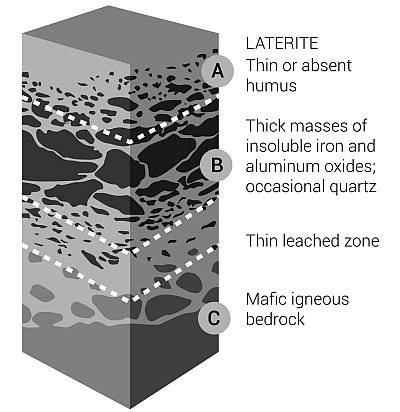
Laterite Profile
What is Laterization?
- Laterization is the process of removing silica from the upper layers rather than sesquioxides, allowing sesquioxides to concentrate in the solum.
- It refers to a specific cemented horizon in certain soils that, when dried, becomes extremely hard, similar to a brick.
- Laterization is a pedogenic (soil formation) process that occurs in tropical and subtropical regions.
- Laterization is especially widespread in tropical locations with a long dry season and a close-to-surface water table.
- It entails chemical and physical changes, as well as the transformation of basic rock-forming minerals into compounds rich in lattice clay minerals and laterite elements.
- Laterization is the weathering process that produces laterite.
- Soils and rocks are depleted of soluble compounds, such as silica-rich and alkaline components, and enriched in soluble substances, such as hydrated aluminium and iron oxides, throughout the process.
- It consists of three steps:
- The first phase is decomposition, which includes the disintegration of minerals, releasing component elements such as calcium oxide, magnesium oxide, and so on.
- Laterization, which involves leaching, is the second phase (loss of soluble substances and colloids from the topmost layer of soil).
- Dehydration or desiccation of minerals is the third phase.
- It refers to a special cemented horizon in some soils that, when dried, becomes extremely hard, similar to a brick.
- Laterites or latosols (Oxisols) are soils in the tropics that have been extensively mixed with sesquioxides (iron and aluminium oxides) to the amount of 70 to 80% of the total mass.
- Soil degradation, also known as retrogression, is a deterioration in soil condition caused by incorrect usage or bad management.
- Water purification entails the removal of impurities, and methods employed include sedimentation, filtration, and so on.
- Soil sterilisation is a chemical or physical technique that causes organisms in the soil to die.
Laterites or Latosols (Oxisols)
- Laterite is a soil and rock type rich in iron and aluminium that is thought to have originated in hot and humid tropical environments.
- Because of the high iron oxide concentration, nearly all laterites are rusty-red in colour.
- They form as a result of intense and extended weathering of the underlying parent rock, commonly during times of high temperatures and heavy rainfall with alternate wet and dry intervals.
- Tropical weathering (laterization) is a long-term chemical weathering process that results in a wide range of thickness, grade, chemistry, and ore mineralogy in the ensuing soils.
- The soil usually has a thin but extremely fertile layer of humus shed from plants and animals in the forest above, followed by an infertile second layer owing to quick leaching from the heavy rain.
- Weathered bedrock, the third stratum, is found in practically all soil types.
- Because all nutrients leak out fast when the forest is destroyed and the layer of humus is no longer being renewed, the latosol is fully dependent on the rainforest to sustain fertility.
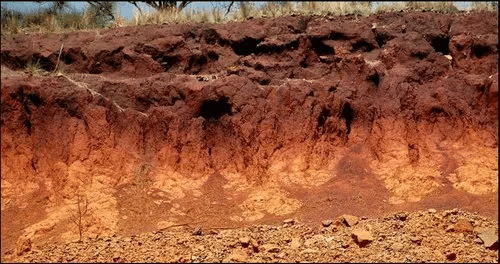
Laterites or Latosols
- Laterite soils may be found mostly in Karnataka, Kerala, Tamil Nadu, Madhya Pradesh, Andhra Pradesh, and hilly portions of Odisha and Assam.
- This soil is especially good for growing tea and coffee if adequate soil conservation practices are used, notably in hilly parts of Karnataka, Kerala, and Tamil Nadu.
Conclusion
The term laterite is derived from the word later, which means brick or tile, and was originally applied to a group of high clay Indian soils found in Kerala, Tamil Nadu, Karnataka, and Maharashtra's Malabar hills. Laterite is often pisolitic (pealike). Exposed surfaces range in colour from blackish-brown to reddish and have a slaggy, scoriaceous, lavalike appearance. It is generally lighter in colour (red, yellow, and brown) where freshly broken, and it is soft when freshly quarried but hardens with exposure.
FAQs
Question: What is laterization in the context of soil formation?
Answer: Laterization is a soil formation process that occurs in tropical and subtropical climates, characterized by high rainfall and warm temperatures. This process leads to the development of laterite soils, which are rich in iron and aluminum oxides due to the leaching of soluble minerals. Laterization results in the formation of a hard and clayey layer of soil, often found in regions with intense weathering and significant chemical reactions.
Question: What are the key characteristics of laterite soil?
Answer: Laterite soil exhibits several distinctive characteristics, including a reddish color due to the high iron content, a coarse texture, and a low nutrient-holding capacity. These soils are typically acidic and can become hard upon drying. Laterite soils also have a high clay content, which can impact water retention and drainage, making them less suitable for certain agricultural practices without appropriate management.
Question: How does laterization affect agricultural practices?
Answer: Laterization can significantly impact agricultural practices by limiting soil fertility and nutrient availability. The high acidity and low organic matter content can restrict the growth of certain crops. Farmers in laterite soil regions often need to amend the soil with organic fertilizers and implement appropriate cropping systems to enhance productivity. Additionally, managing water retention and drainage is crucial for successful agriculture in these soils.
Question: In which regions is laterization most commonly found?
Answer: Laterization is most commonly found in tropical and subtropical regions, particularly in areas with high rainfall and warm temperatures. This includes parts of Africa, Southeast Asia, and some regions of South America. In India, laterite soils are prevalent in the Western Ghats, parts of Odisha, West Bengal, and Assam, where the climatic conditions favor the laterization process.
Question: What is the significance of laterite soils in construction?
Answer: Laterite soils have significant importance in construction, particularly in regions where they are abundant. Due to their hardness when dried, laterite can be quarried and used as building material, especially for low-cost housing and road construction. The unique properties of laterite make it suitable for creating bricks and other construction elements that are both durable and eco-friendly.
MCQs
1. Laterization primarily occurs in which type of climate?
A) Arid
B) Tropical
C) Temperate
D) Polar
Answer: See the Explanation
Explanation: Laterization primarily occurs in tropical climates, characterized by high rainfall and warm temperatures, leading to the development of laterite soils.
2. Which of the following is a characteristic of laterite soil?
A) High nutrient content
B) Reddish color
C) Sandy texture
D) High pH level
Answer: See the Explanation
Explanation: A characteristic of laterite soil is its reddish color due to the high content of iron oxides, not its nutrient content.
3. What impact does laterization have on soil fertility?
A) Increases soil fertility
B) Decreases soil fertility
C) No impact
D) Only affects physical properties
Answer: See the Explanation
Explanation: Laterization generally decreases soil fertility due to leaching of nutrients and the formation of acidic conditions.
4. Where in India is laterite soil commonly found?
A) Northern Plains
B) Western Ghats
C) Thar Desert
D) Himalayan Region
Answer: See the Explanation
Explanation: Laterite soil is commonly found in the Western Ghats of India, where the climatic conditions favor its formation.
5. Laterite soils are primarily used in which of the following?
A) Agriculture only
B) Construction
C) Mining
D) Textile production
Answer: See the Explanation
Explanation: Laterite soils are primarily used in construction, especially for making bricks and low-cost housing materials.
GS Mains Questions and Model Answers
Q1: Discuss the process of laterization and its impact on soil characteristics and fertility.
Answer: Laterization is a process of soil formation that occurs in tropical and subtropical climates, characterized by high rainfall and high temperatures. This process leads to the leaching of soluble minerals, resulting in the accumulation of iron and aluminum oxides. The impact of laterization on soil characteristics includes the development of a hard and clayey layer that is typically reddish in color due to iron content. Fertility is often reduced as essential nutrients are leached away, leading to soil that is acidic and low in organic matter. To improve productivity, agricultural practices in these regions must incorporate organic amendments and proper water management strategies.
Q2: Evaluate the agricultural challenges posed by laterite soils and propose suitable strategies for management.
Answer: Laterite soils present several agricultural challenges, including low nutrient availability, high acidity, and poor water retention capabilities. These factors limit crop growth and require careful management. Strategies to address these challenges include the application of organic fertilizers to enhance soil fertility, crop rotation to maintain soil health, and the use of cover crops to improve organic matter content. Additionally, adopting conservation tillage practices can help maintain soil structure and prevent erosion. Implementing these strategies can improve agricultural productivity in laterite soil regions.
Q3: Analyze the socio-economic significance of laterite soil in construction and its use in local economies.
Answer: Laterite soil holds significant socio-economic importance in construction, especially in regions where it is abundant. Its durability when dried allows for its use in building materials, such as bricks and blocks, which are essential for low-cost housing and infrastructure development. The local economies benefit as laterite can be easily sourced, reducing construction costs and providing employment opportunities in quarrying and manufacturing. Furthermore, the use of locally available materials promotes sustainable building practices and can lead to enhanced economic resilience in rural communities.
Previous Year Questions on Laterization
1. UPSC CSE Prelims 2020:
Question: What type of soil is primarily formed through the process of laterization?
A) Alluvial soil
B) Black soil
C) Laterite soil
D) Loamy soil
Answer: (C)
Explanation: Laterization primarily leads to the formation of laterite soil, characterized by high iron and aluminum content.
2. UPSC CSE Mains 2021 (GS Paper 1):
Question: "Assess the impact of laterization on agricultural practices in tropical regions." Discuss with examples.
Answer: Laterization significantly impacts agricultural practices in tropical regions by altering soil fertility and composition. For instance, in regions with laterite soils, farmers face challenges such as low nutrient availability and acidity, which require amendments to sustain crop productivity. The adaptation strategies include the use of organic fertilizers, intercropping, and employing water conservation techniques to mitigate the negative effects of laterization. These adaptations not only enhance agricultural output but also promote sustainable land management practices.
Download the PREPP App and attempt FREE IAS Exam Mock Tests and get complete study material!

Full Test - 04: UPSC CSE Prelims CSAT (Paper-II)
Full Test - 03: UPSC CSE Prelims CSAT (Paper-II)
UPSC CSE Prelims 2026 GS Paper 1 Question Paper (24-May-2026)
UPSC CSE Prelims 2026 CSAT Paper 2 Question Paper (24-May-2026)

17 February 2025 | The Hindu Must Read Articles | Current Affairs

16 February 2026 | The Hindu Must Read Articles | Current Affairs

13 February 2026 | The Hindu Must Read Articles | Current Affairs









Comments