Soil Texture - Agriculture Notes
Soil texture is the "feel" of soil when manipulated between the thumb and forefinger. It is one of the more useful tests for assessing soil. Some soils are sticky, while others do not stick together at all and feel "doughy" or "spongy." Because of these differences in properties, soils are classified as clays, loams, or sands in agriculture. Clays stick to your boots, loams are easily moulded but not sticky, and sands are not cohesive and cannot be moulded when wet. The coarseness/fineness of the mineral content in the soil is referred to as soil texture. The percentage of sand, silt, and clay particles determines it. This article will explain to you about Soil texture which will be helpful in preparing the Agriculture Syllabus for the UPSC Civil Service exam.
|
Table of Contents |
What is Soil Texture?
- The proportion of sand, silt, and clay sized particles that make up the mineral fraction of the soil is referred to as soil texture.
- For example, light soil is one that is high in sand relative to clay, whereas heavy soils are mostly clay.
- Sand, clay, and silt are the three types of separates. Sand and silt are unimportant to the soil since they contribute nothing to the soil's ability to recover water or nutrients.
- Clay is an active component of soil texture because of its tiny size, high surface area per unit mass, and ability to store ions and water.
- Texture matters because it influences:
- the amount of water that the soil can store;
- the rate at which water moves through the soil;
- how fertile and workable the soil is.
- Sand, for example, is well aerated but does not hold much water and contains few nutrients. Clay soils generally hold more water and provide more nutrients.
- Because texture often changes with depth, roots must deal with a variety of conditions as they penetrate the soil.
- Soil texture has a strong influence on the physical and chemical behaviour of a soil, which varies due to differences in the type and mineral composition of the parent material, the soil's position in the landscape, and the physical and chemical weathering processes involved in soil formation.
- Soil texture influences the movement and availability of air, nutrients, and water in a soil, and it is frequently used to estimate other soil properties, particularly soil water properties, when direct measurements are not available.
Behaviour of Sand, Loam & Clay
Sand
- Sands, due to their larger grain size, allow for greater water permeability than clays.
- Sands have the disadvantage of holding very little water that would otherwise be available to plants and have no ability to hold onto plant nutrients in the same way that clays do.
- Sand does not retain moisture, but as a component of loamy soil, it provides adequate aeration and drainage.
Loam
- Loam soils contain sand, silt, and clay in proportions that balance stickyness and non-adhesiveness, resulting in soils that are mouldable but not sticky.
- Loams are the most "user-friendly" soils.
- Loam has a loose and crumbly structure in addition to successfully supplying nutrients and water.
- This is known as being friable. Loose soil allows for the presence of oxygen in the soil, which is also required for root development.
- Because loam is friable, roots may spread out easily to ingest nutrients and water.
Clay
- Due to their sheet structure and large surface area, clays can absorb and hold large amounts of water. This property causes clay soils to expand and contract as they wet and dry.
- Clays are thus important in the formation of soil cracks through which roots can easily pass.
- Of course, when clays become wet and swollen, drainage is compromised and water cannot flow freely.
- The surfaces and edges of the clay particle sheet structure carry negative and positive charges.
- Potassium, calcium, and magnesium are held on these charged surfaces and can be absorbed into solution by plant roots. As a result, clays play an important role in soil fertility.
- Clay is an excellent material for making bricks but unsuitable for enabling water, air, or plant roots to pass through. However, clay contains more nutrients than the other soil components.
Measuring Soil Texture
Field Method
- The behaviour of a small handful of soil when moistened and kneaded into a ball slightly larger than the size of a golf ball or bolus and pressed out to form a ribbon between the thumb and forefinger is referred to as field texturing.
- The field texture is defined by the behaviour of the soil during bolus formation and the ribbon produced.
- Making a bolus allows you to understand the behaviour, feel, colour, sound, and cohesiveness of the soil when texturing it.
- A sandy loam, for example, will only just stick together (becoming slightly coherent), and there will be noticeable sand grains that can be seen, felt, and heard if you squeeze the bolus close to your ear.
- The bolus must then be formed into a ribbon to determine the clay content of the soil. The higher the clay content, the longer the ribbon.
- The length of the ribbon is measured against a ruler, and the soil's behaviour is compared to the descriptions on the soil texture table.
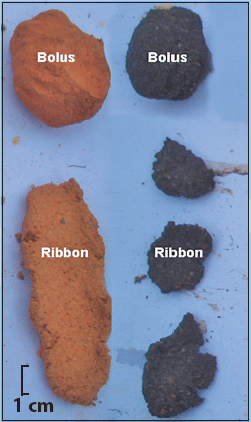
Manipulation of Soil During Field texturing
Laboratory Method
- A laboratory determination of soil texture provides a more detailed and reliable estimate of the proportions of sand, silt, and clay particles in a soil.
- Particle size analysis (PSA) is a common term for measuring soil texture in the laboratory.
- Particle size analysis (PSA) determines a soil's particle size distribution (PSD), and while field texture is closely related to the PSD, the texture classes assigned by field texture and PSA are not always equivalent.
- Sodic soils, for example, have a heavier field texture than the PSA determined in the laboratory.
Classification of Soil Texture
- The United States Department of Agriculture (USDA) defines twelve major soil texture classifications.
- Sand, loamy sand, sandy loam, loam, silt loam, silt, sandy clay loam, clay loam, silty clay loam, sandy clay, silty clay, and clay are the different types.
- The soil texture triangle is then used to determine the soil texture's name.
- This triangle is used to ensure that terms such as "clay" and "loam" always have the same meaning. Each texture represents a different percentage of sand, silt, or clay.
- The primary constituent particle size or a combination of the most abundant particle sizes is typically used to name classifications, such as "sandy clay" or "silty clay."
- A fourth term, loam, is used to describe a soil sample that contains equal amounts of sand, silt, and clay.
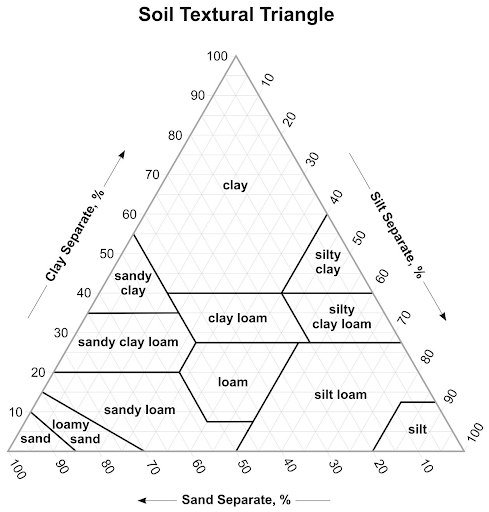
Soil Textural Triangle
| Texture Grade | Behavior of Moist Bolus | Ribbon Length | Clay Content |
|---|---|---|---|
| Sand | Coherence nil to very slight, cannot be moulded; single sand grains adhere to fingers. | Nil | <10% |
| Loamy Sand | Slight coherence. | 5 mm | 5-10% |
| Sandy Loam | Bolus just coherent but very sandy to touch; dominant sand grains are of medium size and are easily visible. | 15-25 mm | 10-20% |
| Loam | Bolus coherent and rather spongy; smooth feel when manipulated, no obvious sandiness or silkiness; may be greasy to the touch if much organic matter is present. | 25 mm | 25% |
| Silt Loam | Coherent bolus; very smooth to silky when manipulated. | 25 mm | 25% |
| Sandy Clay Loam | Strongly coherent bolus, sandy to touch; medium size sand grains visible in finer matrix. | 25-40 mm | >25% |
| Clay Loam | Coherent plastic bolus, smooth to manipulate. | 40-50 mm | 20-30% |
| Silty Clay Loam | Coherent smooth bolus; plastic and often silky to the touch. | 40-50 mm | 30-35% |
| Sandy Clay | Plastic bolus; fine to medium sand grains can be seen, felt or heard in clayey matrix. | 50-75 mm | 35-40% |
| Silty Clay | Plastic bolus, smooth and silky to manipulate. | 50-75 mm | 35-40% |
| Clay | Plastic bolus; smooth to touch; slight resistance to shearing between thumb and forefinger. | 50-75 mm | 35-40% |
Conclusion
Soil texture is a classification tool used both in the field and in the laboratory to define soil types based on physical texture. Soil texture influences water retention, nutrient retention, nutrient fixation, drainage, compressibility, and aeration. Most soils contain varying sizes of mineral particles known as sand, silt, or clay. A soil's sand, silt, clay, and organic matter particles combine to form larger particles. The largest mineral particle is sand. Silt is a type of medium-sized soil particle. Clay is the smallest mineral soil particle size.
FAQs
Question. What is soil texture and why is it important in agriculture?
Answer: Soil texture refers to the proportion of different sized soil particles—sand, silt, and clay—in a soil sample. It plays a crucial role in determining soil's physical properties, such as its water retention, aeration, and nutrient-holding capacity. In agriculture, soil texture directly impacts plant growth, as it influences root penetration, drainage, and the ability of the soil to hold and supply nutrients. For example, sandy soils drain quickly but hold fewer nutrients, while clayey soils retain more water and nutrients but may face issues with drainage.
Question. What are the different types of soil textures?
Answer: Soil texture is classified into several categories based on the relative proportions of sand, silt, and clay:
- Sandy soil: Contains a high proportion of sand particles, drains quickly, but holds fewer nutrients.
- Clay soil: Contains a high proportion of fine clay particles, which hold water and nutrients well but have poor drainage.
- Silty soil: Contains a higher proportion of silt, offering a smooth texture and good moisture retention, but may compact easily.
- Loamy soil: A mixture of sand, silt, and clay in roughly equal proportions. Loamy soil is ideal for most agricultural crops because it offers good drainage, moisture retention, and nutrient-holding capacity.
Question. How does soil texture affect water retention and drainage?
Answer: Soil texture plays a major role in determining how well soil holds and drains water:
- Sandy soils: Drain quickly due to larger particle sizes, but they do not retain moisture well, making them less suitable for crops that require constant moisture.
- Clay soils: Retain water well but can become waterlogged because the fine particles restrict water movement, causing poor drainage.
- Loam soils: Offer a balance between water retention and drainage, making them ideal for most agricultural purposes. They retain enough moisture while still draining excess water effectively.
Question. How does soil texture impact nutrient availability in the soil?
Answer: Soil texture affects the soil's nutrient-holding capacity and its ability to supply nutrients to plants:
- Clayey soils: Have more surface area and can retain more nutrients because their fine particles hold onto cations (positively charged ions) like calcium, magnesium, and potassium. However, they also tend to hold water too long, potentially leading to nutrient leaching and poor aeration.
- Sandy soils: With their larger particles, do not retain nutrients as effectively and may require more frequent fertilization to compensate for the lower nutrient content.
- Loamy soils: Strike a balance, holding enough nutrients while allowing for proper drainage and aeration, making them ideal for growing most crops.
Question. How can farmers improve soil texture for better agricultural productivity?
Answer: Farmers can adopt several practices to improve soil texture and overall soil health:
- Adding Organic Matter: Incorporating compost, manure, or cover crops can help improve soil structure, increasing water retention in sandy soils and improving drainage in clayey soils.
- Using Mulch: Applying organic mulch helps protect the soil surface, reduce water evaporation, and prevent soil erosion, especially in sandy soils.
- Crop Rotation and Cover Crops: These practices help improve soil structure, prevent soil compaction, and enhance nutrient cycling.
- Soil Amendments: Adding soil conditioners such as gypsum (for clay soils) can help break up compacted soil and improve water infiltration.
MCQs
- Which of the following soils has the best balance for agricultural use?
A) Sandy soil
B) Clay soil
C) Silty soil
D) Loamy soil
Answer: (D) See the Explanation
Loamy soil provides a perfect balance between drainage and water retention, making it the most suitable for most agricultural crops.
- Which soil type is characterized by poor water retention but good drainage?
A) Clay soil
B) Sandy soil
C) Silty soil
D) Loamy soil
Answer: (B) See the Explanation
Sandy soil allows for rapid water drainage but does not hold moisture or nutrients well, which can make it difficult for plants that require consistent moisture.
- How does clay soil affect plant growth?
A) It promotes quick root growth
B) It holds water but may cause poor drainage
C) It allows water to drain quickly
D) It has high nutrient-holding capacity but poor aeration
Answer: (B) See the Explanation
Clay soil holds water well but often suffers from poor drainage, leading to waterlogging, which can inhibit root growth and cause plant stress.
- Which soil texture has the highest nutrient-holding capacity?
A) Sandy soil
B) Clay soil
C) Silty soil
D) Loamy soil
Answer: (B) See the Explanation
Clay soils have more surface area and are able to retain a higher amount of nutrients, but they often suffer from poor drainage.
- What is the primary effect of improving soil texture with organic matter?
A) Decreases water retention
B) Increases soil compaction
C) Improves nutrient-holding capacity
D) Reduces soil pH
Answer: (C) See the Explanation
Adding organic matter improves soil texture by increasing its ability to hold nutrients and water, which is beneficial for plant growth.
GS Mains Questions and Model Answers
Q1: Explain how soil texture affects agricultural practices and crop productivity.
Answer: Soil texture plays a critical role in determining the physical properties of soil, such as its ability to retain water, hold nutrients, and allow root penetration. Sandy soils, with their larger particles, drain quickly but cannot retain water or nutrients well, making them less suited for crops that require consistent moisture and nutrient supply. Clay soils, with their fine particles, hold water and nutrients effectively but suffer from poor drainage, leading to waterlogging and root damage. Loamy soils, which are a mixture of sand, silt, and clay, provide an ideal balance for most crops, offering both water retention and good drainage, making them suitable for high agricultural productivity. Understanding soil texture helps farmers adopt the right irrigation techniques, fertilization practices, and crop selection for optimal yields.
Q2: Discuss the impact of soil texture on the sustainability of agricultural practices in India.
Answer: Soil texture is an essential factor in determining the sustainability of agricultural practices in India. India’s agricultural productivity is highly dependent on the soil’s water retention capacity, nutrient availability, and root penetration ability, all of which are influenced by the soil's texture. Sandy soils in regions like Rajasthan are prone to rapid water drainage, requiring more frequent irrigation and fertilizers, which increases costs and water consumption. Conversely, clay soils in areas like the Gangetic plains may suffer from waterlogging, leading to crop stress and reduced yields. Understanding the diverse soil textures across India enables farmers to implement sustainable agricultural practices such as rainwater harvesting, drip irrigation, and crop rotation that improve soil health, conserve water, and reduce the dependency on chemical fertilizers.
Q3: What measures can be adopted to improve soil texture for better agricultural productivity in areas with degraded soils?
Answer: To improve soil texture in areas with degraded soils, several measures can be adopted:
- Adding Organic Matter: Incorporating compost, manure, or cover crops can improve the structure of both sandy and clayey soils by increasing organic content, which improves water retention and nutrient-holding capacity.
- Reducing Tillage: Excessive tillage breaks down soil aggregates, leading to compaction and reduced water infiltration. Conservation tillage helps preserve soil structure.
- Use of Soil Amendments: Adding amendments like gypsum can help break up compacted clay soils, improving drainage, while adding organic mulches can improve sandy soils’ water-holding capacity.
- Crop Rotation: Growing different crops can help restore soil structure by introducing diverse root systems and reducing soil erosion. By adopting these measures, farmers can restore the fertility and structure of degraded soils, leading to improved agricultural productivity and sustainability.
Previous Year Questions on Soil Texture
1. UPSC 2021
Question: Discuss the relationship between soil texture and agricultural practices, and suggest ways to optimize soil management.
Answer: This question required candidates to examine how soil texture affects farming practices, such as irrigation, fertilization, and crop selection, and to suggest ways to optimize soil management based on different soil textures to improve agricultural productivity.
2. UPSC 2019
Question: Analyze the impact of soil texture on irrigation practices in India.
Answer: The question required candidates to explore how soil texture influences irrigation practices in India, particularly in regions with varying soil types, and how farmers can adapt their irrigation techniques to improve water use efficiency.
Download the PREPP App and attempt FREE IAS Exam Mock Tests and get complete study material!

Full Test - 04: UPSC CSE Prelims CSAT (Paper-II)
Full Test - 03: UPSC CSE Prelims CSAT (Paper-II)
UPSC CSE Prelims 2026 CSAT Paper 2 Question Paper (24-May-2026)
UPSC CSE Prelims 2026 GS Paper 1 Question Paper (24-May-2026)

17 February 2025 | The Hindu Must Read Articles | Current Affairs

16 February 2026 | The Hindu Must Read Articles | Current Affairs

13 February 2026 | The Hindu Must Read Articles | Current Affairs









Comments