Artificial Intelligence (AI): Everything you need to know – Science & Technology Notes
Artificial intelligence is a technique for teaching a computer, a computer-controlled robot, or software to think intelligently in the same way that humans do. AI is achieved by studying human brain patterns and analysing the cognitive process. These studies result in the development of intelligent software and systems. In this article, we will discuss in detail regarding Artificial Intelligence (AI) which will be helpful for UPSC exam preparation.
| To Read update on this topic: |
Table of Contents
- Artificial Intelligence (AI) – Background
- Artificial Intelligence (AI)
- Components of Artificial Intelligence (AI)
- Categories of Artificial Intelligence (AI)
- Types of Artificial Intelligence (AI)
- How Does Artificial Intelligence Work?
- Applications of Artificial Intelligence (AI)
- Examples of Artificial Intelligence (AI)
- Advantages of Artificial Intelligence (AI)
- Disadvantages of Artificial Intelligence (AI)
- Ethical Use of Artificial Intelligence
- India and Artificial Intelligence
- Government Initiatives in AI
- Challenges of AI in India
- Conclusion
- FAQs
- MCQs
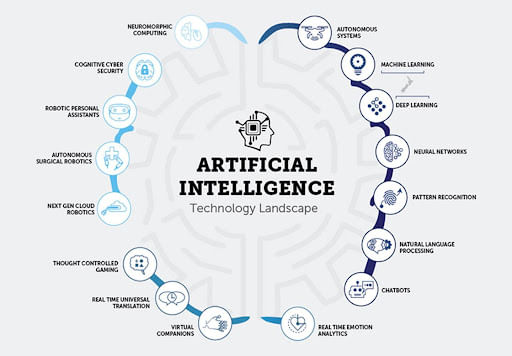
Artificial Intelligence
Artificial Intelligence (AI) – Background
- For centuries, many mathematicians and philosophers shaped the concept of artificially intelligent machines through a variety of concepts.
- However, the field rose to prominence when Alan Turing, an English mathematician, published Computing Machinery and Intelligence in 1950 with a simple proposition: can machines think?
- At the Dartmouth Summer Research Project on Artificial Intelligence, which McCarthy co-hosted with Marvin Minsky, John McCarthy coined the term "artificial intelligence" in 1956.
- Although the conference fell short of McCarthy's expectations, the concept was carried on, and AI research and development has progressed at an incredible rate since then.
What is Artificial Intelligence (AI)?
- Artificial intelligence, or AI, is a catch-all term for a variety of techniques that enable machines to mimic human intelligence.
- When humans think, they sense what is going on around them, understand what those inputs mean, make a decision based on them, and then act.
- Artificially intelligent devices are just starting to replicate these same behaviours.
- AI employs techniques such as machine learning and deep learning to learn from data and improve on a regular basis.
- AI is more than just a subfield of computer science. It instead draws on statistics, mathematics, information engineering, neuroscience, cybernetics, psychology, linguistics, philosophy, economics, and many other disciplines.
- Artificial intelligence (AI) is significant because it may provide organisations with previously unknown insights about their operations and because, in some situations, AI can execute tasks better than humans.
Components of Artificial Intelligence (AI)
Machine Learning
- It automates the creation of analytical models. It employs methods from neural networks, statistics, operations research, and physics to uncover hidden insights in data without being explicitly programmed as to where to look or what conclusions to draw.
Neural Network
- It is a type of machine learning composed of interconnected units (similar to neurons) that process information by responding to external inputs and relaying information between each unit.
- Multiple passes through the data are required to find connections and derive meaning from undefined data.
Deep Learning
- It employs massive neural networks with many layers of processing units to learn complex patterns in large amounts of data, taking advantage of advances in computing power and improved training techniques. Image and speech recognition are two common applications.
Computer Vision
- To recognise what's in a picture or video, computer vision uses pattern recognition and deep learning.
- When machines can process, analyse, and comprehend images, they can capture and interpret images or videos in real time.
Natural Language Processing (NLP)
- It refers to computers' ability to analyse, comprehend, and generate human language, including speech.
- Natural language interaction is the next stage of NLP, which allows humans to communicate with computers to perform tasks using normal, everyday language.
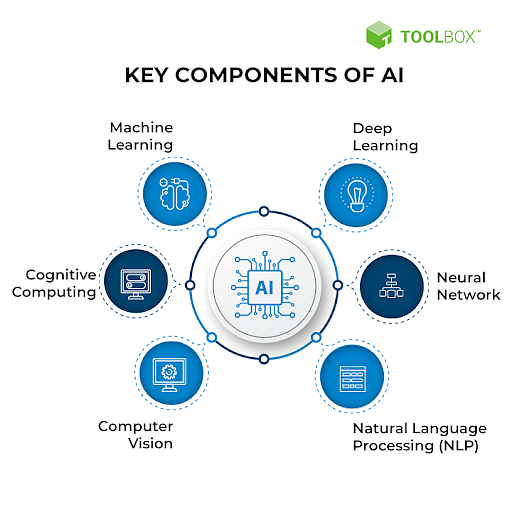
Components of AI
Categories of Artificial Intelligence (AI)
Based on its ability to mimic human intelligence, artificial intelligence can be divided into three categories. They can be divided into three categories: weak, strong, and super.
Weak AI (Narrow AI)
- It refers to AI systems that are designed to perform specific tasks and are only capable of performing those tasks.
- These AI systems are excellent at their assigned tasks but lack general intelligence.
- Voice assistants like Siri or Alexa, recommendation algorithms, and image recognition systems are all examples of poor AI.
- Weak AI works within predefined boundaries and is unable to generalise beyond its specialised domain.
Strong AI (General AI)
- Strong AI, also known as general AI, refers to AI systems that have human-level intelligence or even outperform humans in a variety of tasks.
- Strong AI would be capable of comprehending, reasoning, learning, and applying knowledge to solve complex problems in the same way that humans do.
- However, the development of strong AI remains largely theoretical and has yet to be realised.
Super AI (Artificial Super Intelligence)
- ASI, or artificial super intelligence, is a hypothetical AI. It is also known as super AI, and we can only think of ASI after we have achieved AGI.
- Super AI refers to machines that outperform human intelligence and cognitive abilities.
- Once we unlock ASI, machines will have enhanced predictive capabilities and will be able to think in ways that humans simply cannot comprehend.
- Machines powered by ASI will outperform us in every way. In the face of a super AI, our decision-making and problem-solving abilities will appear inadequate.
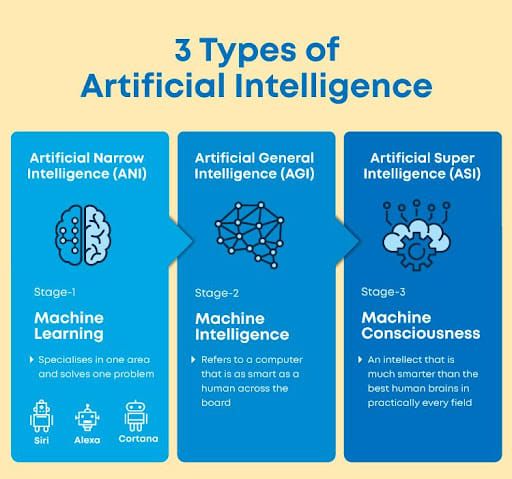
Categories of AI
Types of Artificial Intelligence (AI)
1) Reactive Machines
- These AI systems have no memory and are only used for specific tasks.
- Deep Blue, the IBM chess programme that defeated Garry Kasparov in the 1990s, is one example.
- Deep Blue can identify pieces on a chessboard and make predictions, but it cannot use past experiences to inform future ones because it lacks memory.
2) Limited Memory
- Because these AI systems have memories, they can use past experiences to make better decisions in the future.
- This is how some of the decision-making functions in self-driving cars are designed.
3) Theory of Mind
- Theory of mind is a psychological concept. When applied to AI, it means that the system has the social intelligence to comprehend emotions.
- This type of AI will be able to predict human behaviour and infer human intentions, which is a necessary skill for AI systems to become integral members of human teams.
4) Self-awareness
- AI systems in this category have a sense of self, which gives them consciousness.
- Machines with self-awareness are aware of their current state. This type of artificial intelligence does not yet exist.
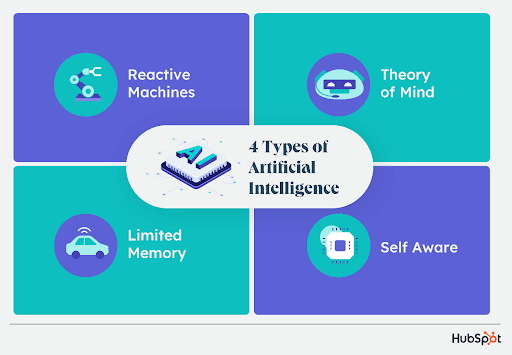
Types of AI
How Does Artificial Intelligence Work?
- In general, AI systems operate by ingesting large amounts of labelled training data, analysing the data for correlations and patterns, and then applying these patterns to predict future states.
- By reviewing millions of examples, a chatbot fed text examples can learn to generate lifelike exchanges with people, or an image recognition tool can learn to identify and describe objects in images.
- New generative AI techniques that are rapidly improving can generate realistic text, images, music, and other media.
- Artificial intelligence programming focuses on cognitive abilities such as the following:
- Learning - This aspect of AI programming is concerned with gathering data and developing rules for turning it into actionable information. The rules, known as algorithms, instruct computing devices on how to complete a specific task in a step-by-step manner.
- Reasoning - This aspect of AI programming focuses on selecting the best algorithm to achieve a desired result.
- Self-correction - This aspect of AI programming is intended to constantly fine-tune algorithms in order to provide the most accurate results possible.
- Creativity - This branch of artificial intelligence employs neural networks, rules-based systems, statistical methods, and other AI techniques to generate new images, text, music, and ideas.
Applications of Artificial Intelligence (AI)
AI in Healthcare
- Disease diagnosis, medical imaging analysis, drug discovery, personalised medicine, and patient monitoring are all examples of AI applications in healthcare.
- AI can help detect patterns in medical data and provide insights for improved diagnosis and treatment.
- IBM Watson is a well-known healthcare technology. It understands natural language and can respond to inquiries. The system mines patient data as well as other available data sources to generate a hypothesis, which it then presents with a confidence scoring schema.
- Other AI applications include the use of online virtual health assistants and chatbots to assist patients and healthcare customers in locating medical information, scheduling appointments, understanding the billing process, and completing other administrative tasks.
AI in Business
- Machine learning algorithms are being integrated into analytics and customer relationship management (CRM) platforms to learn how to better serve customers.
- Chatbots have been integrated into websites to provide customers with immediate service.
- The rapid advancement of generative AI technology, such as ChatGPT, is expected to have far-reaching consequences, such as job loss, product redesign revolution, and business model disruption.
AI in Education
- Grading can be automated with AI, giving educators more time for other tasks.
- It is capable of assessing students and adapting to their needs, allowing them to work at their own pace.
- AI tutors can help students stay on track by providing extra assistance.
- As demonstrated by ChatGPT, Bard, and other large language models, generative AI can assist educators in creating course work and other teaching materials, as well as engaging students in novel ways.
AI in Finance
- In the finance industry, AI is widely used for fraud detection, algorithmic trading, credit scoring, and risk assessment.
- Machine learning models are capable of analysing massive amounts of financial data in order to identify patterns and make predictions.
AI in Law
- In law, the discovery process (sifting through documents) can be overwhelming for humans.
- Using AI to help automate labor-intensive processes in the legal industry saves time and improves client service.
- Machine learning is used by law firms to describe data and predict outcomes, computer vision is used to classify and extract information from documents, and natural language processing (NLP) is used to interpret information requests.
AI in Entertainment and Media
- The entertainment industry employs AI techniques for targeted advertising, content recommendation, distribution, fraud detection, script creation, and film production.
- Automated journalism assists newsrooms in streamlining media workflows, thereby saving time, money, and complexity.
- AI is used in newsrooms to automate routine tasks such as data entry and proofreading, as well as to research topics and assist with headlines.
AI in Software and IT
- New generative AI tools can be used to generate application code based on natural language prompts, but these tools are still in their early stages and are unlikely to replace software engineers anytime soon.
- Many IT processes, including data entry, fraud detection, customer service, and predictive maintenance and security, are also being automated with AI.
AI in Security
- AI techniques are being successfully applied to a variety of aspects of cybersecurity, including anomaly detection, false-positive detection, and behavioural threat analytics.
- Machine learning is used by organisations in security information and event management (SIEM) software and related areas to detect anomalies and suspicious activities that indicate threats.
- AI can detect new and emerging attacks much faster than human employees or previous technology iterations by analysing data and applying logic to identify similarities to known malicious code.
AI in Manufacturing
- Manufacturing has been a pioneer in integrating robots into the workflow.
- For example, industrial robots that were once programmed to perform single tasks while being separated from human workers are increasingly being used as cobots: smaller, multitasking robots that collaborate with humans and take on more responsibilities in warehouses, factory floors, and other workspaces.
AI in Banking
- Banks are successfully using chatbots to inform customers about services and offerings, as well as to handle transactions that do not require human intervention.
- AI virtual assistants are used to improve and reduce the costs of banking regulatory compliance.
- AI is used by banking organisations to improve loan decision-making, set credit limits, and identify investment opportunities.
AI in Transportation
- Aside from playing a critical role in autonomous vehicle operation, AI technologies are used in transportation to manage traffic, predict flight delays, and make ocean shipping safer and more efficient.
- AI is replacing traditional methods of forecasting demand and predicting disruptions in supply chains, a trend accelerated by COVID-19, when many companies were caught off guard by the effects of a global pandemic on goods supply and demand.
AI in Retail
- AI enables virtual shopping by making personalised recommendations and discussing purchase options with the consumer.
- AI will also improve stock management and site layout technologies.
AI in Agriculture
- AI is also playing an important role in propelling the food revolution
- AI addresses a variety of issues, including excessive pesticide use, insufficient demand prediction, and a lack of guaranteed irrigation.
- AI has the potential to improve crop production, detect pest attacks, forecast crop prices, and provide real-time advice.
Examples of Artificial Intelligence (AI)
| ChatGPT |
|
| Google Maps |
|
| Smart Assistants |
|
| Snapchat Filters |
|
| Self-Driving Cars |
|
| Wearables |
|
Advantages of Artificial Intelligence (AI)
- Enhanced Accuracy: AI algorithms can analyse massive amounts of data with pinpoint accuracy, reducing errors and improving accuracy in a variety of applications such as diagnostics, predictions, and decision-making.
- Improved Decision-Making: AI provides data-driven insights and analysis, assisting in informed decision-making by identifying patterns, trends, and potential risks that humans may not recognise.
- Innovation and Discovery: AI promotes innovation by enabling new discoveries, uncovering hidden insights, and pushing the boundaries of what is possible in a variety of fields such as healthcare, science, and technology.
- Increased Productivity: AI tools and systems have the potential to augment human capabilities, resulting in increased productivity and output across a wide range of industries and sectors.
- Continuous Learning and Adaptability: AI systems can learn from new data and experiences, improving performance, adapting to changes, and keeping up with evolving trends and patterns.
- Exploration and Space Research: Artificial intelligence (AI) plays an important role in space exploration, enabling autonomous spacecraft, robotic exploration, and data analysis in remote and hazardous environments.
Disadvantages of Artificial Intelligence (AI)
- Job Displacement: Because machines and algorithms can perform tasks previously performed by humans, AI automation may result in the displacement of certain jobs. This can lead to unemployment and the need for workforce reskilling or retraining.
- Ethical Concerns: The potential for bias in algorithms, invasion of privacy, and the ethical implications of autonomous decision-making systems are all ethical concerns raised by AI.
- Availability and Quality of Data: AI systems rely heavily on data availability and quality. Data that is biased or incomplete can produce inaccurate results or reinforce existing biases in decision-making.
- Risks to Security: AI systems are vulnerable to cyber-attacks and exploitation. Malicious actors can manipulate AI algorithms or use AI-powered tools for malicious ends, posing security risks.
- Overreliance: Relying on AI blindly without proper human oversight or critical evaluation can result in errors or incorrect decisions, especially when the AI system encounters unfamiliar or unexpected situations.
- Lack of Transparency: Some AI models, such as deep learning neural networks, can be difficult to interpret, making understanding the reasoning behind their decisions or predictions difficult (known as the "black box" problem).
- Initial investment and ongoing costs: AI system implementation frequently necessitates significant upfront investment in infrastructure, data collection, and model development. Furthermore, maintaining and updating AI systems can be expensive.
Ethical Use of Artificial Intelligence
- While AI tools provide a variety of new capabilities for businesses, their use raises ethical concerns because, for better or worse, an AI system will reinforce what it has already learned.
- This can be a problem because machine learning algorithms, which are at the heart of many of the most advanced AI tools, are only as smart as the data they are fed during training.
- Because the data used to train an AI programme is chosen by a human, the possibility of machine learning bias exists and must be closely monitored.
- Anyone interested in using machine learning in real-world, in-production systems must incorporate ethics into their AI training processes and strive to avoid bias.
- This is especially true when using deep learning and generative adversarial network (GAN) AI algorithms, which are inherently unexplainable.
- In summary, AI's ethical challenges include the following:
- bias caused by improperly trained algorithms and human bias;
- misuse caused by deepfakes and phishing;
- legal concerns, including AI libel and copyright issues;
- job loss; and
- data privacy concerns, particularly in the banking, healthcare, and legal sectors.
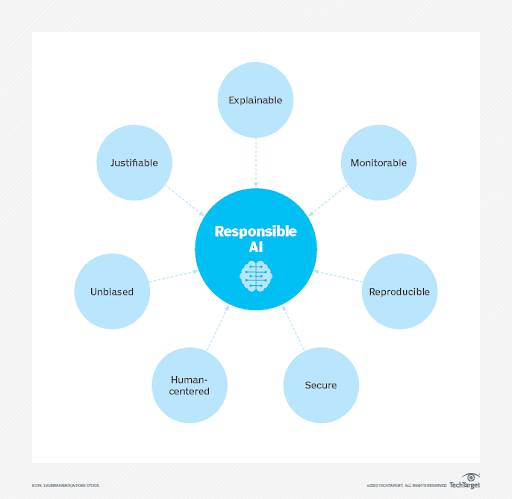
Ethical Use of AI
India and Artificial Intelligence
- According to industry analysts, the Artificial Intelligence market in India could be worth $957 billion by 2035.
- Many programmes and initiatives have already been launched by the government and private organisations in India to strengthen the AI sector, which will contribute to the country's economic and social progress.
- In May 2020, the Indian government launched the National AI Portal of India, a one-stop digital platform for AI-related developments in the country. This portal serves as a knowledge-sharing tool and a platform for learning about AI jobs.
- In addition, the government launched the Responsible AI for Youth Programme. The goal of this programme is to provide a platform for young students to improve their mew-age tech mindsets and AI skill sets and make them future ready.
- India's participation in the GPAI-Global Partnership on Artificial Intelligence- was one of the most significant steps towards the AI revolution in India. India joined the Global Partnership on Artificial Intelligence in June 2020. GPAI is an international multi-stakeholder initiative.
- AI for All- India's Artificial Intelligence Strategy aims to develop AI solutions with the goal of making India the world's AI Garage.
- It emphasises development through the use of Artificial Intelligence technologies and establishes India as a trustworthy nation on which the rest of the world can rely for AI-related work.
- From 2020 onwards, the Central Board of Secondary Education included Artificial Intelligence in the curriculum.
- IIT Hyderabad is the first Indian educational institution to offer a full-fledged Bachelor of Technology (B Tech) programme in artificial intelligence.
- The National Artificial Intelligence Policy for India, prepared by NITI Aayog, outlines the best course of action for utilising AI's capability in a variety of industries.
- Artificial intelligence methods and initiatives that use such dynamic data assist India in meeting societal requirements in sectors such as healthcare, education, agriculture, smart cities, and infrastructure, including smart mobility and transportation.
Government Initiatives in AI
| AIRAWAT |
|
| AskDISHA |
|
| Amazon Web Services (AWS) |
|
| CORE |
|
| ICTAI |
|
Challenges of AI in India
- Low Adoption and High Resource Costs: Due to high resource costs and a lack of awareness about the potential benefits of AI, many businesses in India have been slow to adopt it.
- Absence of Enabling Data Ecosystems: The availability and quality of data are critical in AI development, and India is struggling to build robust data ecosystems that can support AI applications.
- Low Research Intensity: To foster innovation, knowledge creation, and technological advancements in the field, India's research efforts in AI must be strengthened.
- Unfavourable Intellectual Property Regime: India's current intellectual property regime may not adequately encourage AI research and adoption, stifling innovation and investment.
- Skill Development Gap: India suffers from a shortage of skilled AI professionals, limiting the country's ability to fully leverage AI technologies and impeding overall growth in the field.
- Uncertain Regulations: Clear regulations governing AI security, privacy, and ethics are critical for fostering public trust and ensuring responsible AI deployment, but more clarity is required.
Conclusion
AI has the ability to outperform human intelligence and perform any task much more accurately and efficiently. There is also no doubt that AI has enormous potential, which contributes to making the world a better place to live. However, anything in excess is bad, and nothing can compete with the human brain. As a result, AI should not be used excessively, as too much automation and reliance on machines can create a very dangerous environment for current humankind and future generations.
| Other Relevant Links | |
|---|---|
| Science & Technology Policy in India | Scientific Policy Resolution 1958 |
| Science & Technology Policy of 1983 | Science & Technology Policy of 2003 |
| Science, Technology and Innovation Policy 2013 | New Initiatives Aligned with the National Agenda |
| India and World collaboration in science projects | National Intellectual Property Rights Policy |
FAQs
Question. What is Artificial Intelligence (AI)?
Answer: AI refers to the simulation of human intelligence in machines designed to think, learn, and make decisions like humans. It includes techniques such as machine learning and deep learning, which allow systems to learn from data.
Question. What are the types of AI?
Answer: AI can be categorized into three types:
- Weak AI (Narrow AI): Designed for specific tasks, like voice assistants or recommendation systems.
- Strong AI (General AI): AI that can perform any intellectual task that humans can do.
- Super AI (Artificial Super Intelligence): A hypothetical AI that surpasses human intelligence.
Question. What are the key components of AI?
Answer: Key components include Machine Learning, Neural Networks, Deep Learning, Computer Vision, and Natural Language Processing (NLP), each contributing to how AI systems learn, interpret, and act on data.
Question. How does AI work?
Answer: AI systems work by analyzing large sets of data to recognize patterns, learn from the data, and make decisions based on those patterns, often using techniques like deep learning and machine learning.
Question. What are the applications of AI?
Answer: AI is used in various fields such as healthcare (diagnostics), finance (fraud detection), automotive (self-driving cars), and entertainment (recommendation algorithms).
MCQs
- Which of the following is an example of Weak AI?
A) Siri
B) Self-driving cars
C) General AI
D) Super AI
Answer: (A) See the Explanation
Siri is an example of Weak AI, designed for specific tasks like voice recognition and assistance.
- What is the primary function of Machine Learning in AI?
A) Enhancing visual capabilities
B) Teaching machines to think like humans
C) Analyzing and making decisions based on data
D) Mimicking human emotions
Answer: (C) See the Explanation
Machine learning is used in AI to allow systems to analyze data and make decisions based on it.
- What does NLP in AI stand for?
A) Neural Language Programming
B) Natural Language Processing
C) Non-Linear Programming
D) Neural Learning Process
Answer: (B) See the Explanation
NLP refers to the ability of machines to understand and generate human language.
- Which category of AI has the potential to surpass human intelligence?
A) Weak AI
B) Super AI
C) Reactive Machines
D) Limited Memory
Answer: (B) See the Explanation
Super AI refers to AI that would surpass human intelligence.
- What is the main characteristic of Reactive Machines in AI?
A) They have memory to learn from past experiences.
B) They can predict human behavior.
C) They perform specific tasks without memory.
D) They have self-awareness.
Answer: (C) See the Explanation
Reactive Machines like IBM’s Deep Blue can perform specific tasks but cannot use past experiences for future decision-making.
GS Mains Questions and Model Answers
Q1. Discuss the significance of Artificial Intelligence (AI) in shaping future technological advancements.
Answer: AI plays a critical role in advancing various technologies by enabling machines to learn from data and make decisions without human intervention. AI is expected to revolutionize industries such as healthcare, finance, transportation, and education by enhancing efficiency, automating tasks, and providing insights that were previously unattainable. With developments in machine learning, computer vision, and natural language processing, AI has the potential to address complex problems like disease diagnosis, autonomous driving, and personalized learning. The future of AI holds immense promise for improving productivity, solving global challenges, and driving innovation.
Q2. Explain the ethical concerns surrounding the development and use of Artificial Intelligence.
Answer: The development of AI raises several ethical concerns, including the potential for job displacement due to automation, data privacy issues, and the creation of biased algorithms that may perpetuate discrimination. Another concern is the risk of creating autonomous systems that could act unpredictably or be used for malicious purposes, such as warfare or surveillance. Ensuring transparency, accountability, and fairness in AI systems is crucial to address these issues. Ethical frameworks and regulations must be developed to ensure that AI technologies are used responsibly and benefit society as a whole.
Q3. Analyze the potential impact of AI on global economies, particularly in developing countries.
Answer: AI has the potential to boost global economies by improving productivity, reducing costs, and enabling innovation in various sectors. In developing countries, AI could be transformative by providing solutions in areas such as agriculture, healthcare, and education. For example, AI-powered tools can help improve crop yields, diagnose diseases more accurately, and enhance learning experiences. However, the widespread adoption of AI also presents challenges, such as the risk of widening the digital divide, as access to AI technologies may be limited in low-income regions. To mitigate these challenges, policies focused on digital literacy, infrastructure development, and equitable access to AI should be prioritized.
Previous Year Questions on Artificial Intelligence (AI)
1. UPSC CSE 2023
Question: "What are the potential ethical challenges in the widespread adoption of Artificial Intelligence (AI)?"
Answer: Ethical challenges in AI adoption include concerns about privacy, job displacement, algorithmic bias, and the lack of accountability in autonomous systems. These issues must be addressed by establishing ethical guidelines, promoting transparency, and ensuring AI systems are developed with fairness and equity in mind.
2. UPSC CSE 2022
Question: "Evaluate the impact of Artificial Intelligence (AI) on global competitiveness and economic growth."
Answer: AI significantly impacts global competitiveness by driving technological innovation, automating production processes, and creating new business models. Countries that lead in AI research and development are poised to gain a competitive edge in global markets, contributing to economic growth. However, there is a risk of widening the gap between developed and developing economies, as AI adoption may be skewed towards regions with advanced technological infrastructure.
Download the PREPP App and attempt FREE IAS Exam Mock Tests and get complete study material!
UPSC IAS : CSAT - Mini Live Test

Live Test : UPSC CSE Prelims CSAT (Paper-II) (Oct 20 - 23)
Full Test - 04: UPSC CSE Prelims CSAT (Paper-II)
Full Test - 03: UPSC CSE Prelims CSAT (Paper-II)
UPSC CSE Prelims 2026 GS Paper 1 Question Paper (24-May-2026)
UPSC CSE Prelims 2026 CSAT Paper 2 Question Paper (24-May-2026)

17 February 2025 | The Hindu Must Read Articles | Current Affairs

16 February 2026 | The Hindu Must Read Articles | Current Affairs

13 February 2026 | The Hindu Must Read Articles | Current Affairs









Comments