Science & Technology Policy of 1983 – S&T Policy in India – Science & Technology Notes
The Science & Technology Policy of 1983, also known as Technology Policy Statement (TPS) was established in 1983 with the goal of achieving technological competence and self-reliance through the promotion and development of indigenous technologies. It led to the creation of the Technology Development Fund and the Technology, Information Forecasting, and Assessment Council (TIFAC). For achieving technological competence, these S&T policies relied on mass education and the cultivation of science and scientific research in HEIs. In this article, we will discuss regarding the features of the Science & Technology Policy of 1983 which will be helpful for UPSC exam preparation.
Table of Contents
Science & Technology Policy of 1983 - Background
- Following the passage of SPR in 1958, India spent the next three decades expanding its scientific enterprise.
- India had advanced scientific and technological infrastructure in space, industrial research, nuclear energy, defence research, biotechnology, agriculture, and health by 1980.
- By the early 1980s, India had established a solid industrial and agricultural foundation, as well as a large pool of trained human resources.
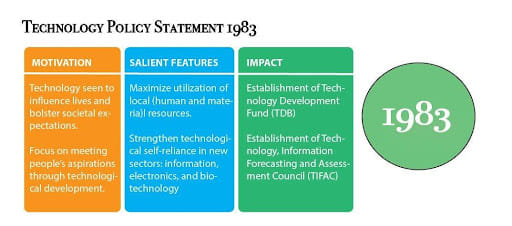
- TPS 1983, the next major policy document, focused primarily on meeting people's aspirations through technological development, as technology was increasingly seen to influence lives and boost societal expectations.
Science & Technology Policy of 1983 – Salient Features
- The primary goal of TPS 1983 was to promote and develop indigenous technologies in order to achieve technological self-sufficiency.
- Adoption of indigenous technology would reduce vulnerabilities in critical areas while also helping to maximise the use of local (human and material) resources.
- TPS 1983 recognized that efficient adoption of imported technologies should occur, but not at the expense of national interest.
- Obsolete technologies had to be identified and replaced with technologies that improve product productivity, efficiency, quality, and reliability while using the least amount of capital and energy.
- The overarching goal was to use technology to benefit all segments of society, with a particular emphasis on the poor and underprivileged.
- Finally, TPS 1983 emphasized the importance of strengthening the technology base, particularly in new sectors such as information, electronics, and biotechnology, by increasing R&D investments and collaboration among governmental organisations, educational institutions, and industries.
- To carry out the mandate of TPS 1983, a committee was formed to draft detailed guidelines for ministries and industries.
- The Technology Development Fund (TDB) was established to provide financial assistance to Indian industries in order to boost indigenous technology development.
- TPS 1983 emphasized the importance of continuous and systematic forecasting of how useful emerging and current technologies will be in the future (technology forecasting), as well as assessment studies, particularly in ministries with large investments and/or production value.
- In light of this, the Technology Information Forecasting and Assessment Council was established.
Conclusion
The 1983 policy was the second policy, and it was primarily concerned with achieving technological competence and self-reliance. However, economic liberalisation after 1991 paved the way for significant foreign investment in a variety of sectors. Thus, technological self-reliance and the adoption of indigenous technologies ran counter to economic policies in several socioeconomic sectors that relied heavily on foreign investment.
FAQs
Question: What was the main aim of the Science and Technology Policy of 1983 in India?
Answer: The 1983 Science and Technology Policy aimed to promote indigenous technological development and reduce dependence on foreign technologies, ensuring sustainable economic growth and self-reliance in critical sectors.
Question: How did the 1983 Science and Technology Policy address India’s need for self-reliance?
Answer: The policy emphasized building indigenous capabilities in core scientific and technological fields, especially in defense, space, and energy, to reduce dependence on foreign technology and foster self-reliance.
Question: How did the 1983 policy influence India’s research and development (R&D) sector?
Answer: The policy led to increased investment in R&D, aimed at improving the quality of Indian research, facilitating collaboration between government institutions, and supporting the development of key industries like telecommunications and information technology.
Question: What role did the private sector play in India’s Science and Technology Policy of 1983?
Answer: The 1983 policy recognized the private sector’s potential in contributing to technological advancements, encouraging partnerships between government agencies and private industries to boost innovation and technological capabilities.
Question: How did the 1983 Science and Technology Policy contribute to India’s defense sector?
Answer: The policy promoted the development of indigenous defense technologies, with a focus on areas such as space exploration, nuclear energy, and electronics, strengthening national security and reducing reliance on foreign imports.
MCQs
1. What was the primary goal of India’s Science and Technology Policy of 1983?
A) To encourage foreign investment in Indian technology
B) To promote indigenous technological development and self-reliance
C) To focus solely on space exploration
D) To develop global partnerships for technology transfer
Answer: (B) See the Explanation
Explanation: The primary aim of the 1983 Science and Technology Policy was to foster indigenous technological development and self-reliance, with a focus on key sectors like defense, space, and energy.
2. Which sector was given particular emphasis in the 1983 Science and Technology Policy of India?
A) Agriculture
B) Defense and Space
C) Biotechnology
D) Renewable Energy
Answer: (B) See the Explanation
Explanation: The policy focused heavily on strengthening India’s defense and space capabilities, encouraging indigenous research and development to support national security and technological sovereignty.
3. How did the 1983 Science and Technology Policy address the issue of technological dependence?
A) By inviting more foreign technology into India
B) By promoting indigenous research and development
C) By relying solely on defense technologies
D) By limiting the role of the private sector in technology
Answer: (B) See the Explanation
Explanation: The policy aimed to reduce India’s dependence on foreign technology by promoting indigenous technological research and encouraging self-reliance in critical sectors like defense, telecommunications, and space.
4. What was the major shift in India’s science and technology strategy with the 1983 policy?
A) A shift towards purely academic research
B) A focus on increasing foreign collaborations
C) A focus on self-reliance and reducing dependence on foreign technologies
D) A complete disengagement from international technological advancements
Answer: (C) See the Explanation
Explanation: The 1983 policy marked a shift towards greater self-reliance in science and technology. It emphasized reducing India’s dependence on foreign technology and instead focused on fostering domestic innovation.
5. Which of the following was a key feature of the 1983 Science and Technology Policy?
A) Heavy restrictions on private sector participation
B) Focusing on reducing government expenditure on research
C) Encouraging private sector involvement in technological development
D) Promoting technology imports from foreign countries
Answer: (C) See the Explanation
Explanation: The 1983 policy recognized the role of the private sector in technological innovation, encouraging collaboration between the government and private industries to boost India’s technological capabilities.
GS Mains Questions and Model Answers
Q1: Discuss the impact of the 1983 Science and Technology Policy on India's technological growth. How did it address the challenges of technological dependence?
Answer: The 1983 Science and Technology Policy aimed to reduce India’s technological dependence by fostering self-reliance in key sectors like defense, space, and energy. It focused on enhancing domestic research and development, which was critical for technological growth. The policy led to the establishment of several institutions to support innovation and infrastructure development, which contributed to significant advances in nuclear energy, space exploration, and defense technologies. It also promoted private sector involvement, facilitating industrial growth and fostering new technologies. Over the years, these steps have paved the way for India to become more competitive globally in technology and innovation.
Q2: How did the 1983 Science and Technology Policy contribute to India’s defense sector? Discuss its long-term implications.
Answer: The 1983 Science and Technology Policy significantly impacted India’s defense sector by encouraging the development of indigenous defense technologies. The policy focused on self-reliance in defense systems, leading to advancements in areas such as missile technology, radar systems, and nuclear defense capabilities. This shift towards indigenous defense technology not only enhanced national security but also reduced dependence on foreign defense imports. Over the long term, it enabled India to strengthen its defense infrastructure, promote military industrialization, and reduce vulnerability to international supply chain disruptions. This policy laid the foundation for India's strategic autonomy in defense matters.
Q3: Critically evaluate the role of the private sector in the 1983 Science and Technology Policy. How has it evolved since then?
Answer: The 1983 Science and Technology Policy acknowledged the importance of the private sector in driving innovation and technological advancement. It encouraged collaboration between the government and private enterprises, allowing the private sector to participate in key areas like industrial research, software development, and technology commercialization. Over time, this collaboration has evolved, especially with the rise of the IT and biotechnology industries, where private enterprises have become leaders in technological development. The policy’s initial emphasis on self-reliance in key sectors like defense and space has given way to a more global approach, where India is now a leader in global software services and has a burgeoning startup ecosystem in fields like AI and renewable energy.
Previous Year Questions on Science and Technology Policy
1. UPSC CSE Prelims 2017:
Question: Which of the following best describes the focus of India’s 1983 Science and Technology Policy?
A) Encouraging foreign technological partnerships
B) Fostering self-reliance in key technological sectors
C) Promoting only space research
D) Focusing solely on military technology
Answer: (B) Fostering self-reliance in key technological sectors
Explanation: The 1983 policy was centered on reducing India’s dependence on foreign technologies by focusing on self-reliance in sectors like defense, space, and energy, along with promoting indigenous research and development.
2. UPSC CSE Mains 2018:
Question: Examine the role of the private sector in the development of India’s technological capabilities as per the 1983 Science and Technology Policy.
Answer: The 1983 Science and Technology Policy recognized the importance of the private sector in technological development. It encouraged partnerships between government institutions and private enterprises, particularly in industrial research, IT, and biotechnology. Over the years, the policy has contributed to India’s growth in global technology markets, making the private sector a key player in driving innovation and technological advancements.
Download the PREPP App and attempt FREE IAS Exam Mock Tests and get complete study material!

Full Test - 04: UPSC CSE Prelims CSAT (Paper-II)
Full Test - 03: UPSC CSE Prelims CSAT (Paper-II)
UPSC CSE Prelims 2026 GS Paper 1 Question Paper (24-May-2026)
UPSC CSE Prelims 2026 CSAT Paper 2 Question Paper (24-May-2026)

17 February 2025 | The Hindu Must Read Articles | Current Affairs

16 February 2026 | The Hindu Must Read Articles | Current Affairs

13 February 2026 | The Hindu Must Read Articles | Current Affairs









Comments