Supercomputers: Everything you need to know about – Science & Technology Notes
A supercomputer is a powerful computer consisting of many processors that work in parallel to perform a complex task. Supercomputers are changing the way scientists study the origins of our universe, design new drugs for public health and model our changing climate. In this article, we will discuss in detail regarding Supercomputers which will be helpful for UPSC exam preparation.
Table of Contents
Evolution of Supercomputers
- In the early 1960s, IBM released the IBM 7030 Stretch and Sperry Rand released the UNIVAC LARC, the first two supercomputers designed to be significantly more powerful than the fastest business machines available at the time.
- The United States government consistently supported the research and development of cutting-edge, high-performance computer technology for defence purposes in the late 1950s, influencing supercomputing development.
- Although only a few supercomputers were initially built for government use, the new technology eventually made its way into the commercial and industrial sectors, mainstreaming the technology.
- Control Data Corporation (CDC) and Cray Research, for example, dominated the commercial supercomputer sector from the mid-1960s to the late 1970s.
- The CDC 6600, designed by Seymour Cray, is widely regarded as the first commercially viable supercomputer.
What is a Supercomputer?
- A supercomputer is a computer with superior performance to a general-purpose computer.
- A supercomputer's performance is measured in floating-point operations per second (FLOPS) rather than million instructions per second (MIPS).
- Supercomputers have tens of thousands of processors and can perform billions and trillions of calculations per second. Some supercomputers can achieve 100 quadrillion FLOPS.
- Supercomputers are ideal for real-time applications because information moves quickly between processors (in comparison to distributed computing systems).
- Quantum mechanics, weather forecasting, oil and gas exploration, molecular modelling, physical simulations, aerodynamics, nuclear fusion research, and cryptoanalysis are all done on supercomputers.
- To increase the speed of each supercomputer, early operating systems were custom designed.
- In recent years, the architecture of supercomputers has shifted away from proprietary, in-house operating systems and towards Linux.
How do Supercomputers Work?
There are primarily two ways in which supercomputers work:
- A large number of discrete computers (such as laptops) distributed across a network devote some or all of their time to solving a typical problem; each individual computer (client) receives and completes many small tasks, reporting the results to a central server, which integrates all of the clients' task results into the solution.
- A large number of processors are placed in close proximity to one another; this saves time moving data around and allows the processors to work together (rather than on separate tasks). Simulations, aerodynamics, nuclear fusion research, and cryptoanalysis are all areas of study.
Anatomy of a Supercomputer
List of Fastest Supercomputers in the World
Following is the list of fastest supercomputers in the world as per the TOP500 list for June 2023:
| Rank | System | Rmax (PFlop/s) | Location |
|---|---|---|---|
| 1 | HPE Frontier | 1194 | US |
| 2 | FugakuFujitsu | 442.01 | Japan |
| 3 | HPE LUMI | 309.1 | Finland |
| 4 | Atos Leonardo | 238.7 | Italy |
| 5 | IBM Summit | 148.6 | US |
| 6 | IBM Sierra | 94.64 | US |
| 7 | Sunway TaihuLight | 93.01 | China |
| 8 | HPE Perlmutter | 70.87 | US |
| 9 | Nvidia Selene | 63.46 | US |
| 10 | NUDT Tianhe-2A | 61.44 | China |
Applications of Supercomputers
- Scientific Research: Scientists use supercomputers to analyse solar systems, satellites, and other nuclear research areas in this field.
- Data mining: It is a technique used by large corporations to extract useful information from data storage warehouses or a cloud system. Life insurance companies, for example, use supercomputers to reduce actuarial risks.
- Weather forecasting: A climatologist can use the forecasting power of supercomputers to predict the likelihood of rain or snowfall in the area. It can also forecast the actual path of hurricanes and cyclones, as well as their likelihood of striking.
- Intelligence Agencies: Supercomputers are used by government intelligence agencies to monitor communication between private citizens and fraudsters. These agencies primarily require supercomputers' numerical processing power to encrypt cell phones, emails, and satellite transmission.
- Military and defence: Supercomputing enables military and defence departments to conduct virtual tests of nuclear explosions and weapon ballistics.
- Automobile: Using supercomputers, an automobile company can assist customers in purchasing vehicles by allowing them to test the simulation environment created by supercomputers prior to purchasing a vehicle.
- Smog control system: In the laboratory, many scientists and climatologists use supercomputers to predict fog and other pollution and smog levels in a specific region.
- Entertainment: Supercomputers are used in the entertainment industry to create animations. In addition, supercomputers are widely used by online gaming companies to develop animation games.
Advantages of Supercomputers
- Unmatched Processing Speed: Supercomputers perform tasks thousands of times faster than conventional computers, accelerating data analysis and complex simulations.
- High Parallelism: Parallel processing capabilities allow supercomputers to divide tasks among multiple processors, reducing execution time significantly.
- Scientific Advancements: Supercomputers enable groundbreaking discoveries in various scientific disciplines, leading to advancements that benefit humanity.
- Precision and Accuracy: Complex calculations executed by supercomputers yield precise and accurate results, critical for scientific research and engineering simulations.
- National Security: Supercomputers enhance national security through advanced cryptography, secure communication, and defense-related simulations.
Challenges related to Supercomputers
- High Costs: Supercomputers are prohibitively expensive to acquire and maintain, limiting their accessibility to only well-funded organizations.
- Energy Consumption: Supercomputers consume massive amounts of energy, leading to environmental concerns and high operational costs.
- Software Optimization: Developing software that efficiently utilizes the parallel processing capabilities of supercomputers remains a significant challenge.
- Cooling Requirements: The immense processing power generates substantial heat, necessitating sophisticated cooling systems.
Supercomputers in India
History
- India began its journey towards supercomputers after being denied importation of Cray supercomputers from the United States of America due to an arms embargo imposed on India following nuclear tests in the 1970s.
- They believed that because supercomputers were classified as dual-use technology, India could use them for military rather than civilian purposes.
- The Centre for Development of Advanced Computing was established in the 1980s, when India was having problems with supercomputers.
- C-DAC released the PARAM 8000 supercomputer with a 1 Gigaflop speed in 1991. The PARAM 8000 was India's first supercomputer. PARAM is an abbreviation for Parallel Machine.
- PARAM 8000 was followed by PARAM 8600 by the C-DAC. As part of its second and third missions, the C-DAC launched PARAM 9000 and PARAM Padma with teraflop ranges.
National Supercomputing Mission (NSM)
- The National Supercomputing Mission was announced in 2015, with the goal of connecting national academic and research institutions to a grid of more than 70 high-performance computing facilities at a cost of 4,500 crores over a seven-year period.
- It backs the government's 'Digital India' and 'Make in India' initiatives.
- The Department of Science and Technology (Ministry of Science and Technology) and the Ministry of Electronics and Information Technology (MeitY) are carrying out the mission through the Centre for Development of Advanced Computing (C-DAC) in Pune and the Indian Institute of Science (IISc) in Bengaluru.
- It is also an effort to increase India's number of supercomputers.
- These supercomputers will also be linked to the National Supercomputing Grid via the National Knowledge Network (NKN).
- The NKN is a high-speed network that connects academic institutions and R&D labs.
- The long-term goal of NSM is to create a strong base of 20,000 skilled people over the next five years who will be able to handle the complexities of supercomputers.
- The government of India (GOI) committed $2.5 billion for research in the field of supercomputing in the 12th five-year plan.
- The first three supercomputers of the National Supercomputing Mission were installed in the following locations:
- Param Shakti (performance of 650 teraFLOPS) – IIT Kharagpur
- Param Shivay (performance of 1 PetaFLOPS) – IIT BHU
- Param Brahma (speed of 650 teraFLOPS) – IIT Madras
- India now has two fastest supercomputers, Mihir and Pratyush, with a total of 6.8 petaFLOPS.
- Mihir was introduced by the National Centre for Medium-Range Weather Forecast in Noida.
- Pratyush was introduced by the Indian Institute of Tropical Meteorology in Pune.
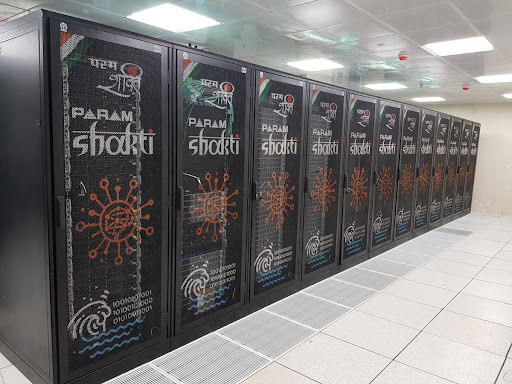
PARAM Shakti – Supercomputer at IIT Kharagpur
| Supercomputers Installed & Commissioned in India as a part of NSM | ||
|---|---|---|
| Name | Speed | Location |
| PARAM Shivay | 833 TF | IIT BHU Varanasi |
| PARAM Shakti | 1.66 PF | IIT Kharagpur |
| PARAM Brahma | 797 TF | IISER Pune |
| PARAM Sanganak | 1.66 PF | IIT Kanpur |
| PARAM Seva | 833 TF | IIT-H |
| PARAM Yukti | 833 TF | JNCASR |
| PARAM Smriti | 833 TF | NABI Mohali |
| PARAM Utkarsh | 833 TF | C-DAC B |
| PARAM Sidhi | 5.26 PF | National AI Facility CDAC-Pune |
| PARAM Pravega | 3.3 PF | IISC |
| PARAM Ganga | 1.66 PF | IIT Roorkee |
| Total | 18.5 PF | |
| Supercomputers expected to be commissioned in India as a part of NSM | |
|---|---|
| Location | Speed |
| IIT Guwahati | 833 TF |
| IIT Gandhinagar | 833 TF |
| IIT Mandi | 833 TF |
| NIT Trichy | 833 TF |
| Total | 3.33 PF |
Way Forward
The following steps can be taken to improve India's supercomputing capabilities and maintain technological advancements:
- Continued investment in R&D to remain at the forefront of supercomputing technology.
- Collaboration with international partners and organisations in order to capitalise on global expertise.
- Increasing the use of supercomputing infrastructure by academia, researchers, MSMEs, and startups for scientific breakthroughs and innovation.
- Expanding the network and providing adequate resources to the National Supercomputing Mission (NSM).
- Upgrading supercomputing systems on a regular basis to keep up with evolving computational demands and maintain global competitiveness.
Conclusion
Supercomputers, like any other computer, are used to simulate reality on a larger scale. Cloud computing can perform some of the functions of a supercomputer. Cloud computing, like supercomputers, combines the power of multiple processors to achieve power that a PC cannot match. The supercomputer and high-performance computing (HPC) market is expanding as more vendors develop their own supercomputers, such as Amazon Web Services, Microsoft, and Nvidia. Supercomputers with hundreds of exaflops may become a reality as computing power continues to grow exponentially.
| Other Relevant Links | |
|---|---|
| Science & Technology Policy in India | Scientific Policy Resolution 1958 |
| Science & Technology Policy of 1983 | Science & Technology Policy of 2003 |
| Science, Technology and Innovation Policy 2013 | New Initiatives Aligned with the National Agenda |
| India and World collaboration in science projects | National Intellectual Property Rights Policy |
FAQs
Question: What is a supercomputer and how does it differ from a regular computer?
Answer: A supercomputer is a highly advanced machine designed to perform complex calculations at extremely high speeds, significantly faster than regular computers. Supercomputers are used in scientific simulations, weather forecasting, and large-scale data analysis, whereas regular computers handle less intensive tasks.
Question: What are some applications of supercomputers?
Answer: Supercomputers are used in fields like climate modeling, genetic research, aerospace, quantum simulations, cryptography, and even national security. They solve problems that require immense computational power, like predicting weather patterns or simulating molecular interactions.
Question: How fast are supercomputers compared to personal computers?
Answer: Supercomputers can perform trillions of calculations per second, known as petaflops (quadrillion floating-point operations). In contrast, personal computers perform millions to billions of calculations per second, making supercomputers orders of magnitude faster.
Question: What is the significance of supercomputers in scientific research?
Answer: Supercomputers are crucial for advancing scientific research, enabling researchers to solve complex problems like simulating climate change, studying protein folding, or testing new drugs. They provide insights that are not possible with conventional computational methods.
Question: Which country currently leads the world in supercomputer technology?
Answer: As of recent reports, the United States and China are the global leaders in supercomputing technology. The U.S. houses some of the most powerful supercomputers, including those at the Oak Ridge National Laboratory and the Lawrence Livermore National Laboratory.
MCQs
1. Which of the following is NOT an application of supercomputers?
A) Weather forecasting
B) Genetic research
C) Text processing
D) Climate modeling
Answer: (C) See the Explanation
Explanation: Text processing is not a task typically associated with supercomputers. Supercomputers are used for complex applications like weather forecasting, genetic research, and climate modeling, which require immense computational power.
2. The term “petaflop” refers to:
A) A million floating-point operations per second
B) A billion floating-point operations per second
C) A trillion floating-point operations per second
D) A quadrillion floating-point operations per second
Answer: (D) See the Explanation
Explanation: A petaflop refers to one quadrillion floating-point operations per second (10^15). It is used as a measure of computational power in supercomputers.
3. Which of the following supercomputers is considered one of the most powerful in the world?
A) Titan
B) Fugaku
C) Blue Gene
D) Cray-1
Answer: (B) See the Explanation
Explanation: Fugaku, developed by RIKEN and Fujitsu in Japan, is currently one of the most powerful supercomputers in the world. It was ranked number one on the TOP500 list of the most powerful supercomputers.
4. What is the main difference between supercomputers and parallel computers?
A) Supercomputers are cheaper
B) Supercomputers use more energy
C) Parallel computers have more processing units
D) Supercomputers are optimized for specific tasks
Answer: (D) See the Explanation
Explanation: Supercomputers are typically optimized for specific, complex tasks, such as simulations or data analysis, whereas parallel computers are designed to distribute processing tasks across multiple processors but may not be as task-specific.
5. What does the architecture of a supercomputer typically include?
A) A single central processing unit
B) Thousands of processors working in parallel
C) A basic microprocessor
D) A hard drive for data storage
Answer: (B) See the Explanation
Explanation: Supercomputers are built with thousands of processors working in parallel, allowing them to handle vast amounts of data and perform complex calculations rapidly. This architecture is key to their extraordinary computational power.
GS Mains Questions and Model Answers
Q1: Discuss the role of supercomputers in advancing scientific research and technological development in modern times. How have they transformed industries like healthcare, climate science, and space exploration?
Answer: Supercomputers have revolutionized various scientific fields by enabling simulations and data analysis that were previously impossible. In healthcare, they aid in drug discovery and genetic research, allowing faster, more accurate results. In climate science, supercomputers model weather patterns, predict climate changes, and assess the impact of environmental policies. In space exploration, they assist in the analysis of astronomical data and simulations of space missions. Their ability to process large datasets and perform complex calculations at high speed makes them indispensable in modern scientific and technological endeavors.
Q2: Evaluate the ethical concerns related to the development and deployment of supercomputers. How can nations balance the benefits of technological advancements with potential risks?
Answer: The rapid development of supercomputers raises ethical concerns such as privacy, security, and the potential for misuse in military or surveillance applications. Additionally, the environmental impact of maintaining large-scale supercomputing facilities, due to their high energy consumption, cannot be ignored. Nations must implement strong regulatory frameworks that ensure the responsible use of supercomputing technology while encouraging innovation. They must also invest in sustainable energy solutions to mitigate environmental harm and ensure that these technologies are used to benefit society as a whole, rather than for harmful purposes.
Q3: Analyze the geopolitical implications of supercomputer development. How do countries like the U.S., China, and Japan compete in the race for supercomputing dominance?
Answer: Supercomputing has significant geopolitical implications, as nations vie for technological supremacy in this critical field. The U.S., China, and Japan have been at the forefront of developing cutting-edge supercomputers, with each country leveraging these technologies for military, economic, and scientific advantages. The race for supercomputing dominance influences global power dynamics, as countries with advanced computing capabilities can lead in fields like artificial intelligence, cybersecurity, and national defense. However, it also raises concerns about the potential for technological arms races, with the need for international cooperation to ensure that supercomputing advances benefit global peace and security.
Previous Year Questions on Supercomputers
1. UPSC CSE Prelims 2020:
Question: Which of the following statements about supercomputers is NOT correct?
A) Supercomputers are used in climate modeling
B) Supercomputers have limited applications in genetics
C) Supercomputers are used in simulating complex scientific phenomena
D) Supercomputers contribute to national security
Answer: (B)
Explanation: Supercomputers have extensive applications in genetics, especially in genome sequencing and drug discovery, among other bioinformatics tasks. They are crucial for simulating complex scientific phenomena and supporting national security efforts.
2. UPSC CSE Mains 2021:
Question: Analyze the contributions of supercomputers in the fields of space exploration and disaster management. How do they enhance global cooperation in these areas?
Answer: Supercomputers play an essential role in space exploration by processing astronomical data and simulating space missions, which enables more accurate planning of missions to other planets. In disaster management, supercomputers help predict natural disasters such as earthquakes, tsunamis, and hurricanes by analyzing vast amounts of data, thereby aiding in timely warnings. These technologies enhance global cooperation by sharing data and resources, facilitating international collaborations in space missions and disaster relief efforts, especially in managing global challenges like climate change and pandemic control.
Download the PREPP App and attempt FREE IAS Exam Mock Tests and get complete study material!

Full Test - 04: UPSC CSE Prelims CSAT (Paper-II)
Full Test - 03: UPSC CSE Prelims CSAT (Paper-II)
UPSC CSE Prelims 2026 GS Paper 1 Question Paper (24-May-2026)
UPSC CSE Prelims 2026 CSAT Paper 2 Question Paper (24-May-2026)

17 February 2025 | The Hindu Must Read Articles | Current Affairs

16 February 2026 | The Hindu Must Read Articles | Current Affairs

13 February 2026 | The Hindu Must Read Articles | Current Affairs









Comments