Scientific Policy Resolution 1958 – S&T Policy in India – Science & Technology Notes
The Indian Parliament passed the first significant scientific policy resolution in 1958. The policy document was drafted by the government of Jawaharlal Nehru, India's then-prime minister. It served as the foundation for India's scientific efforts and mindset. This determination stemmed from the realization that the development of a welfare state necessitated investments in science and technology. As a result, technology and science would be used to effect socioeconomic change. In this article, we will discuss regarding the Scientific Policy Resolution of 1958 which will be helpful for UPSC preparation.
Table of Contents
Scientific Policy Resolution 1958 – Background
- Jawahar Lal Nehru laid the groundwork for science and technology in India, as he did for several other critical national sectors such as politics, economics, and others.
- He was the project's chief designer for India.
- He was quick to recognize the importance of science and technology, believing that scientific advancement was the only way for the country to overcome its many problems.
- He declared that only science could solve the problems of hunger and poverty, the mentally ill and illiteracy, superstitions, depressing traditions, enormous riches that go to waste, and wealthy nations with starving populations.
- As a result, he decided to make science and technology a key component of the nation's goals and priorities.
- He co-created a framework for integrating science and technology into governmental economic planning with P.C. Mahalanobis.
- Numerous organisations and agencies were established and supported in order to conduct and coordinate research in various scientific and technological fields.
- Each document included a five-year plan outlining the thrust areas of science and technology in the country's socioeconomic transformation.
Scientific Policy Resolution (SPR 1958) – Salient Features
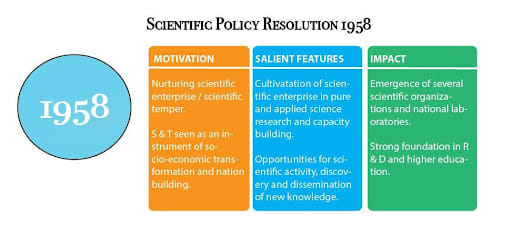
- SPR 1958 established the basis for scientific enterprise and scientific temper in India. Nehru envisioned India as a welfare state.
- This resolution arose from the realisation that the establishment of a welfare state could only be accomplished through investments in science and technology. Thus, science and technology would serve as a tool for socioeconomic transformation.
- Investment in science and technology was critical in order to provide a reasonable amount of economic, social, cultural amenities and services to every citizen through industrialisation, as it would reduce the burden on the use of capital andraw material.
- Creating a large pool of high-quality scientists was required to meet the country's needs, particularly in areas such as agriculture and defence.
- SPR 1958 emphasised the importance of developing a culture and mechanism in which citizens' creative talents are recognised and opportunities for scientific activity, acquisition, dissemination, and discovery of new knowledge are found.
- SPR 1958 was primarily a document of science policy. Technology development was given second priority because it was assumed that technological development could only come from the study of science and its applications at the time.
- However, following the SPR of 1958, large-scale investments in science resulted in the formation of a number of scientific organisations and national laboratories.
- SPR 1958 was successful in establishing a solid foundation in R&D and higher education.
Conclusion
Apart from the spirit of the people, the key to national prosperity in the modern era lies in the effective combination of three factors: technology, raw materials, and capital, of which the first is perhaps the most important, because the development and application of new scientific techniques can, in fact, compensate for a lack of natural resources while reducing capital demands. However, technology can only emerge from the study of science and its applications.
FAQs
Question: What was the objective of the Scientific Policy Resolution (1958) in India?
Answer: The Scientific Policy Resolution (SPR) of 1958 was a landmark policy initiative introduced by the Government of India to promote scientific research and development in the country. The primary objective was to harness scientific knowledge and technological advancements for the socio-economic development of India. The policy emphasized the need to promote scientific education, research, and innovation in various sectors such as agriculture, industry, and health. The SPR aimed to foster a scientific temper among the Indian population, encourage scientific careers, and strengthen the country's research institutions. Additionally, it called for greater collaboration between the government, industry, and research institutions to facilitate technological progress.
Question: How did the Scientific Policy Resolution of 1958 influence India's scientific and technological development?
Answer: The Scientific Policy Resolution of 1958 played a pivotal role in shaping India's scientific and technological landscape. By emphasizing the importance of science in nation-building, the policy laid the foundation for the establishment of several key research institutions, such as the Indian Space Research Organisation (ISRO) and the Council of Scientific and Industrial Research (CSIR). It encouraged the government to allocate more resources to scientific research and fostered a culture of innovation and technological advancement. The policy also played a crucial role in developing the human capital needed for technological growth, leading to advancements in sectors such as nuclear energy, space exploration, and agriculture.
Question: What were the key features of the Scientific Policy Resolution (1958)?
Answer: The key features of the Scientific Policy Resolution (1958) included:
- Promotion of Scientific Education: The policy stressed the need to enhance scientific education and provide opportunities for scientific training across the country.
- Development of Scientific Research: It advocated for the establishment and strengthening of research institutions to promote scientific and technological research.
- Industrial Application of Science: The policy aimed to apply scientific knowledge to industries to improve productivity and foster industrialization.
- Integration of Science with National Development: The policy emphasized the use of science for addressing national challenges such as poverty, health, and food security.
- Public Awareness and Scientific Temper: It encouraged the cultivation of scientific temper and rational thinking among the general population.
Question: What role did the Scientific Policy Resolution (1958) play in India's technological advancements?
Answer: The Scientific Policy Resolution (1958) played a critical role in the technological advancements witnessed in India over the subsequent decades. The policy created a framework for the country's technological development by encouraging investment in key sectors such as space technology, defense technology, and nuclear energy. It provided a vision for integrating science with industry, fostering innovation in fields like agriculture, transportation, and telecommunications. The policy also laid the groundwork for India's technological self-reliance, enabling the country to make significant strides in space exploration (through ISRO), nuclear energy, and the development of indigenous technologies that contributed to India's position as a growing technological power.
Question: How did the Technology Policy of India evolve after the 1958 Scientific Policy Resolution?
Answer: After the Scientific Policy Resolution of 1958, India's Technology Policy evolved to focus more on the application of science and technology to economic development. This was particularly evident in the 1983 Technology Policy, which placed a strong emphasis on technological self-reliance, innovation, and industrial capacity building. The policy encouraged the creation of a robust national system for research and development (R&D) and sought to bridge the technological gap between India and advanced nations. It promoted the transfer of technology, the establishment of technology parks, and the development of human resources to ensure that India could develop and utilize its own technology in fields such as biotechnology, information technology, and telecommunications.
MCQs
1. What was the main aim of the Scientific Policy Resolution (1958)?
A) To establish a nuclear policy for India
B) To promote scientific research and education
C) To improve trade relations with foreign countries
D) To develop agricultural policies
Answer: (B) See the Explanation
Explanation: The main aim of the Scientific Policy Resolution (1958) was to promote scientific research and education in India, with a focus on technological development for socio-economic growth.
2. Which of the following institutions was established in India as a result of the Scientific Policy Resolution of 1958?
A) Indian Institute of Technology (IIT)
B) Indian Space Research Organisation (ISRO)
C) Council of Scientific and Industrial Research (CSIR)
D) National Research Development Corporation (NRDC)
Answer: (B) See the Explanation
Explanation: The Indian Space Research Organisation (ISRO) was established in the aftermath of the Scientific Policy Resolution of 1958, helping India make significant strides in space technology.
3. Which sector was specifically targeted for development under the Scientific Policy Resolution?
A) Banking and finance
B) Agriculture and irrigation
C) Scientific research and industrial applications
D) Social welfare
Answer: (C) See the Explanation
Explanation: The Scientific Policy Resolution specifically targeted the development of scientific research and its industrial applications to boost technological and industrial growth in India.
4. What was the focus of the Technology Policy in India after 1958?
A) Focusing on military technology
B) Developing information technology
C) Achieving technological self-reliance
D) Importing foreign technology
Answer: (C) See the Explanation
Explanation: The focus of the Technology Policy in India after 1958 was to achieve technological self-reliance by fostering innovation and strengthening India's own research and development capabilities.
5. Which of the following statements is true about the Scientific Policy Resolution (1958)?
A) It focused only on scientific research in agriculture
B) It was aimed at promoting science in all sectors including industry, agriculture, and health
C) It did not emphasize technological development
D) It was primarily about promoting foreign investments in science
Answer: (B) See the Explanation
Explanation: The Scientific Policy Resolution (1958) aimed at promoting science across all sectors, including industry, agriculture, health, and other areas crucial for India's development.
GS Mains Questions and Model Answers
Q1: Discuss the significance of the Scientific Policy Resolution of 1958 in shaping India's scientific and technological landscape.
Answer: The Scientific Policy Resolution of 1958 was pivotal in shaping India's scientific and technological progress. By emphasizing the importance of scientific education, research, and industrial application, the policy laid the foundation for India's scientific institutions, such as the Indian Space Research Organisation (ISRO) and the Council of Scientific and Industrial Research (CSIR). The policy also fostered a scientific temper among the population and integrated science into national development efforts, leading to advancements in space technology, nuclear energy, and industry. The resolution served as a blueprint for India to achieve technological self-reliance, which is evident in the country's advancements in sectors such as information technology, biotechnology, and defense technology.
Q2: How did the Scientific Policy Resolution (1958) contribute to the development of indigenous technological capabilities in India?
Answer: The Scientific Policy Resolution (1958) was instrumental in fostering indigenous technological capabilities in India by encouraging self-reliance in key sectors such as space exploration, nuclear energy, and defense technologies. The establishment of institutions like ISRO and the Atomic Energy Commission helped India develop homegrown technologies and reduce its dependency on foreign imports. The policy also encouraged collaborations between academia, industry, and government, facilitating the transfer of technology and knowledge. As a result, India was able to make significant strides in technological advancements, such as the successful launch of satellites, the development of nuclear energy, and the growth of the information technology sector.
Q3: Examine the role of the Scientific Policy Resolution of 1958 in promoting scientific temper and technological growth in India.
Answer: The Scientific Policy Resolution of 1958 played a key role in promoting a scientific temper and technological growth in India by integrating scientific principles into national development. The policy focused on creating an environment conducive to scientific inquiry and research, which helped foster innovation in critical sectors. It encouraged rational thinking, problem-solving, and the application of scientific methods in addressing societal challenges such as poverty, food security, and public health. By institutionalizing scientific research and technology in various sectors, the policy laid the foundation for India's journey towards becoming a technologically advanced nation.
Previous Year Questions on Scientific Policy Resolution
1. UPSC CSE Prelims 2020:
Question: The Scientific Policy Resolution of 1958 aimed at promoting which of the following?
A) Technological self-reliance
B) International collaborations in science
C) Space research only
D) Foreign investments in technology
Answer: (A)
Explanation: The primary aim of the Scientific Policy Resolution was to promote technological self-reliance and the application of science and technology for India's socio-economic development.
2. UPSC CSE Mains 2017 (GS Paper 3):
Question: "How has the Scientific Policy Resolution of 1958 shaped India's technological policies and research institutions?"
Answer: The Scientific Policy Resolution of 1958 played a crucial role in shaping India's technological policies by emphasizing self-reliance and the importance of scientific research. It led to the creation of key institutions such as ISRO, CSIR, and the Atomic Energy Commission, which helped India achieve significant technological advancements. The policy's focus on integrating science into national development ensured that technological progress was aligned with India's social and economic needs, fostering a culture of innovation and indigenous research.
Download the PREPP App and attempt FREE IAS Exam Mock Tests and get complete study material!
Live Test : UPSC IAS : GS - Modern History - Subject Knowledge Test

Live Test : UPSC CSE Prelims CSAT (Paper-II) (Oct 20 - 23)
Full Test - 04: UPSC CSE Prelims CSAT (Paper-II)
Full Test - 03: UPSC CSE Prelims CSAT (Paper-II)
UPSC CSE Prelims 2026 CSAT Paper 2 Question Paper (24-May-2026)
UPSC CSE Prelims 2026 GS Paper 1 Question Paper (24-May-2026)

17 February 2025 | The Hindu Must Read Articles | Current Affairs

16 February 2026 | The Hindu Must Read Articles | Current Affairs

13 February 2026 | The Hindu Must Read Articles | Current Affairs









Comments