Science & Technology Policy of 2003 – S&T Policy in India – Science & Technology Notes
Science and Technology Policy 2003 brought together S&T areas with the goal of increasing R&D and innovation investment in areas affecting the economy and society. This resulted in the establishment of a strong institutional mechanism, the Scientific and Engineering Research Board (SERB), under the auspices of DST, to promote scientific and engineering research in the country. Following the S&T Policy 2003, there has been a significant increase in R&D investment, as well as an increase in publication ranking and a steady increase in institutional and human capacity. In this article, we will discuss regarding the Science & technology Policy of 2003 which will be helpful for UPSC exam preparation.
Table of Contents
Science & Technology Policy of 2003 - Background
- Since the year 2000, India has focused on converting knowledge into wealth and value, addressing the country's socioeconomic needs, and integrating science, technology, and innovation (STI).
- By the millennium's turn, India had built a solid infrastructure in science and technology, both in terms of institutions and human resources.
- Science was becoming more multidisciplinary, encompassing various sectors and countries.
- As a result, the formation of institutional clusters and multinational collaboration was required. Even in basic research, large investments in R&D were required.
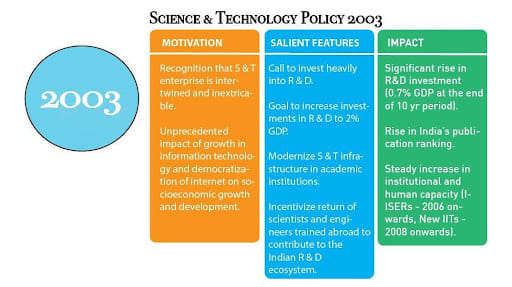
- SPR 1958 and TPS 1983 concentrated on science and technology, respectively. However, the science and technology enterprises were so intertwined that it was necessary to consider them as a whole rather than as separate elements.
- With the rapid advancement of information and communication technologies and the democratization of the internet, knowledge and information were being exchanged at an unprecedented rate.
- Science and technology have had a previously unheard-of impact on economic growth and social development. New cybersecurity and ethics issues, such as privacy considerations and inequity, emerged.
- STP 2003 was enacted by the Government of India in order to keep pace with science and technology, to remain competitive in an increasingly globalized world, and to meet our primary goal of equitable and sustainable development.
Science & Technology Policy of 2003 – Salient Features
- STP 2003 included a process to develop mechanisms within ministries and agencies to gather input from scientists and technologists in relation to planning and policymaking, as well as a call to invest heavily in the R&D sector, with the goal of increasing investment to 2% of GDP.
- STP 2003 recognised the need to modernize existing science and engineering infrastructure in academic institutions as well as establish new funding mechanisms for basic research.
- The policy also called for the creation of incentive mechanisms to attract foreign scientists and engineers, particularly those of Indian origin, to contribute to the Indian STI ecosystem.
- STP 2003 aimed to encourage R&D and innovation in areas that have an impact on the economy and society, as well as to develop mechanisms to facilitate interaction among the ecosystem's various stakeholders.
- Finally, STP 2003 advocated for industry and scientific research cross-pollination, as well as the establishment of intellectual property regimes to protect and incentivize inventors.
- It also encouraged research into natural disaster management and mitigation.
- This policy document emphasized science diplomacy, particularly international science and technological cooperation among developing countries in the global south.
Impact of Science & Technology Policy of 2003
- Following 2003, there was a significant increase in overall R&D investment (increase in both public and private investment).
- Even though R&D investment did not reach 2% of national GDP by the end of the 10-year period following the adoption of the STP 2003 mandate, it was at a globally benchmarked figure of 0.7% of GDP.
- India has risen significantly in the publication rankings.
- Human capacity was also steadily increasing.
- We began graduating a greater number of PhD students, filed more patents, and incubated more startups.
Conclusion
This policy emphasized the benefits of science and technology while also emphasizing the investment required for research and development. Furthermore, it includes integrated programmes for socioeconomic sectors with the national research and development system to address national problems while also creating a national innovation system. Its goal was to keep up with science and technology, to remain competitive in an increasingly globalized world, and to achieve the overarching goal of equitable and sustainable development.
FAQs
Question: What were the key objectives of India's Science and Technology Policy of 2003?
Answer: The key objectives of the 2003 policy included improving the quality of life, promoting inclusive and sustainable development, enhancing India’s global technological standing, and fostering innovation in key sectors like biotechnology, information technology, and defense.
Question: How did the 2003 Science and Technology Policy aim to strengthen India’s innovation ecosystem?
Answer: The policy focused on fostering a culture of innovation through increased investment in R&D, strengthening partnerships between government institutions, private industries, and academia, and supporting the commercialization of indigenous technologies.
Question: What role did information technology (IT) play in the 2003 Science and Technology Policy?
Answer: IT played a pivotal role in the 2003 policy by promoting the use of technology for sustainable development, improving governance, and enhancing India’s competitiveness in the global digital economy.
Question: How did the policy address challenges in India’s science and technology infrastructure?
Answer: The 2003 policy emphasized strengthening India’s science and technology infrastructure by investing in research institutions, improving the technological base in rural areas, and developing world-class capabilities in emerging technologies like space and nanotechnology.
Question: How did the 2003 Science and Technology Policy address the need for international collaboration?
Answer: The policy recognized the importance of international collaboration in advancing India’s scientific capabilities, and it emphasized global partnerships in R&D, technology transfer, and joint ventures to access cutting-edge technologies.
MCQs
1. What was a significant aim of the 2003 Science and Technology Policy of India?
A) To focus solely on improving agriculture
B) To improve India’s standing in global technology and innovation
C) To reduce investments in R&D
D) To limit the role of private enterprises in science and technology
Answer: (B) See the Explanation
Explanation: The 2003 Science and Technology Policy primarily aimed to enhance India’s global standing in technology and innovation, focusing on sectors like biotechnology, IT, and defense while fostering sustainable and inclusive development.
2. Which sector was particularly emphasized in the 2003 Science and Technology Policy of India?
A) Information Technology and Biotechnology
B) Manufacturing and Heavy Industries
C) Agriculture and Forestry
D) Traditional Industries
Answer: (A) See the Explanation
Explanation: The 2003 policy placed a special emphasis on IT and biotechnology, aiming to leverage these sectors to improve India’s competitiveness in the global economy and create a knowledge-based economy.
3. Which of the following was a key element of the 2003 Science and Technology Policy in terms of global collaboration?
A) Isolation from global scientific communities
B) Enhancing international collaboration in R&D and technology transfer
C) Limiting foreign investment in technology sectors
D) Reducing India’s engagement in international scientific treaties
Answer: (B) See the Explanation
Explanation: The 2003 policy emphasized enhancing international collaboration in research and development, particularly through technology transfer, joint ventures, and strategic partnerships with developed countries and organizations.
4. How did the 2003 policy seek to address India’s technological challenges in rural areas?
A) By investing in urban-centric technologies
B) By promoting rural self-sufficiency in technology
C) By focusing solely on urban infrastructure
D) By limiting technological access to rural areas
Answer: (B) See the Explanation
Explanation: The 2003 policy recognized the importance of spreading technological advances to rural areas. It aimed to enhance rural infrastructure and support the application of technology in areas like agriculture, healthcare, and education.
5. Which of the following best describes the 2003 Science and Technology Policy's approach to R&D?
A) It discouraged private sector participation in R&D
B) It called for increased government funding and collaboration with the private sector
C) It focused only on defense R&D
D) It limited R&D to select sectors only
Answer: (B) See the Explanation
Explanation: The policy aimed to increase government funding in R&D, while encouraging private sector collaboration and partnerships between industry, academia, and government institutions to foster innovation and development in key sectors.
GS Mains Questions and Model Answers
Q1: How did the 2003 Science and Technology Policy of India align with the goals of inclusive and sustainable development? Discuss its impact on the nation’s scientific and technological infrastructure.
Answer: The 2003 Science and Technology Policy was designed to align India’s scientific and technological advancements with the principles of inclusive and sustainable development. It focused on addressing societal challenges such as poverty, healthcare, and education through technology, while promoting sustainable growth in key sectors like agriculture, energy, and water management. The policy's emphasis on decentralized R&D and the application of technology in rural and underserved areas aimed to bridge the technological divide between urban and rural populations. Additionally, it prioritized sustainable use of natural resources, making a lasting impact on India’s scientific infrastructure by encouraging research in renewable energy and green technologies.
Q2: What role did the 2003 Science and Technology Policy play in boosting India’s position in global technological innovation? How did it contribute to India’s information technology and biotechnology sectors?
Answer: The 2003 policy played a pivotal role in positioning India as a global player in technological innovation by focusing on emerging sectors such as information technology (IT) and biotechnology. The policy encouraged investments in R&D, facilitated the growth of the IT sector through supportive policies, and laid the groundwork for India’s rise as a global leader in software and digital services. In biotechnology, the policy supported indigenous research, fostering advancements in agriculture, healthcare, and pharmaceutical industries. By focusing on these sectors, India was able to enhance its global competitiveness, attract foreign investment, and foster a knowledge-based economy.
Q3: Critically examine the role of international collaboration in the 2003 Science and Technology Policy. How did it affect India’s scientific and technological growth?
Answer: The 2003 Science and Technology Policy acknowledged that international collaboration was essential for India to stay at the forefront of scientific and technological advancements. It promoted joint ventures, technology transfer agreements, and partnerships with developed countries, enhancing India’s access to cutting-edge technologies. By actively engaging in international research initiatives and scientific forums, India was able to accelerate its capabilities in areas such as space exploration, nuclear energy, and information technology. This policy shift allowed India to benefit from global expertise while contributing to international scientific endeavors. As a result, the country saw accelerated growth in both research outputs and technological capabilities, which helped India become an attractive destination for global tech investments.
Previous Year Questions on Science and Technology Policy
UPSC CSE Mains 2017:
Question: Discuss the role of the private sector in India’s technological advancements under the 2003 Science and Technology Policy. How has it impacted the country’s development?
Answer: The policy recognized the importance of the private sector in driving innovation. It encouraged collaborations between government institutions and private companies, particularly in sectors like biotechnology and information technology. The involvement of the private sector led to an increase in investments, faster commercialization of technologies, and India’s emergence as a global IT hub, boosting the country’s economy and technological capabilities.
Download the PREPP App and attempt FREE IAS Exam Mock Tests and get complete study material!

Full Test - 04: UPSC CSE Prelims CSAT (Paper-II)
Full Test - 03: UPSC CSE Prelims CSAT (Paper-II)
UPSC CSE Prelims 2026 GS Paper 1 Question Paper (24-May-2026)
UPSC CSE Prelims 2026 CSAT Paper 2 Question Paper (24-May-2026)

17 February 2025 | The Hindu Must Read Articles | Current Affairs

16 February 2026 | The Hindu Must Read Articles | Current Affairs

13 February 2026 | The Hindu Must Read Articles | Current Affairs









Comments