Metaverse – Explained in Layman’s Terms – Science & Technology Notes
The term "metaverse" is a combination of two words: "meta," which means "beyond" in Greek, and "verse," which comes from the word "universe." The concept itself suggests a location beyond the known world or universe. It is also known as a virtual realm that appears to be real. We are already familiar with video games, Oculus headsets, and game consoles that immerse us in virtual worlds, so the concept is not that novel. In this article, we will understand the concept of Metaverse in simple terms which will be helpful for UPSC exam preparation.
Table of Contents
Metaverse – Background
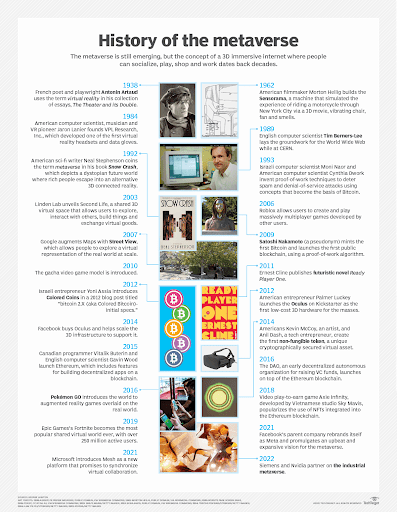
- The term was first used in the novel Snow Crash by Neal Stephenson in 1992.
- The book portrays the metaverse as the next step in the evolution of the Internet.
- The book demonstrates how virtual interactions in virtual reality can affect the real world.
- He described the concept as the successor to internet.
- It generally refers to shared virtual world environments accessible via the internet.
What is Metaverse?
- The term "metaverse" refers to a virtual world in which people can communicate and interact with digital objects in 3D space.
- The metaverse is a virtual reality that incorporates aspects of social media, online gaming, augmented reality, virtual reality, and cryptocurrencies.
- Instead of just viewing digital content, users in the metaverse will be able to immerse themselves in a space where the digital and physical worlds converge.
- It is created with cutting-edge technology such as Virtual Reality (VR) and Augmented Reality (AR).
- It's a network of interconnected virtual worlds, each with its own distinct characteristics.
- There is also a type of metaverse that employs blockchain technology.
- The metaverse's definition is changing, but it now refers to real-time 3D virtual spaces where users can meet, create, socialise, work, buy goods and services, and attend events with people who are not physically present.
- Facebook's name was changed to "Meta" on October 29, 2021, to better reflect its new focus on the metaverse.
- The company's rebranding enthralled the tech world, and the term "metaverse" became a buzzword in the industry, with many companies developing products for the metaverse.
Virtual Reality (VR)
Augmented Reality (AR)
|
Metaverse Technologies
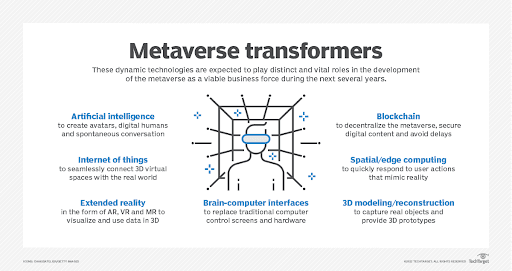
The following seven technologies are expected to have the biggest impact on metaverse development over the next decade:
- Artificial Intelligence
- Internet of Things
- Extended Reality
- Brain-computer interfaces
- 3D modelling and construction
- Spatial and edge computing
- Blockchain
Current Status of Metaverse
- Gaming: Many gaming platforms have already successfully used the metaverse concept. Epic Games, the creators of Fortnite, recently held a music concert in their game featuring pop singer Ariana Grande.
- Cryptocurrency: Another aspect of a virtual universe that has been realised is cryptocurrency, which will be part of the new metaverse world order in which all services will be offered in exchange for crypto.
Application & Potential of Metaverse
E-Commerce
- Because the metaverse can bridge the gap between the physical and virtual worlds, online and offline commerce can be combined into one.
- This means users will be able to digitally experience the physical world through the metaverse, making online shopping more convenient.
- Companies would greatly benefit from the metaverse because it not only broadens their consumer base but also has the potential to receive reviews on new products, pointing them in the right direction for the future.
- Despite geological barriers, brands can interact with a global audience via Metaverse in the ecommerce business framework.
Skill Enhancement
- Because of its ability to create new experiential learning scenarios, the metaverse can play an important role in remote skill enhancement.
Virtual Tourism
- The 360° virtual tour allows viewers to not only watch the recorded location but also to be present digitally in the desired location with realistic effects.
- For example, Virtual Reality Holiday "Try before you Fly" allows potential tourists to virtually visit their desired destinations.
Education and Learning
- The combination of VR and the effects of Metaverse has elevated the learning experience to a whole new level.
- Students can now observe live experiments that use more intensive and high-quality knowledge resources.
- Another Metaverse example is Microsoft's Mesh, a mixed reality platform where faculty, staff, and students can interact using 3D avatars.
Healthcare
- Telemedicine and Telehealth are concepts fuelled by the post-pandemic Metaverse in which patients and doctors can interact in virtual 3D clinics.
Hardware Sales
- According to Facebook CEO Mark Zuckerberg, augmented reality glasses will eventually be as common as smartphones. If this is true, this will be a massive market.
Gaming
- Facebook's Oculus VR gaming platform is expected to be the portal into the metaverse.
Physical Sales
- In the future, physical goods and services will be linked to the virtual ecosystem.
Immersive Learning
- It is a training method that employs Virtual Reality (VR) to simulate real-world scenarios and train students in a safe and engaging immersive training environment.
Non-Fungible Tokens (NFTs)
- NFTs, which are claims of ownership for a unique, non-interchangeable digital asset stored on a blockchain, have the potential to be widely adopted.
Challenges & Concerns Associated with Metaverse
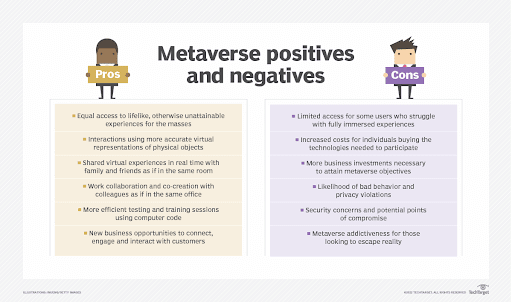
Privacy and Security
- In the metaverse, unwanted contact may become more intrusive and pervasive, exacerbating online risks.
- There is a chance that citizens' data will be collected and sold to third-party aggregators.
- If the metaverse has lax security, it may be vulnerable to cyber-attacks, identity theft, fraud, and a haven for harassers, criminals, and fringe groups.
- The rise of virtual interactions and the development of concepts such as digital avatars will make it more difficult to track and intercept illegal content and cybercriminals.
Tradition vs. Technology
- While technology has many advantages, it also has many disadvantages for tradition.
- With the rise of social media, there has been a slight blurring of traditional social values such as collectivism and brotherhood.
Legality of the Metaverse
- Legislations and jurisdictions that will be applicable in this limitless digital world are also major concerns that lawmakers must address.
- Another legal issue that is likely to arise is the protection of intellectual property (IP) and ownership.
- Protecting content creators' IPR (Intellectual Property Rights) will be difficult as well, given the difficulty in tracking copyright infringements in the virtual space.
Inadequate Infrastructure and Connectivity
- Creating a pragmatic, robust, and accessible meta-governance infrastructure is difficult.
- A 5G connection will be required at the very least to provide a safe and reliable experience.
- The majority of rural communities are still struggling to obtain and maintain a secure 4G connection.
- Furthermore, the amount of energy currently available is insufficient in comparison to the energy required by the metaverse.
The Digital Divide
- According to the ITU's World Telecommunication/ICT Indicators Database 2020, only 43% of Indians use the internet.
- This has increased the disparity between demographics and regions that have access to modern information and communication technology (ICT) and those that do not or have limited access.
Loss of Touch with Reality
- Because augmented, virtual, and mixed reality will play an important role in the metaverse, users will need to immerse themselves in them.
- Individuals' sense of time and space may be distorted as a result of this unconscious immersion or suspension of consciousness.
- People may become so engrossed in virtual reality that they lose touch with reality.
Others
- Censorship, communication control, tax reporting, the prevention of online radicalization, etc. are some other issues.
Conclusion
Metaverse is a fully immersive and interactive virtual world in which users can interact with one another and with digital objects in a way that feels as real as the physical world. It is an open virtual space that is expected to be a new and exciting frontier for businesses, governments, and individuals alike. The metaverse has the potential to change the way we interact with the digital world, as well as the way we live our lives.
| Other Relevant Links | |
|---|---|
| Science & Technology Policy in India | Scientific Policy Resolution 1958 |
| Science & Technology Policy of 1983 | Science & Technology Policy of 2003 |
| Science, Technology and Innovation Policy 2013 | New Initiatives Aligned with the National Agenda |
| India and World collaboration in science projects | National Intellectual Property Rights Policy |
FAQs
Question: What is the Metaverse?
Answer: The Metaverse is a virtual reality space where users can interact with each other and digital environments using avatars. It combines augmented reality (AR), virtual reality (VR), and blockchain technology.
Question: How is the Metaverse different from the internet?
Answer: Unlike the internet, which is primarily based on text and media, the Metaverse offers an immersive, 3D virtual environment where users can experience and interact in real-time.
Question: What technologies power the Metaverse?
Answer: The Metaverse is powered by a combination of augmented reality (AR), virtual reality (VR), artificial intelligence (AI), blockchain, and cryptocurrencies to create an immersive, interactive experience.
Question: Can the Metaverse be used for business?
Answer: Yes, the Metaverse offers opportunities for businesses to create virtual storefronts, conduct meetings, and offer services in virtual spaces, making it a new platform for e-commerce and digital marketing.
Question: How does the Metaverse impact privacy?
Answer: The Metaverse could pose challenges for privacy, as it involves the collection of large amounts of personal data, and there are concerns about user surveillance and data misuse.
MCQs
1. What technology is NOT a key component of the Metaverse?
A) Virtual Reality (VR)
B) Augmented Reality (AR)
C) Blockchain
D) Radio Frequency Identification (RFID)
Answer: (D) See the Explanation
Explanation: The Metaverse relies on VR, AR, and blockchain technology, but RFID, which is used for tracking, is not a core component of the Metaverse experience.
2. How do users experience the Metaverse?
A) Through text-based interfaces
B) By using avatars in a 3D immersive environment
C) Through radio and sound devices
D) By using physical locations
Answer: (B) See the Explanation
Explanation: Users experience the Metaverse by creating avatars and interacting with a 3D virtual environment, which offers an immersive experience far beyond traditional 2D web interfaces.
3. Which of the following is a major concern regarding the Metaverse?
A) Loss of digital data
B) Privacy and data security
C) Technological obsolescence
D) Increased social interaction
Answer: (B) See the Explanation
Explanation: One of the main concerns regarding the Metaverse is privacy and data security, as large amounts of personal data will be collected and processed in virtual environments.
4. What is the role of blockchain in the Metaverse?
A) To facilitate immersive gaming experiences
B) To create decentralized, secure transactions and digital ownership
C) To provide augmented reality experiences
D) To monitor user behavior in virtual environments
Answer: (B) See the Explanation
Explanation: Blockchain technology enables secure transactions, digital ownership, and the creation of NFTs (non-fungible tokens) within the Metaverse, allowing users to own virtual assets.
5. How does the Metaverse impact the economy?
A) It decreases the role of traditional economies
B) It opens new opportunities for virtual commerce and business models
C) It replaces real-world currency
D) It limits the growth of traditional industries
Answer: (B) See the Explanation
Explanation: The Metaverse creates new opportunities for virtual commerce, digital real estate, and online businesses, thus transforming the economic landscape.
GS Mains Questions and Model Answers
Q1: Discuss the potential of the Metaverse in transforming the future of education and remote learning.
Answer: The Metaverse has the potential to revolutionize education by offering immersive learning experiences. Students can engage in 3D simulations, attend virtual classrooms, and interact with instructors and peers in a more engaging and dynamic manner. This could be especially beneficial for remote learning, as it removes geographical barriers and fosters collaborative learning. Additionally, subjects that require practical demonstrations, such as medical procedures or scientific experiments, can be taught in a virtual environment, providing students with hands-on experience without the need for physical presence. However, challenges such as digital accessibility, infrastructure, and privacy concerns need to be addressed to make this a viable mainstream education tool.
Q2: Examine the role of blockchain technology in ensuring digital ownership within the Metaverse.
Answer: Blockchain plays a critical role in the Metaverse by providing a decentralized platform for securing digital ownership. Blockchain allows users to own virtual assets, such as land, avatars, and items, in a secure and transparent manner. Through smart contracts and the use of Non-Fungible Tokens (NFTs), ownership of digital goods is verifiable and immutable. This ensures that users can buy, sell, or trade virtual assets with the assurance of authenticity and security. Moreover, blockchain also facilitates decentralized governance within the Metaverse, allowing users to have a say in the management and development of virtual environments.
Q3: What are the ethical and privacy concerns associated with the Metaverse, and how can they be mitigated?
Answer: The Metaverse raises significant ethical and privacy concerns, including the potential for data misuse, surveillance, and the risk of digital addiction. Personal data collected from users, such as biometric information, behavioral patterns, and interactions within virtual environments, can be exploited for commercial or malicious purposes. Additionally, the immersive nature of the Metaverse may lead to social isolation or addiction. To mitigate these concerns, robust data protection regulations must be implemented, along with transparency in data usage policies. Ethical frameworks should be developed to ensure the protection of user rights, and mental health support systems should be integrated into virtual environments to promote well-being.
Previous Year Questions on Metaverse
1. UPSC CSE Prelims 2021:
Question: Which of the following technologies is NOT essential for the functioning of the Metaverse?
A) Augmented Reality (AR)
B) Blockchain
C) Quantum Computing
D) Virtual Reality (VR)
Answer: (C)
Explanation: While AR, VR, and blockchain are integral to the Metaverse, quantum computing is not yet essential for its functioning, although it may have future applications.
2. UPSC CSE Prelims 2020:
Question: The concept of the Metaverse is primarily associated with which of the following fields?
A) Virtual reality and digital interaction
B) Cryptocurrency and digital banking
C) Artificial intelligence in robotics
D) Space exploration
Answer: (A)
Explanation: The Metaverse is primarily associated with virtual reality (VR) and digital interaction, allowing users to engage with immersive 3D environments and virtual communities.
Download the PREPP App and attempt FREE IAS Exam Mock Tests and get complete study material!

Full Test - 04: UPSC CSE Prelims CSAT (Paper-II)
Full Test - 03: UPSC CSE Prelims CSAT (Paper-II)
UPSC CSE Prelims 2026 GS Paper 1 Question Paper (24-May-2026)
UPSC CSE Prelims 2026 CSAT Paper 2 Question Paper (24-May-2026)

17 February 2025 | The Hindu Must Read Articles | Current Affairs

16 February 2026 | The Hindu Must Read Articles | Current Affairs

13 February 2026 | The Hindu Must Read Articles | Current Affairs









Comments