Gravitational Waves – Science & Technology Notes
Gravitational waves are ripples in space-time (the Universe's fabled "fabric") caused by massive objects moving at high speeds. In outer space, this refers to objects such as neutron stars or black holes orbiting each other at ever increasing speeds, or stars that explode (supernovae). In this article, we will discuss in detail regarding Gravitational Waves which will be helpful for UPSC exam preparation.
Table of Contents
Gravitational Waves – Background
- In his general theory of relativity, Albert Einstein predicted the existence of gravitational waves in 1916.
- Though Einstein predicted the existence of gravitational waves in 1916, the first proof of their existence came 20 years later, in 1974.
- In that same year, two astronomers, Russell Hulse and Joseph Taylor, discovered a binary pulsar 21000 light years from Earth using the Arecibo Radio Observatory in Puerto Rico.
- This was exactly the type of system predicted by general relativity to emit gravitational waves.
- Taylor and two colleagues (Joel Weisberg and Lee Fowler) began tracking the radio emissions from the stars to measure how their orbital period changed over time, knowing that the system could be studied to test Einstein's prediction.
- They first reported seeing a change in the period after only four years, confirming that the stars were getting closer to each other at the rate predicted by general relativity (GR) if they were emitting gravitational waves (the rate predicted by GR agreed with the observed rate to within half a percent).
- Hulse and Taylor were awarded the Nobel Prize in Physics in 1993 "for the discovery of a new type of pulsar, a discovery that has opened up new possibilities for the study of gravitation."
- On September 14, 2015, LIGO detected undulations in spacetime caused by gravitational waves generated by two colliding black holes 1.3 billion light-years away.
- The first detection by LIGO will be remembered as one of humanity's greatest scientific achievements.
What are Gravitational Waves?
- Gravitational waves are 'ripples' in space-time caused by some of the Universe's most violent and energetic processes.
- Einstein's mathematics demonstrated that massively accelerating objects (such as neutron stars or black holes orbiting each other) disrupted space-time in such a way that 'waves' of undulating space-time propagated in all directions away from the source.
- These cosmic ripples would travel at light speed, carrying information about their origins as well as hints about the nature of gravity itself.
- Cataclysmic events such as colliding black holes, supernovae (massive stars exploding at the end of their lives), and neutron starscolliding produce the strongest gravitational waves.
- Other gravitational waves are predicted to be produced by the rotation of neutron stars that are not perfect spheres, as well as possibly by the remnants of gravitational radiation produced by the Big Bang.
- Gravitational waves are inherently invisible. They are, however, extremely fast. They travel at light speed (186,000 miles per second). Gravitational waves squeeze and stretch everything in their path.
- While the processes that generate gravitational waves are extremely violent and destructive, by the time the waves reach Earth, they have shrunk thousands of billions of times, diminishing over time and space in the same way that waves from a pebble dropped in a pond shrink as they move away from the source.
- In fact, by the time gravitational waves from LIGO's first detection reached us, the amount of space-time wobbling they caused was 1000 times smaller than an atom's nucleus.
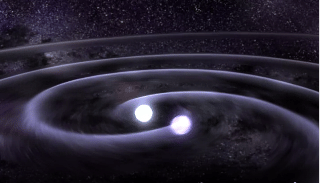
Illustration of Gravitational Waves emitted by two neutron stars
What is LIGO?
|
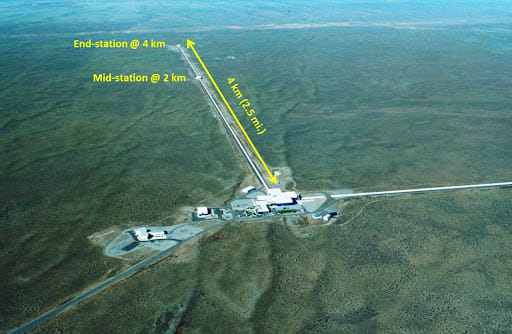
LIGO Observatory
Sources of Gravitational Waves
- Technically, any physical object that accelerates generates gravitational waves. This includes humans, automobiles, and aeroplanes, among other things.
- However, the masses and accelerations of objects on Earth are far too small to produce gravitational waves large enough for our instruments to detect.
- To find large enough gravitational waves, we must look far beyond our own solar system.
- The Universe is filled with extremely massive objects undergoing rapid accelerations, which produce gravitational waves, which we can now detect.
- When objects move at high speeds, the most powerful gravitational waves are produced.
- The following are some examples of events that could result in a gravitational wave:
- when two big stars orbit each other
- when a star explodes asymmetrically (supernova)
- when two black holes orbit each other and merge
Types of Gravitational Waves
1) Continuous Gravitational Waves
- A single spinning massive object, such as a neutron star, is expected to produce continuous gravitational waves. As this star spins, any bumps or imperfections in its spherical shape will generate gravitational waves. If the star's spin rate remains constant, so will the gravitational waves it emits. That is, the gravitational wave has the same frequency and amplitude all the time (like a singer holding a single note). This is why they are referred to as "Continuous Gravitational Waves."
2) Compact Binary Inspiral Gravitational Waves
- The gravitational waves produced by orbiting pairs of massive and dense ("compact") objects such as white dwarf stars, black holes, and neutron stars are known as compact binary inspiral gravitational waves.
- This category contains three subclasses of "compact binary" systems:
- Binary Neutron Star (BNS) - Twoneutron stars that orbit each other.
- Binary Black Hole (BBH) - Twoblack holes that orbit each other.
- Neutron Star-Black HoleBinary (NSBH) - Asystem made up of a neutron star and a black hole that orbit each other.
- Each binary pair generates a distinct pattern of gravitational waves based on factors such as the masses of each object, how their orbits are oriented with respect to the Earth, and how far apart they are, but the wave-generation mechanism is the same for all three.
- "Inspiral" is the name of this type of pattern.
3) Stochastic Gravitational Waves
- Astronomers predict that there are so few significant sources of continuous or binary inspiral gravitational waves in the Universe that LIGO is unconcerned about multiple ones passing by Earth at the same time (creating confusing signals in the detectors).
- However, we assume that many small gravitational waves pass by all the time from all over the Universe and are mixed together at random.
- These small waves from all directions combine to form what is known as a "Stochastic Signal," so named because the word "stochastic" refers to a random pattern that can be statistically analysed but not precisely predicted.
- These will be the tiniest and most difficult gravitational waves to detect, but it is possible that some of this stochastic signal will come from the Big Bang.
- Detecting relic gravitational waves from the Big Bang will allow us to look further back in time than ever before.
4) Burst Gravitational Waves
- The search for 'burst gravitational waves' is truly a search for the unexpected, both because LIGO has yet to detect them and because there are so many unknowns that we have no idea what to expect.
- We cannot assume that these gravitational waves will have well-defined properties like continuous and compact binary inspiral waves when searching for them.
- This means that we cannot limit our analyses to looking only for the signatures of gravitational waves predicted by scientists.
- To look for burst gravitational waves, you must be completely open-minded.
- Scientists must recognise a pattern of signals for these types of gravitational waves even when such a pattern has not previously been modelled.
- It's extremely difficult to find what you're looking for if you don't know what you're looking for.
- While this complicates the search for burst gravitational waves, detecting them has the greatest potential to reveal revolutionary information about the Universe.
How are Gravitational Waves Detected?
- A gravitational wave squeezes and stretches space as it passes by Earth. This squeezing and stretching can be detected by LIGO.
- Each LIGO observatory has two "arms" that are over two miles (4 kilometres) long each.
- The length of the arms changes slightly as a result of a passing gravitational wave.
- To detect these minute changes, the observatory employs lasers, mirrors, and extremely sensitive instruments.
- LIGO is a gravitational wave antenna capable of detecting vibrations in the 'fabric' of space-time itself, emanating from the cosmos's farthest reaches.
- Colliding black holes, which are completely invisible to EM astronomers, serve as beacons in the vast cosmic sea for LIGO.
Significance of Detecting Gravitational Waves
- Since gravitational waves interact with matter very weakly (unlike electromagnetic radiation, which can be absorbed, reflected, refracted, or bent by gravity), they travel through the Universe virtually unimpeded, carrying information about their origins that is free of distortion.
- LIGO detects gravitational waves caused by some of the Universe's most profoundly cataclysmic events—colliding black holes, merging neutron stars, exploding stars, and possibly even the birth of the Universe itself.
- Detecting and analysing gravitational wave information allows us to observe the Universe in ways never before possible, giving astronomers and other scientists their first glimpses of unseen wonders.
- LIGO has lifted a veil of mystery from the Universe, ushering in exciting new research in physics, astronomy, and astrophysics.
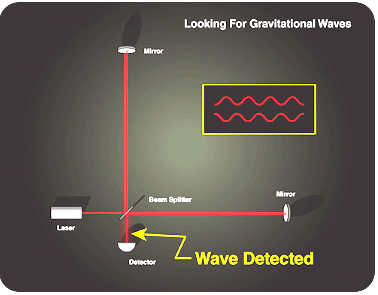
Detection of Gravitational Waves
LIGO-India Collaboration
- LIGO-India is a partnership between the LIGO Laboratory (run by Caltech and MIT) and three Indian institutes: the Raja Ramanna Centre for Advanced Technology (RRCAT, in Indore), the Institute for Plasma Research (IPR, in Ahmedabad), and the Inter-University Centre for Astronomy and Astrophysics (IUCAA, in Pune).
- The ultimate goal is to pinpoint a source of gravitational waves anywhere in the sky. To accomplish this, at least four comparable detectors must be operational at the same time around the world.
- Of course, given the complexity of gravitational wave detectors, more than four detectors in a network are required to increase the likelihood that four detectors are operational at the same time.
- In fact, a fourth detector, Kagra, is now operational in Japan, though it lacks the gravitational wave sensitivity of LIGO and Virgo.
- LIGO India will be the crucial fifth member. LIGO India, once operational, will significantly increase the likelihood that four detectors are operational at any given time.
- LIGO India will play a critical role in the global gravitational wave detector network.
- The LIGO Laboratory and India are both contributing significantly financially and intellectually to the project:
- The LIGO Laboratory provides the hardware for a complete LIGO interferometer, technical data on its design, installation, and commissioning, training and installation and commissioning assistance, and the requirements and designs for the required infrastructure (including the vacuum system).
- India will provide the site, hoover system, and other infrastructure needed to house and operate the interferometer, as well as all labour, materials, and supplies for installation, commissioning, and operation.
- The LIGO-India facilities are funded by the Indian Departments of Atomic Energy (DAE) and Department of Science and Technology (DST), with the DAE serving as the lead agency.
- LIGO-India will be scientifically managed and operated in collaboration with the US LIGO detectors once it is operational to maximise the scientific return.
Conclusion
The detection of gravitational waves can teach us a lot about the evolution of our universe. It describes the motion of cosmological objects. Because of gravitational waves, we can see further into the past of the universe. It aids in the advancement of Einstein's theory of relativity. These waves aid in the discovery of dark matter and new celestial objects. It contains a wealth of information for astronomers and scientists looking to discover new wonders.
| Other Relevant Links | |
|---|---|
| Science & Technology Policy in India | Scientific Policy Resolution 1958 |
| Science & Technology Policy of 1983 | Science & Technology Policy of 2003 |
| Science, Technology and Innovation Policy 2013 | New Initiatives Aligned with the National Agenda |
| Technology Vision Document 2035 | National Intellectual Property Rights Policy |
FAQs
Question: What are gravitational waves?
Answer: Gravitational waves are ripples in spacetime caused by violent cosmic events, like merging black holes or neutron stars, predicted by Einstein's general theory of relativity.
Question: How were gravitational waves first detected?
Answer: Gravitational waves were first detected in 2015 by LIGO (Laser Interferometer Gravitational-Wave Observatory) when two black holes merged, sending ripples through space.
Question: What is the significance of detecting gravitational waves?
Answer: The detection of gravitational waves provides direct evidence of Einstein's theory of general relativity and opens a new way to observe the universe, revealing cosmic events invisible to traditional telescopes.
Question: What are the sources of gravitational waves?
Answer: Gravitational waves are generated by massive cosmic events such as the merging of black holes, neutron stars, and supernovae, or even from asymmetrical spinning of compact objects.
Question: Why are gravitational waves important for astrophysics?
Answer: Gravitational waves provide a new tool for astrophysics, allowing scientists to study phenomena like black hole mergers and the behavior of matter under extreme conditions.
MCQs
1. Who first predicted the existence of gravitational waves?
A) Isaac Newton
B) Albert Einstein
C) Niels Bohr
D) Stephen Hawking
Answer: (B) See the Explanation
Explanation: Albert Einstein predicted the existence of gravitational waves in 1915 as part of his general theory of relativity, which describes how massive objects distort spacetime.
2. What is the main scientific instrument used to detect gravitational waves?
A) Hubble Space Telescope
B) LIGO (Laser Interferometer Gravitational-Wave Observatory)
C) James Webb Space Telescope
D) Chandra X-ray Observatory
Answer: (B) See the Explanation
Explanation: LIGO is the primary instrument used to detect gravitational waves. It measures minute changes in distance caused by the passage of gravitational waves through spacetime.
3. What is the primary cause of gravitational waves?
A) Supernova explosions
B) Massive rotating bodies
C) Merging black holes or neutron stars
D) Cosmic inflation
Answer: (C) See the Explanation
Explanation: Gravitational waves are primarily caused by massive events such as the merging of black holes or neutron stars, where immense energy is released, sending ripples through spacetime.
4. What was the first event detected by LIGO that confirmed the existence of gravitational waves?
A) Supernova explosion
B) A neutron star merger
C) A black hole merger
D) A cosmic inflation wave
Answer: (C) See the Explanation
Explanation: In 2015, LIGO detected gravitational waves from the merger of two black holes, providing the first direct evidence of their existence.
5. What part of Einstein’s theory of general relativity predicts the existence of gravitational waves?
A) The curvature of spacetime around massive objects
B) The behavior of light near a black hole
C) The bending of light by gravity
D) The expansion of the universe
Answer: (A) See the Explanation
Explanation: Gravitational waves are predicted by Einstein's theory of general relativity, which suggests that massive objects distort spacetime, sending ripples across the universe.
GS Mains Questions and Model Answers
Q1: Explain the significance of detecting gravitational waves in the context of modern astrophysics. How has this discovery changed our understanding of the universe?
Answer: The detection of gravitational waves marks a groundbreaking achievement in astrophysics, providing direct evidence of Einstein's general theory of relativity. This discovery opens up a new way to observe astronomical phenomena like black hole mergers and neutron star collisions, which were previously invisible to traditional telescopes. It also enhances our understanding of the fabric of spacetime and contributes to cosmological research by offering insights into the behavior of matter under extreme conditions.
Q2: Discuss the role of LIGO in advancing our knowledge of gravitational waves. How has its technology contributed to detecting these cosmic phenomena?
Answer: LIGO, or the Laser Interferometer Gravitational-Wave Observatory, uses highly sensitive interferometers to detect minute changes in distance caused by gravitational waves passing through space. Its ability to measure distortions in spacetime with incredible precision has enabled the first-ever detection of gravitational waves from events such as black hole mergers. LIGO's technology allows scientists to observe cosmic events that were previously undetectable, opening new avenues for studying the universe’s most energetic phenomena.
Q3: How do gravitational waves provide evidence for the existence of black holes? Discuss their role in confirming the theory of general relativity.
Answer: Gravitational waves provide direct evidence for the existence of black holes by detecting the ripples in spacetime produced by their mergers. These waves, observed by LIGO, match predictions made by Einstein’s general theory of relativity, confirming that black holes can merge and emit gravitational radiation. The study of gravitational waves from such events has not only proven the existence of black holes but also reinforced the accuracy of general relativity in explaining the nature of these cosmic giants.
Previous Year Questions on Gravitational Waves
1. UPSC CSE Mains 2020 (GS Paper 3):
Question: "What are gravitational waves, and how do they provide a new method for observing the universe?"
Answer: Gravitational waves are ripples in spacetime caused by massive cosmic events, such as black hole mergers. Their detection allows scientists to observe phenomena that are invisible to traditional telescopes, offering insights into the most violent and energetic processes in the universe.
2. UPSC CSE Mains 2019 (GS Paper 3):
Question: "Discuss the role of LIGO in advancing astrophysical research. How has the detection of gravitational waves revolutionized our understanding of the cosmos?"
Answer: LIGO has revolutionized astrophysical research by providing the first direct evidence of gravitational waves, confirming many predictions of Einstein's general relativity. The detection of these waves opens a new window into the study of black holes, neutron stars, and other extreme cosmic events that were previously beyond our observational reach.
Download the PREPP App and attempt FREE IAS Exam Mock Tests and get complete study material!

Full Test - 04: UPSC CSE Prelims CSAT (Paper-II)
Full Test - 03: UPSC CSE Prelims CSAT (Paper-II)
UPSC CSE Prelims 2026 GS Paper 1 Question Paper (24-May-2026)
UPSC CSE Prelims 2026 CSAT Paper 2 Question Paper (24-May-2026)

17 February 2025 | The Hindu Must Read Articles | Current Affairs

16 February 2026 | The Hindu Must Read Articles | Current Affairs

13 February 2026 | The Hindu Must Read Articles | Current Affairs









Comments