Standard Particle Model of Quantum Mechanics: Inside an Atom – Science & Technology Notes
Everything in the universe is discovered to be composed of a few basic building blocks known as fundamental particles, which are governed by four fundamental forces. The Standard Model of particle physics encapsulates our best understanding of how these particles and three of the forces interact with one another. It was created in the early 1970s and has successfully explained almost all experimental results as well as accurately predicted a wide range of phenomena. The Standard Model has been established as a well-tested physics theory over time and through many experiments. In this article, we will discuss in detail regarding Standard Particle Model of Quantum Mechanics which will be helpful for UPSC exam preparation.
Table of Contents
Standard Model – Background
- Following a series of groundbreaking theoretical and experimental developments, physicists began developing the Standard Model in the 1950s.
- On the theoretical front, physicists had recently extended quantum mechanics, which was originally developed to explain only subatomic particles, to explain the electromagnetic force.
- On the experimental side, physicists had just developed the atomic bomb and were aware of the strong and weak nuclear forces but lacked complete descriptions of them.
- The Standard Model evolved into its modern form in the 1970s, after several key elements were in place: a quantum theory to explain the strong force, the realisation that the electromagnetic and weak nuclear forces could be unified, and the discovery of the Higgs mechanism, which gave rise to particle masses.
What is the Standard Model?
- The Standard Model is the most comprehensive description of the subatomic world ever devised in modern physics.
- Throughout the twentieth century, the model was built on the foundations of quantum mechanics, the strange theory that describes how particles behave at the smallest scales.
- Three of nature's four forces are explained by the Standard Model: electromagnetism, the strong nuclear force, and the weak nuclear force.
- The standard model contains seventeen named particles, which are organised in the chart below.
- The W and Z bosons were discovered in 1983, the top quark in 1995, the tau neutrino in 2000, and the Higgs boson in 2012.
- The Standard Model classifies all of nature's particles in the same way that the periodic table classifies elements.
- Despite its flaws, the theory has been tested thousands of times with incredible precision and remains one of modern science's most important achievements.
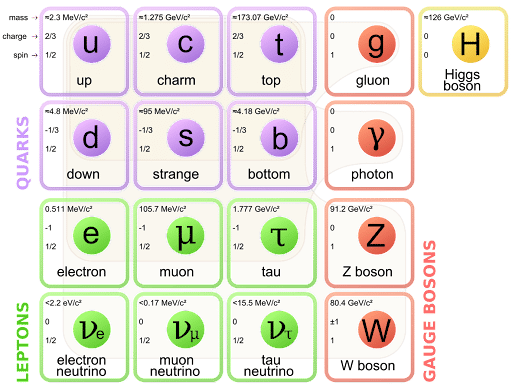
Standard Model – Fundamental Particles
Understanding the Composition of Standard Model
- The Standard Model divides the subatomic world into two broad categories of particles known as fermions and bosons.
- Fermions cannot share the same quantum state (for example, the same energy level inside an atom).
- Fermions are the "building blocks" of ordinary matter, combining in various ways to form well-known subatomic particles like protons, electrons, and neutrons.
- Fermions are classified into two types: leptons, which respond to electromagnetic and weak nuclear forces, and quarks, which respond to strong nuclear forces.
- The electron is one of the leptons, as are its heavier cousins, the muon and the tau. These two particles share the same properties as the electron but are more powerful.
- Each of these leptons is associated with a neutrino. Neutrinos are ultralight particles that are produced in nuclear reactions but rarely interact with matter.
- There are electron-neutrinos, muon-neutrinos, and tau-neutrinos, among others.
- In addition to these six leptons, quarks have six types, or "flavours": up, down, charm, strange, top, and bottom.
- The lightest and most stable quarks are up and down quarks, which combine in triplets to form protons and neutrons.
- Bosons, on the other hand, can have the same energy state. The photon, the electromagnetic force carrier, is the most well-known boson.
- Other force-carrying bosons include the three carriers of the weak nuclear force (called the W+, W-, and Z bosons) and the eight carriers of the strong nuclear force, known as gluons.
- The final boson, known as the Higgs boson, is unique and plays a critical role in the Standard Model.
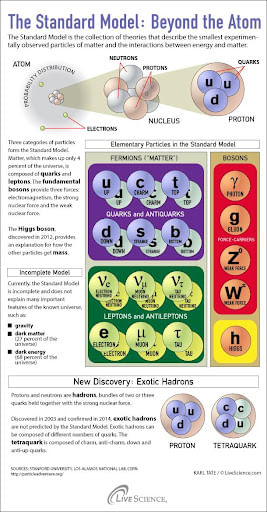
Standard Model
Fundamental Particles of Standard Model
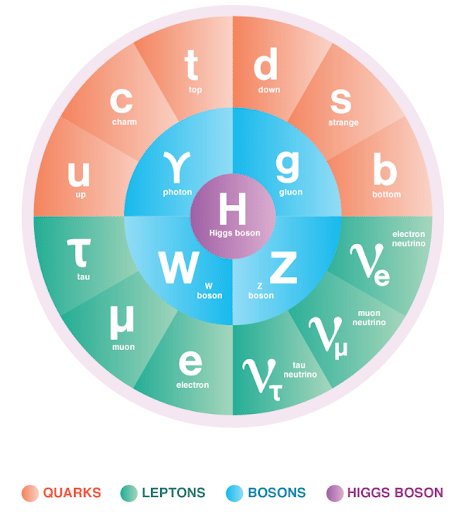
Fundamental Particles
| Fundamental Particle | Name | Description | Mass | Charge | Spin |
|---|---|---|---|---|---|
| Quarks | Up Quark | Up and down quarks make up protons and neutrons, which make up the nucleus of every atom. | 2.3 MeV | 2/3 | 1/2 |
| Charm Quark | In 1974, two independent research groups conducting experiments at two independent labs discovered the charm quark, the fourth quark to be found. | 1.275 GeV | 2/3 | 1/2 | |
| Top Quark | The top quark is the heaviest quark discovered so far. It has about the same weight as a gold atom. But unlike an atom, it is a fundamental, or elementary, particle; as far as we know, it is not made of smaller building blocks. | 173.21 GeV | 2/3 | 1/2 | |
| Down Quark | Nobody knows why, but a down quark is a just a little bit heavier than an up quark. If that weren’t the case, the protons inside every atom would decay and the universe would look very different. | 4.8 MeV | -1/3 | 1/2 | |
| Strange Quark | A new class of particles with “strange” properties were discovered in the 1960s, many years before it became clear that those properties were due to the fact that the particles all contained a new, “strange” kind of quark. | 95 MeV | -1/3 | 1/2 | |
| Bottom Quark | This particle is a heavier cousin of the down and strange quarks. Its discovery confirmed that all elementary building blocks of ordinary matter come in three different versions. | 4.18 GeV | -1/3 | 1/2 | |
| Leptons | Electron Neutrino | It wasn’t until 1956 that scientists observed the signal of an electron neutrino interacting with other particles. Nuclear reactions in the sun and in nuclear power plants produce electron antineutrinos. | <2 eV | 0 | 1/2 |
| Muon Neutrino | Neutrinos come in three flavors. The muon neutrino was first discovered in 1962. Neutrino beams from accelerators are typically made up of muon neutrinos and muon antineutrinos. | <0.19 MeV | 0 | 1/2 | |
| Tau Neutrino | it took until 2000 for scientists to develop the technologies to identify the particle tracks created by tau neutrino interactions. | <18.2 MeV | 0 | 1/2 | |
| Electron | The electron powers the world. It is the lightest particle with an electric charge and a building block of all atoms. The electron belongs to the family of charged leptons. | 0.511 MeV | -1 | 1/2 | |
| Muon | The muon is a heavier version of the electron. It rains down on us as it is created in collisions of cosmic rays with the Earth’s atmosphere. | 105.66 MeV | -1 | 1/2 | |
| Tau | It was the first discovery of a particle of the so-called third generation. It is the third and heaviest of the charged leptons, heavier than both the electron and the muon. | 1776.82 MeV | -1 | 1/2 | |
| Bosons | Photon | The photon is the only elementary particle visible to the human eye—but only if it has the right energy and frequency (color). It transmits the electromagnetic force between charged particles. | <1x10^-18 eV | 0 | 1 |
| Gluon | The gluon is the glue that holds together quarks to form protons, neutrons and other particles. It mediates the strong nuclear force. | 0 | 0 | 1 | |
| Z Boson | The Z boson is the electrically neutral cousin of the W boson and a heavy relative of the photon. Together, these particles explain the electroweak force. | 91.1876 GeV | 0 | 1 | |
| W Boson | The W boson is the only force carrier that has an electric charge. It’s essential for weak nuclear reactions: Without it, the sun would not shine. | 80.385 GeV | ±1 | 1 | |
| Higgs Boson | Higgs Boson | Discovered in 2012, the Higgs boson was the last missing piece of the Standard Model puzzle. It is a different kind of force carrier from the other elementary forces, and it gives mass to quarks as well as the W and Z bosons. Whether it also gives mass to neutrinos remains to be discovered. | 125.7 GeV | 0 | 0 |
Role of Higgs Mechanism in Standard Model
- In the Standard Model, the Higgs boson serves two functions.
- The electromagnetic and weak nuclear forces combine at high energies to form a single, unified force known as the electroweak force.
- The two forces split into their familiar forms at low energies (the typical energies of everyday life).
- The Higgs boson is responsible for keeping these two forces apart at low energies because the weak nuclear and electromagnetic forces interact differently with the Higgs boson.
- With the exception of neutrinos, all other quarks and leptons interact with the Higgs boson. This interaction determines the masses of the particles, which are determined by how strongly the particle interacts with the Higgs.
- As a result of the presence of the Higgs boson, many particles in our universe can acquire mass.
Shortcomings of Standard Model
- Despite the fact that the Standard Model is currently the best description of the subatomic world, it does not explain the entire picture.
- The theory includes only three of the four fundamental forces, leaving out gravity.
- Aside from gravity, the model lacks a mechanism for assigning masses to neutrinos and does not include dark matter or dark energy, which are the dominant forms of mass and energy in the universe.
- There are also important questions that it does not answer, such as:
- What is dark matter?
- What happened to antimatter after the big bang?
- Why are there three generations of quarks and leptons with such disparities in mass scale?
Conclusion
As a result, while the Standard Model accurately describes the phenomena within its domain, it is still insufficient. Perhaps it is only part of a larger picture that includes new physics hidden deep within the subatomic world or in the universe's dark recesses. New data from LHC experiments will aid in the discovery of more of these missing pieces.
| Other Relevant Links | |
|---|---|
| Science & Technology Policy in India | Scientific Policy Resolution 1958 |
| Science & Technology Policy of 1983 | Science & Technology Policy of 2003 |
| Science, Technology and Innovation Policy 2013 | New Initiatives Aligned with the National Agenda |
| Technology Vision Document 2035 | National Intellectual Property Rights Policy |
FAQs
Question: What is the standard particle model of quantum mechanics?
Answer: The standard particle model of quantum mechanics explains the behavior of particles like electrons and photons. It is based on the concept that particles exhibit both wave-like and particle-like properties, governed by quantum mechanics principles.
Question: How does the standard particle model explain the structure of an atom?
Answer: The model explains that atoms are composed of a nucleus containing protons and neutrons, surrounded by electrons that occupy discrete energy levels. The behavior of electrons is governed by quantum mechanics, with their positions defined probabilistically.
Question: What is wave-particle duality in quantum mechanics?
Answer: Wave-particle duality is the concept that particles such as electrons and light can behave as both waves and particles, depending on the experiment. This is fundamental to quantum mechanics and explains phenomena like interference and diffraction.
Question: How does quantum mechanics differ from classical mechanics?
Answer: Quantum mechanics deals with the behavior of very small particles at atomic and subatomic levels, where classical mechanics fails to explain phenomena such as wave-particle duality and superposition. It involves probabilistic outcomes, unlike classical mechanics' deterministic nature.
Question: What is Heisenberg's uncertainty principle?
Answer: Heisenberg's uncertainty principle states that it is impossible to precisely measure both the position and momentum of a particle simultaneously. The more accurately one of these is measured, the less accurately the other can be known.
MCQs
1. What does the standard particle model of quantum mechanics describe?
A) The trajectory of particles
B) The wave-like properties of particles
C) The interaction of protons and neutrons
D) The continuous behavior of light
Answer: (B) See the Explanation
Explanation: The standard particle model describes the behavior of particles like electrons and photons, emphasizing their wave-like and particle-like properties, which are explained by quantum mechanics.
2. Which principle is associated with quantum mechanics?
A) Newton’s Law
B) Theory of Relativity
C) Heisenberg’s uncertainty principle
D) Conservation of energy
Answer: (C) See the Explanation
Explanation: Heisenberg's uncertainty principle is a key concept in quantum mechanics, which states that it is impossible to simultaneously know both the position and momentum of a particle with absolute precision.
3. In quantum mechanics, the behavior of particles is described by?
A) Classical laws of motion
B) Wave function and probability
C) Kepler's laws
D) Newton's laws of motion
Answer: (B) See the Explanation
Explanation: In quantum mechanics, particles are described by wave functions, which provide the probability of finding a particle in a particular position or state, rather than definite trajectories.
4. What does wave-particle duality explain in quantum mechanics?
A) The position of electrons
B) The behavior of light
C) The behavior of large objects
D) The speed of sound
Answer: (B) See the Explanation
Explanation: Wave-particle duality explains that light and particles like electrons exhibit both wave-like and particle-like properties, depending on the experimental conditions.
5. What is the key difference between classical and quantum mechanics?
A) Quantum mechanics is deterministic
B) Classical mechanics deals with subatomic particles
C) Quantum mechanics deals with probabilistic behavior of particles
D) Classical mechanics involves wave functions
Answer: (C) See the Explanation
Explanation: Quantum mechanics deals with the probabilistic behavior of particles at atomic and subatomic scales, whereas classical mechanics involves deterministic laws of motion at macroscopic levels.
GS Mains Questions and Model Answers
Q1: How does the standard particle model of quantum mechanics explain the behavior of electrons in an atom?
Answer: The standard particle model of quantum mechanics explains that electrons in an atom occupy discrete energy levels and behave like both particles and waves. The position of an electron is not fixed, but is described by a probability distribution known as an orbital. Electrons can absorb or emit energy as they transition between these energy levels, which is fundamental in understanding atomic spectra. The model also incorporates the concept of wave-particle duality, where the wave function of the electron governs its behavior, offering a probabilistic description of its location and momentum.
Q2: Explain the significance of wave-particle duality in quantum mechanics and its impact on scientific theories.
Answer: Wave-particle duality is one of the cornerstones of quantum mechanics, suggesting that particles such as electrons and light can exhibit both wave-like and particle-like properties. This dual nature challenges classical physics, which could only explain light and particles as either waves or particles, but not both. The development of wave-particle duality has led to the development of quantum mechanics and has significantly impacted our understanding of atomic and subatomic behavior, paving the way for technological advancements like quantum computing, lasers, and semiconductors.
Q3: Discuss the implications of Heisenberg’s uncertainty principle on our understanding of particle behavior in quantum mechanics.
Answer: Heisenberg’s uncertainty principle asserts that the position and momentum of a particle cannot both be precisely measured at the same time. This principle has profound implications on the behavior of subatomic particles, suggesting that their exact state cannot be determined, and only probabilities of their behavior can be predicted. This challenges classical mechanics, where precise measurements are possible, and has led to the development of quantum mechanics, which focuses on probabilities and wave functions to describe the behavior of particles.
Previous Year Questions on Quantum Mechanics
1. UPSC CSE Mains 2020 (GS Paper 2):
Question: "Discuss the role of quantum mechanics in modern technology and its implications for future advancements."
Answer: Quantum mechanics has played a pivotal role in the development of technologies such as lasers, transistors, and MRI machines. Quantum computing, a potential future advancement, holds the promise of revolutionizing fields like cryptography, material science, and artificial intelligence. By understanding and manipulating the probabilistic nature of particles, quantum mechanics offers a new paradigm for solving complex problems that classical computers cannot handle efficiently.
2. UPSC CSE Mains 2018 (GS Paper 3):
Question: "Explain how the discovery of the electron and the development of quantum theory changed our understanding of atomic structure."
Answer: The discovery of the electron by J.J. Thomson and the subsequent development of quantum theory changed our understanding of atomic structure by revealing that atoms are not indivisible. The quantum theory, with contributions from scientists like Bohr, Schrödinger, and Heisenberg, introduced the concept of quantized energy levels and probabilistic electron positions within atoms, replacing the earlier models of fixed orbits. This new understanding laid the foundation for modern atomic theory and explained phenomena like atomic spectra and chemical bonding.
Download the PREPP App and attempt FREE IAS Exam Mock Tests and get complete study material!

Full Test - 04: UPSC CSE Prelims CSAT (Paper-II)
Full Test - 03: UPSC CSE Prelims CSAT (Paper-II)
UPSC CSE Prelims 2026 GS Paper 1 Question Paper (24-May-2026)
UPSC CSE Prelims 2026 CSAT Paper 2 Question Paper (24-May-2026)

17 February 2025 | The Hindu Must Read Articles | Current Affairs

16 February 2026 | The Hindu Must Read Articles | Current Affairs

13 February 2026 | The Hindu Must Read Articles | Current Affairs









Comments