Dark Matter vs Anti-Matter vs Negative Matter – Science & Technology Notes
Matter is an all-encompassing term for a substance with properties such as mass and volume. The Paul-Exclusion Principle explains the formal particle physics definition: matter is any field, such as an electron, quark, or neutrino, in which particles and antiparticles are accessible, but there is a limit to how much of a field can be at one point. This is why nothing has an infinite density. While the concept of matter is commonly understood and taught at an elementary level, two types of matter that are frequently confused but have different properties play a significant role in the universe as we know it: anti-matter and dark matter. Although these two terms are frequently used interchangeably, they have distinct definitions that are equally important to the universe.
Table of Contents
What is Normal Matter?
- Normal matter, such as that which we are all made of, interacts in the familiar ways with all four forces.
- To this point, all of our science and technology has been based on normal matter and how it behaves.
- However, for a few experiments and in specific particle accelerators, we have only used normal matter. As a result, it got its name.
What is Dark Matter?
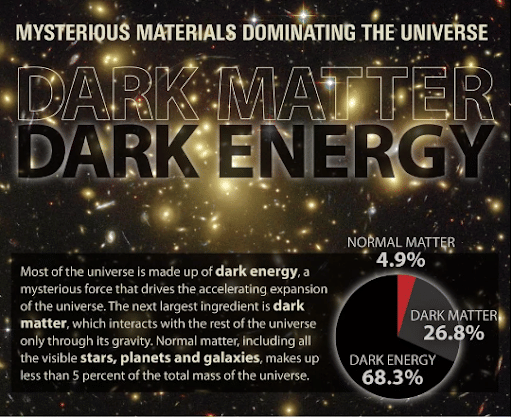
- The vast majority of the universe is made up of dark energy, a mysterious force that propels the universe's accelerating expansion.
- The next most abundant component is dark matter, which only interacts with the rest of the universe via gravity.
- Normal matter, which includes all visible stars, planets, and galaxies, accounts for less than 5% of the total mass of the universe.
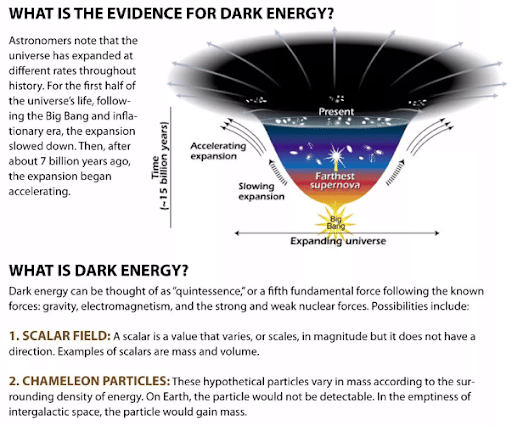
- Dark matter is Dark: Since dark matter emits no light and cannot be seen directly, it cannot be stars or planets.
- Dark matter is not clouds of normal matter: Baryons are ordinary matter particles. If dark matter were made up of baryons, it could be detected using reflected light.
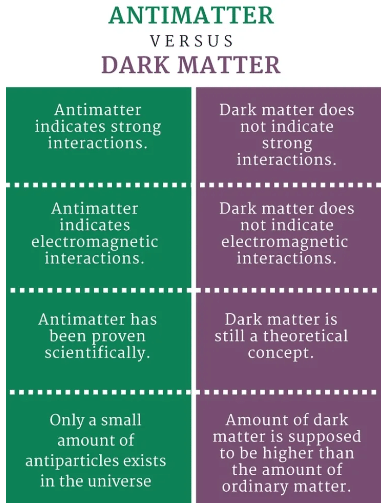
- Dark matter is not Anti-matter: Antimatter annihilates matter on contact, emitting gamma rays.
- Dark matter is not the same as black holes: Gravitational lenses bend light, which is what black holes are. There aren't enough lensing events to account for the amount of dark matter that must exist, according to astronomers.
- Dark matter is defined as matter that does not interact electromagnetically and thus cannot be seen with light.
- Dark matter, on the other hand, interacts gravitationally and can thus be "seen" through its gravitational effect on other matter. It is found throughout the universe and aids in the formation of galaxies.
- According to recent estimates, dark matter is five times more common in our universe than regular matter.
Dark Energy
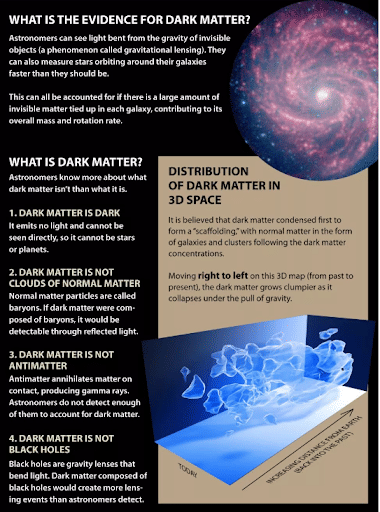
- Dark energy is a universal energy that is pushing galaxies apart and causing the universe to expand at an increasing rate.
- Dark energy, like dark matter, is poorly understood and cannot be directly detected using conventional methods.
- A number of lines of evidence indicate that our universe is expanding. Furthermore, our universe is expanding at an increasing rate.
- The poorly understood mechanism driving this accelerating expansion is known as dark energy.
- Dark matter tends to bring matter together, whereas dark energy tends to separate matter.
- Dark energy is weak and mostly operates at the intergalactic scale, where the gravitational attraction between dark matter and regular matter is negligible.
- Dark energy is thought to be distributed thinly but uniformly throughout the universe.
- Standard particle physics theories do not predict or explain dark energy, but it is included in modern Big Bang models.
- The connection between dark energy and vacuum energy predicted by particle physics is currently unknown.
What is Anti-Matter?
- Antimatter is simply matter with some of its properties reversed, such as its electric charge.
- A positron, for example, is the antimatter version of an electron. They have the same mass but opposing electric charges.
- For starters, antimatter has regular mass and responds to forces in the same way that regular matter does. Antimatter, like regular matter, is gravitationally attracted to other forms of matter.
- There is an antimatter counterpart for every particle (some particles, such as photons, are their own anti-particles).
- When antimatter comes into contact with its regular matter counterpart, they mutually destroy each other and all of their mass is converted to energy.
- Antimatter is extremely rare in our universe when compared to regular matter, but small amounts of antimatter can be found all over the natural world, including inside your body.
- Many types of radioactive decay, such as the decay of potassium-40, produce antimatter.
What is Negative Matter?
- Negative matter (also known as "exotic matter") contains negative energy.
- If it came into contact with ordinary matter, it would produce an underwhelming and abrupt nothing instead of an awesome explosion.
- When exotic matter is combined with ordinary matter, the positive energy of the matter and the negative energy of the exotic matter completely cancel out, leaving nothing behind.
- Negative matter is a hypothetical type of matter that has negative mass and negative energy if it exists.
- It will have a negative gravitational charge and will repel ordinary matter. In every other way, however, it will interact just like any other matter.
- It should be noted that matter and anti-matter repel each other, resulting in annihilation. Under gravity, however, matter and negative matter repel each other. The action of negative matter under the other three forces has yet to be hypothesized.
| Other Relevant Links | |
|---|---|
| Science & Technology Policy in India | Scientific Policy Resolution 1958 |
| Science & Technology Policy of 1983 | Science & Technology Policy of 2003 |
| Science, Technology and Innovation Policy 2013 | New Initiatives Aligned with the National Agenda |
| Technology Vision Document 2035 | National Intellectual Property Rights Policy |
Conclusion
The difference between dark matter and antimatter is that dark matter is an entirely new, distinct form of matter. Antimatter is identical to observational matter except that it has the opposite charge and thus cannot interact productively with matter. Dark matter interacts with matter via gravitational forces, which act as a binding force for the matter. The ever-expanding universe is characterized by dark energy, which pulls matter apart.
FAQs
Question: What is dark matter and how does it differ from regular matter?
Answer: Dark matter is a hypothetical form of matter that doesn't emit or interact with electromagnetic radiation like regular matter, making it invisible. It is inferred from its gravitational effects on visible matter and the universe's structure.
Question: What is antimatter and how is it different from matter?
Answer: Antimatter consists of particles that are the counterparts of normal matter particles but with opposite electric charges. When antimatter and matter meet, they annihilate each other, releasing energy.
Question: What is negative matter, and how does it relate to dark matter?
Answer: Negative matter is a theoretical concept where particles have opposite properties to normal matter. Unlike dark matter, negative matter is believed to have negative mass and may exhibit repulsive gravitational effects.
Question: Why is dark matter important in cosmology?
Answer: Dark matter is crucial in explaining the universe's structure and evolution, as its gravitational influence helps to hold galaxies and galaxy clusters together, impacting the expansion of the universe.
Question: How do scientists detect dark matter if it is invisible?
Answer: Scientists detect dark matter indirectly by observing its gravitational effects on visible matter, such as the rotation of galaxies, gravitational lensing, and the cosmic microwave background radiation.
MCQs
1. Which of the following best describes dark matter?
A) Matter that emits electromagnetic radiation
B) Matter that is visible to the naked eye
C) Matter that does not emit or reflect light but exerts gravitational effects
D) Matter that is found only in black holes
Answer: (C) See the Explanation
Dark matter is not visible and does not emit, absorb, or reflect light. It is detected through its gravitational effects on visible matter in the universe.
2. What happens when matter and antimatter collide?
A) They form a stable new particle
B) They annihilate each other, releasing energy
C) They form a new element
D) They combine to form dark matter
Answer: (B) See the Explanation
When matter and antimatter collide, they annihilate each other, resulting in the release of energy according to Einstein's famous equation E=mc^2.
3. Which of the following particles is a form of antimatter?
A) Proton
B) Electron
C) Positron
D) Neutron
Answer: (C) See the Explanation
The positron is the antimatter counterpart of the electron, with the same mass as an electron but a positive charge.
4. What is the primary evidence for the existence of dark matter?
A) The discovery of dark matter particles
B) The presence of cosmic microwave background radiation
C) The gravitational effects on visible matter in galaxies
D) The detection of dark matter in laboratory experiments
Answer: (C) See the Explanation
The existence of dark matter is inferred from its gravitational effects on visible matter, such as the way galaxies rotate faster than expected based on visible matter alone.
5. What is the primary difference between dark matter and negative matter?
A) Dark matter has negative mass, while negative matter does not
B) Negative matter has negative mass and would exhibit repulsive gravity, unlike dark matter
C) Negative matter is part of dark energy
D) There is no significant difference between them
Answer: (B) See the Explanation
Dark matter has positive mass and is believed to exert attractive gravitational effects, whereas negative matter, if it exists, is theorized to have negative mass and would exhibit repulsive gravitational effects.
GS Mains Questions and Model Answers
Q1: Discuss the theoretical significance of dark matter in understanding the structure of the universe. What are the challenges in detecting it?
Answer: Dark matter plays a crucial role in explaining the observed gravitational effects on galaxies and galaxy clusters. Without dark matter, the motion of galaxies cannot be explained by the visible matter alone. Its detection is challenging because it does not interact with light, making it invisible to current observation techniques. Scientists detect it indirectly by measuring its gravitational effects on visible matter and radiation.
Q2: Explain the concept of antimatter and its potential applications in energy generation and medical technologies.
Answer: Antimatter consists of particles with opposite charges to those of normal matter. When antimatter and matter meet, they annihilate each other, releasing large amounts of energy, which has potential applications in energy generation. In medicine, positron emission tomography (PET) scanners use antimatter (positrons) to create detailed images of the body, aiding in cancer diagnosis and treatment.
Q3: How do advances in the study of dark matter and antimatter impact our understanding of fundamental physics? Discuss their implications for cosmology.
Answer: Advances in dark matter and antimatter research challenge existing models of physics, particularly the Standard Model. The discovery of dark matter provides insights into the composition of the universe, and understanding antimatter could lead to breakthroughs in energy production. Both fields have profound implications for cosmology, offering clues about the universe’s formation, expansion, and the fundamental forces that govern it.
Previous Year Questions on Dark Matter, Antimatter, and Negative Matter
1. UPSC CSE 2020
Question: Explain the concept of dark matter and dark energy. How do they affect the expansion of the universe?
Answer: Dark matter and dark energy are invisible forms of energy and matter that account for approximately 95% of the universe's mass-energy content. Dark matter contributes to the formation of galaxies and galaxy clusters through its gravitational pull, while dark energy is thought to be responsible for the accelerated expansion of the universe.
2. UPSC CSE 2019
Question: Discuss the differences between matter, antimatter, and negative matter. What role do they play in modern physics?
Answer: Matter is composed of particles like protons, neutrons, and electrons. Antimatter consists of particles with opposite charges to those of normal matter, and when matter and antimatter meet, they annihilate each other. Negative matter, a hypothetical concept, has negative mass and may exhibit repulsive gravitational effects. These concepts are central to modern physics, influencing our understanding of the universe's fundamental laws and the potential for future technologies.
Download the PREPP App and attempt FREE IAS Exam Mock Tests and get complete study material!

Full Test - 04: UPSC CSE Prelims CSAT (Paper-II)
Full Test - 03: UPSC CSE Prelims CSAT (Paper-II)
UPSC CSE Prelims 2026 GS Paper 1 Question Paper (24-May-2026)
UPSC CSE Prelims 2026 CSAT Paper 2 Question Paper (24-May-2026)

17 February 2025 | The Hindu Must Read Articles | Current Affairs

16 February 2026 | The Hindu Must Read Articles | Current Affairs

13 February 2026 | The Hindu Must Read Articles | Current Affairs









Comments