Policy on Synthetic Biology – Science & Technology Notes
The Department of Biotechnology under Ministry of Science and Technology has recently released a draft foresight paper on synthetic biology. Synthetic biology has numerous energy, agriculture, and biofuel applications. As a result, there is always the perceived risk of components leaking into the open environment. As a result, the document emphasises the importance of a national policy that can solidify India's position on the issue. In this article, we will discuss in detail regarding Synthetic Biology and its implications which will be helpful for UPSC exam preparation.
Table of Contents
Synthetic Biology – Background
- The research into 'synthetic biology,' i.e., developing organisms and products that are completely new to the world began decades ago.
- Barbara Hobomin coined the term 'synthetic biology' in 1980 to describe bacteria that had been genetically engineered using recombinant DNA technology.
- The Craig Venter Institute in the United States created the first artificial life form, dubbed 'Synthia,' in 2010.
- Synthetic biology has captured the imagination of scientists in less than nine years, and the industry's market of $11 billion in 2016 is expected to grow to $100 billion by 2025.
What is Synthetic Biology?
- The science of using genetic sequencing, editing, and modification to create unnatural organisms or organic molecules that can function in living systems is known as synthetic biology.
- Synthetic biology allows scientists to create new DNA sequences from scratch.
- It is a branch of science that involves engineering organisms to have new abilities in order to redesign them for useful purposes.
- Researchers and companies all over the world are harnessing nature's power to solve problems in medicine, manufacturing, and agriculture.
- The term was used to describe the creation of unnatural organic molecules that serve as building blocks in living systems. In a broader sense, the term has been used to refer to efforts to "redesign life."
- Synthetic biology projects frequently aim to redesign organisms so that they produce a substance, such as a medicine or fuel, or gain a new ability, such as sensing something in the environment.
What is the difference between Synthetic Biology and Genome Editing?
- Synthetic biology is similar to another approach known as "genome editing" in that both involve changing an organism's genetic code; however, some people distinguish between the two approaches based on how that change is made.
- In synthetic biology, scientists typically join together long stretches of DNA and insert them into the genome of an organism.
- These synthesised DNA fragments could be genes found in other organisms or completely novel.
- Scientists typically use tools to make smaller changes to the organism's own DNA when genome editing.
- Small stretches of DNA in the genome can also be deleted or added using genome editing tools.
Applications of Synthetic Biology
- Biofuel production: Could be used to create microorganisms capable of producing biofuels efficiently from renewable feedstocks such as plant material or waste products.
- Natural Product Synthesis: Engineers microbes to produce all of the enzymes and biological functions required to perform complex multistep natural product production.
- Bioremediation uses microorganisms to remove pollutants from our water, soil, and air.
- Medicine: Synthetic biology could be used to create new drugs and therapies like vaccines and cancer treatments.
- Industrial chemicals: Could be used to produce industrial chemicals such as plastics or detergents in a more environmentally friendly and cost-effective manner.
- Applied Protein Design is the process of redesigning existing biological parts and expanding the set of natural protein functions for new processes.
- Rice has been genetically modified to produce beta-carotene, a nutrient commonly associated with carrots that helps prevent vitamin A deficiency.
- Cleanup of the environment: This could be used to create microorganisms that can clean up pollution or restore damaged ecosystems.
- Agriculture: Synthetic biology could be used to boost crop yields, develop drought-resistant crops, and create pest and disease-resistant crops.
- Synthetic Genomics is the process of designing and building a 'simple' genome for a natural bacterium.
- Yeast engineered to produce rose oil as an environmentally friendly and sustainable alternative to real roses used by perfumers to create luxury scents.
- Research and development: Synthetic biology can be used to better understand fundamental biological processes, leading to new insights and innovations in a wide range of fields.
- Identify and categorise standardised genomic parts that can be used (and quickly synthesised) to build new biological systems.
Challenges Related to Synthetic Biology
- Technical difficulties: This involves the design and construction of complex biological systems, which can be difficult. Improved tools and technologies are required to enable the precise and reliable design and construction of synthetic biological systems.
- Regulatory issues: Because there is a lack of clear and consistent regulation for synthetic biology, researchers and companies may find it difficult to navigate the field.
- Ethical concerns: This will raise a number of ethical concerns, such as the possibility of negative environmental consequences or concerns about the ethical implications of creating genetically modified organisms.
- Social issues: There is a lack of public understanding and acceptance of synthetic biology, which could stymie its development and implementation. Synthetic biology has the potential to have a negative impact on industries or job markets, as well as exacerbate existing socioeconomic inequalities.
- Funding issues: This research can be costly and time-consuming, and obtaining funding can be difficult.
- Intellectual property issues: Because the field of synthetic biology is rapidly evolving, there is an ongoing debate about intellectual property rights and who should have access to the field's technologies and tools.
Negative Impact of Synthetic Biology
- Safety: Synthetic biological systems have the potential to behave in unexpected ways, which could have negative consequences. For example, genetically modified organisms (GMOs) used in agriculture may have unintended environmental consequences.
- Negative Environmental Health: The deliberate or unintentional release of genetically engineered organisms into the environment could have serious consequences for both human and environmental health.
- Misapplication of these technologies, as well as a failure to account for unintended consequences, could result in irreversible environmental damage.
- Do-It-Yourself Biology: A movement of "citizen scientists" interested in synthetic biology experiments that has grown into an international phenomenon in the last decade.
- With little prior knowledge of the field, enthusiasts gather in makeshift labs to take biotechnology crash courses and conduct hands-on experiments.
- Security: Synthetic biology has the potential to be used maliciously, such as in the development of bioweapons.
- Concerns about ethics: There are ethical concerns about the use of synthetic biology, such as the possibility of creating genetically modified organisms that could have a negative impact on biodiversity or the fear that it could result in "designer babies."
- There is a lack of public understanding and acceptance of synthetic biology, which could stymie its development and implementation.
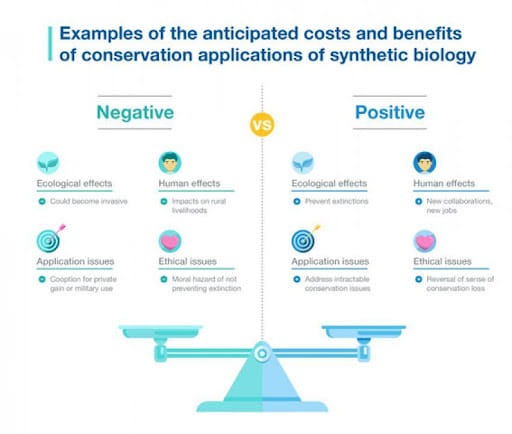
Synthetic Biology – Positives & Negatives
Synthetic Biology in India
- Synthetic biology, like any other emerging technology, has both positive and negative implications.
- Countries such as India are caught in a quandary in which the industry is investing in developing organisms and products with little regulatory or policy oversight.
- For a country like India, a conceptual framework for the potential future implications of synthetic biology would include elements of inclusion and public responsiveness.
- Such an approach may be novel in India, which has traditionally relied on reactive responses in policymaking and legal framework development.
- Furthermore, the number of interventions undertaken by the private sector in India to focus on product development using synthetic biology is surprising.
- India's policy and regulatory framework must prioritise the following:
- Determining what constitutes synthetic biology science?
- What kinds of R&D priorities will be established for the public sector?
- What will be the future guidance for the private sector in synthetic biology research that takes into account all relevant policy frameworks, including those governing intellectual property rights?
- How India will regulate the development and use of this technology, taking into account environmental and socioeconomic concerns?
Synthetic Biology – Way Forward
- Synthetic biology is regarded as one of the top ten breakthrough technologies in the ongoing fourth industrial revolution, and is said to be "most likely to change the world".
- While there are "complex challenges" in developing a national regulatory framework, the potential benefits far outweigh the mostly manageable risks.
- The department's document calls for not only a regulatory policy and framework, but also the definition and scope of synthetic biology.
- Stringent risk assessment and the inclusion of diverse stakeholder perspectives should be used in the development and handling of innovative synthetic biology applications and products in accordance with the precautionary principle.
- It is time for India to solidify its position on synthetic biology science and communicate its interests and aspirations in relevant international fora with clarity, avoiding conflicting positions on science on the one hand and policy on the other.
- It is more important than ever to develop a synthetic biology policy because the field is rapidly evolving, with new discoveries occurring every year.
- Soon, we will see some products, and we must be prepared with a regulatory framework.
Conclusion
Synthetic Biology provides novel approaches for creating new biological systems or redesigning existing ones for practical applications. India provides a classic example of how science-policy interface should or should not work, with the Department of Biotechnology and Ministry of Agriculture supporting promotion of this science and technology, and the Ministry of Environment dealing with approval for commercialization of such new technology. However, India has yet to formally develop its national synthetic biology strategy. In the absence of such a strategy, India risks having the same contentious debates about synthetic biology organisms as it does about genetically modified organisms.
| Other Relevant Links | |
|---|---|
| Science & Technology Policy in India | Scientific Policy Resolution 1958 |
| Science & Technology Policy of 1983 | Science & Technology Policy of 2003 |
| Science, Technology and Innovation Policy 2013 | New Initiatives Aligned with the National Agenda |
| Technology Vision Document 2035 | National Intellectual Property Rights Policy |
FAQs
Question: What is synthetic biology?
Answer: Synthetic biology is an interdisciplinary field that combines biology, engineering, and computer science to design and construct new biological parts, devices, and systems, or to redesign existing biological systems for useful purposes.
Question: What is the primary goal of synthetic biology?
Answer: The primary goal of synthetic biology is to create new, artificial life forms or modify existing organisms to perform specific tasks like producing biofuels, pharmaceuticals, or improving agricultural practices.
Question: What are the applications of synthetic biology?
Answer: Applications of synthetic biology include environmental sustainability, agriculture (e.g., genetically modified crops), biofuel production, disease treatment, and creating new materials like biodegradable plastics.
Question: What are the potential risks associated with synthetic biology?
Answer: Potential risks include ethical concerns, unintended consequences on ecosystems, biosecurity threats from engineered organisms, and the potential for misuse in harmful applications.
Question: How is India regulating synthetic biology?
Answer: India is developing a policy framework for synthetic biology, addressing bioethics, environmental safety, and the regulation of genetically modified organisms to balance innovation and safety.
MCQs
1. What does synthetic biology aim to achieve?
A) Improve traditional farming methods
B) Create new, artificial life forms
C) Restrict genetic engineering
D) Focus solely on natural biological processes
Answer: (B) See the Explanation
Explanation: Synthetic biology aims to create new, artificial life forms or redesign existing biological systems for specific purposes, such as producing biofuels or new drugs.
2. Which of the following is a major application of synthetic biology?
A) Development of renewable energy sources
B) Creation of artificial intelligence
C) Development of nuclear energy
D) Restriction of GMO crops
Answer: (A) See the Explanation
Explanation: Synthetic biology plays a major role in the development of renewable energy sources, such as biofuels, through the modification of organisms to produce bioenergy efficiently.
3. Which of the following is a potential risk of synthetic biology?
A) Reduced efficiency in industrial production
B) Biosecurity threats from engineered organisms
C) Increased biodiversity
D) Decreased agricultural productivity
Answer: (B) See the Explanation
Explanation: One of the primary risks of synthetic biology is the potential for biosecurity threats, such as engineered organisms being misused or causing unintended ecological damage.
4. What is one of the key concerns regarding synthetic biology from an ethical standpoint?
A) Lack of regulatory frameworks
B) Unintended ecosystem disruption
C) Cost of research
D) Limited commercial potential
Answer: (B) See the Explanation
Explanation: Ethical concerns around synthetic biology include the unintended consequences it may have on ecosystems, such as disrupting natural balances or causing harm to biodiversity.
5. Which of the following countries is actively working on a policy framework for synthetic biology?
A) India
B) China
C) United States
D) Russia
Answer: (A) See the Explanation
Explanation: India is currently working on developing a policy framework for synthetic biology, focusing on bioethics, environmental safety, and regulation of genetically modified organisms.
GS Mains Questions and Model Answers
Q1: Discuss the implications of synthetic biology for agriculture in India.
Answer: Synthetic biology holds significant potential for agriculture in India, where it can be leveraged to improve crop yields, create disease-resistant plants, and develop biofortified crops with enhanced nutritional value. It can help address challenges like food security and the impact of climate change on agriculture by creating crops that are more resilient to extreme weather conditions. Moreover, bioengineered crops can help reduce the reliance on chemical fertilizers and pesticides, leading to more sustainable farming practices. However, ethical concerns related to genetically modified organisms (GMOs) and the long-term impact on biodiversity must be carefully addressed in policy formulation. A balanced approach is necessary to ensure that synthetic biology contributes positively to agricultural development while safeguarding environmental and public health interests.
Q2: Evaluate the ethical concerns surrounding synthetic biology and its regulation in India.
Answer: The ethical concerns surrounding synthetic biology are multifaceted and include the potential risks of ecological disruption, biosecurity threats, and the creation of organisms that could be misused. In India, these concerns are particularly significant due to the country's rich biodiversity and the reliance on agriculture for livelihoods. The regulation of synthetic biology must ensure that genetic modifications are safe for both humans and the environment. Additionally, there are concerns about equity, as the technology could potentially widen the gap between those who can afford advanced biotechnology and marginalized communities. Ethical governance is necessary to ensure that synthetic biology innovations are used responsibly, with adequate public consultation and transparent regulatory frameworks.
Q3: How can synthetic biology contribute to India's efforts in combating climate change?
Answer: Synthetic biology can play a crucial role in India's climate change mitigation efforts by enabling the development of biofuels and renewable energy sources. Through the design of microorganisms that can efficiently convert waste materials into biofuels, India could reduce its dependence on fossil fuels, thereby decreasing carbon emissions. Furthermore, synthetic biology could help in developing plants that are more resilient to drought and other climate-related stresses, ensuring food security in a changing climate. Additionally, synthetic biology could be used to create carbon-capture organisms that help remove excess CO2 from the atmosphere, contributing to India's climate adaptation and mitigation strategies.
Previous Year Questions on Synthetic Biology
1. UPSC CSE Mains 2020 (GS Paper 3):
Question: "Discuss the applications and risks of synthetic biology in modern biotechnology. What steps should India take to regulate its development?"
Answer: Synthetic biology has numerous applications in fields like healthcare, agriculture, and environmental sustainability, such as the development of genetically modified organisms (GMOs), biofuels, and bio-remediation agents. However, its risks include biosecurity threats, ecological impacts, and ethical concerns over genetic modification. India should establish a robust regulatory framework that includes guidelines for research, public health assessments, and environmental safety. Additionally, there should be a mechanism for public consultation, ensuring transparency and addressing public concerns about genetic engineering and synthetic biology.
2. UPSC CSE Mains 2019 (GS Paper 3):
Question: "Evaluate the potential of synthetic biology in advancing India's healthcare system. What ethical issues should be considered in its application?"
Answer: Synthetic biology can significantly advance India's healthcare system by enabling the production of affordable drugs, personalized medicine, and targeted therapies for diseases such as cancer and genetic disorders. It also holds potential for improving diagnostics and vaccine production. Ethical issues include concerns over patenting of life forms, the creation of genetically modified organisms, and the accessibility of such technologies for the wider population. Regulatory frameworks should ensure equitable access to benefits, safety standards for genetically modified organisms, and adequate public oversight.
Download the PREPP App and attempt FREE IAS Exam Mock Tests and get complete study material!

Full Test - 04: UPSC CSE Prelims CSAT (Paper-II)
Full Test - 03: UPSC CSE Prelims CSAT (Paper-II)
UPSC CSE Prelims 2026 GS Paper 1 Question Paper (24-May-2026)
UPSC CSE Prelims 2026 CSAT Paper 2 Question Paper (24-May-2026)

17 February 2025 | The Hindu Must Read Articles | Current Affairs

16 February 2026 | The Hindu Must Read Articles | Current Affairs

13 February 2026 | The Hindu Must Read Articles | Current Affairs









Comments