Technology Vision Document 2035 – Science & Technology Notes
The Technology Information, Forecasting and Assessment Council (TIFAC), an autonomous body under the Government of India's Department of Science and Technology (DST), published India's "Technology Vision 2035" in early 2016. It is an account of what we can (and should) be as a people and a country in 2035. TV 2035 claims to be inspired by the "collective aspirations of Indians, the ambitions of our youth, and the likely expectations of Indians in 2035 as the country grows." In this article, we will discuss regarding the Technology Vision 2035 which will be helpful for UPSC exam preparation.
Table of Contents
- Technology Vision Document 2035
- Technology Vision Document 2035 – Prerogatives
- Technology Vision Document 2035 – Essential Prerequisites
- Technology Vision Document 2035 – Grand Challenges
- Technology Vision Document 2035 – Capabilities & Constraints
- Technology Vision Document 2035 – Comprehensive National Power
- Conclusion
- FAQs
- MCQs
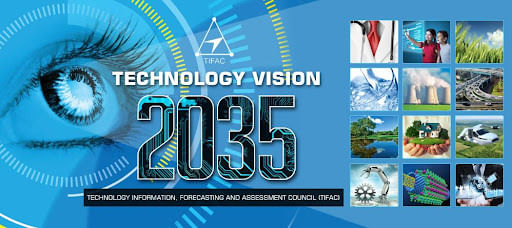
What is Technology Vision Document 2035?
- The document presents a vision of Indian citizens' needs in 2035, as well as how technology can help bring this vision to fruition.
- People are said to be as important as technology in TV 2035: "It considers India's technological 'peoplescape' to be as important as its technological landscape."
- TV 2035 recognises that there is no India without Indians.
- This document is divided into six sections to explore the technological dimensions of this vision.
- The document also identifies 12 technology development sectors - Education, Medical Sciences and Healthcare, Food and Agriculture, Water, Energy, Environment, Habitat, Transportation, Infrastructure, Manufacturing, Materials, and Information and Communication Technology.
| Section | Description |
|---|---|
| First Section |
|
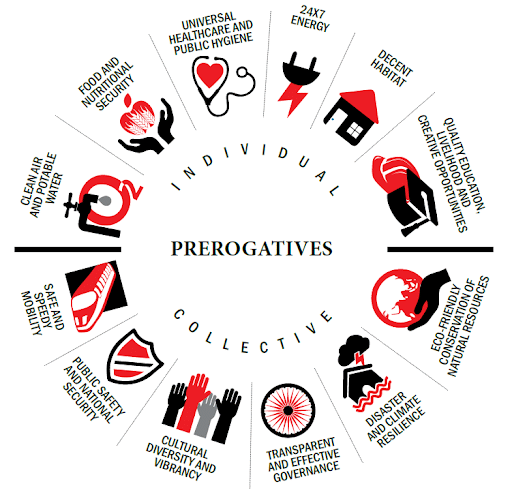
| Second Section | It outlines twelve 'prerogatives' that all Indians will have in 2035:
|
| Third Section |
|
| Fourth Section |
|
| Fifth Section |
|
| Sixth Section |
|
Technology Vision Document 2035 – Prerogatives
- Twelve prerogatives should be available to every Indian, and ensuring their attainment is at the heart of our technology vision for India.
- Nonetheless, our people's inherent and enduring diversity would have to be factored into our policies in order to meet these prerogatives.
- To begin, different targets would need to be set for different population segments: while clean air is a greater challenge in our cities, potable water is a greater challenge in our rural areas.
- Second, technology delivery mechanisms would differ for different population segments: for example, ensuring water availability in our arid zones would present a number of challenges in terms of both technology creation and delivery.
- Finally, success in meeting our technology goals would have different social consequences depending on the characteristics of the population segment: connectivity, for example, would be far more enabling in our countryside than in our metropolitan areas.
Technology Vision Document 2035 – Essential Prerequisites
- Critical technologies that would assist in achieving these prerogatives are identified and placed on a timeline divided into four stages:
- technology that already exists and is thus ready for deployment,
- technology in pilot scale that must be scaled up in order to move from lab to land,
- technology in the R&D stage that requires additional targeted research, and
- technology that is still in the imagination and could emerge as a result of curiosity driven, paradigm shattering research.
- The vision document also mentions the three critical 'transversal' technologies - materials, manufacturing, and information and communication technology (ICT) - that serve as the foundation for all other technologies.
- Furthermore, this will necessitate a strong supporting infrastructure.
- Technology development cannot occur in isolation; it requires an enabling ecosystem and a teamwork culture. It must also heavily rely on cutting-edge fundamental research.
Technology Vision Document 2035 – Grand Challenges
- Many of the challenges encountered during this technology vision exercise could be easily related to our country's developmental needs.
- We attempted to connect technology to the real needs of the people and the country by identifying twelve prerogatives.
- However, it is important to recognise that some goals go beyond the prerogatives in the sense that they address enormous challenges, would be realised only in the medium term, and would necessitate concerted and herculean efforts.
- The Grand Challenges identified here share a few characteristics. They all have a single overarching goal with multiple specific targets.
- If the Grand Challenges are met, they will have a multiplier effect, resulting in positive spinoffs, virtuous cycles, and feed into a variety of sectors.
- The document focuses on the grand challenges in the field of technology that we should address as a nation and are as follows:
- Guaranteeing nutritional Security and eliminating female and child anaemia
- Ensuring quantity and quality of water in all rivers and aquatic bodies
- Securing critical resources Commensurate with the size of our country
- Providing learner centric, language neutral and Holistic education to all
- Understanding national Climate patterns and adapting to them
- Making India Non-fossil fuel based
- Taking the railway to Leh and Tawang
- Ensuring location and ability Independent electoral and financial empowerment
- Developing commercially Viable decentralised and Distributed energy for all
- Ensuring universal ecofriendly Waste management
Technology Vision Document 2035 – Capabilities & Constraints
- There has also been a heated debate about the social impact of technology and the trade-off between capital and labour.
- Capital-intensive technology has been projected as detrimental to the use of 'Manpower,' particularly in India with abundant human resources, because it is argued that it would reduce jobs.
- The Vision Document seeks to dispel this myth by arguing in favour of prudent policy and deliberate planning in the use of technology to teach new skills to workers and meet societal needs.
- It depicts technology as a great equaliser rather than a source of social stratification.
- To address these challenges, the Vision Document 2035 envisions a rational assessment of the Indian Technological Landscape's capabilities and constraints.
- From an Indian perspective, it divides technologies into six categories:
- Technology leadership refers to those niche technologies in which we have core competencies, trained and skilled manpower, supportive infrastructure, an intellectual environment, and a traditional knowledge base, and can thus seek to assume a leadership role.
- Technology independence refers to technologies that we would be forced to develop on our own because they are critical and simply would not be available elsewhere.
- Technology innovation entails connecting disparate technologies or applying a breakthrough in one technology to another.
- Technology adoption entails acquiring technologies from other sources, either by purchasing them or through a collaborative approach, and then modifying them to meet our needs, reducing our permanent reliance on other sources.
- Technology dependence: those technological areas in which our country would remain dependent for reasons of infancy (technologies in which India is at the infancy stage and is likely to fall behind the curve in the long run), insignificance (technologies that are unlikely to have a significant impact on India's growth trajectory in the next 20 years), or redundancy (technologies that could easily be purchased from elsewhere and whose costs are low).
- Technology constraints refer to areas where technology is threatening and problematic, either due to its negative environmental or social impact or due to serious legal and ethical issues.
Technology Vision Document 2035 – Comprehensive National Power
- In a separate section of the Vision Document, a 'Call to Action' is issued to all key stakeholders. It highlights the importance of long-term sustainability of India's technological prowess.
- Technical Education Institutions conduct large-scale advanced research that leads to game-changing innovations.
- The government increases its financial support from 1% to the long-planned 2% of GDP.
- In the core research sector, the number of full-time equivalent Scientists should increase.
- Participation and investment by the private sector in emerging technologies that are easily deployable and transferable from lab to field, thereby increasing efficiency in terms of technology and economic returns.
- The connection between academia, intelligence, and industry is established through idea exchange, innovative curriculum design based on industry needs, industry-sponsored student internships, and research fellowships, among other things.
- Creating a Research Ecosystem to translate research into a technology product/process by bringing together students, researchers, and entrepreneurs.
- In addition, three key activities are identified as part of the 'Call to Action' in the document.
- The first is the creation of knowledge. It asserts that India cannot afford not to be at the forefront of the applied or pure knowledge revolution.
- The second activity is ecosystem design for innovation and development. Intriguingly, the document again states that the primary responsibility for ecosystem design must necessarily rest with government authorities.
- A third key activity mentioned is technology deployment, which involves launching specific national missions with specific targets, defined timelines, and only a few carefully defined identified players.
| Other Relevant Links | |
|---|---|
| Science & Technology Policy in India | Scientific Policy Resolution 1958 |
| Science & Technology Policy of 1983 | Science & Technology Policy of 2003 |
| Science, Technology and Innovation Policy 2013 | New Initiatives Aligned with the National Agenda |
| India and World collaboration in science projects | National Intellectual Property Rights Policy |
Conclusion
While this vision document looks to the future while considering the entire country, the technology roadmap for each sector would provide details outlining future technology trends, R&D directives, research points, anticipated challenges, and policy imperatives for each sector.
FAQs
Question: What is the Technology Vision Document 2035 and its primary objective?
Answer: The Technology Vision Document 2035 is a strategic framework aimed at guiding India’s technological advancements over the next decade. Its primary objective is to ensure that India becomes a leader in critical technological sectors such as artificial intelligence (AI), biotechnology, cybersecurity, and space technology. The document outlines a roadmap for developing indigenous capabilities, fostering innovation, and addressing emerging global challenges. By 2035, India aims to enhance its technological infrastructure to drive economic growth, improve quality of life, and strengthen its global competitiveness.
Question: What are the key focus areas of the Technology Vision Document 2035?
Answer: The Technology Vision Document 2035 focuses on several key areas including:
- Artificial Intelligence and Robotics: Leveraging AI and robotics for improving manufacturing, healthcare, and governance.
- Digital Infrastructure: Building robust digital infrastructure to enable widespread internet access and promote digital literacy.
- Clean Energy Technology: Promoting the development of clean and sustainable energy solutions to combat climate change.
- Space Technology: Enhancing India’s capabilities in space exploration and satellite technology.
- Cybersecurity: Strengthening national security through enhanced cybersecurity measures.
Question: How does the Technology Vision Document 2035 aim to drive economic growth in India?
Answer: The document envisions a transformation of India’s economy through technological innovation and advancements. By investing in sectors such as AI, IoT (Internet of Things), and clean energy, it aims to create new industries and jobs, enhance productivity in traditional sectors like agriculture and manufacturing, and boost exports of high-tech products. Furthermore, promoting digital literacy and infrastructure will enable inclusive growth, ensuring that all sections of society benefit from technological advancements.
Question: What role does innovation play in the Technology Vision Document 2035?
Answer: Innovation is at the core of the Technology Vision Document 2035. It emphasizes creating a conducive ecosystem for research and development (R&D), fostering public-private partnerships, and encouraging startups in emerging technologies. The government aims to provide financial and infrastructural support to innovative enterprises, particularly in sectors like biotechnology, artificial intelligence, and advanced manufacturing, to drive technological breakthroughs and make India a global innovation leader.
Question: How does the Technology Vision Document 2035 align with India’s broader national goals?
Answer: The Technology Vision Document 2035 aligns with India’s national goals of sustainable development, economic self-sufficiency, and global competitiveness. It is designed to complement other national initiatives such as the Digital India program, Make in India, and Skill India by providing a technological backbone to these efforts. By focusing on innovation, sustainability, and inclusivity, the document supports India’s ambition to become a $5 trillion economy and improve the quality of life for all citizens by 2035.
MCQs
1. What is the primary aim of the Technology Vision Document 2035?
A) To make India a global leader in technology
B) To develop space exploration programs
C) To increase international trade in technology
D) To increase defense capabilities
Answer: (A) See the Explanation
Explanation: The primary aim of the Technology Vision Document 2035 is to establish India as a global leader in technology by focusing on innovation and technological advancements.
2. Which of the following is NOT a focus area of the Technology Vision Document 2035?
A) Artificial Intelligence
B) Biotechnology
C) Cybersecurity
D) Space Tourism
Answer: (D) See the Explanation
Explanation: While space technology is a key focus area, space tourism is not specifically highlighted in the Technology Vision Document 2035.
3. What role does innovation play in the Technology Vision Document 2035?
A) It is central to driving economic growth and technological advancements
B) It is limited to enhancing manufacturing processes
C) It is only focused on digital infrastructure
D) It is primarily aimed at improving agricultural productivity
Answer: (A) See the Explanation
Explanation: Innovation is central to the document’s goals, driving advancements in various sectors including AI, clean energy, and digital infrastructure.
4. How does the Technology Vision Document 2035 aim to improve the standard of living in India?
A) By focusing on rural development
B) By increasing the manufacturing of low-cost goods
C) By enhancing access to digital infrastructure and technology
D) By limiting technological advancements to defense
Answer: (C) See the Explanation
Explanation: The document aims to enhance the standard of living by improving digital infrastructure, which will enable better access to services, education, and healthcare for all citizens.
5. Which sector is highlighted as critical for the growth of India’s technology ecosystem in the Vision Document 2035?
A) Defense technology
B) Space technology
C) Clean energy
D) Tourism technology
Answer: (C) See the Explanation
Explanation: Clean energy technology is highlighted as critical for sustainable growth, contributing to environmental conservation and energy security.
GS Mains Questions and Model Answers
Q1: Analyze how the Technology Vision Document 2035 aligns with India’s goal of becoming a $5 trillion economy.
Answer: The Technology Vision Document 2035 plays a pivotal role in India’s ambition to become a $5 trillion economy by enhancing the technological ecosystem in sectors such as AI, clean energy, and digital infrastructure. By focusing on innovation and digital transformation, the document aims to increase productivity, create new industries, and boost exports. Additionally, promoting research and development (R&D) and fostering entrepreneurship will help create jobs and improve economic competitiveness. The document’s emphasis on clean energy also aligns with sustainable growth, which is essential for long-term economic success.
Q2: How does the emphasis on digital infrastructure in the Technology Vision Document 2035 contribute to inclusive growth in India?
Answer: The focus on digital infrastructure in the Technology Vision Document 2035 is essential for promoting inclusive growth by improving access to services, education, and healthcare for all sections of society. Expanding broadband connectivity, particularly in rural areas, will bridge the digital divide, enabling people to benefit from digital education, telemedicine, and government services. By integrating underserved areas into the digital economy, the document aims to foster economic participation and reduce regional inequalities.
Q3: Discuss the role of artificial intelligence and robotics in transforming India’s industrial landscape as envisioned in the Technology Vision Document 2035.
Answer: The Technology Vision Document 2035 highlights artificial intelligence (AI) and robotics as transformative technologies for India’s industrial sector. AI and robotics can improve manufacturing efficiency, reduce costs, and enhance product quality. By integrating these technologies into sectors like automotive, electronics, and agriculture, India can achieve higher productivity and competitiveness in global markets. Additionally, AI-driven automation can help address labor shortages and enhance precision in industrial processes, leading to a more robust and technologically advanced industrial landscape.
Previous Year Questions on Technology and Innovation
1. UPSC CSE Prelims 2020:
Question: What is the key focus of India’s Technology Vision Document 2035?
A) To make India a global leader in clean energy
B) To establish India as a leader in space exploration
C) To improve technological infrastructure and innovation
D) To focus exclusively on artificial intelligence
Answer: (C)
Explanation: The document focuses on improving technological infrastructure and innovation across sectors to position India as a leader in various technological fields.
2. UPSC CSE Mains 2019 (GS Paper 3):
Question: How does the Technology Vision Document 2035 address India’s technological challenges and opportunities?
Answer: The document identifies key technological challenges such as limited infrastructure, dependence on imports, and the digital divide. It proposes solutions including investment in R&D, fostering innovation, expanding digital infrastructure, and promoting clean energy technologies. These initiatives are expected to transform India into a global technology hub by enhancing capabilities in AI, biotechnology, and cybersecurity, thereby addressing both current challenges and future opportunities.
Download the PREPP App and attempt FREE IAS Exam Mock Tests and get complete study material!

Full Test - 04: UPSC CSE Prelims CSAT (Paper-II)
Full Test - 03: UPSC CSE Prelims CSAT (Paper-II)
UPSC CSE Prelims 2026 GS Paper 1 Question Paper (24-May-2026)
UPSC CSE Prelims 2026 CSAT Paper 2 Question Paper (24-May-2026)

17 February 2025 | The Hindu Must Read Articles | Current Affairs

16 February 2026 | The Hindu Must Read Articles | Current Affairs

13 February 2026 | The Hindu Must Read Articles | Current Affairs









Comments