The Big Bang Theory – Science & Technology Notes
Astronomers use the big bang theory to explain how the universe began. It is the concept that the universe began as a single point, then expanded and stretched to become the size it is now—and it is still stretching. In this article, we will discuss in detail regarding the Big Bang Theory which will be helpful for UPSC exam preparation.
Table of Contents
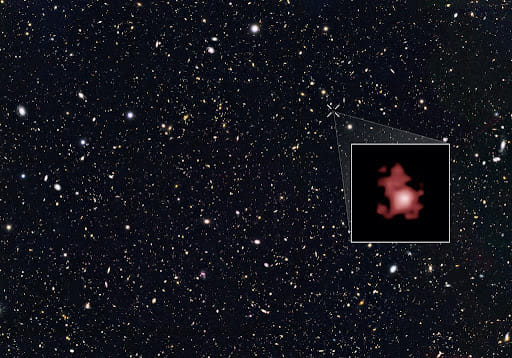
Hubble Image of Galaxy after Big Bang
Big Bang Theory – Background
- Edwin Hubble, an American astronomer, discovered in 1929 that the distances to distant galaxies were proportional to their redshifts.
- When a light source moves away from its observer, the apparent wavelength of the light is stretched towards the red part of the spectrum by the Doppler effect.
- Because the farthest galaxies had the fastest apparent velocities, Hubble's observation implied that distant galaxies were moving away from us.
- If galaxies are moving away from us, Hubble reasoned, they must have been clustered close together at some point in the past.
- Hubble's discovery provided the first empirical evidence for Georges Lemaître's Big Bang theory of the universe, which he proposed in 1927.
- Lemaître proposed that the universe expanded explosively from an extremely dense and hot state, and that this process is still ongoing.
- Subsequent calculations have placed the Big Bang around 13.7 billion years ago.
- In 1998, two independent teams of astronomers in Berkeley, California, discovered that supernovae (exploding stars) were moving away from Earth at an increasing rate. In 2011, they were awarded the Nobel Prize in Physics for their efforts.
- Physicists assumed that matter in the universe would slow its expansion, and that gravity would eventually cause the universe to collapse on itself.
What is the Big Bang Theory?
- The Big Bang Theory is the most widely accepted explanation for how the universe came to be.
- Simply put, it states that the universe as we know it began with an infinitely hot and dense single point that inflated and stretched — at first at unimaginable speeds, then at a more measurable rate — over the next 13.7 billion years to form the still-expanding cosmos we see today.
- Because current technology does not allow astronomers to literally peer back into the universe's birth, much of what we know about the Big Bang is based on mathematical formulas and models.
- Astronomers, on the other hand, can see the "echo" of the expansion via a phenomenon known as the cosmic microwave background.
- While the majority of the astronomical community accepts the theory, some theorists propose alternative explanations, such as eternal inflation or an oscillating universe, in addition to the Big Bang.
Origin of the Universe
- The universe was extremely hot and dense in the first moments after the Big Bang.
- As the universe cooled, conditions were just right for the formation of matter's building blocks, quarks and electrons, of which we are all composed.
- A few millionths of a second later, quarks clumped together to form protons and neutrons. These protons and neutrons merged into nuclei within minutes.
- Things began to happen more slowly as the universe continued to expand and cool.
- It took 380,000 years for electrons to become trapped in orbits around nuclei, resulting in the formation of the first atoms.
- These mainly consisted of helium and hydrogen, which are still the most abundant elements in the universe.
- According to current evidence, the first stars formed from gas clouds around 150-200 million years after the Big Bang.
- Since then, heavier atoms such as carbon, oxygen, and iron have been continuously produced in the cores of stars and catapulted throughout the universe in spectacular stellar explosions known as supernovae.
- However, stars and galaxies do not tell the entire story. According to astronomical and physical calculations, the visible universe accounts for only a small percentage (4%) of the universe's total mass.
- A significant portion of the universe, in fact 26%, is made up of an unknown type of matter known as "dark matter."
- Dark matter, unlike stars and galaxies, does not emit any light or electromagnetic radiation, so we can only detect it through its gravitational effects.
- An even more mysterious form of energy known as "dark energy" accounts for roughly 70% of the universe's mass-energy content. It is even less understood than dark matter.
- This theory is based on the observation that all galaxies appear to be receding from one another at an increasing rate, implying that some intangible extra energy is at work.
Development of the Universe
- Initially, all matter in the universe existed in a single location as a "tiny ball" (singular atom) with an unimaginably small volume, infinite temperature, and infinite density.
- The "tiny ball" exploded violently during the Big Bang. This resulted in a massive expansion. The big bang is thought to have occurred approximately 13.7 billion years ago.
- The expansion has continued to the present day. Some energy was converted into matter as it expanded.
- Within fractions of a second of the bang, there was particularly rapid expansion. Following that, the expansion slowed. The first atom began to form within three minutes of the Big Bang event.
- Temperature dropped to 4,500 Kelvin within 300,000 years of the Big Bang, giving rise to atomic matter.
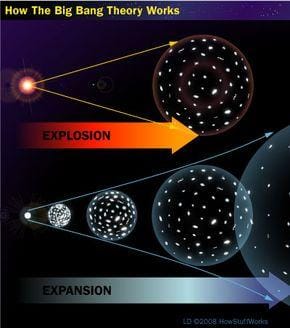
Expansion of Universe
Evidence Supporting Big Bang Theory
- Hubble's Law states that galaxies move away from us at a rate proportional to their distance. Edwin Hubble (1929) discovered this phenomenon. This observation both supports the expansion of the universe and suggests that it was once compacted at a point.
- The theory is also supported by the phenomenon of Red Shift. The light appears to shift towards the red end of the spectrum as the distance between Earth and the galaxy increases. Red has the longest wavelength in the visible spectrum. The greater the red shift, the further away the galaxy.
- We should be able to find some remnants of this heat because the universe was initially very hot. Arno Penzias and Robert Wilson discovered the 2.725 degree Kelvin (-270.425 degree Celsius) Cosmic Microwave Background Radiation (CMBR) that pervades the observable universe in 1965. They both received the Nobel Prize in Physics in 1978 for their discovery.
- Light elements found in abundance in the observable universe, such as hydrogen and helium, lend support to the Big Bang theory.
What is Steady State Theory?
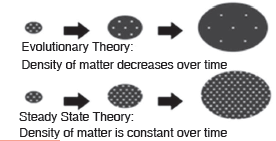 |
Missions to Study Big Bang Theory
Cosmic Background Explorer (COBE)
- COBE was the first mission launched by NASA to study cosmic background radiation, which captures "baby images" of the universe only 400,000 years after it was created.
- COBE's mission was to measure diffuse radiation with an accuracy of 1 micrometre to 1 cm across the entire celestial sphere.
- The Big Bang's electromagnetic radiation is still present in the universe today.
- These minute temperature changes are linked to slight density variations in the early universe, which are depicted in the image below as different shades of blue and purple.
- These fluctuations are thought to have resulted in the formation of the structures that make up the universe today, such as galaxy clusters and large, empty spaces.
Wilkinson Microwave Anisotropy Probe (WMAP)
- WMAP (Wilkinson Microwave Anisotropy Probe), launched in 2001, was the second mission to study cosmic background radiation.
- WMAP looked at the entire sky, measuring temperature variations in microwave radiation that is almost uniformly distributed throughout the Universe with significantly higher resolution than COBE.
Planck
- The European Space Agency and NASA launched the third mission, codenamed Planck, in 2009.
- Planck's microwave background radiation maps are the most precise ever created.
- It measures temperature variations in the CMB with an accuracy limited only by fundamental astrophysical constraints due to detectors sensitive to temperature variations of a few millionths of a degree and mapping of the entire sky across 9 wavelength bands.
Misconceptions of Big Bang Theory
Big Bang explains the origin of the Universe
- The theory is frequently misunderstood as describing the origin of the universe.
- The big bang theory attempts to explain how the universe evolved from a very small, dense state to what it is today.
- It makes no attempt to explain what caused the universe to be created, what happened before the big bang, or even what exists outside the universe.
Big Bang was an explosion
- Another common misconception is that the big bang was an explosion.
- The big bang describes the universe's expansion.
- While some versions of the theory refer to an extremely fast expansion (possibly faster than the speed of light), it is not an explosion in the traditional sense.
Big Bang conflicts with Religious Beliefs
The theory is a scientific explanation of the origins of the universe and does not necessarily contradict religious beliefs.
Conclusion
While this is not the only modern theory of how the Universe came to be – the Steady State Theory and the Oscillating Universe Theory, for example – it is the most widely accepted and popular. The model not only explains the origin of all known matter, the laws of physics, and the large scale structure of the Universe, but it also accounts for the Universe's expansion and a variety of other phenomena.
| Other Relevant Links | |
|---|---|
| Science & Technology Policy in India | Scientific Policy Resolution 1958 |
| Science & Technology Policy of 1983 | Science & Technology Policy of 2003 |
| Science, Technology and Innovation Policy 2013 | New Initiatives Aligned with the National Agenda |
| Technology Vision Document 2035 | National Intellectual Property Rights Policy |
FAQs
Question: What is the Big Bang Theory?
Answer: The Big Bang Theory suggests that the universe began as a singularity around 13.8 billion years ago and expanded rapidly, leading to the formation of galaxies, stars, and other cosmic structures.
Question: What evidence supports the Big Bang Theory?
Answer: Key evidence for the Big Bang Theory includes cosmic microwave background radiation, the redshift of galaxies, and the observed abundance of light elements such as hydrogen and helium in the universe.
Question: What is cosmic microwave background radiation?
Answer: Cosmic microwave background radiation is the afterglow of the Big Bang, a faint radiation present throughout the universe, providing evidence of the universe's early hot, dense state.
Question: How does the redshift of galaxies support the Big Bang Theory?
Answer: The redshift of galaxies shows that galaxies are moving away from us, with more distant galaxies moving faster, supporting the theory that the universe is expanding from a singular point.
Question: What are some limitations of the Big Bang Theory?
Answer: While the Big Bang Theory explains many cosmic observations, it does not address the very origin of the singularity, and certain phenomena like dark matter and dark energy remain unexplained.
MCQs
1. What does the Big Bang Theory suggest about the origin of the universe?
A) The universe has always existed
B) The universe began from a singularity
C) The universe was created by a deity
D) The universe started with the formation of the solar system
Answer: (B) See the Explanation
Explanation: The Big Bang Theory suggests that the universe began from a singularity and expanded over billions of years to its current form.
2. What is the primary evidence for the Big Bang Theory?
A) The age of the Earth
B) Cosmic microwave background radiation
C) The formation of stars
D) The composition of Earth’s atmosphere
Answer: (B) See the Explanation
Explanation: Cosmic microwave background radiation is considered one of the primary pieces of evidence for the Big Bang Theory, showing the remnants of the early universe.
3. How does the redshift of galaxies provide evidence for the expanding universe?
A) It shows galaxies are moving towards us
B) It indicates galaxies are moving away from us
C) It proves the Earth is at the center of the universe
D) It shows galaxies are stationary
Answer: (B) See the Explanation
Explanation: The redshift of galaxies shows that they are moving away from Earth, supporting the idea that the universe is expanding as described by the Big Bang Theory.
4. What is one of the unresolved issues in the Big Bang Theory?
A) The origin of the singularity
B) The abundance of dark matter
C) The discovery of exoplanets
D) The formation of stars
Answer: (A) See the Explanation
Explanation: One of the unresolved issues is the origin of the singularity from which the Big Bang originated, which the theory itself does not explain.
5. What phenomenon is known as cosmic microwave background radiation?
A) Radiation from nearby stars
B) Faint radiation left over from the early universe
C) Radiation from black holes
D) Heat from the Sun
Answer: (B) See the Explanation
Explanation: Cosmic microwave background radiation is the afterglow from the Big Bang, providing evidence of the universe's early hot and dense state.
GS Mains Questions and Model Answers
Q1: Analyze the key evidence supporting the Big Bang Theory and how it has shaped our understanding of the universe.
Answer: The Big Bang Theory is supported by several key pieces of evidence, including cosmic microwave background radiation, the redshift of galaxies, and the observed abundance of light elements. These pieces of evidence suggest that the universe began in an extremely hot and dense state and has been expanding ever since. The discovery of cosmic microwave background radiation, for example, revealed the faint afterglow of the early universe, confirming the Big Bang hypothesis. The redshift of galaxies shows that distant galaxies are moving away from us, further supporting the expansion of the universe. The abundance of light elements like hydrogen and helium also matches predictions made by the Big Bang nucleosynthesis model. Together, these observations have radically transformed our understanding of the universe's origins and evolution.
Q2: What are the limitations of the Big Bang Theory, and how do they influence ongoing research in cosmology?
Answer: Despite its success, the Big Bang Theory has several limitations. It does not explain the exact origin of the singularity, the point from which the universe began, nor does it address the nature of dark matter and dark energy, which constitute much of the universe's mass-energy content. Additionally, the theory does not fully explain the homogeneity and isotropy observed in the universe, known as the horizon problem. These limitations have led to ongoing research in cosmology, including the exploration of alternative theories like the multiverse hypothesis and the study of cosmic inflation, which aims to address some of the Big Bang's unresolved issues. Scientists are also working to better understand dark matter and dark energy, which may provide further insights into the universe’s evolution.
Q3: How does the discovery of cosmic microwave background radiation contribute to the understanding of the early universe?
Answer: The discovery of cosmic microwave background radiation provided critical evidence for the Big Bang Theory by offering a snapshot of the universe’s state approximately 380,000 years after the Big Bang. This radiation is the residual heat left over from the Big Bang, and its uniformity across the universe suggests that the early universe was in a hot, dense state. The detection and study of cosmic microwave background radiation have allowed scientists to map the universe’s early conditions, helping to confirm the expansion of the universe and estimate its age and composition. The detailed study of its fluctuations also provides insight into the formation of galaxies and large-scale structures in the universe.
Previous Year Questions on the Big Bang Theory
1. UPSC CSE Mains 2018 (GS Paper 1):
Question: "Discuss the evidence supporting the Big Bang Theory and its implications for our understanding of the universe’s origin and evolution."
Answer: The Big Bang Theory is supported by key evidence such as cosmic microwave background radiation, the redshift of galaxies, and the relative abundance of light elements in the universe. These observations suggest that the universe originated from an extremely hot and dense state and has been expanding ever since. The implications of this theory have profound effects on our understanding of the universe’s origin, its future, and the fundamental laws of physics, influencing cosmology and astrophysics research to this day.
2. UPSC CSE Mains 2021 (GS Paper 1):
Question: "How does the discovery of cosmic microwave background radiation support the Big Bang Theory?"
Answer: The discovery of cosmic microwave background radiation supports the Big Bang Theory by providing direct evidence of the heat left over from the universe’s early stages. This radiation, which is detectable throughout the universe, corresponds to the temperature of the universe approximately 380,000 years after the Big Bang. Its uniformity and distribution across the cosmos are consistent with the predictions of the Big Bang model, confirming that the universe was once in an extremely hot, dense state before expanding and cooling over time.
Download the PREPP App and attempt FREE IAS Exam Mock Tests and get complete study material!

Full Test - 04: UPSC CSE Prelims CSAT (Paper-II)
Full Test - 03: UPSC CSE Prelims CSAT (Paper-II)
UPSC CSE Prelims 2026 GS Paper 1 Question Paper (24-May-2026)
UPSC CSE Prelims 2026 CSAT Paper 2 Question Paper (24-May-2026)

17 February 2025 | The Hindu Must Read Articles | Current Affairs

16 February 2026 | The Hindu Must Read Articles | Current Affairs

13 February 2026 | The Hindu Must Read Articles | Current Affairs









Comments