The Four Fundamental Forces of Nature – Science & Technology Notes
Scientists have spent centuries attempting to describe the forces that govern interactions on the largest and smallest scales, from planets to particles. They understand that the universe we live in is shaped by four fundamental forces: gravity, electromagnetism, and the strong and weak nuclear forces. In this article, we will discuss in detail regarding The Four Fundamental Forces of Nature which will be helpful for UPSC exam preparation.
Table of Contents
What are the four fundamental forces of nature?
- There are four natural forces. Two are well-known to everyone, while the other two are less so.
- Every day, whether we realise it or not, the four fundamental forces act on us. Everything that happens in the universe is governed by these forces.
- Everything from playing basketball to launching a rocket into space to sticking a magnet on your refrigerator can be reduced to a critical quartet: gravity, the weak force, electromagnetism, and the strong force.
- First, gravity is the force that pulls us to the Earth's surface, keeps the planets in orbit around the Sun, and causes planets, stars, and galaxies to form.
- Second, electromagnetism is the force that governs how matter produces and responds to electricity and magnetism. We use it extensively in almost all of our household appliances.
- Then there are the less familiar forces. Both are only active within the nuclei of atoms.
- The Strong Nuclear Force holds an atom's nucleus together.
- Certain types of radioactive decay are caused by the Weak Nuclear Force. For example, the type of decay measured by archaeologists when performing radiocarbon dating.
- Except for gravity, quantum theory explains all forces. This means that tiny particles carry the forces.
- Indeed, electromagnetism and the weak nuclear force have been demonstrated to be different aspects of the same fundamental force, and many scientists believe that the strong force can also be unified with this electroweak force.
- The best way to explain gravity is to use Albert Einstein's Theory of General Relativity, which is not a quantum theory.
- Instead, it imagines gravity being created when matter distorts space, much like a heavy object stretching a rubber sheet.
- Smaller objects then 'roll' downwards in the direction of the larger object.
- Many scientists are working on developing a quantum theory of gravity in which gravity is carried by small particles known as "gravitons."
- M-theory is one approach that treats particles as if they were tiny knots or vibrations in minuscule 'string'.
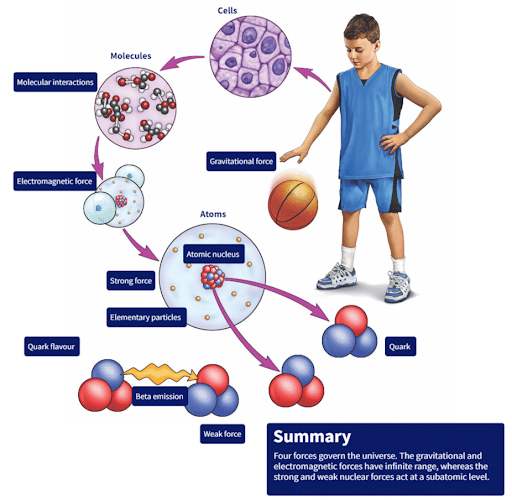
Four Fundamental Forces governing the Universe
Gravitational Force
- Gravity is the most familiar force. It is in charge of keeping our feet on the ground and the Earth in orbit around the Sun.
- Gravity is defined by the general theory of relativity as bends and curves in the fabric of space-time that affect the motions of galaxies, stars, planets, and even light.
- Anything with mass causes a dent in space-time, attracting objects to each other.
- Gravity is a force that attracts two objects together. Its strength increases approximately with the masses of the two objects but decreases with the square of the distance between them.
- That means that if the Moon were twice as far away from Earth as it is now, the gravitational tug between the two would be one-fourth of what it is now.
- Despite being the weakest force, gravity works across infinite distances, causing the universe's structure to form.
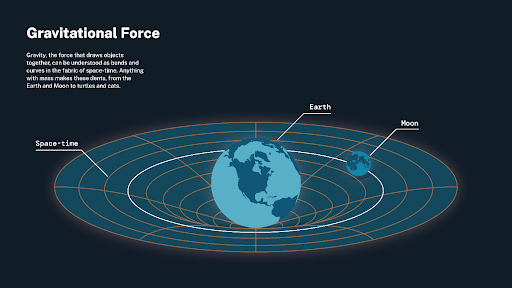
Gravitational Force
Electromagnetic Force
- Electromagnetic force is carried by light, which illuminates our homes at night, maintains electrons in orbit around atomic nuclei, and allows chemical compounds to form.
- Electromagnetism, as the name implies, is a force that includes both electricity and magnetism.
- They are inextricably linked: a moving electric field generates a magnetic field, and vice versa.
- Electromagnetism, like gravity, loses strength with the square of the distance between objects and operates at an infinite range.
- Electromagnetism, on the other hand, only applies to charged objects, and whether it attracts or repels depends on the charges of each.
- Two oppositely charged charges repel each other; one of each attracts.
- While electromagnetism is stronger than gravity, in large objects it is often balanced out by the equal number of positive and negative charges that form neutral atoms.
- Earth, for example, has a magnetic field due to electric currents in its liquid core, but it is electrically neutral.
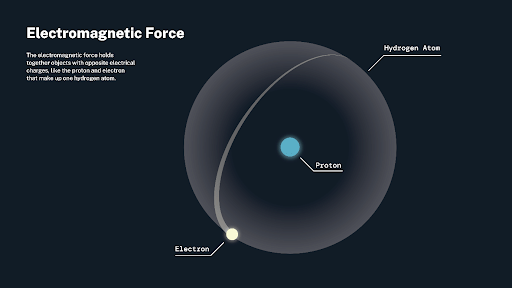
Electromagnetic Force
Strong Nuclear Force
- Nuclear forces have an impact on our daily lives, but they operate on scales smaller than atoms.
- The strong nuclear force, or strong force for short, holds the atoms together. In atoms, it always attracts and works on two different size scales.
- The strong force holds together the protons and neutrons that make up the essence of the elements at the level of an atomic nucleus.
- On a smaller scale, the strong force holds the oppositely charged quarks that comprise neutrons and protons together.
- The strong force, as the name implies, is the most powerful of the fundamental forces.
- It is approximately 100 times more powerful than electromagnetism and 100 trillion trillion trillion times more powerful than gravity.
- However, the strong force has no effect beyond very short distances.
- Anything larger than the nucleus of a medium-sized atom (about 100 million times smaller than the width of a human hair) quickly loses its influence, and other forces become more powerful.
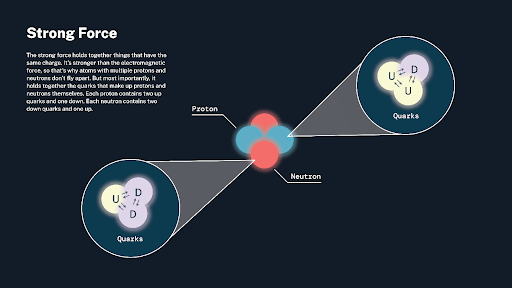
Strong Nuclear Force
Weak Nuclear Force
- The weak force governs interactions between subatomic particles, which are the tiny particles that make up matter, such as protons, neutrons, and electrons.
- The weak force, in particular, has the ability to transform one quark type into another.
- Protons and neutrons are made up of two types of quarks: up and down.
- The weak force can convert a neutron's down quark into an up quark, transforming the neutron into a proton and changing its electric charge from neutral to positive.
- If that neutron was in the nucleus of an atom, changing it to a proton would transform that atom into a different element. Such reactions occur all the time in our Sun, providing it with the energy to shine.
- This type of action also occurs in radioactive decay, which occurs when atoms shed energy and subatomic particles spontaneously.
- The weak force operates on 1,000 times smaller distance scales than the strong force.
- It is also approximately a million times weaker than the strong force, though it is still significantly stronger than gravity.
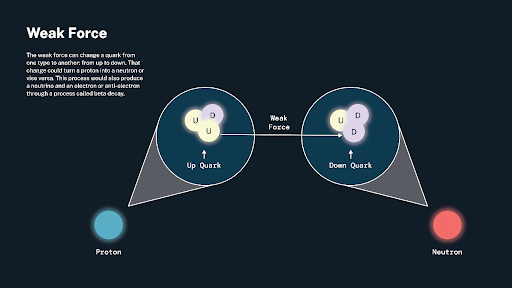
Weak Nuclear Force
Electroweak Theory and Grand Unification Theories (GUT)
- It is thought that in the very early Universe, when temperatures were extremely high (the Planck Scale), all four forces were unified into a single force.
- Then, as the temperature dropped, gravitation separated first, followed by the other three forces.
- Even back then, the weak, electromagnetic, and strong forces had been combined into a single force.
- When the temperature dropped, these forces separated from one another, with the strong force separating first and the electromagnetic and weak forces separating at a lower temperature, leaving us with the four distinct forces that we see in our current Universe.
- The separation of the forces is referred to as spontaneous symmetry breaking.
- The Standard Electroweak Theory, or simply the Standard Model, has unified the weak and electromagnetic interactions. (In 1979, Glashow, Weinberg, and Salaam were awarded the Nobel Prize for this).
- Grand unification theories seek to treat both strong and electroweak interactions within the same mathematical framework (Combination of Weak and Strong Forces).
- Attempts to include gravitation in this image have so far failed.
- Superunified Theories are theories that include gravity and attempt to unify all four fundamental forces into a single force.
- While the Grand Unified and Superunified Theories are still theoretical speculations, there is strong experimental evidence for the unification of electromagnetic and weak interactions in the Standard Electroweak Theory.
- Furthermore, while GUTs have not been experimentally proven, there is strong circumstantial evidence to suggest that theory, at least in the form of a Grand Unified Theory, is required to make sense of the Universe.
Are there more than four fundamental forces?
- While the Standard Model of Physics only describes four force carriers and their effects, there is little to prevent additional forces from being present in alternative models.
- In recent years, high energy experiments have captured glimpses of potentially new particles with the characteristics of an unknown force carrier.
- The subtle effects of this force can be seen in the directions subatomic particles take when emitted during certain types of decay. Their existence could even explain the existence of dark matter.
- For the time being, any additional forces are highly speculative. Future experiments may rule them out, or they may discover new physics indicating that there are more than four forces in the Universe.
Conclusion
Every action in the universe is the result of these four natural forces. Without these forces, the existence of the entire universe would be impossible. These forces can be found in everything from a very large body to a molecular level. These forces keep our planets, whether nuclear or proton, stable. After discovering these forces, scientists improved their theories in a variety of ways, allowing us to reap the benefits of science today.
| Other Relevant Links | |
|---|---|
| Science & Technology Policy in India | Scientific Policy Resolution 1958 |
| Science & Technology Policy of 1983 | Science & Technology Policy of 2003 |
| Science, Technology and Innovation Policy 2013 | New Initiatives Aligned with the National Agenda |
| Technology Vision Document 2035 | National Intellectual Property Rights Policy |
FAQs
Question: What are the four fundamental forces of nature?
Answer: The four fundamental forces of nature are gravitational force, electromagnetic force, strong nuclear force, and weak nuclear force. These forces govern all interactions in the universe, from the motion of planets to atomic and subatomic interactions.
Question: What is the gravitational force?
Answer: The gravitational force is the attractive force between two masses. It is responsible for the formation of planets, stars, and galaxies, and governs the motion of celestial bodies in the universe.
Question: What is the electromagnetic force?
Answer: The electromagnetic force acts between charged particles. It is responsible for electric and magnetic fields and is essential in the structure of atoms and molecules, governing interactions in chemistry and electricity.
Question: What is the strong nuclear force?
Answer: The strong nuclear force holds the nucleus of an atom together. It is the most powerful of the four forces but acts only over short distances at the subatomic level.
Question: What is the weak nuclear force?
Answer: The weak nuclear force is responsible for radioactive decay and nuclear fusion. It operates at a very short range and plays a crucial role in nuclear reactions within stars.
MCQs
1. Which of the following is the strongest of the four fundamental forces?
A) Gravitational force
B) Electromagnetic force
C) Strong nuclear force
D) Weak nuclear force
Answer: (C) See the Explanation
Explanation: The strong nuclear force is the strongest of the four fundamental forces. It binds protons and neutrons in the atomic nucleus and is much stronger than gravity, electromagnetic, and weak nuclear forces over short distances.
2. Which force is responsible for the attraction between two masses?
A) Electromagnetic force
B) Gravitational force
C) Strong nuclear force
D) Weak nuclear force
Answer: (B) See the Explanation
Explanation: Gravitational force is the force that attracts two masses toward each other. It is responsible for the movement of celestial bodies and governs the structure of the universe.
3. What does the electromagnetic force govern?
A) The decay of atomic nuclei
B) The attraction between charged particles
C) The formation of galaxies
D) The fusion in stars
Answer: (B) See the Explanation
Explanation: The electromagnetic force governs the interactions between charged particles. It is responsible for electric and magnetic fields and plays a key role in chemistry and electricity.
4. Which force is responsible for radioactive decay?
A) Electromagnetic force
B) Gravitational force
C) Strong nuclear force
D) Weak nuclear force
Answer: (D) See the Explanation
Explanation: The weak nuclear force is responsible for processes like radioactive decay and plays a critical role in nuclear reactions such as those occurring in stars.
5. Which force is primarily responsible for holding the atomic nucleus together?
A) Gravitational force
B) Electromagnetic force
C) Strong nuclear force
D) Weak nuclear force
Answer: (C) See the Explanation
Explanation: The strong nuclear force is responsible for holding protons and neutrons together in the atomic nucleus, overcoming the electromagnetic repulsion between positively charged protons.
GS Mains Questions and Model Answers
Q1: Discuss the four fundamental forces of nature and their significance in the universe.
Answer: The four fundamental forces—gravitational, electromagnetic, strong nuclear, and weak nuclear forces—are essential for understanding the interactions that govern the universe. Gravitational force governs the movement of celestial bodies and is responsible for the formation of planets, stars, and galaxies. Electromagnetic force governs interactions between charged particles and is responsible for electricity, magnetism, and light. The strong nuclear force binds protons and neutrons in the nucleus of an atom, while the weak nuclear force is responsible for radioactive decay and nuclear fusion. Together, these forces shape everything from subatomic particles to large-scale cosmic structures.
Q2: Explain the role of the strong nuclear force and weak nuclear force in the behavior of atoms and the universe.
Answer: The strong nuclear force binds protons and neutrons within the nucleus of an atom, ensuring atomic stability. It is the strongest force in nature, operating over short distances, and is responsible for nuclear reactions in stars. The weak nuclear force, on the other hand, is responsible for processes like radioactive decay and nuclear fusion. It plays a crucial role in stellar energy production and the transformation of one element into another, contributing to the synthesis of heavier elements in stars. Both forces are fundamental to the behavior of matter at the atomic and subatomic levels.
Q3: How do the fundamental forces influence the study of cosmology and astrophysics?
Answer: The fundamental forces are critical to the study of cosmology and astrophysics, as they govern the behavior of celestial bodies, the formation of the universe, and the interactions of matter and energy on a cosmic scale. Gravitational force governs the motion of planets, stars, and galaxies, shaping the structure of the universe. Electromagnetic forces play a role in the behavior of light, radiation, and cosmic phenomena such as black holes. The strong nuclear force governs the stability of atomic nuclei, while the weak nuclear force is involved in processes such as supernovae and the formation of elements in stars. Understanding these forces helps scientists explain the origin, evolution, and fate of the universe.
Previous Year Questions on Fundamental Forces
1. UPSC CSE Mains 2018 (GS Paper 1):
Question: "Explain the role of the four fundamental forces of nature in shaping the universe and the formation of matter."
Answer: The four fundamental forces—gravitational, electromagnetic, strong nuclear, and weak nuclear forces—interact to shape the universe. Gravitational force governs the motion of celestial bodies and the formation of galaxies. Electromagnetic forces are essential in governing the interactions of atoms and molecules. The strong nuclear force binds atomic nuclei, while the weak nuclear force is crucial for nuclear decay and fusion. These forces have shaped everything from the formation of stars to the structure of atoms, thus influencing the creation of matter and the evolution of the universe.
2. UPSC CSE Mains 2020 (GS Paper 3):
Question: "Discuss the significance of weak nuclear force in the context of nuclear physics and its implications for energy production in stars."
Answer: The weak nuclear force is essential in nuclear physics, as it governs processes like radioactive decay and nuclear fusion. It enables the transformation of particles and elements, leading to the production of energy in stars through fusion reactions. The weak force plays a pivotal role in the Sun’s ability to convert hydrogen into helium, releasing vast amounts of energy that powers the Sun and sustains life on Earth. Understanding the weak nuclear force is key to advancing nuclear energy research and understanding the processes that occur in stars.
Download the PREPP App and attempt FREE IAS Exam Mock Tests and get complete study material!

Full Test - 04: UPSC CSE Prelims CSAT (Paper-II)
Full Test - 03: UPSC CSE Prelims CSAT (Paper-II)
UPSC CSE Prelims 2026 GS Paper 1 Question Paper (24-May-2026)
UPSC CSE Prelims 2026 CSAT Paper 2 Question Paper (24-May-2026)

17 February 2025 | The Hindu Must Read Articles | Current Affairs

16 February 2026 | The Hindu Must Read Articles | Current Affairs

13 February 2026 | The Hindu Must Read Articles | Current Affairs









Comments