Science & Technology Policy in India – Science & Technology Notes
Science, technology, and innovation (STI) have emerged as key drivers of national development around the world. Since independence, four major policies have been implemented: Scientific Policy Resolution (SPR 1958), Technology Policy Statement 1983, Science and Technology Policy 2003 (STP 2003), and Science Technology Innovation Policy 2013 (STIP 2013). As India strives for faster, more sustainable, and inclusive growth, the Indian STI system, which benefits from a large demographic dividend and a large talent pool, will need to play a pivotal role in achieving these national objectives. This article will attempt to provide a retrospective on how the STI ecosystem that we see today came to be.
Table of Contents
- Science & Technology Policy in India – Background
- Need for Science & Technology Policy in India
- Scientific Policy Resolution 1958
- Science & Technology Policy of 1983
- Science & Technology Policy of 2003
- Science, Technology and Innovation Policy 2013
- Impact of Science & Technology Policy in India
- Conclusion
- FAQs
- MCQs
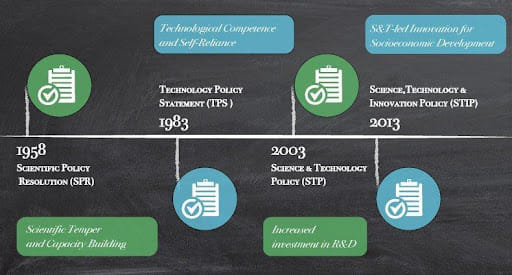
Science & Technology Policy in India – Background
- The Scientific Policy Resolution (SPR) of India in 1958 resolved to "encourage, promote, and sustain" the "cultivation of science and scientific research in all its aspects."
- Technology was expected to flow from the country's established scientific infrastructure at the time.
- The 1983 Technology Policy Statement (TPS) emphasised the importance of developing technological competence and self-reliance.
- The 2003 Science and Technology Policy (STP) brought science and technology (S& T) together and emphasised the importance of R&D investment.
- It advocated for the integration of socioeconomic sector programmes with the national R&D system in order to address national problems, as well as the establishment of a national innovation system.
Need for Science & Technology Policy in India
- Scientific research uses money to generate knowledge, and innovation converts knowledge into wealth and/or value by providing solutions. Thus, innovation entails S&T-based solutions that are successfully implemented in the economy or society.
- It has taken centre stage in nations' development goals. Innovation paradigms have become country and context specific.
- Historically, India has not placed a high value on innovation as a policy tool. The national S&T enterprise must now embrace S&T-led innovation as a development driver.
- India has designated the period 2010-20 as the "Decade of Innovation."
- The government has emphasised the importance of developing a policy to integrate science, technology, and innovation, and it has also established the National Innovation Council (NlnC).
- These declarations are supported by the STI Policy 2013. It aims to bring new perspectives to bear on innovation in India.
Scientific Policy Resolution 1958
- The Indian Parliament passed the first significant scientific policy resolution in 1958.
- The policy document was drafted by the government of Jawaharlal Nehru, India's then-prime minister.
- It served as the foundation for India's scientific efforts and mindset.
- This determination stemmed from the realization that the development of a welfare state necessitated investments in science and technology.
- As a result, technology and science would be used to effect socioeconomic change.
- Numerous organisations and agencies were established and supported in order to conduct and coordinate research in various scientific and technological fields.
- Each document included a five-year plan outlining the thrust areas of science and technology in the country's socioeconomic transformation
*For detailed notes of this topic, check this link Scientific Policy Resolution 1958
Science & Technology Policy of 1983
- The Science & Technology Policy of 1983, also known as Technology Policy Statement (TPS) was established in 1983 with the goal of achieving technological competence and self-reliance through the promotion and development of indigenous technologies.
- It led to the creation of the Technology Development Fund and the Technology, Information Forecasting, and Assessment Council (TIFAC).
- For achieving technological competence, these S&T policies relied on mass education and the cultivation of science and scientific research in HEIs.
- India had advanced scientific and technological infrastructure in space, industrial research, nuclear energy, defence research, biotechnology, agriculture, and health by 1980.
- By the early 1980s, India had established a solid industrial and agricultural foundation, as well as a large pool of trained human resources.
- TPS 1983, the next major policy document, focused primarily on meeting people's aspirations through technological development, as technology was increasingly seen to influence lives and boost societal expectations.
*For detailed notes of this topic, check this link Science & Technology Policy of 1983
Science & Technology Policy of 2003
- Science and Technology Policy 2003 brought together S&T areas with the goal of increasing R&D and innovation investment in areas affecting the economy and society.
- This resulted in the establishment of a strong institutional mechanism, the Scientific and Engineering Research Board (SERB), under the auspices of DST, to promote scientific and engineering research in the country.
- Following the S&T Policy 2003, there has been a significant increase in R&D investment, as well as an increase in publication ranking and a steady increase in institutional and human capacity.
- Since the year 2000, India has focused on converting knowledge into wealth and value, addressing the country's socioeconomic needs, and integrating science, technology, and innovation (STI).
- By the millennium's turn, India had built a solid infrastructure in science and technology, both in terms of institutions and human resources.
- SPR 1958 and TPS 1983 concentrated on science and technology, respectively. However, the science and technology enterprises were so intertwined that it was necessary to consider them as a whole rather than as separate elements.
- STP 2003 was enacted by the Government of India in order to keep pace with science and technology, to remain competitive in an increasingly globalised world, and to meet our primary goal of equitable and sustainable development.
*For detailed notes of this topic, check this link Science & Technology Policy of 2003
Science, Technology and Innovation Policy 2013
- The Science, Technology, and Innovation Policy 2013 (STIP 2013) was designed to place India among the top five global scientific powers.
- The main goals of this policy were to foster an S&T-led innovation ecosystem in the country, attract private sector investment in R&D, and link STI to socioeconomic priorities.
- The 12th Five-Year Plan (2012-17) emphasized the establishment and development of R&D facilities, the establishment of technology partnerships with states, large-scale investment in Mega Science projects, and so on.
- The decade from 2010 to 2020 has been designated as the "Decade of Innovation," with the goal of establishing a 21st Century National Innovation Ecosystem and developing innovative institutions and mindsets for national progress.
- It was necessary to combine science, technology, and innovation in order to place India among the top five global scientific powers.
- The fourth policy, the STIP 2013, was implemented with this goal in mind.
*For detailed notes of this topic, check this link Science, Technology and Innovation Policy 2013
Impact of Science & Technology Policy in India
- India has been successful in creating a massive ecosystem of science, technology, and innovation (STI) since its independence in 1947.
- Universities, public and private enterprises, and human resources are all part of a STI ecosystem.
- According to data collected in 2010-11, we have over 16,000 colleges, 600 universities, 2000 research and development institutes, and over 400,000 science professionals.
- Our science and policy ecosystem has benefited some of the world's top scientists, technologists, and CEOs. This has been made possible by the central and state governments enacting strong policies over the years.
Conclusion
Indian STI policy is rapidly evolving in response to shifting national and international dynamics. The four national policies discussed here were significant turning points in this journey. While these policies have had a positive overall impact on India's STI ecosystem, some targets have been missed. The reasons for this could be numerous, including an inability to attract private funding, insufficient incentives, or simply discrepancies in data reporting. There are numerous factors that influence policy implementation success. Some of the most important factors in achieving success are consistent commitment and support from changing/alternative governments, shared ownership and accountability among various implementing agencies, and timely evaluation of policies and associated programs.
FAQs
Q1: What is the main objective of India's Science and Technology Policy?
Answer: The primary objective of India's Science and Technology Policy is to promote scientific research, innovation, and the application of science and technology for sustainable development. It aims to address socio-economic challenges, improve quality of life, and enhance India's global competitiveness in scientific research and innovation.
Q2: When was the first Science Policy Resolution adopted in India?
Answer: The first Science Policy Resolution in India was adopted in 1958. It emphasized the development of scientific research and technology to achieve national progress and self-reliance.
Q3: What are the key focus areas of the latest Science, Technology, and Innovation Policy (STIP)?
Answer: The latest Science, Technology, and Innovation Policy (STIP) focuses on promoting research and development (R&D), enhancing innovation ecosystems, improving scientific literacy, increasing investments in science and technology, fostering inclusivity, and encouraging collaboration between academia, industry, and government.
Q4: How does India promote innovation and startups in science and technology?
Answer: India promotes innovation and startups through various initiatives like the Atal Innovation Mission (AIM), Startup India, incubation centers, and technology parks. These programs provide funding, mentorship, and support for startups and innovators in the science and technology sector.
Q5: What role does international collaboration play in India's Science and Technology Policy?
Answer: International collaboration is crucial for India's Science and Technology Policy, enabling knowledge sharing, joint research projects, technology transfer, and access to global expertise. Such partnerships strengthen India's scientific capabilities and foster innovations that address global challenges.
MCQs
- What was the focus of the first Science Policy Resolution in India, adopted in 1958?
A) Promoting private enterprise
B) Fostering scientific research and technological self-reliance
C) Importing foreign technology
D) Limiting scientific research to specific sectors
Answer: (B) See the Explanation
- Which initiative promotes innovation and startup culture in India?
A) Startup India
B) Make in India
C) Green Revolution
D) Operation Flood
Answer: (A) See the Explanation
- What is a key focus area of the latest Science, Technology, and Innovation Policy (STIP) in India?
A) Reducing scientific research
B) Enhancing R&D and innovation ecosystems
C) Promoting agriculture only
D) Limiting international collaboration
Answer: (B) See the Explanation
- Which of the following supports international collaboration in science and technology for India?
A) Restrictive trade agreements
B) International partnerships and joint research initiatives
C) Reducing foreign investments
D) Limiting access to foreign expertise
Answer: (B) See the Explanation
- Which body is primarily responsible for promoting scientific research in India?
A) Ministry of Health and Family Welfare
B) Indian Council of Medical Research
C) Department of Science and Technology (DST)
D) Ministry of External Affairs
Answer: (C) See the Explanation
GS Mains Questions and Model Answers
Q1: Discuss the evolution of India's Science and Technology Policy and its impact on national development.
Answer: India's Science and Technology Policy has evolved significantly since the first Science Policy Resolution of 1958, which emphasized scientific research and technological self-reliance. Subsequent policies focused on promoting innovation, enhancing research capabilities, and fostering collaboration between academia, industry, and government. The policies have contributed to advancements in space research, information technology, healthcare, and renewable energy. Initiatives like the Atal Innovation Mission and Startup India have bolstered the innovation ecosystem, encouraging entrepreneurship. However, challenges such as limited R&D funding and skill gaps remain. Addressing these issues is crucial to maintaining India's competitiveness and achieving sustainable development goals.
Q2: Analyze the role of innovation ecosystems in driving scientific advancements in India.
Answer: Innovation ecosystems, including research institutions, startups, technology incubators, and government initiatives, play a crucial role in driving scientific advancements in India. Programs like the Atal Innovation Mission and technology parks provide funding, mentorship, and support for innovators and researchers, fostering a culture of creativity and entrepreneurship. Collaboration between industry and academia ensures the practical application of scientific research, leading to technological breakthroughs and solutions to societal challenges. However, strengthening the innovation ecosystem requires increased investment in R&D, improved industry-academia linkages, and policy support to enhance global competitiveness and drive inclusive growth.
Q3: Explain the importance of international collaboration in India's science and technology sector.
Answer: International collaboration is vital for India's science and technology sector as it facilitates knowledge sharing, technology transfer, joint research, and access to global expertise. Collaborations with international institutions and countries help India address global challenges such as climate change, public health, and energy security. They also provide opportunities for Indian researchers to engage in cutting-edge projects, enhancing the country's research capabilities and fostering innovation. By participating in global initiatives and establishing international partnerships, India can strengthen its position as a leader in science and technology while contributing to global advancements in critical areas.
Previous Year Questions on Science & Technology Policy in India
1. UPSC CSE 2020
Question: Evaluate the impact of India's Science and Technology Policy on economic growth and innovation.
Answer: India's Science and Technology Policy has significantly contributed to economic growth and innovation by fostering a robust research and innovation ecosystem. Policies promoting R&D, industry-academia collaboration, and startup culture have driven technological advancements in sectors like space research, IT, biotechnology, and manufacturing. Initiatives such as Startup India and technology parks have encouraged entrepreneurship, leading to job creation and economic development. However, challenges such as low R&D investment, regulatory hurdles, and skill gaps hinder the full realization of these benefits. Strengthening policy implementation and increasing investment in science and technology can further enhance economic growth and innovation.
2. UPSC CSE 2019
Question: Discuss the challenges and opportunities in promoting scientific research and innovation in India.
Answer: Promoting scientific research and innovation in India faces challenges such as inadequate R&D funding, limited industry-academia collaboration, and skill gaps in the workforce. Bureaucratic delays and regulatory hurdles can also impede innovation. Despite these challenges, there are significant opportunities for growth. Government initiatives like the Atal Innovation Mission and Startup India provide platforms for entrepreneurs and researchers. Collaborations with international institutions offer access to cutting-edge technologies and expertise. Strengthening the innovation ecosystem, investing in R&D, and fostering a culture of research and entrepreneurship can help India become a global leader in science and technology.
Download the PREPP App and attempt FREE IAS Exam Mock Tests and get complete study material!

Full Test - 04: UPSC CSE Prelims CSAT (Paper-II)
Full Test - 03: UPSC CSE Prelims CSAT (Paper-II)
UPSC CSE Prelims 2026 GS Paper 1 Question Paper (24-May-2026)
UPSC CSE Prelims 2026 CSAT Paper 2 Question Paper (24-May-2026)

17 February 2025 | The Hindu Must Read Articles | Current Affairs

16 February 2026 | The Hindu Must Read Articles | Current Affairs

13 February 2026 | The Hindu Must Read Articles | Current Affairs









Comments