Science, Technology and Innovation Policy (STIP) 2013 – S&T Policy in India – Science & Technology Notes
The Science, Technology, and Innovation Policy 2013 (STIP 2013) was designed to place India among the top five global scientific powers. The main goals of this policy were to foster an S&T-led innovation ecosystem in the country, attract private sector investment in R&D, and link STI to socioeconomic priorities. The 12th Five-Year Plan (2012-17) emphasized the establishment and development of R&D facilities, the establishment of technology partnerships with states, large-scale investment in Mega Science projects, and so on. In this article, we will discuss key features of Science, Technology, and Innovation Policy 2013 which will be helpful in preparation of UPSC exam.
Table of Contents
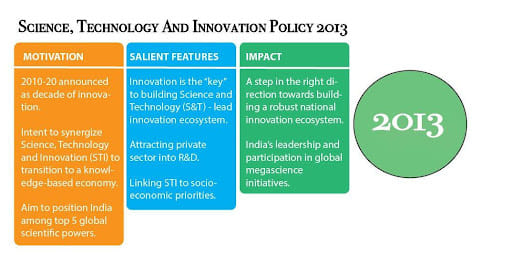
Science, Technology, and Innovation Policy 2013 – Background
- The decade from 2010 to 2020 has been designated as the "Decade of Innovation," with the goal of establishing a 21st Century National Innovation Ecosystem and developing innovative institutions and mindsets for national progress.
- It was necessary to combine science, technology, and innovation in order to place India among the top five global scientific powers.
- The fourth policy, the STIP 2013, was implemented with this goal in mind.
Science, Technology, and Innovation Policy 2013 – Salient Features
- The term "innovation" was a critical new element in this policy document, as the name suggests.
- STIP 2013 focused on promoting a science and technology-led innovation ecosystem in the country and broadly linking science, technology, and innovation to socioeconomic priorities.
- This policy document was a positive step towards establishing a strong national innovation ecosystem.
- It paved the way for the country to promote science and technology-led innovation by attracting private-sector contributions to the R&D ecosystem.
- It emphasised the importance of directing scientific discoveries and the outcomes of science and technology activities towards key development priorities (agriculture, manufacturing, water, health, environment, and infrastructure).
Science, Technology, and Innovation Policy 2013 – Key Elements
- Promoting the spread of scientific temper throughout society.
- Improving the ability of young people from all social backgrounds to apply science.
- Making science, research, and innovation careers appealing to talented and bright minds.
- Creating world-class R&D infrastructure to achieve global leadership in a few select frontier areas of science.
- By 2020, India will be ranked among the top five global scientific powers.
- Linking the contributions of the science, research, and innovation system to the inclusive economic growth agenda, and combining excellence and relevance priorities.
- Creating an environment conducive to increased private-sector participation in R&D.
- Converting R&D outputs into societal and commercial applications by replicating previously successful models and establishing new PPP structures.
- Seeding high-risk S&T innovations with new mechanisms.
- Promoting resource-efficient, cost-effective innovations across all size and technology domains.
- Causing changes in mindset and value systems in order to recognize, respect, and reward performances that generate wealth from S&T derived knowledge.
- Developing a strong national innovation system.
Impact of Science, Technology, and Innovation Policy 2013
- As a result of this policy, India has increased its participation in global mega-science initiatives such as the Laser Interferometer Gravitational-Wave Observatory (LIGO), the Large Hadron Collider (LHC - CERN), the International Thermonuclear Experimental Reactor (ITER), and the Square Kilometre Array (SKA), among others.
Conclusion
It was recognized that in order to remain globally competitive, a transition to a knowledge-based economy was required. This policy document was a step towards establishing a strong national innovation ecosystem.
FAQs
Question: What is the Science, Technology, and Innovation Policy (STIP) 2013 in India?
Answer: STIP 2013 aims to promote scientific research, foster innovation, and ensure inclusive and sustainable technological growth in India. It focuses on improving the synergy between science, technology, and industry.
Question: What are the main objectives of STIP 2013?
Answer: The objectives of STIP 2013 include fostering scientific excellence, promoting innovation for economic growth, ensuring public-private partnerships, and addressing global challenges like climate change and health.
Question: How does the STIP 2013 promote innovation?
Answer: STIP 2013 emphasizes creating a conducive environment for innovation by enhancing intellectual property rights (IPR) awareness, fostering collaboration among academia, industry, and government, and supporting startups.
Question: How does STIP 2013 address the issue of technological inclusivity?
Answer: STIP 2013 ensures that technological advancements reach all sections of society, particularly marginalized groups, by focusing on rural development, affordable technology, and ensuring equitable access to scientific benefits.
Question: What are the challenges in implementing STIP 2013 in India?
Answer: The challenges include insufficient funding for R&D, lack of effective collaboration between academia and industry, inadequate infrastructure, and issues related to regulatory frameworks and IPR enforcement.
MCQs
1. What is the primary goal of STIP 2013 in India?
A) Promoting scientific excellence and research
B) Enhancing private sector involvement in research
C) Ensuring the economic viability of science and technology
D) All of the above
Answer: (D) See the Explanation
STIP 2013 aims to promote scientific excellence, foster private sector participation, and ensure that science and technology contribute to the economic and social development of India.
2. How does STIP 2013 aim to address climate change?
A) By focusing on green technologies
B) Through research on renewable energy
C) By encouraging sustainable agricultural practices
D) All of the above
Answer: (D) See the Explanation
STIP 2013 tackles climate change by encouraging research on green technologies, renewable energy, and sustainable practices in agriculture, aiming for a holistic approach to environmental sustainability.
3. What role does the private sector play in the STIP 2013?
A) It is excluded from the process of technological innovation
B) It is encouraged to collaborate with the government and academia
C) It focuses solely on profit-making and not on innovation
D) None of the above
Answer: (B) See the Explanation
STIP 2013 actively encourages the private sector to collaborate with government agencies and academia to foster innovation, technological advancements, and commercialization of research.
4. Which of the following is a key component of STIP 2013?
A) Intellectual Property Rights (IPR) awareness
B) Strengthening academic institutions
C) Development of human resources in science and technology
D) All of the above
Answer: (D) See the Explanation
STIP 2013 emphasizes awareness about IPR, strengthening academic institutions, and improving human resource development in the fields of science and technology to promote a knowledge-driven economy.
5. What is one of the major challenges in implementing STIP 2013?
A) Lack of technological resources
B) Limited private sector involvement
C) Poor regulatory frameworks
D) All of the above
Answer: (D) See the Explanation
Implementing STIP 2013 faces challenges such as limited private sector participation, inadequate resources for research, and regulatory issues that hinder effective technology transfer and commercialization.
GS Mains Questions and Model Answers
Q1: How does the Science, Technology, and Innovation Policy (STIP) 2013 contribute to India's economic and social development? Discuss its long-term impact.
Answer: STIP 2013 aims to integrate science and technology into India's socio-economic development by encouraging innovation, improving research infrastructure, and fostering public-private partnerships. It focuses on improving the accessibility of technology, supporting startups, and enhancing the quality of human resources in science and technology. Over the long term, STIP is expected to contribute to sustainable development, create jobs in high-tech industries, and improve the standard of living by enabling affordable and efficient technology solutions.
Q2: Critically evaluate the role of intellectual property rights (IPR) in fostering innovation in India. How does STIP 2013 address IPR challenges?
Answer: Intellectual property rights (IPR) are crucial for incentivizing innovation by providing legal protection to creators. STIP 2013 addresses IPR challenges by emphasizing the importance of awareness and capacity-building among scientists, researchers, and startups. It advocates for the creation of a robust IPR framework that supports the commercialization of inventions while protecting the interests of innovators. However, the implementation of IPR laws remains a challenge due to a lack of enforcement and widespread awareness, which STIP seeks to improve.
Q3: Discuss the challenges and opportunities for the Indian government in fostering innovation in the science and technology sector. How can STIP 2013 overcome these challenges?
Answer: The Indian government faces challenges in fostering innovation, such as inadequate funding for research, lack of collaboration between academia and industry, and insufficient infrastructure. STIP 2013 offers opportunities by promoting public-private partnerships, encouraging the creation of innovation hubs, and focusing on emerging technologies like AI, robotics, and renewable energy. By addressing the issues of funding, collaboration, and infrastructure, STIP can help India become a global leader in technological innovation while ensuring inclusivity and sustainable development.
Previous Year Questions on Science, Technology, and Innovation
1. UPSC CSE 2020
Question: Analyze the role of technology in sustainable development. Discuss the government policies that promote sustainable technological innovation.
Answer: Technology plays a critical role in achieving sustainable development by improving efficiency, reducing resource consumption, and enabling the development of renewable energy sources. Government policies like STIP 2013, the National Solar Mission, and the Smart Cities Mission promote sustainable technological innovation by encouraging research in green technologies, fostering public-private partnerships, and ensuring inclusive access to technology.
2. UPSC CSE 2019
Question: Discuss the impact of public-private partnerships on scientific research in India. How does the Science, Technology, and Innovation Policy (STIP) 2013 facilitate such partnerships?
Answer: Public-private partnerships in India have enhanced scientific research by pooling resources and expertise from both sectors. STIP 2013 promotes such partnerships by establishing frameworks for collaboration, ensuring that innovations are commercialized efficiently, and providing incentives for private companies to invest in research and development. This has led to the growth of India's startup ecosystem and improvements in healthcare, agriculture, and renewable energy technologies.
Download the PREPP App and attempt FREE IAS Exam Mock Tests and get complete study material!

Full Test - 04: UPSC CSE Prelims CSAT (Paper-II)
Full Test - 03: UPSC CSE Prelims CSAT (Paper-II)
UPSC CSE Prelims 2026 GS Paper 1 Question Paper (24-May-2026)
UPSC CSE Prelims 2026 CSAT Paper 2 Question Paper (24-May-2026)

17 February 2025 | The Hindu Must Read Articles | Current Affairs

16 February 2026 | The Hindu Must Read Articles | Current Affairs

13 February 2026 | The Hindu Must Read Articles | Current Affairs









Comments