FRP Composite Material and Its Applications – Science & Technology Notes
Fiber-Reinforced Polymer (FRP) composite materials have revolutionized various industries with their exceptional mechanical properties and lightweight nature. Comprising a matrix of polymers reinforced with high-strength fibers, FRPs have found extensive applications across diverse sectors. In this article, we will discuss in detail regarding FRP Composite Material and Its Applications which will be helpful for UPSC exam preparation.
Table of Contents
What is Fiber-Reinforced Polymer (FRP)?
- A fiber-reinforced polymer (FRP) composite is a polymer that has been reinforced with fibre. It represents a class of materials that are classified as composite materials.
- The particles of one or more materials are dispersed in another material, which forms a continuous network around them, to create composite materials.
- FRP composites differ from traditional building materials such as steel and aluminium. Steel and aluminium are isotropic, whereas FRP composites are anisotropic.
- These materials have a high strength-to-density ratio, excellent corrosion resistance, and practical electrical, magnetic, and thermal properties.
- They are, however, brittle, and the rate of loading, temperature, and environmental conditions can all affect their mechanical properties.
- The primary function of fibre reinforcement is to carry load along the fiber's length while also providing strength and stiffness in one direction. It is used to replace metallic materials in many structural applications where load capacity is critical.
- Because of their mechanical properties, the use of FRP in engineering applications enables engineers to achieve significant achievements in the functionality, safety, and economy of construction.
- Bakelite was the first plastic with fibre reinforcement.
- Glass, carbon, basalt, or aramid, as well as fibres such as paper, wood, or asbestos, are used as fibre material in FRP composites.
- Typically, an epoxy, vinylester, or polyester thermosetting plastic, or phenol formaldehyde resin, is used as polymer materials in FRP composites.
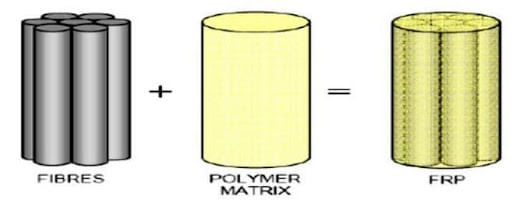
Fibre Reinforced Polymer
Components of Composite Materials
Fibres
- The properties of composite materials are frequently influenced by the fibre used.
- Carbon, glass, and aramid are the three most common types of fibres used in construction.
- The reinforcing fibre is frequently used to name the composite, for example, CFRP for Carbon Fibre Reinforced Polymer.
- The most important differences between fibre types are stiffness and tensile strain.
Matrices
- The matrix should transfer forces between the fibres while also protecting them from harmful effects.
- Thermosetting resins (thermosets) are nearly always used. The most common matrices are vinylester and epoxy.
- Epoxy is preferred over vinylester, but it is also more expensive.
- At 20 degrees Celsius, epoxy has a pot life of about 30 minutes, but this can be changed with different formulations.
- Epoxies have excellent strength, bonding, and creep properties. Epoxies have high strength, creep properties, and chemical resistance.
Types of FRP Material
Carbon Fiber Reinforced Polymer (CFRP)
- CFRP composites boast high tensile strength, low weight, and excellent stiffness, making them a top choice for applications requiring high-performance materials, such as aerospace and sports equipment.
Glass Fiber Reinforced Polymer (GFRP)
- GFRP composites are more cost-effective than CFRP and offer good strength-to-weight ratio. They find widespread applications in construction, marine, and automotive industries.
Aramid Fiber Reinforced Polymer (AFRP)
- AFRP composites are known for their exceptional impact resistance and are commonly used in bulletproof vests, helmets, and other protective gear.

FRP Composite Gazebo
Manufacturing of FRP Composite Material
The manufacturing process of FRP composites involves several techniques, with the choice depending on the application and desired properties. Common manufacturing methods include:
Pultrusion
- It is a process used to make FRP composites with a regular and uniform shape, such as bars, beams, and rods.
- After being saturated with resin and drawn through, the fibres are pulled through a heated steel die to shape them into the desired shape.
Filament winding
- It is primarily used to create parts for tanks and pipes. Long filaments of wet resin-soaked fibre are twisted around a mould to create the desired shape.
Hand Lamination
- It is a low-cost technology used to create complex shapes such as the hull of a boat and the fuselage of an aeroplane.
- The fibres are arranged in a fabric over a mould and then wet with resin.
Vacuum Infusion
- Vacuum infusion is used to create extremely light FRP components.
- FRP components containing resin and fibre are vacuum bagged to increase resin penetration into the fibre cloth.
Properties of FRP
- High Strength-to-Weight Ratio: FRP composites are renowned for their exceptional strength while being significantly lighter than traditional materials like steel and concrete.
- Corrosion Resistance: Unlike metals, FRP materials are immune to corrosion, making them ideal for marine, chemical, and corrosive environments.
- Flexibility and Design Freedom: The manufacturing process allows designers to create complex shapes and customize designs as per specific project requirements.
- Low Thermal Conductivity: FRP materials exhibit low thermal conductivity, providing excellent insulation properties for applications in construction and transportation.
- High Fatigue Resistance: FRP composites display remarkable fatigue resistance, ensuring longevity and reliability in dynamic load conditions.

Left: Conventional Steel Bridge; Right: FRP Composite Bridge
Applications of FRP
- Aerospace Industry: CFRP composites are extensively used in aircraft components, including wings, fuselage sections, and interior parts, contributing to weight reduction and fuel efficiency.
- Automotive Sector: GFRP and CFRP find application in automobile body panels, chassis components, and interior parts, leading to enhanced performance and fuel economy.
- Civil Engineering: GFRP composites are used for strengthening and retrofitting concrete structures, bridges, and seismic retrofitting, improving their load-bearing capacity and durability.
- Sports Equipment: CFRP composites are commonly used in sports equipment such as tennis rackets, golf clubs, and bicycles, offering improved performance and durability.
- Marine Industry: FRP materials are used in boat hulls, decks, and other marine structures due to their corrosion resistance and lightweight nature.
- Wind Energy: The wind energy sector has embraced FRP materials for constructing turbine blades that offer better efficiency and reduced maintenance costs.
Advantages of FRP
- Weight Reduction: The lightweight nature of FRP composites contributes to reduced transportation costs and improved overall performance.
- High Strength: FRP materials exhibit excellent strength, allowing them to withstand heavy loads and stresses.
- Corrosion Resistance: FRP composites are highly resistant to corrosion, extending the life of structures and reducing maintenance costs.
- Design Flexibility: The versatility of FRP materials allows for intricate designs and customization as per specific project requirements.
- Low Maintenance: Due to their durability and resistance to environmental factors, FRP structures require minimal maintenance over their lifetime.
Disadvantages of FRP
- Cost: FRP composites can be relatively expensive to produce compared to traditional materials.
- Fire Resistance: FRP materials are less fire-resistant than metals and may require additional fireproofing measures.
- Material Variability: The properties of FRP composites can vary, making quality control challenging in large-scale applications.
- Environmental Challenges: While FRPs themselves are durable and have a longer life, the disposal of these materials can raise environmental concerns due to their non-biodegradable nature.
- Recycling FRP materials is a complex process, leading to limited recycling options.
| Other Relevant Links | |
|---|---|
| Science & Technology Policy in India | Scientific Policy Resolution 1958 |
| Science & Technology Policy of 1983 | Science & Technology Policy of 2003 |
| Science, Technology and Innovation Policy 2013 | New Initiatives Aligned with the National Agenda |
| Technology Vision Document 2035 | National Intellectual Property Rights Policy |
Conclusion
While the range of potential applications is impressive, more technological advancement is required to make the process cost-effective and ensure the ultimate durability of the FRP component. Materials science and production engineering must collaborate to address current issues and make these composites the first choice for a wide range of applications.
FAQs
Question: What is FRP Composite Material?
Answer: FRP (Fiber Reinforced Polymer) composite materials are made from a polymer matrix reinforced with fibers such as glass, carbon, or aramid. These materials combine the high strength of fibers with the lightweight and durability of polymers, making them ideal for various applications in industries like aerospace, automotive, and construction.
Question: What are the primary components of FRP composites?
Answer: FRP composites consist of two primary components: the matrix (usually a polymer resin) and the reinforcing fibers (such as glass, carbon, or aramid). The matrix holds the fibers in place and provides structural integrity, while the fibers enhance the strength, stiffness, and other mechanical properties of the material.
Question: What are the advantages of using FRP composites over traditional materials?
Answer: FRP composites offer several advantages, including high strength-to-weight ratio, corrosion resistance, low maintenance, and flexibility in design. These properties make them suitable for use in industries like aerospace, marine, construction, and automotive, where traditional materials may fall short.
Question: What are the common applications of FRP composites?
Answer: FRP composites are used in a variety of applications, including the construction of lightweight and durable components in the aerospace, automotive, and marine industries. Other common uses include wind turbine blades, pipelines, structural reinforcements, and pressure vessels, where strength, durability, and resistance to corrosion are critical.
Question: What are the challenges in manufacturing FRP composites?
Answer: The challenges in manufacturing FRP composites include high production costs, complex fabrication processes, and difficulties in recycling these materials. Additionally, the durability of FRP materials can be affected by environmental factors such as UV radiation and temperature fluctuations, which can degrade the polymer matrix over time.
MCQs
1. What is the primary advantage of using FRP composite materials in the construction industry?
A) High thermal conductivity
B) High strength-to-weight ratio
C) High cost of production
D) Low corrosion resistance
Answer: (B) See the Explanation
Explanation: The primary advantage of FRP composites in the construction industry is their high strength-to-weight ratio. This makes them ideal for use in structural applications where strength is required without adding significant weight. Their lightweight nature helps reduce transportation costs and makes handling easier.
2. Which of the following fibers is commonly used in FRP composites for enhanced mechanical properties?
A) Wool fibers
B) Glass fibers
C) Cotton fibers
D) Hemp fibers
Answer: (B) See the Explanation
Explanation: Glass fibers are commonly used in FRP composites because they offer a combination of strength, flexibility, and low cost. Glass fiber-reinforced polymers (GFRP) are widely used in construction, automotive, and aerospace industries for their excellent mechanical properties and durability.
3. What is a key disadvantage of FRP composites in comparison to traditional materials?
A) High environmental impact
B) Difficulty in recycling
C) Low strength-to-weight ratio
D) Poor corrosion resistance
Answer: (B) See the Explanation
Explanation: One key disadvantage of FRP composites is the difficulty in recycling them. Unlike metals or other materials, FRP composites cannot be easily broken down and reused due to the nature of their polymer matrix and reinforcing fibers. This poses challenges for sustainability in the long term.
4. In which of the following industries are FRP composites most commonly used?
A) Food processing
B) Aerospace and automotive
C) Textile manufacturing
D) Paper production
Answer: (B) See the Explanation
Explanation: FRP composites are most commonly used in the aerospace and automotive industries. These industries benefit from the lightweight, durable, and high-strength characteristics of FRP composites, which help improve performance and fuel efficiency while reducing the weight of components.
5. Which property of FRP composites makes them resistant to corrosion?
A) The polymer matrix
B) The reinforcing fibers
C) The high temperature resistance
D) The flexibility of the material
Answer: (A) See the Explanation
Explanation: The polymer matrix in FRP composites provides resistance to corrosion. The resin used in the composite acts as a protective barrier against moisture, chemicals, and environmental factors, preventing the reinforcing fibers from degrading over time. This makes FRP composites ideal for use in harsh environments.
GS Mains Questions and Model Answers
Q1: Discuss the environmental and economic benefits of using FRP composites in modern infrastructure development.
Answer: The use of FRP composites in infrastructure offers several environmental and economic benefits. Environmentally, FRP composites are corrosion-resistant and have a long service life, reducing the need for frequent repairs and replacements, thus lowering maintenance costs and minimizing environmental waste. Economically, their lightweight nature reduces transportation costs, and their high strength-to-weight ratio allows for the construction of stronger, more durable structures without increasing overall weight. Additionally, FRP composites can help reduce energy consumption in buildings and vehicles, contributing to sustainable development.
Q2: Explain the role of FRP composites in the aerospace and automotive industries. How do they contribute to performance and efficiency?
Answer: In the aerospace and automotive industries, FRP composites are used to manufacture lightweight yet strong components, leading to improved performance and efficiency. In aerospace, the use of FRP composites reduces the weight of aircraft, which in turn improves fuel efficiency and reduces carbon emissions. Similarly, in the automotive industry, FRP composites contribute to lighter vehicles, which enhance fuel economy and performance while reducing emissions. The durability and resistance to corrosion of FRP materials also extend the lifespan of components, making them cost-effective in the long term.
Q3: What are the challenges faced in the widespread adoption of FRP composites in various industries?
Answer: Despite their numerous advantages, the widespread adoption of FRP composites faces challenges such as high production costs, complex manufacturing processes, and issues related to recycling. The high cost of raw materials and specialized equipment for production makes FRP composites more expensive than traditional materials. Additionally, the lack of efficient recycling methods for FRP composites raises environmental concerns, as they are difficult to dispose of sustainably. Overcoming these challenges requires innovations in production technology, cost reduction, and the development of effective recycling processes.
Previous Year Questions on FRP Composites
UPSC CSE 2017
Question: "Discuss the importance and applications of FRP composites in modern industries, particularly in aerospace and automotive sectors."
Answer: FRP composites are crucial in the aerospace and automotive industries due to their high strength-to-weight ratio, which leads to reduced vehicle weight, improved fuel efficiency, and enhanced performance. Their corrosion resistance also makes them ideal for components exposed to harsh environments. Aerospace applications include aircraft wings, fuselages, and internal structures, while in automotive, they are used for body panels, structural reinforcements, and engine components. These materials help reduce energy consumption, emissions, and maintenance costs, contributing to more sustainable industrial practices.
UPSC CSE 2019
Question: "Explain the environmental and economic impact of using FRP composites in infrastructure and transportation sectors."
Answer: The use of FRP composites in infrastructure and transportation reduces environmental impact by minimizing the need for frequent repairs and replacements due to their durability and corrosion resistance. Economically, their lightweight nature leads to lower transportation and construction costs. In transportation, FRP composites improve fuel efficiency, while in infrastructure, they extend the lifespan of buildings and bridges, reducing maintenance costs. This makes FRP composites a cost-effective and sustainable choice for modern industries.
Download the PREPP App and attempt FREE IAS Exam Mock Tests and get complete study material!

Full Test - 04: UPSC CSE Prelims CSAT (Paper-II)
Full Test - 03: UPSC CSE Prelims CSAT (Paper-II)
UPSC CSE Prelims 2026 GS Paper 1 Question Paper (24-May-2026)
UPSC CSE Prelims 2026 CSAT Paper 2 Question Paper (24-May-2026)

17 February 2025 | The Hindu Must Read Articles | Current Affairs

16 February 2026 | The Hindu Must Read Articles | Current Affairs

13 February 2026 | The Hindu Must Read Articles | Current Affairs









Comments