Organ Donation Rules in India – Science & Technology Notes
The surgical procedure of transplanting a healthy organ to replace a defective one in a patient, increasing their survival rate by years, is known as organ donation. The Transplantation of Human Organs Act, India's primary organ donation and transplantation legislation, was passed in 1994 and is aimed at regulating the removal, storage, and transplantation of human organs for therapeutic purposes, as well as the prevention of commercial dealings in human organs. In this article, we will discuss regarding Organ Donation Rules in India.
Table of Contents
- Organ Transplantation
- Types of Organ Donation
- Laws and Rules Governing Organ Transplantation in India
- Transplantation of Human Organs Act (THOA) – Main Provisions
- Current Scenario of Organ Transplantation in India
- Government Agencies Related to Organ Donation
- Need for Organ Donation
- Challenges Related to Organ Transplantation
- Conclusion
- FAQs
- MCQs
What is Organ Transplantation?
- Organ transplantation is the transfer of an organ from one body to another.
- The person who donates the organ is known as the donor, while the person who receives it is known as the recipient.
- Organ transplantation is performed to replace the recipient's damaged organ with the donor's working organ, allowing the recipient to function normally.
- Organ transplantation has benefited the medical industry by saving the lives of those who would have died otherwise.
- Organ donation is sometimes the only way to treat chronic conditions like kidney failure or leukaemia. A transplant is a second chance at life for those in need.
- Organs such as the kidney, heart, liver, and pancreas can be transplanted, allowing patients to avoid costly treatments.
- Human organs for transplantation are in high demand. In fact, the demand for transplantable organs far outnumbers the supply.
- This disparity has resulted in the development of various laws attempting to regulate scarce resources (transplantable human organs) and to assist in the establishment of an equitable system for allocating organs where they can do the most good.
Types of Organ Donation
Living Organ Donation
- This is when an organ is removed from a healthy living person and transplanted into the body of someone who has end-stage organ failure.
- This is commonly done in cases of liver or kidney failure (because the liver can regrow to its normal size and a donor can live on one kidney).
- Living donors are classified as either close relatives or distant relatives/friends, and so on.
- A spouse, son/daughter, brother/sister, parents, grandparents, and grandchildren are examples of close relatives.
- Other than close relatives and friends, those who wish to donate organs must obtain permission from the State Authorization Committee.
- If the hospital refuses to hear such cases, the patient may file a legal notice against the hospital for failing to follow the Transplant Act.
Deceased Organ Donation
- Deceased Organ Donation is what we mean when we talk about pledging your organs for donation or about organ donation after death.
- This is an organ donation from a person who has been declared brain stem dead by a hospital's team of authorised doctors.
- When there is an irreversible loss of consciousness, the absence of brain stem reflexes, and the irreversible loss of the ability to breathe, a person is said to be brain stem dead.
- Organ donation after death is only permitted in India in the case of brainstem death. Donation after cardiac death is common in the West, but donations after cardiac death are uncommon in India.
- Although organs such as the liver and kidney can be easily donated from a living donor to a recipient, we should strive for a world in which everyone donates their organs after death (if they can), so that no living person is forced to donate an organ to another.
Laws and Rules Governing Organ Transplantation in India
- Each state in India governs health-related matters.
- The Transplantation of Human Organs Act was started at the request of Maharashtra, Himachal Pradesh, and Goa (who thus adopted it by default) and was later adopted by all states except Andhra Pradesh and Jammu and Kashmir.
- Despite the existence of a regulatory framework, instances of commercial dealings in human organs have been reported in the media.
- The states of Goa, Himachal Pradesh, and West Bengal proposed an amendment to the Act in 2009 to address deficiencies in the Act's efficacy, relevance, and impact.
- The Act was amended by parliament in 2011, and the rules were published in 2014. By default, the proposing states and union territories adopt it, and other states may adopt it by passing a resolution.
Transplantation of Human Organs Act (THOA) – Main Provisions
- Brain death has been identified as a type of death. Form 10 defines the process and criteria for certifying brain death.
- Allows for the transplantation of human organs and tissues from living and deceased donors (after cardiac or brain death).
- Regulatory and advisory bodies for transplantation activity, as well as their constitution, are defined.
- Appropriate Authority (AA): inspects and registers hospitals for transplantation, enforces hospital standards, and conducts regular inspections to ensure the quality of transplants. It has the authority of a civil court to summon anyone, request documents, and issue search warrants and may conduct investigations into complaints alleging violations of Act provisions.
- Advisory Committee: made up of domain experts who advise the appropriate authority.
- Authorization Committee (AC): oversees living donor transplantation by reviewing each case to ensure that the donor is not exploited for monetary gain and to prevent commercial dealings in transplantation. The proceedings will be video recorded, and decisions will be made within 24 hours. Appeals may be made to the state or federal governments in response to their decision.
- Medical board (Brain Death Committee): A group of doctors who are in charge of certifying brain death. In the absence of a neurologist or neurosurgeon, any surgeon, physician, anesthetist, or intensivist nominated by the hospital's medical administrator may certify brain death.
- Living donors are classified as either a close relative or a stranger.
- A close relative (spouse, children, grandchildren, siblings, parents, and grandparents) must obtain permission from the transplant center's doctor in-charge in order to donate their organ.
- A non-related donor requires the approval of a state-established Authorization Committee in order to donate his organs.
- When a near relative living donor is medically incompatible with the recipient, the pair may undergo a swap transplant with another related unmatched donor/recipient pair.
- Authorization for organ donation after brain death
- may be given before death by the individual or
- by the person in legal possession of the body. Every person admitted to the ICU must be asked by a doctor if any prior authorization has been obtained. If this is not the case, the patient or a close relative should be informed of the option to authorize such donation.
- Outlined the authorization process for organ or tissue donation from unclaimed bodies.
- Once registered with the appropriate authority, organ retrieval is permitted from any hospital with an ICU facility.
- Any hospital with an Intensive Care Unit (ICU) and the manpower, infrastructure, and equipment needed to diagnose and maintain a brain-stem dead person, as well as retrieve and transport organs and tissues, including a facility for temporary storage, can register as a retrieval centre.
- The recipient, institution, government, NGO, or society will bear the cost of donor management, retrieval, transportation, and preservation, not the donor family.
- The procedure for organ donation in medico-legal cases is defined in order to avoid jeopardising the determination of the cause of death and delaying organ retrieval.
- The manpower and facilities needed to register a hospital as a transplant centre are outlined.
- Tissue banks' infrastructure, equipment requirements, guidelines, and standard operating procedures are all outlined.
- Transplant surgeons' qualifications, as well as cornea and tissue retrieval technicians', have been defined.
- All transplant centres must appoint transplant coordinators (with specific qualifications).
- Non-governmental organisations, registered societies, and trusts engaged in organ or tissue removal, storage, or transplantation will be required to register.
- The central government will establish a National Human Organs and Tissues Removal and Storage Network, which will include NOTTO (National Organ and Tissue Transplant Organisation), ROTTO (Regional Organ and Tissue Transplant Organisation), and SOTTO (State Organ and Tissue Transplant Organisation).
- The central government is responsible for keeping a registry of donors and recipients of human organs and tissues.
- Penalties for illegal organ removal, making or receiving payment for supplying human organs, or violating any other provision of the Act have been made extremely severe in order to serve as a deterrent to such activities.
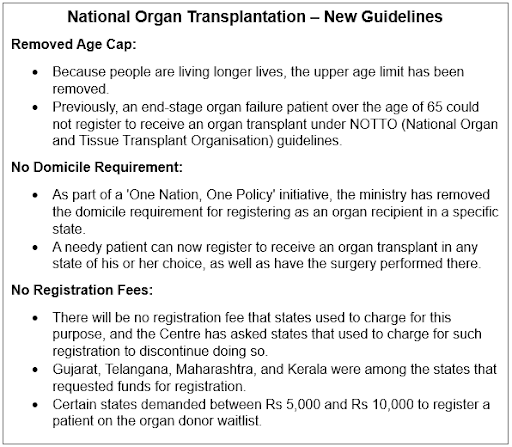
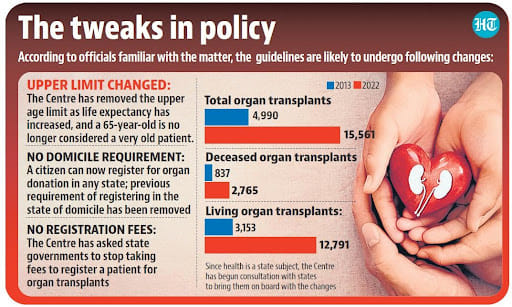
National Organ Transplantation - New Guidelines
Current Scenario of Organ Transplantation in India
- From 4,990 in 2013 to 15,561 in 2022, the number of organ transplants has more than tripled.
- The kidney is the most commonly transplanted organ, followed by the liver, heart, lung, pancreas, and small bowel.
- Nearly 12,791 living donor transplants and 2,765 deceased donor transplants were performed in 2022 alone.
- Only 1,743 (14%) of the organs harvested came from deceased donors, with the vast majority coming from living donors, specifically kidney and liver donations.
- In 2021, nearly all deceased organ donations were made in 15 states, with the top five accounting for more than 85% of the total.
- An estimated 1.5-2 lakh people require a kidney transplant each year. In 2022, only about 10,000 people received one.
- In 2022, less than 3,000 of the 80,000 people who needed a liver transplant received one.
- In 2022, only 250 of the 10,000 people who needed a heart transplant received one.
Government Agencies Related to Organ Donation
1) National Organ and Tissue Transplant Organisation (NOTTO)
- The National Organ and Tissue Transplant Organisation (NOTTO) is an organisation at the national level.
- The Transplantation of Human Organs and Tissues (Amendment) Act of 2011 mandates the establishment of NOTTO.
- It was established under the Directorate General of Health Services of the Ministry of Health and Family Welfare of the Government of India.
- NOTTO serves as the focal point for all-India coordination and networking for the procurement and distribution of organs and tissues, as well as the registration of organ and tissue donation and transplantation in the country.
- NOTTO is the nodal networking agency for Delhi and the National Capital Region, as well as the network for Procurement Allocation and Distribution of Organs and Tissues in Delhi and the National Capital Region.
2) Regional Organ & Tissue Transplant Organisation (ROTTO)
- The regional government organisation is the Regional Organ & Tissue Transplant Organisation (ROTTO). In India, there are five ROTTOs.
- They serve as distinct regional branches that ensure protocol among the state organisations that are enlisted under each of them.
- They are all based in the region's Government Hospital.
- Each ROTTO currently manages 5-7 states and is in charge of activities such as coordination and networking for the procurement, distribution, and transplantation of organs and tissues between their respective state organisations.
Need for Organ Donation
- India has the world's third highest number of transplants, but the number of organs required is still far greater than the number of transplants.
- Because heart and lungs can only be obtained from deceased donors, lifestyle diseases are increasing the demand for organs.
- Every year, nearly 1.5 lakh people die in road traffic accidents in India, many of whom could potentially donate organs.
- Organ transplantation also reduces the burden on the healthcare system by reducing the need for hospitalization, repeat surgeries, and long-term care.
- The rate of organ donation in India is 0.52 per million people, which is significantly lower than the rate in Spain (49.6 per million).
- Because one donor can donate several organs, organ donation can help save the lives of many people.
Challenges Related to Organ Transplantation
- Lack of awareness: Because people are unaware of the importance of organ donation and transplantation, there is a scarcity of donated organs.
- Donor shortage: Despite increased awareness, there is still a donor shortage due to a variety of factors, including religious beliefs and a lack of trust in the medical system.
- Legal and ethical concerns: There are several legal and ethical concerns surrounding organ donation, including consent, organ allocation, and the equitable distribution of organs.
- Transportation and preservation: Organs must be transported and preserved under specific conditions to ensure viability for transplantation, which presents logistical challenges, particularly for organs with a short shelf life.
- Medical suitability: Due to medical conditions or other factors, not all donated organs are suitable for transplantation, which can limit the number of available organs for transplant.
- Costs: The costs of organ transplantation can be prohibitively expensive, limiting some patients' access to treatment.
| Other Relevant Links | |
|---|---|
| Science & Technology Policy in India | Scientific Policy Resolution 1958 |
| Science & Technology Policy of 1983 | Science & Technology Policy of 2003 |
| Science, Technology and Innovation Policy 2013 | New Initiatives Aligned with the National Agenda |
| Technology Vision Document 2035 | National Intellectual Property Rights Policy |
Conclusion
People of all ages and with any medical history can now become donors thanks to recent medical advances. However, the final decision is made after doctors examine the donor's medical condition. Many people are in desperate need of vital organs to live. Given the number of people who die every day, the lack of organ donors is a situation that can be avoided.
FAQs
Question: What is organ donation in India?
Answer: Organ donation in India refers to the voluntary process where a person donates their organ(s) to another individual who needs them due to medical conditions like organ failure. It can be either living donation or posthumous donation, where organs are donated after death.
Question: What are the rules for organ donation in India?
Answer: The rules for organ donation in India are governed by the Transplantation of Human Organs and Tissues Act, 1994, which regulates organ donation, transplantation, and related procedures. It ensures that the process is ethical, transparent, and voluntary, with strict guidelines for obtaining consent from the donor or their family.
Question: How does a person register for organ donation in India?
Answer: Individuals can register as organ donors with authorized organizations, such as the National Organ and Tissue Transplant Organization (NOTTO) or through state-level donation programs. Registration can be done online, at hospitals, or through donor cards that indicate the individual’s consent for organ donation.
Question: What are the eligibility criteria for organ donation in India?
Answer: To donate organs, individuals must be over the age of 18, mentally competent, and give informed consent. For living donations, the donor must be a close relative of the recipient, and the organ donated must be suitable for transplantation based on medical evaluations.
Question: How does the government regulate organ donation in India?
Answer: The government regulates organ donation through the Transplantation of Human Organs and Tissues Act, which establishes guidelines for the registration, transplantation process, and monitoring of organ transplants. The government also sets up transplantation committees to ensure compliance with ethical standards and prevent illegal trade.
MCQs
1. Which of the following acts regulates organ donation in India?
A) Transplantation of Human Organs and Tissues Act, 1994
B) Indian Medical Council Act, 1956
C) National Organ Transplant Act, 2010
D) Human Rights Protection Act, 1993
Answer: (A) See the Explanation
The Transplantation of Human Organs and Tissues Act, 1994, regulates organ donation and transplantation in India, ensuring ethical practices, transparency, and the safety of both donors and recipients.
2. Which of the following is a requirement for registering as an organ donor in India?
A) Written approval from family
B) Physical health certificate
C) Voluntary informed consent
D) Proof of employment status
Answer: (C) See the Explanation
The primary requirement for registering as an organ donor is voluntary, informed consent. This ensures that the individual understands the implications and is willing to donate their organs or tissues upon death.
3. What is the minimum age requirement for organ donation in India?
A) 16 years
B) 18 years
C) 21 years
D) 25 years
Answer: (B) See the Explanation
Individuals must be at least 18 years old to register as an organ donor in India, as they must be mentally competent to make such a decision independently.
4. Which organization facilitates organ donation registration in India?
A) National Health Authority
B) Indian Medical Association
C) National Organ and Tissue Transplant Organization (NOTTO)
D) Ministry of Health and Family Welfare
Answer: (C) See the Explanation
The National Organ and Tissue Transplant Organization (NOTTO) facilitates organ donation registration and coordinates organ transplantation in India.
5. What is a living organ donation?
A) Donation of organs after death
B) Donation of a kidney or liver by a healthy individual
C) Donation of tissues such as skin
D) Donation of organs for research purposes
Answer: (B) See the Explanation
Living organ donation refers to the donation of organs like kidneys or a portion of the liver by a living person, typically a close relative, to someone in need of a transplant.
GS Mains Questions and Model Answers
Q1: Discuss the ethical issues surrounding organ donation in India and the legal frameworks in place to regulate it.
Answer: Ethical issues surrounding organ donation include consent, the potential for coercion in cases of living donations, and the fairness of allocation. The legal framework for organ donation in India, established by the Transplantation of Human Organs and Tissues Act, 1994, addresses these concerns by ensuring that donations are voluntary and based on informed consent. The act prohibits commercial trade of organs and mandates a transparent, regulated process for organ allocation, aiming to prevent exploitation and ensure equitable distribution based on medical need.
Q2: Evaluate the role of organ donation in addressing the healthcare needs of India’s growing population.
Answer: Organ donation plays a vital role in addressing the healthcare needs of India’s growing population, particularly in the context of increasing incidences of organ failure. With a limited supply of organs, the waitlist for transplants is long, leading to many preventable deaths. Expanding organ donation awareness, improving legal frameworks, and addressing cultural taboos are essential for increasing the organ donor pool. A robust organ donation system can significantly improve patient outcomes and reduce mortality rates associated with organ failure.
Q3: How can India increase organ donation rates and ensure fair distribution among its population?
Answer: To increase organ donation rates in India, efforts should focus on raising awareness, removing cultural stigmas, and making the donation process easier and more accessible. Encouraging individuals to register as donors through campaigns and online platforms can help increase donations. The government can improve the efficiency of the organ allocation process by establishing national and regional transplant networks. Furthermore, providing financial incentives or support for families of deceased donors may also help improve donation rates. Finally, increasing medical infrastructure for transplants and ensuring equitable distribution based on medical need are crucial for improving fairness in organ donation.
Previous Year Questions on Organ Donation
1. UPSC CSE Prelims 2020:
Question: What is the primary objective of the Transplantation of Human Organs and Tissues Act, 1994?
A) To promote the sale of human organs
B) To regulate organ donation and transplantation
C) To create awareness about organ donation
D) To establish new transplant hospitals
Answer: (B)
Explanation: The primary objective of the Transplantation of Human Organs and Tissues Act, 1994, is to regulate organ donation and transplantation, ensuring ethical practices and preventing organ trade.
2. UPSC CSE Mains 2021 (GS Paper 2):
Question: "Assess the ethical concerns and regulatory measures associated with organ donation in India."
Answer: Ethical concerns regarding organ donation in India include ensuring voluntary consent, preventing exploitation of vulnerable populations, and addressing cultural taboos. Regulatory measures, such as the Transplantation of Human Organs and Tissues Act, 1994, ensure that donations are voluntary, prevent commercial trade, and regulate the organ allocation process. These measures aim to maintain transparency and fairness, but challenges such as improving public awareness and increasing donation rates remain.
Download the PREPP App and attempt FREE IAS Exam Mock Tests and get complete study material!

Full Test - 04: UPSC CSE Prelims CSAT (Paper-II)
Full Test - 03: UPSC CSE Prelims CSAT (Paper-II)
UPSC CSE Prelims 2026 GS Paper 1 Question Paper (24-May-2026)
UPSC CSE Prelims 2026 CSAT Paper 2 Question Paper (24-May-2026)

17 February 2025 | The Hindu Must Read Articles | Current Affairs

16 February 2026 | The Hindu Must Read Articles | Current Affairs

13 February 2026 | The Hindu Must Read Articles | Current Affairs









Comments