Higgs Boson: The God Particle – Science & Technology Notes
The Higgs boson is the fundamental particle associated with the Higgs field, which pervades the entire universe and provides mass to other fundamental particles like electrons and quarks. This field was first proposed in the mid-1960s by Peter Higgs and his colleagues. Researchers at the Large Hadron Collider (LHC), the world's most powerful particle accelerator, discovered the particle on July 4, 2012, at the European particle physics laboratory CERN in Switzerland. In this article, we will discuss regarding Higgs Boson which will be helpful for UPSC preparation.
Table of Contents
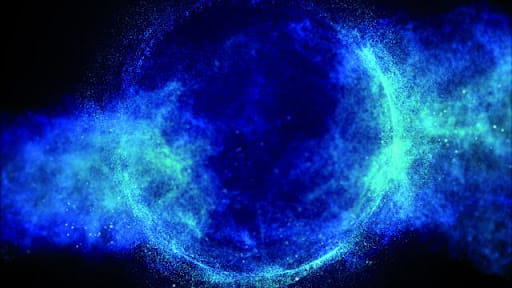
View of Higgs Field
Higgs Boson – Background
- Peter Higgs, François Englert, and four other theorists proposed the Higgs boson in 1964 to explain why certain particles have mass.
- Scientists confirmed its existence in 2012 with the ATLAS and CMS experiments at CERN's Large Hadron Collider (LHC).
- Higgs and Englert were awarded the Nobel Prize in Physics in 2013 as a result of their discovery.
- The discovery of the Higgs boson was significant because it confirmed the existence of the Higgs field and provided experimental evidence for how particles gain mass.
- It also filled a gap in the Standard Model, which successfully described the behaviour of the majority of known particles but lacked experimental confirmation of the Higgs mechanism at first.
What is Higgs Boson?
- The Higgs boson is a particle with a mass of approximately 125 gigaelectronvolts (GeV), making it 130 times more massive than a proton.
- It is also chargeless and has no spin, which is the quantum mechanical equivalent of angular momentum. The Higgs Boson is the only elementary particle that does not have a spin.
- It decays quickly into other particles, making direct detection difficult.
- The Higgs boson was created by high-energy particle collisions at the LHC, and its decay products were observed to confirm its existence.
- A boson is a "force carrier" particle that enters the picture when particles interact, with a boson being exchanged during the interaction. When two electrons interact, they exchange a photon, which is the force-carrying particle in electromagnetic fields.
- Because quantum field theory uses wave mechanics to describe the microscopic world and the quantum fields that fill the universe, a boson can also be described as a wave in a field.
- Scientists are now examining the Higgs boson's properties to see if they exactly match the predictions of the Standard Model of particle physics.
- If the Higgs boson deviates from the model, it may reveal new particles that only interact with other Standard Model particles via the Higgs boson, leading to new scientific discoveries.
Discovery of Higgs Boson
- It's not as simple as setting up a detector and waiting for it to detect the Higgs boson. These particles existed only in the early universe's high-energy conditions.
- That means that before this particle can be detected, these high-energy conditions must be replicated and Higgs bosons must be created.
- The LHC accomplishes this by accelerating protons to near-light speed and colliding them. This results in a cascade of particles that decay quickly into lighter particles.
- Because the Higgs boson decays too quickly to be detected, it was discovered by detecting particle decays that indicated a particle with no spin and matched theoretical predictions for this missing boson.
- Both the LHC ATLAS detector and the Compact Muon Solenoid (CMS) detector detected the particle.
- The discovery of the Higgs boson completed this picture of the subatomic world by revealing this particle predicted by the standard model.
- There are still unanswered questions beyond this theory, such as the nature of dark matter, which the Higgs boson's unique properties may help to solve.
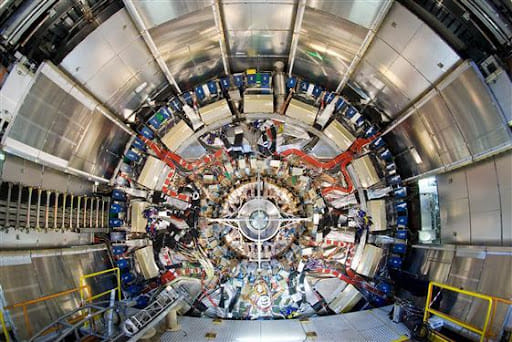
ATLAS Detector
Higgs Boson – Important Facts
- The Higgs boson, like other particles, derives its mass from its interactions with the Higgs field.
- There could be multiple Higgs bosons. Five Higgs bosons are predicted by one theoretical model of new physics.
- While the Higgs boson gives mass to the quarks that make up a proton, it only accounts for about 10% of a proton's mass. The complex interactions of quarks and the strong nuclear force account for the remaining 90% of a proton's mass.
- Because the Higgs boson is responsible for generating the mass of other particles, and dark matter can be detected primarily through its mass, the Higgs boson can be a unique portal for detecting signs of dark matter.
Conclusion
The LHC at CERN is the world's highest-energy particle collider. It is the only place where scientists can currently create and study Higgs bosons. These experiments are taking precise measurements of the Higgs boson's properties to see if it matches the Standard Model predictions or provides hints to new physics, exploring new particles and their interactions, and identifying dark matter's new physics.
| Other Relevant Links | |
|---|---|
| Science & Technology Policy in India | Scientific Policy Resolution 1958 |
| Science & Technology Policy of 1983 | Science & Technology Policy of 2003 |
| Science, Technology and Innovation Policy 2013 | New Initiatives Aligned with the National Agenda |
| Technology Vision Document 2035 | National Intellectual Property Rights Policy |
FAQs
Question: What is the Higgs boson particle?
Answer: The Higgs boson is a subatomic particle associated with the Higgs field, responsible for giving mass to other particles. It was confirmed in 2012 by the Large Hadron Collider (LHC) experiments.
Question: Why is the Higgs boson referred to as the "God particle"?
Answer: The Higgs boson is called the "God particle" due to its crucial role in the Standard Model of particle physics, providing an explanation for why particles have mass, a fundamental aspect of the universe.
Question: What was the significance of discovering the Higgs boson?
Answer: The discovery of the Higgs boson confirmed the existence of the Higgs field, validating the Standard Model of particle physics and deepening our understanding of the universe’s fundamental structure.
Question: How was the Higgs boson discovered?
Answer: The Higgs boson was discovered in 2012 at the Large Hadron Collider (LHC) by the CERN research team. They used high-energy particle collisions to detect the presence of the particle.
Question: What role does the Higgs boson play in the Standard Model of particle physics?
Answer: The Higgs boson is crucial to the Standard Model because it explains how other particles acquire mass through their interactions with the Higgs field, a key component of the theory.
MCQs
1. What is the primary role of the Higgs boson in particle physics?
A) It interacts with the weak force
B) It gives mass to particles
C) It generates gravitational force
D) It controls electromagnetic interactions
Answer: (B) See the Explanation
Explanation: The Higgs boson gives mass to elementary particles by interacting with the Higgs field, which is essential to the Standard Model of particle physics.
2. Where was the Higgs boson discovered?
A) Fermilab, USA
B) Large Hadron Collider, CERN
C) Brookhaven National Laboratory
D) Oak Ridge National Laboratory
Answer: (B) See the Explanation
Explanation: The Higgs boson was discovered in 2012 at the Large Hadron Collider (LHC) at CERN, a major breakthrough in particle physics.
3. Why is the Higgs boson also called the "God particle"?
A) Because it explains the existence of dark matter
B) Because it is the most powerful particle
C) Because it gives mass to other particles
D) Because it is the smallest particle in the universe
Answer: (C) See the Explanation
Explanation: The Higgs boson is referred to as the "God particle" because it is essential to understanding how particles acquire mass, a fundamental concept in the universe’s creation.
4. What year was the Higgs boson discovered?
A) 2010
B) 2011
C) 2012
D) 2013
Answer: (C) See the Explanation
Explanation: The Higgs boson was discovered in 2012 by the CERN team at the Large Hadron Collider, marking a milestone in particle physics.
5. What does the discovery of the Higgs boson confirm in physics?
A) That gravity is the fundamental force
B) The existence of dark energy
C) The Higgs field and particle mass acquisition
D) That time travel is possible
Answer: (C) See the Explanation
Explanation: The discovery of the Higgs boson confirmed the existence of the Higgs field, which is responsible for particles acquiring mass, validating the Standard Model of particle physics.
GS Mains Questions and Model Answers
Q1: Explain the significance of the Higgs boson in understanding the Standard Model of particle physics.
Answer: The Higgs boson is a crucial discovery in particle physics as it supports the existence of the Higgs field, a key component of the Standard Model. This field is responsible for providing mass to elementary particles. Without the Higgs field and the corresponding Higgs boson, the Standard Model would lack an explanation for why particles like the W and Z bosons, and fermions such as quarks and leptons, have mass. The discovery of the Higgs boson in 2012 at CERN confirmed the validity of the theoretical framework that had been proposed in the 1960s, marking a monumental achievement in understanding the fundamental forces of nature.
Q2: Discuss the role of the Large Hadron Collider (LHC) in the discovery of the Higgs boson.
Answer: The Large Hadron Collider (LHC) played a central role in the discovery of the Higgs boson. Located at CERN, the LHC is the world’s largest and most powerful particle accelerator. It was designed to collide protons at extremely high speeds, mimicking conditions similar to the moments after the Big Bang. These collisions allowed physicists to detect new particles, including the Higgs boson. In 2012, the LHC experiments identified a particle consistent with the predicted characteristics of the Higgs boson, providing strong evidence of its existence. This discovery confirmed key aspects of the Standard Model and advanced our understanding of the universe’s fundamental structure.
Q3: What are the implications of the Higgs boson discovery for the future of particle physics?
Answer: The discovery of the Higgs boson has profound implications for the future of particle physics. It validates the Standard Model, providing a deeper understanding of the fundamental forces and particles that govern the universe. However, it also raises new questions and opens avenues for further research. For instance, the discovery has not explained phenomena such as dark matter and dark energy, which remain largely mysterious. Additionally, it may lead to new theories that extend beyond the Standard Model, such as supersymmetry or string theory. As researchers continue to explore the data from the LHC and other experiments, the discovery of the Higgs boson will likely play a pivotal role in shaping the next breakthroughs in theoretical and experimental physics.
Previous Year Questions on the Higgs Boson
1. UPSC CSE Mains 2020 (GS Paper 3):
Question: "Discuss the role of the Higgs boson in the Standard Model of particle physics and its discovery."
Answer: The Higgs boson is a fundamental particle that provides an explanation for how other particles acquire mass, a crucial aspect of the Standard Model of particle physics. Its discovery in 2012 at the Large Hadron Collider confirmed the existence of the Higgs field, a key element in the Standard Model. This discovery was a milestone in understanding the fundamental forces of nature and marked a major advancement in theoretical physics.
2. UPSC CSE Mains 2019 (GS Paper 2):
Question: "Explain the significance of the Higgs boson’s discovery for the field of particle physics and its implications for modern science."
Answer: The discovery of the Higgs boson provided the missing link in the Standard Model of particle physics, offering a solution to the question of how elementary particles acquire mass. Its discovery confirmed the existence of the Higgs field, essential for understanding particle interactions. The implications for modern science are profound, as it not only validates a key aspect of theoretical physics but also opens up new areas of research into unknown phenomena like dark matter and dark energy, which remain unexplained by current models.
Download the PREPP App and attempt FREE IAS Exam Mock Tests and get complete study material!

Full Test - 04: UPSC CSE Prelims CSAT (Paper-II)
Full Test - 03: UPSC CSE Prelims CSAT (Paper-II)
UPSC CSE Prelims 2026 GS Paper 1 Question Paper (24-May-2026)
UPSC CSE Prelims 2026 CSAT Paper 2 Question Paper (24-May-2026)

17 February 2025 | The Hindu Must Read Articles | Current Affairs

16 February 2026 | The Hindu Must Read Articles | Current Affairs

13 February 2026 | The Hindu Must Read Articles | Current Affairs









Comments