Gene Editing – What is CRISPR-Cas9? – Science & Technology Notes
CRISPR-Cas9 is a novel technology that allows geneticists and medical researchers to edit portions of the genome by removing, adding, or modifying DNA sequences. It is currently the simplest, most versatile, and precise method of genetic manipulation, and it is causing quite a stir in the scientific community. In this article, we will discuss in depth regarding CRISPR-Cas9 which will be helpful for UPSC exam preparation.
Table of Contents
What is Gene Editing?
- Gene/genome editing is a technology that allows for the modification of an organism's DNA.
- It entails using enzymes known as 'engineered nucleases' to cut specific DNA sequences.
- Genome editing can be used to insert, delete, or change DNA in the genome.
- The genome can be edited to change the characteristics of a cell or an organism.
- Its applications include correcting genetic defects, treating and preventing disease spread, and improving crops, among others.
- CRISPR-Cas9 is the most widely used, low-cost, and efficient genome editing system.
CRISPR-Cas9 – Background
- Some bacteria have a built-in gene editing system similar to the CRISPR-Cas9 system, which they use to respond to invading pathogens such as viruses, similar to an immune system.
- The bacteria use CRISPR to snip out parts of the virus DNA and save a piece of it to help them recognise and defend against the virus the next time it attacks.
- This system was modified by scientists so that it could be used in other animal cells, including mice and humans.
What is CRISPR-Cas9?
- CRISPR is the system's DNA-targeting component, consisting of an RNA molecule, or 'guide,' designed to bind to specific DNA bases via complementary base-pairing.
- Cas9 is an abbreviation for CRISPR-associated protein 9 and is the nuclease component that cuts the DNA.
- The CRISPR-Cas9 system was discovered in bacteria, which use it to destroy invading viruses.
- CRISPR (Clustered Regularly Interspaced Short Palindromic Repeats) are short DNA sequences found in the genomes of prokaryotic organisms such as bacteria that serve as reminders of previous bacteriophage (virus) attacks that the bacteria successfully repelled.
- The Cas9 enzyme (a component of bacteria's defence mechanism) uses these flags to precisely target and cut any foreign DNA, thereby protecting the bacteria from future attacks by similar bacteriophages.
- CRISPR-Cas9 technology, which has recently been demonstrated in editing genes in cells and organisms, is based on the unprecedented precision of targeting DNA sequences and then efficiently cutting them.
How Does CRISPR-Cas9 Work?
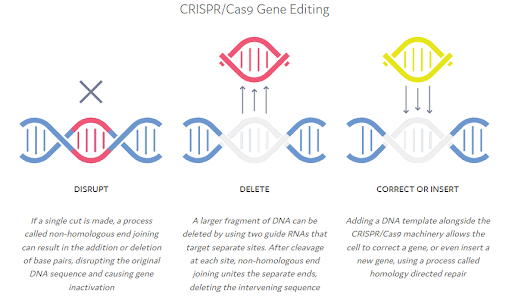
- The CRISPR-Cas9 system is made up of two key molecules that change (mutate) the DNA. They are as follows:
- Cas9 enzyme - This enzyme functions as a pair of 'molecular scissors' that can cut the two strands of DNA at a specific location in the genome, allowing bits of DNA to be added or removed.
- guide RNA (gRNA) - This is a small piece of pre-designed RNA sequence (about 20 bases long) that is located within a larger RNA scaffold.
- The scaffold component binds to DNA, while the pre-designed sequence 'guides' Cas9 to the correct region of the genome. This ensures that the Cas9 enzyme cuts at the correct location in the genome.
- The guide RNA is intended to locate and bind to a specific sequence of DNA.
- The RNA bases in the guide RNA are complementary to those in the target DNA sequence in the genome. This means that, in theory, the guide RNA will only bind to the target sequence and will not bind to any other regions of the genome.
- Cas9 follows the guide RNA to the same location in the DNA sequence and cuts across both strands.
- At this point, the cell recognises that the DNA has been damaged and attempts to repair it.
- Scientists can use the DNA repair machinery to modify one or more genes in the genome of an interest cell.
Application of CRISPR-Cas9
- Animal models: By mutating or silencing genes, CRISPR-Cas9 can be used to create animal models that mimic human diseases and help researchers understand disease development.
- Genome editing in specific tissues: Using hydrodynamic injection and adeno-associated virus (AAV), researchers were able to modify the genomes of specific tissues such as liver and brain.
- Multiple Gene Mutation: CRISPR-Cas9 can be used to generate mutants for multiple target genes.
- Disease treatment: CRISPR-Cas9 can be applied to cells in vivo or ex vivo. CRISPR-Cas9 is directly transferred to cells in the body using either viral or nonviral methods in the in vivo approach. The cells are removed from the body first, then CRISPR is applied to them, and they are returned to the body.
- Industrial use: CRISPR was first used commercially to make resistant to viral infections bacterial cultures used in cheese and yoghurt production.
- RNA editing: CRISPR-Cas9 can also edit single-stranded RNA (ssRNA) sequences.
- Military applications: These studies are frequently focused on increasing soldiers' tolerance to biological or chemical warfare. This technology has the potential to improve human performance.
Gene Editing – Pros & Cons
| Pros | Cons |
|---|---|
|
|
| Other Relevant Links | |
|---|---|
| Science & Technology Policy in India | Scientific Policy Resolution 1958 |
| Science & Technology Policy of 1983 | Science & Technology Policy of 2003 |
| Science, Technology and Innovation Policy 2013 | New Initiatives Aligned with the National Agenda |
| India and World collaboration in science projects | National Intellectual Property Rights Policy |
Conclusion
CRISPR is not only an extremely versatile technology, but it is also proving to be precise and increasingly safe to use, according to recent scientific advances. However, much progress remains to be made; we are only now beginning to realise the full potential of genome-editing tools such as CRISPR-Cas9. Technological and ethical barriers continue to stand in the way of a future in which we can feed the planet with engineered food, eliminate genetic disorders, and resurrect extinct animal species.
FAQs
Question: What is CRISPR-Cas9?
Answer: CRISPR-Cas9 is a revolutionary gene-editing technology that allows scientists to alter DNA within living organisms with high precision. It uses a guide RNA to target specific sequences of DNA, enabling gene modifications.
Question: How does CRISPR-Cas9 work?
Answer: CRISPR-Cas9 works by using a guide RNA to identify the DNA sequence that needs editing. The Cas9 enzyme then cuts the DNA at the targeted location, enabling either gene insertion, deletion, or modification.
Question: What are the applications of CRISPR-Cas9 technology?
Answer: CRISPR-Cas9 has various applications, including in gene therapy, disease research, crop modification, and agriculture, as well as in studying gene function by creating gene knockouts or mutations.
Question: What are the ethical concerns regarding CRISPR-Cas9?
Answer: Ethical concerns around CRISPR-Cas9 include the potential for gene editing in humans, leading to unintended consequences, germline editing, designer babies, and the possibility of exacerbating social inequalities.
Question: What is the potential of CRISPR-Cas9 in medical science?
Answer: CRISPR-Cas9 holds great potential in medical science, offering the ability to treat genetic disorders like sickle cell anemia, cystic fibrosis, and muscular dystrophy, by directly correcting mutations in the DNA.
MCQs
1. What is the primary function of the Cas9 enzyme in the CRISPR-Cas9 technology?
A) To synthesize RNA
B) To cut the DNA at a specific location
C) To repair the DNA
D) To replicate the DNA
Answer: (B) See the Explanation
Explanation: The Cas9 enzyme in CRISPR-Cas9 technology acts as a molecular scissors, cutting the DNA at a specific location guided by a complementary RNA sequence.
2. Which of the following is NOT a potential application of CRISPR-Cas9?
A) Gene therapy
B) Cloning of animals
C) Editing human genes for designer babies
D) Modification of agricultural crops
Answer: (C) See the Explanation
Explanation: While CRISPR-Cas9 has applications in gene therapy, cloning, and crop modification, editing human genes for creating designer babies is considered unethical and is not a primary application of the technology.
3. What is the role of guide RNA in CRISPR-Cas9 technology?
A) To repair the DNA
B) To cut the DNA
C) To guide the Cas9 enzyme to the target DNA sequence
D) To insert new genes
Answer: (C) See the Explanation
Explanation: The guide RNA in CRISPR-Cas9 technology is responsible for guiding the Cas9 enzyme to the specific DNA sequence that needs to be edited.
4. What are the ethical concerns associated with CRISPR-Cas9 technology?
A) It might lead to job loss in the biotechnology sector
B) It could be used for germline editing and designer babies
C) It could lead to environmental degradation
D) It is too expensive for practical use
Answer: (B) See the Explanation
Explanation: One major ethical concern surrounding CRISPR-Cas9 is the potential for its misuse in human germline editing, which could lead to designer babies and unintended genetic consequences.
5. What is a key potential benefit of CRISPR-Cas9 in agriculture?
A) Increasing the cost of farming
B) Reducing the genetic diversity of crops
C) Creating genetically modified crops with better resistance to diseases
D) Limiting crop production
Answer: (C) See the Explanation
Explanation: CRISPR-Cas9 can be used to create genetically modified crops with improved resistance to diseases, pests, and environmental stress, leading to better crop yields and food security.
GS Mains Questions and Model Answers
Q1: Discuss the potential of CRISPR-Cas9 in transforming modern medicine. What are the challenges in its clinical application?
Answer: CRISPR-Cas9 has immense potential in modern medicine, particularly in treating genetic disorders by directly editing defective genes. Its applications in diseases like sickle cell anemia, muscular dystrophy, and cystic fibrosis have shown promise in clinical trials. However, challenges remain, including ethical concerns regarding germline editing, off-target effects (unintended genetic changes), and potential long-term consequences. Regulatory frameworks are also needed to ensure the technology is applied safely and equitably, particularly in human germline editing. The balance between scientific advancement and ethical responsibility will be crucial in its future medical applications.
Q2: Evaluate the ethical implications of using CRISPR-Cas9 technology in human gene editing. Should it be allowed in humans?
Answer: The ethical implications of using CRISPR-Cas9 in human gene editing are profound. On one hand, it offers the potential to cure genetic diseases and improve human health by correcting harmful mutations. On the other hand, there are concerns regarding the safety and consequences of altering the human genome, particularly in germline cells that can be passed on to future generations. Issues such as creating "designer babies," exacerbating social inequalities, and the long-term effects of genetic modifications are deeply concerning. While therapeutic use to treat genetic disorders may be ethically acceptable, the modification of non-disease-related traits raises serious ethical questions that require careful regulation and oversight.
Q3: CRISPR-Cas9 has opened up new possibilities for agricultural biotechnology. What are its implications for food security and biodiversity?
Answer: CRISPR-Cas9 holds great promise for improving food security by enabling the development of crops with better resistance to pests, diseases, and environmental stress. This could lead to higher yields, reduced pesticide use, and more sustainable farming practices. However, there are concerns about its impact on biodiversity, as genetically modified crops may lead to the erosion of genetic diversity. Additionally, widespread use of CRISPR in agriculture could lead to market monopolies and a dependency on biotechnology companies for seeds. While the technology offers significant benefits, it must be implemented responsibly to ensure environmental sustainability and equitable access for farmers.
Previous Year Questions on CRISPR-Cas9
1. UPSC CSE Prelims 2020:
Question: CRISPR-Cas9 is a revolutionary technology that has wide applications. Which of the following is NOT an application of CRISPR-Cas9?
A) Gene therapy
B) Gene editing for designer babies
C) Gene modification in plants
D) Cloning of animals
Answer: (B)
Explanation: Gene editing for creating designer babies is considered unethical and is not an application of CRISPR-Cas9. The technology is used in gene therapy, crop modification, and cloning research.
2. UPSC CSE Mains 2019 (GS Paper 3):
Question: “What is CRISPR-Cas9 and how is it revolutionizing gene editing technology? Discuss its applications in biotechnology and the ethical concerns associated with it.”
Answer: CRISPR-Cas9 is a gene-editing technology that allows precise alterations to DNA. Its applications in biotechnology include gene therapy, agriculture, and disease research. However, ethical concerns include its potential misuse in germline editing, the possibility of creating genetically modified humans, and the societal implications of such advancements.
Download the PREPP App and attempt FREE IAS Exam Mock Tests and get complete study material!

Full Test - 04: UPSC CSE Prelims CSAT (Paper-II)
Full Test - 03: UPSC CSE Prelims CSAT (Paper-II)
UPSC CSE Prelims 2026 GS Paper 1 Question Paper (24-May-2026)
UPSC CSE Prelims 2026 CSAT Paper 2 Question Paper (24-May-2026)

17 February 2025 | The Hindu Must Read Articles | Current Affairs

16 February 2026 | The Hindu Must Read Articles | Current Affairs

13 February 2026 | The Hindu Must Read Articles | Current Affairs









Comments