Ebola Virus Disease – A Challenge to India – Science & Technology Notes
Ebola is a highly contagious disease that causes haemorrhagic fever with internal and external bleeding and is transmitted through bodily fluids. In 70% of cases, death occurs. Though traditionally thought to be confined to African countries, Ebola viral disease has attracted a great deal of global attention in recent years due to its rapid progression in a short period of time. In this article, we will discuss regarding Ebola and its challenges which will be helpful for UPSC exam preparation.
Table of Contents
Ebola Disease – Background
- The Ebola virus disease (EVD) first appeared in two concurrent outbreaks in 1976, one in Nzara, Sudan, and the other in Yambuku, Democratic Republic of the Congo.
- The Yambuku outbreak occurred in a village near the Ebola River, which gave rise to the disease's name.
- The current Ebola outbreak in West Africa is the largest and most complex since the Ebola virus was discovered in 1976.
- In March 2014, the first cases were reported.
- Guinea, Sierra Leone, and Liberia, which have only recently emerged from long periods of conflict and instability, have very weak health systems with a lack of human and infrastructural resources.
What is Ebola?
- Ebola virus disease (EVD or Ebola) is a rare but deadly illness that affects humans. It is frequently fatal.
- The Ebola virus is transmitted to humans from wild animals and spreads through human-to-human transmission.
- Some types of Ebola can be prevented and treated with vaccines and medications.
- Filoviridae viruses are divided into three genera: Cuevavirus, Marburgvirus, and Ebolavirus.
- Six species of Ebolavirus have been identified: Zaire, Bundibugyo, Sudan, Tai Forest, Reston, and Bombali.
Transmission of Ebola
- People become infected with Ebola through contact with infected animals when preparing, cooking or eating them.
- Ebola enters the body through skin cuts or by touching the eyes, nose, or mouth.
- The Ebola virus spreads among humans via human transmission chains triggered by direct contact with the blood, body fluids, or skin of EVD patients or people with broken skin or mucous membranes (eyes, nose, or mouth) who have died from EVD.
- Healthcare workers who treat Ebola patients, as well as their family and friends, are the most vulnerable to infection.
- Personnel involved in the burial of Ebola victims face a high risk of becoming infected with the virus.
- Ebola can also be transmitted through contaminated objects (such as needles and syringes).
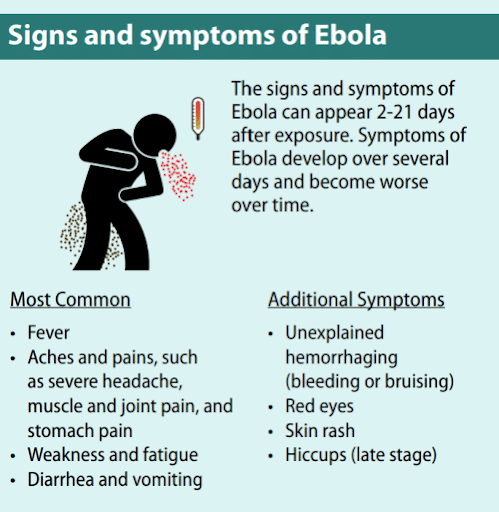
- Ebola typically incubates for 2 to 21 days after exposure, with an average of 8 to 10 days.
Symptoms of Ebola
- Fever, severe headache, muscle pain, weakness, diarrhoea, vomiting, abdominal (stomach) pain, and unstoppable haemorrhage (bleeding or bruising) are all symptoms of EVD.
Ebola Virus Disease – Vaccines
- Currently, there are two approved Ebola vaccines.
- The European Medicines Agency licenced Ervebo in November 2019 and WHO prequalified it.
- The vaccine was approved by the US Food and Drug Administration in December 2019.
- Burundi, Central African Republic, Democratic Republic of Congo, Ghana, Guinea, Rwanda, Uganda, and Zambia have all approved the vaccine since then.
- The vaccine is both safe and effective against the Zaire ebolavirus.
- In May 2020, the European Medicines Agency recommended that a second new vaccine, Zabdeno (Ad26.ZEBOV) and Mvabea (MVA-BN-Filo), delivered in two doses, be granted marketing authorization for individuals 1 year and older.
- The vaccine is given in two doses: Zabdeno is given first, followed by Mvabea approximately 8 weeks later
- As a result, this prophylactic 2-dose regimen is not appropriate for an outbreak response where immediate protection is required.
- Individuals at imminent risk of Ebola exposure (for example, health care professionals and those living in or visiting areas where an Ebola virus disease outbreak is ongoing) who completed the Zabdeno and Mvabea 2-dose vaccination regimen should consider a Zabdeno booster vaccination if more than 4 months have passed since the second dose was administered.
India and the Ebola Risk
- Nearly 45,000 Indian nationals live and work in Guinea, Liberia, Sierra Leone, and Nigeria, the worst-affected countries by the Ebola virus.
- In the event that the Ebola situation in the affected countries worsens, Indian nationals will almost certainly return to India.
- As a result, India is at high risk of EVD, as even a single case can devastate human security and negatively impact the environment.
- The risk is increased because the patient is likely to return by air to one of India's megacities such as Delhi, Mumbai, or Chennai.
- Given the dense population of large cities, EVD has the potential to become a major epidemic.
- The risk of transmission may be heightened in the case of strained medical facility systems.
- In addition, extreme poverty and a lack of awareness may prevent affected individuals from approaching appropriate medical authorities.
- India is a poor country with a health-care system that is already overburdened during the disease season.
- Furthermore, with a growing population and overburdened medical response systems, India faces greater challenges due to an insufficient ability to quarantine.
Measures to Tackle Ebola
- Despite the challenges, timely and effective action can prevent Ebola from becoming a pandemic. The first step in this direction would be to spread awareness as quickly as possible.
- The Government of India's Department of Health and Family Welfare, Ministry of Health and Family Welfare, has issued several guidelines for dealing with an Ebola outbreak.
- These guidelines are primarily intended to increase public awareness of the risk factors for Ebola infection.
- The guidelines provide individuals with protective measures that are the only way to reduce human infection and death.
- In addition, the Health Ministry has issued strict guidelines for hospital infection control while managing EVD suspects/cases.
- The National Institute of Virology in Pune and the National Centre for Disease Control in Delhi play critical roles in management of Ebola.
- In addition, India has implemented effective environmental infection control measures.
- The Indian government has also issued advisories to disease surveillance units in order to detect and manage travel-related cases as early as possible.
- Families staying in affected West African countries, as well as visitors and returnees, have been issued with specific advisory guidelines.
- On a global scale, India has agreed to provide $12 million to combat the epidemic.
| Other Relevant Links | |
|---|---|
| Science & Technology Policy in India | Scientific Policy Resolution 1958 |
| Science & Technology Policy of 1983 | Science & Technology Policy of 2003 |
| Science, Technology and Innovation Policy 2013 | New Initiatives Aligned with the National Agenda |
| India and World collaboration in science projects | National Intellectual Property Rights Policy |
Conclusion
The Ebola virus disease has all of the hallmarks of wreaking havoc on humans and their environments. Because there is no detailed antidote readily available, the risk factor multiplies dramatically. However, timely health and preventive measures can go a long way towards preventing an EVD outbreak. It would also aid in the development of defences against potential bio-terrorism attacks. Fortunately, Ebola is curable. India and the rest of the international community must step up their efforts to combat the deadly Ebola virus.
FAQs
Question: What is Ebola Virus Disease (EVD)?
Answer: Ebola Virus Disease (EVD) is a severe, often fatal illness caused by the Ebola virus. It is transmitted to humans from animals, and human-to-human transmission occurs through bodily fluids. Symptoms include fever, vomiting, diarrhea, and in some cases, internal bleeding. EVD has high mortality rates, especially without proper medical care.
Question: How is Ebola Virus Disease transmitted?
Answer: Ebola is primarily transmitted through direct contact with the bodily fluids (blood, saliva, vomit, sweat) of an infected person or animal. It can also spread through contaminated objects such as needles. Healthcare workers and family members caring for the infected are at higher risk.
Question: What are the major challenges Ebola Virus Disease poses to India?
Answer: Ebola poses several challenges to India, including the risk of an outbreak due to international travel and trade, inadequate preparedness and awareness, and the strain it places on India’s healthcare infrastructure. Rapid detection, containment, and effective treatment are crucial in managing any potential outbreak.
Question: How does India prepare for potential outbreaks of Ebola Virus Disease?
Answer: India has developed preparedness plans for EVD through its health ministry and public health systems. These include protocols for surveillance, rapid isolation of suspected cases, training healthcare workers, and establishing quarantine centers. The government also coordinates with the WHO and other international agencies to ensure effective response.
Question: Is there a vaccine for Ebola Virus Disease?
Answer: Yes, there is a vaccine for Ebola, called the rVSV-ZEBOV vaccine. It has shown effectiveness in preventing EVD outbreaks, especially during emergency situations. However, its widespread use is still limited, and research continues to improve its accessibility and efficacy in diverse populations.
MCQs
1. What is the primary method of transmission of the Ebola Virus Disease?
A) Airborne transmission
B) Contact with contaminated water
C) Human-to-human transmission through bodily fluids
D) Ingestion of contaminated food
Answer: (C) See the Explanation
Ebola is transmitted through direct contact with the bodily fluids of an infected person or animal, making human-to-human transmission the primary method of spread.
2. Which of the following is the first line of defense in containing an Ebola outbreak?
A) Vaccination
B) Quarantine and isolation of affected individuals
C) Antiviral medication
D) Immediate global travel restrictions
Answer: (B) See the Explanation
Quarantine and isolation of affected individuals are the first line of defense in containing an Ebola outbreak, to prevent further spread through human-to-human contact.
3. Which organization plays a key role in coordinating international response to Ebola outbreaks?
A) United Nations (UN)
B) World Health Organization (WHO)
C) International Committee of the Red Cross (ICRC)
D) Centers for Disease Control and Prevention (CDC)
Answer: (B) See the Explanation
The World Health Organization (WHO) plays a leading role in coordinating the international response to Ebola outbreaks, providing guidance, technical support, and funding for containment efforts.
4. What is the effectiveness of the rVSV-ZEBOV vaccine for Ebola?
A) It has no effect on the virus
B) It is effective only for children
C) It has shown effectiveness in preventing Ebola outbreaks
D) It is effective for a limited time only
Answer: (C) See the Explanation
The rVSV-ZEBOV vaccine has shown effectiveness in preventing Ebola outbreaks, especially during emergency situations. It has been used successfully in outbreak areas to protect individuals from infection.
5. What are the primary challenges Ebola poses to India’s public health system?
A) Lack of a vaccine
B) Insufficient healthcare workers
C) Difficulty in maintaining effective surveillance
D) Limited infrastructure for medical care and containment
Answer: (D) See the Explanation
India faces challenges in containing Ebola due to limited healthcare infrastructure for medical care, isolation, and containment of the virus. These challenges are especially critical in managing outbreaks in rural areas.
GS Mains Questions and Model Answers
Q1: Examine the health risks and preparedness of India for handling an Ebola outbreak.
Answer: India faces significant health risks from Ebola, particularly due to its global connectivity and the possibility of an outbreak linked to international travelers or refugees. While India has developed preparedness plans, such as the establishment of isolation units, emergency response teams, and health surveillance networks, challenges remain in strengthening rural healthcare infrastructure and ensuring rapid response to suspected cases. India's preparedness relies on improving public awareness, investing in healthcare resources, and enhancing cooperation with international health organizations to mitigate the risks posed by the disease.
Q2: Discuss the role of international cooperation in managing Ebola outbreaks and preventing global health crises.
Answer: International cooperation is essential in managing Ebola outbreaks due to the highly contagious nature of the virus and its ability to spread across borders. Organizations like the World Health Organization (WHO) play a crucial role in coordinating global responses, providing technical support, and distributing vaccines. The collaboration between affected countries, international organizations, and NGOs ensures rapid deployment of medical supplies, containment strategies, and humanitarian assistance. International cooperation also helps in sharing research and best practices for preventing future outbreaks, as well as addressing socio-economic impacts in affected regions.
Q3: How does climate change contribute to the spread of diseases like Ebola, and what measures can be taken to address these impacts?
Answer: Climate change contributes to the spread of diseases like Ebola by altering ecosystems and increasing the frequency of extreme weather events, which may displace populations and bring them into closer contact with wildlife, increasing the risk of zoonotic diseases. Additionally, changes in rainfall patterns and rising temperatures can affect disease transmission. To address these impacts, governments need to strengthen health surveillance systems, invest in climate-resilient infrastructure, and promote early warning systems for disease outbreaks. Public health campaigns focusing on preventive measures and increasing awareness of the links between climate change and disease spread are also vital for mitigating these risks.
Previous Year Questions on Infectious Diseases
1. UPSC CSE Prelims 2021:
Question: Which of the following is the primary mode of transmission of Ebola Virus Disease?
A) Airborne transmission
B) Human-to-human through bodily fluids
C) Through insect bites
D) Through contaminated food
Answer: (B)
Explanation: Ebola virus is primarily transmitted from human to human through direct contact with bodily fluids such as blood, saliva, vomit, and feces.
2. UPSC CSE Mains 2020 (GS Paper 2):
Question: "Discuss the global efforts to control Ebola outbreaks and the challenges faced by affected countries."
Answer: The global efforts to control Ebola outbreaks include coordinated responses led by organizations like the WHO, which provide resources, technical expertise, and vaccines. However, affected countries face challenges such as weak healthcare infrastructure, inadequate isolation facilities, and public health misinformation. The lack of sufficient resources and the remote locations of some outbreaks further complicate containment efforts. To overcome these challenges, international support, improved preparedness plans, and robust health infrastructure are essential for reducing the impact of future Ebola outbreaks.
Download the PREPP App and attempt FREE IAS Exam Mock Tests and get complete study material!

Full Test - 04: UPSC CSE Prelims CSAT (Paper-II)
Full Test - 03: UPSC CSE Prelims CSAT (Paper-II)
UPSC CSE Prelims 2026 GS Paper 1 Question Paper (24-May-2026)
UPSC CSE Prelims 2026 CSAT Paper 2 Question Paper (24-May-2026)

17 February 2025 | The Hindu Must Read Articles | Current Affairs

16 February 2026 | The Hindu Must Read Articles | Current Affairs

13 February 2026 | The Hindu Must Read Articles | Current Affairs









Comments