Covid Tests: Different Types of Coronavirus Testing – Science & Technology Notes
COVID-19 is a disease caused by the novel coronavirus SARS-CoV-2. While COVID-19 is usually mild to moderate, it can also cause severe illness. COVID-19 can be detected using a variety of tests. Viral tests, like molecular and antigen tests, can identify active infections. Meanwhile, antibody tests can tell you if you've had the novel coronavirus before. People can choose from a variety of COVID-19 tests to determine whether or not they are infected with the virus. In this article, we will discuss regarding the different types of Covid tests which will be helpful for UPSC exam preparation.
Table of Contents
What is Coronavirus (COVID-19)?
- Coronaviruses are a type of virus that causes respiratory illness in humans.
- The virus is called a "corona" because it has crown-like spikes on its surface.
- Coronaviruses that cause illness in humans include severe acute respiratory syndrome (SARS), Middle East respiratory syndrome (MERS), and the common cold.
- SARS-CoV-2, a new coronavirus strain, was first identified in December 2019 in Wuhan, China. Since then, it has spread to every country on the planet.
- The WHO has officially named the Novel Coronavirus COVID-19 where "co" stands for "corona," "vi" for "virus," and "d" for "disease," with "19" representing the year the outbreak was first discovered (December 31, 2019).
Types of Covid Tests
1) Molecular Tests
- The Molecular test, also known as the RT-PCR test, is a type of testing used to detect the presence of a virus in a sample.
- RT-PCR Tests are the ‘gold standard’ for Covid-19 tests.
- The test detects the virus's RNA, which is the virus's genetic material.
- The reverse transcriptase enzyme is used to convert the RNA to DNA in the first step of this test.
- This DNA is then detected by PCR testing.
- As a result, the term RT-PCR was coined.
- These are also known as the nucleic acid amplification test (NAAT) and the diagnostic test.
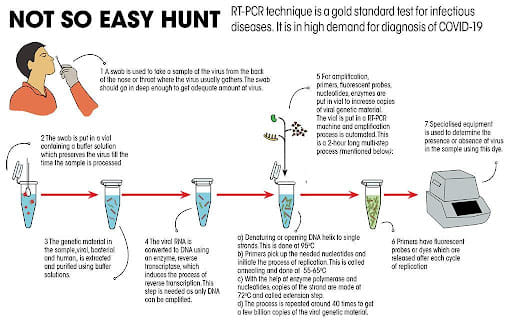
RT-PCR Test
2) Antigen Tests
- Any foreign matter or viral proteins in the body that causes an immune response is referred to as a COVID-19 antigen.
- This test aids in the identification of antigens associated with the COVID-19 virus.
- The antigen test, also known as the rapid antigen test, is a type of rapid diagnostic test that produces results faster than molecular tests.
- However, antigen tests have a higher chance of missing an active infection.
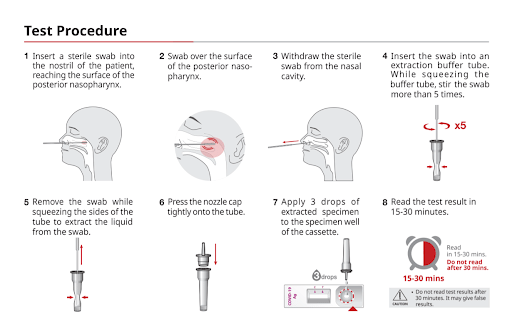
Rapid Antigen Test
3) Antibody Tests
- COVID-19 Antibody tests, also known as Serology tests, serological tests, or Serology blood tests, are blood tests that look for COVID-19 antibodies.
- It determines whether a patient has previously been infected with the virus that causes COVID-19.
- The antibody test does not look for active virus but rather assesses how well one's immune system has responded to infection.
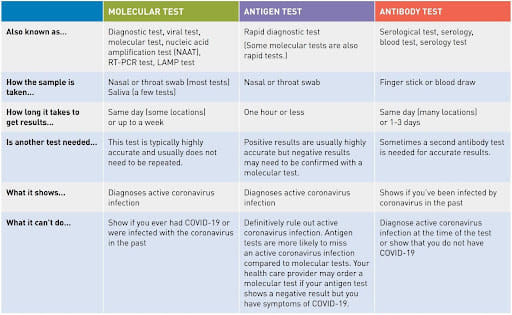
Molecular Test vs Antigen Test vs Antibody Test
| Other Relevant Links | |
|---|---|
| Science & Technology Policy in India | Scientific Policy Resolution 1958 |
| Science & Technology Policy of 1983 | Science & Technology Policy of 2003 |
| Science, Technology and Innovation Policy 2013 | New Initiatives Aligned with the National Agenda |
| India and World collaboration in science projects | National Intellectual Property Rights Policy |
Conclusion
COVID-19 tests come in a variety of formats. Viral tests and antibody tests are examples of these. Viral tests are used to determine whether you have COVID-19. Molecular and antigen tests are the two types of viral tests. The molecular test is the more accurate of the two. Antibody tests can tell you if you've had the novel coronavirus before. However, they are unable to detect current COVID-19 illness.
FAQs
Question: What are the different types of COVID-19 tests used for diagnosing the virus?
Answer: The main types of COVID-19 tests are RT-PCR (Reverse Transcription Polymerase Chain Reaction) tests, antigen tests, and antibody tests. RT-PCR tests are used to detect the virus’s genetic material, while antigen tests detect viral proteins. Antibody tests identify past infections by detecting antibodies produced by the immune system.
Question: How do RT-PCR tests work in diagnosing COVID-19?
Answer: RT-PCR tests work by detecting the viral RNA in a patient’s sample (usually from the nose or throat). The sample is processed in a laboratory, where it is converted into DNA and amplified. If the virus is present, the DNA will multiply, making it detectable. RT-PCR is considered the gold standard for diagnosing COVID-19 due to its high accuracy.
Question: What is the difference between antigen tests and RT-PCR tests?
Answer: The primary difference is that antigen tests detect viral proteins (antigens) on the surface of the virus, while RT-PCR tests detect the virus’s genetic material (RNA). Antigen tests are faster and less expensive but have lower accuracy, especially in people with mild or no symptoms. RT-PCR tests, on the other hand, are more accurate but take longer to process.
Question: What role do antibody tests play in COVID-19 diagnostics?
Answer: Antibody tests are used to detect antibodies produced by the immune system in response to past COVID-19 infection. They are typically used in seroprevalence studies to understand the spread of the virus in a population and are not useful for diagnosing active infections, as antibodies take time to develop after infection.
Question: Why are antigen tests important in COVID-19 testing strategies?
Answer: Antigen tests are important because they provide a quick, cost-effective way to screen large populations, especially in high-risk areas. They can help identify potentially infectious individuals, even in cases where RT-PCR testing is not immediately available. However, due to their lower sensitivity, they are typically used in conjunction with other diagnostic methods.
MCQs
1. Which of the following is considered the gold standard for COVID-19 testing?
A) Antibody test
B) Antigen test
C) RT-PCR test
D) Serological test
Answer: (C) See the Explanation
The RT-PCR test is considered the gold standard for COVID-19 testing because it has high sensitivity and can detect the genetic material of the virus even in low viral loads.
2. What is the main advantage of antigen tests over RT-PCR tests?
A) Higher sensitivity
B) Faster results
C) Greater accuracy
D) Detects antibodies
Answer: (B) See the Explanation
Antigen tests provide faster results compared to RT-PCR tests. While RT-PCR tests take hours or days for results, antigen tests typically deliver results in 15-30 minutes, making them suitable for rapid screening.
3. What is the purpose of antibody testing in COVID-19 diagnostics?
A) Detect active infection
B) Identify exposure to the virus in the past
C) Diagnose severe cases
D) Monitor virus mutation
Answer: (B) See the Explanation
Antibody tests are used to identify past exposure to the virus by detecting antibodies that the body produces in response to an infection. They do not detect active infections.
4. Which type of test is best suited for diagnosing active COVID-19 infections?
A) Antigen test
B) RT-PCR test
C) Antibody test
D) None of the above
Answer: (B) See the Explanation
The RT-PCR test is the most accurate test for diagnosing active COVID-19 infections as it detects the virus's genetic material, even in the early stages of infection.
5. Why are antigen tests less accurate than RT-PCR tests?
A) They only detect genetic material
B) They detect viral proteins instead of RNA
C) They are more expensive
D) They are slower
Answer: (B) See the Explanation
Antigen tests detect viral proteins, which are less specific than the genetic material detected by RT-PCR tests. This makes antigen tests more prone to false negatives, particularly in individuals with low viral loads or mild symptoms.
GS Mains Questions and Model Answers
Q1: Evaluate the effectiveness of different types of COVID-19 tests in controlling the spread of the virus.
Answer: Different types of COVID-19 tests serve distinct roles in controlling the spread of the virus. RT-PCR tests are the most accurate and effective for diagnosing active infections and are crucial for confirming cases. However, their turnaround time and cost make them less suitable for mass screening. Antigen tests, while less accurate, provide rapid results and are useful for screening large populations in high-risk areas. They help identify potentially infectious individuals quickly, but their lower sensitivity can lead to false negatives. Antibody tests, although not useful for diagnosing active infections, are valuable for understanding the spread of the virus and monitoring immunity in the population. To control the spread effectively, a combination of these tests, along with timely contact tracing and quarantine measures, is essential.
Q2: Discuss the challenges of COVID-19 testing in India and suggest ways to overcome them.
Answer: COVID-19 testing in India has faced several challenges, including limited access to testing facilities in rural areas, long waiting times for results, and the high cost of some diagnostic methods. The availability of RT-PCR tests has been limited in many regions, and there has been a reliance on antigen tests, which, while faster, are less accurate. To overcome these challenges, India should focus on expanding testing infrastructure, particularly in underserved areas, and invest in more affordable diagnostic technologies. Additionally, integrating digital platforms for result reporting and improving public awareness about testing options can help streamline the process and increase participation in testing programs.
Q3: How does the use of antigen tests affect the strategy for managing COVID-19 outbreaks in urban and rural settings?
Answer: Antigen tests can play a crucial role in managing COVID-19 outbreaks, especially in urban areas with high population density. Their speed and cost-effectiveness allow for rapid screening and identification of potentially infected individuals, enabling quick isolation and contact tracing. However, in rural areas, where the prevalence of the virus may be lower and healthcare access limited, the use of antigen tests may be less effective, as false negatives are more common. To address this, antigen tests should be used as part of a broader testing strategy, with confirmatory RT-PCR tests for individuals showing symptoms or with a positive antigen result.
Previous Year Questions on Health and Technology
1. UPSC CSE Prelims 2020:
Question: Which of the following tests is considered the gold standard for diagnosing COVID-19 infections?
A) Antibody test
B) RT-PCR test
C) Antigen test
D) CT scan
Answer: (B)
Explanation: The RT-PCR test is considered the gold standard for diagnosing COVID-19 as it detects the virus's genetic material with high accuracy.
2. UPSC CSE Mains 2021 (GS Paper 2):
Question: "Examine the role of testing strategies in controlling the COVID-19 pandemic in India."
Answer: Testing strategies play a crucial role in controlling the COVID-19 pandemic by identifying infected individuals and preventing further transmission. In India, the government initially focused on RT-PCR tests for accurate diagnosis, but as the demand for testing surged, antigen tests were deployed for faster results. While RT-PCR remains the gold standard, antigen tests helped screen large populations quickly. To ensure effective control, India’s strategy should combine rapid testing, contact tracing, and isolation measures, while continuously improving access to testing in rural and remote areas.
Download the PREPP App and attempt FREE IAS Exam Mock Tests and get complete study material!

Full Test - 04: UPSC CSE Prelims CSAT (Paper-II)
Full Test - 03: UPSC CSE Prelims CSAT (Paper-II)
UPSC CSE Prelims 2026 GS Paper 1 Question Paper (24-May-2026)
UPSC CSE Prelims 2026 CSAT Paper 2 Question Paper (24-May-2026)

17 February 2025 | The Hindu Must Read Articles | Current Affairs

16 February 2026 | The Hindu Must Read Articles | Current Affairs

13 February 2026 | The Hindu Must Read Articles | Current Affairs









Comments