Anti-Microbial Resistance (AMR) and the Red Line Campaign – Science & Technology Notes
Antimicrobial resistance (AMR) occurs when bacteria, viruses, fungi, and parasites evolve and no longer respond to antibiotics, making infections more difficult to treat and increasing the risk of disease spread, severe illness, and death. Antibiotics and other antimicrobial medicines become ineffective as a result of drug resistance, and infections become increasingly difficult or impossible to treat. In this article, we will discuss in detail regarding Anti-Microbial Resistance (AMR) and the Red Line Campaign which will be helpful for UPSC exam preparation.
Table of Contents
What is Anti-Microbial Resistance (AMR)?
- Antimicrobials are medications that are used to prevent and treat infections in humans, animals, and plants. They include antibiotics, antivirals, antifungals, and antiparasitics.
- Antimicrobial resistance is the ability of any microorganism (bacteria, viruses, fungi, parasites, etc.) to develop resistance to antimicrobial drugs used to treat infections.
- It happens when a microorganism evolves and no longer responds to medications, making infections more difficult to treat and increasing the risk of disease spread, severe illness, and death.
- The World Health Organisation (WHO) has named AMR as one of the top ten global health threats.
- Antimicrobial-resistant microorganisms are referred to as "superbugs" at times.
- In India, over 56,000 newborns die each year as a result of sepsis caused by organisms resistant to first-line antibiotics.
- It should be noted that the microbe, not the person (patient), will develop antibiotic resistance.
- A person cannot develop antibiotic resistance because resistance is a property of the microbe, not of a person or other organism infected with a microbe.
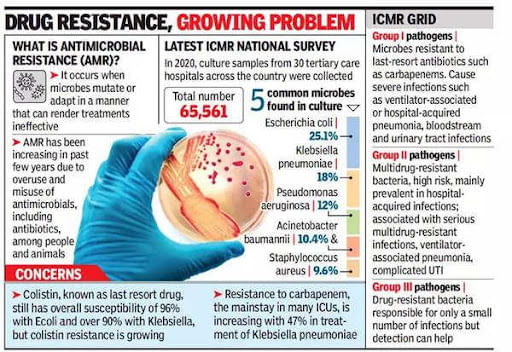
Problem of Anti-microbial Resistance
Why is AMR a Global Concern?
- The emergence and spread of drug-resistant pathogens with new resistance mechanisms, resulting in antimicrobial resistance, continues to jeopardise our ability to treat common infections.
- The rapid global spread of multi- and pan-resistant bacteria (also known as "superbugs") that cause infections that are not treatable with existing antimicrobial medicines such as antibiotics is especially concerning.
- The pipeline of new antimicrobials in clinical trials is depleted. In 2019, WHO identified 32 antibiotics in clinical development that address the WHO priority pathogen list, only six of which were classified as innovative.
- Furthermore, a major issue is a lack of access to high-quality antimicrobials.
- Antibiotic shortages are affecting countries at all stages of development, particularly health-care systems.
- Antibiotics are becoming less effective as drug resistance spreads around the world, resulting in more difficult-to-treat infections and death.
- The cost of AMR to national economies and health systems is significant because it reduces the productivity of patients and carers by requiring longer hospital stays and more expensive and intensive care.
- Over one million people died as a result of AMR in 2019. It is estimated that low-income countries such as India could lose more than 5% of their GDP by 2050 as a result of an unhealthy workforce incurring increased out-of-pocket expenses.
- Without effective tools for preventing and treating drug-resistant infections, as well as improved access to existing and new quality-assured antimicrobials, the number of people requiring treatment or dying from infections will rise.
- Surgery, including caesarean sections and hip replacements, cancer chemotherapy, and organ transplantation will become riskier.
Reasons for Spreading of AMR
- AMR develops naturally over time, usually as a result of genetic changes.
- People, animals, food, plants, and the environment (in water, soil, and air) all contain antimicrobial resistant organisms.
- They can spread from person to person or between people and animals, including through food derived from animals.
- The main drivers of antimicrobial resistance are:
- misuse and overuse of antimicrobials;
- incorrect prescriptions by physicians;
- improper disposal of unused or expired antibiotics;
- overuse of antibiotics for growth stimulation in the agriculture, poultry, and aquaculture industries;
- release of untreated effluents from factories, healthcare institutions, and pharmaceutical manufacturing units into water bodies
- a lack of access to clean water, sanitation, and hygiene (WASH) for both humans and animals;
- poor infection and disease prevention and control in health-care facilities and farms;
- a lack of access to quality, affordable medicines, vaccines, and diagnostics;
- a lack of awareness and knowledge; and
- a lack of legislative enforcement.
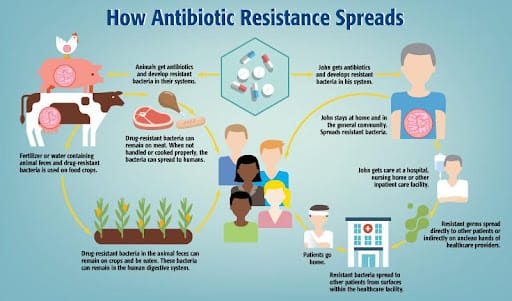
Spread of Antimicrobial Resistance
Global Initiatives to combat Anti-Microbial Resistance (AMR)
Global Action Plan (GAP) on Anti-Microbial Resistance
- During the 2015 World Health Assembly, countries committed to the framework outlined in the Global Action Plan (GAP) 2015 on AMR, as well as the development and implementation of multisectoral national action plans.
- It was later endorsed by the Food and Agriculture Organisation of the United Nations (FAO) and the World Organisation for Animal Health (OIE).
- Countries must ensure the costing and implementation of national action plans across sectors to ensure long-term progress.
World Antimicrobial Awareness Week (WAAW)
- WAAW is a global campaign that has been held annually since 2015 to raise awareness of antimicrobial resistance and encourage best practises among the general public, health workers, and policymakers to slow the development and spread of drug-resistant infections.
Global Antimicrobial Resistance and Use Surveillance System (GLASS)
- In 2015, WHO launched the GLASS to continue filling knowledge gaps and informing strategies at all levels.
- GLASS was designed to gradually incorporate data from surveillance of AMR in humans, surveillance of antimicrobial medicine use, AMR in the food chain, and AMR in the environment.
Global Research and Development Priority Setting for AMR
- WHO created the WHO priority pathogens list in 2017 to help guide research and development of new antimicrobials, diagnostics, and vaccines.
- WHO reviews the pre-clinical and clinical antibacterial pipelines on an annual basis to see how they are progressing in relation to the WHO priority pathogens list.
- There is still a critical gap in research and development, particularly for antibacterial targeting of gram-negative carbapenem-resistant bacteria.
Global Antibiotic Research and Development Partnership (GARDP)
- GARDP is a non-profit global partnership that is developing treatments for the most dangerous drug-resistant infections.
- GARDP works across sectors to ensure equitable access to treatments and promote responsible use of these treatments.
Anti-Microbial Resistance (AMR) in India
- AMR is especially concerning in developing countries, such as India, where the burden of infectious disease is high but healthcare spending is low.
- India has one of the highest rates of bacterial infection in the world. As a result, the impact of AMR is likely to be greater in the Indian context.
- The 2017 National Health Policy emphasises the issue of antimicrobial resistance and calls for immediate action to address it.
- AMR has been identified as one of the top ten priorities for the Ministry of Health and Family Welfare's collaborative work with the World Health Organisation (WHO).
- In Tuberculosis, Vector Borne Diseases, AIDS, and other programmes, India has instituted surveillance of the emergence of drug resistance in disease-causing microbes.
- To regulate the sale of antimicrobials in the country, a separate Schedule H-1 has been incorporated into Drug and Cosmetic rules since March 2014.
- Antibiotics and several pharmacologically active substances have been banned in fisheries by the Food Safety and Standards Authority of India (FSSAI).
- The government has also set a limit on the maximum amount of drugs that can be used to promote growth in meat and meat products.
- With its large population, rising incomes that allow for the purchase of antibiotics, high burden of infectious diseases, and easy over-the-counter access to antibiotics, India is an important locus for the generation of resistance genes (such genes help bacteria survive when exposed to antibiotics).
- The multi-drug resistance determinant New Delhi Metallo-beta-lactamase-1 (NDM-1) emerged from this region and spread throughout the world.
- Multi-drug resistant typhoid, which originated in South Asia, has also infected Africa, Europe, and other parts of Asia.
- In India, organisms resistant to first-line antibiotics cause over 56,000 newborn deaths each year due to sepsis.
- According to an ICMR (Indian Council of Medical Research) study of ten hospitals, when Covid patients acquire drug-resistant infections in hospitals, the mortality rate is nearly 50-60%.
- According to the Global Research on Antimicrobial Resistance (GRAM) report, AMR (Antimicrobial Resistance) killed 1.27 million people in 2019.
- Lower respiratory infections, such as pneumonia, and bloodstream infections, which can lead to sepsis, were responsible for the majority of AMR deaths.
- MRSA (Methicillin-Resistant Staphylococcus Aureus) was especially dangerous, and E. coli and several other bacteria were also linked to high levels of drug resistance.
Initiatives by Government of India to combat AMR
- National Programme on AMR Containment: Established in 2012. The AMR Surveillance Network has been strengthened as a result of this programme by the establishment of labs at State Medical College.
- National Action Plan on AMR: It was launched in April 2017 with the goal of involving various stakeholder ministries/departments and focuses on the One Health approach.
- Antimicrobial Resistance Surveillance and Research Network (AMRSN): It was established in 2013 with the goal of gathering evidence and capturing trends and patterns of drug-resistant infections in the country.
- AMR Research and International Collaboration: To strengthen medical research in AMR, the Indian Council of Medical Research (ICMR) has taken initiatives to develop new drugs/medicines through international collaborations.
- In 2017, the ICMR and the Research Council of Norway (RCN) launched a joint call for antimicrobial resistance research.
- The ICMR has a joint Indo-German collaboration for AMR research with the Federal Ministry of Education and Research (BMBF) in Germany.
- Antibiotic Stewardship Programme: The ICMR has launched the Antibiotic Stewardship Programme (AMSP) as a pilot project across India to combat antibiotic misuse and overuse in hospital wards and intensive care units.
- DCGI had prohibited 40 Fixed Dose Combinations (FDCs) that were deemed ineffective.
What is Red Line Campaign?
- The Union Health Ministry's Anti-Microbial Resistance Awareness Campaign advises people not to use medicines marked with a red vertical line, including antibiotics, unless they have a doctor's prescription.
- These medications are known as "Medicines with a Red Line."
- To prevent irrational antibiotic use, the 'red line' will assist users in distinguishing them from other drugs.
- This campaign aims to discourage the unnecessary prescription and over-the-counter sale of antibiotics, which cause drug resistance in a variety of critical diseases such as tuberculosis, malaria, urinary tract infection, and even HIV.
- Quinolones, cephalosporins, and carbapenems are among the antibiotics covered by this red line campaign.
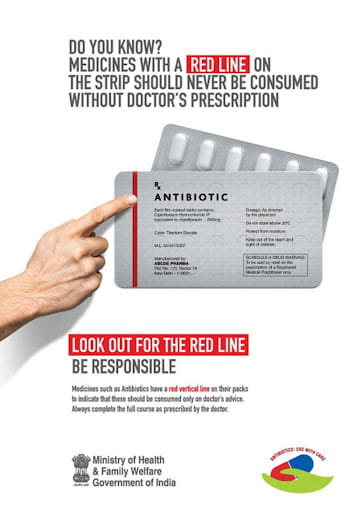
Red Line Campaign
Way Forward
- Addressing AMR necessitates a multipronged and multisectoral approach. The need for new drugs should not deter us from implementing measures to make better use of existing antimicrobials.
- Improved infection control in communities and hospitals, the availability and use of quality diagnostics and laboratories, and antimicrobial education have all proven effective in lowering antimicrobial pressure — a precursor to resistance.
- All of this necessitates a comprehensive plan led by a designated coordinating agency and supported by adequate funding.
- One Health Approach: Antimicrobial resistance (AMR) has the potential to return the world to a pre-antibiotic era when medicines were unable to treat even simple infections.
- As a result, a One Health Approach is required to contain AMR through coherent, integrated, multi-sectoral cooperation and actions, as human, animal, and environmental health are all intertwined.
- Antibiotic resistance breakers (ARBs) are being developed to restore the effectiveness of older antibiotic classes.
- It is time to implement strategies for optimising antibiotic use across disciplines and to exercise caution in all areas, including pharmaceutical effluent discharge.
- Effective microbiological surveillance of the agriculture and livestock industries, as well as pharmaceutical manufacturing plants, would enable informed policy actions to combat AMR.
- Promoting research to address the data gap around AMR for evidence-based assessment and intervention will help in this fight even more.
Conclusion
Antibiotics have made enormous advances in medicine, increasing human longevity and virtually eliminating infectious death. Because no alternative to antibiotics has yet been developed, the emergence of antimicrobial resistant superbugs threatens to undo all medical progress. Several nations and international organisations are making large-scale efforts to prevent antimicrobial resistance. It is, however, also our responsibility to assist our countries. To avoid future crises, we can at the very least raise awareness and follow basic sanitation guidelines.
| Other Relevant Links | |
|---|---|
| Science & Technology Policy in India | Scientific Policy Resolution 1958 |
| Science & Technology Policy of 1983 | Science & Technology Policy of 2003 |
| Science, Technology and Innovation Policy 2013 | New Initiatives Aligned with the National Agenda |
| India and World collaboration in science projects | National Intellectual Property Rights Policy |
FAQs
Question: What is Anti-Microbial Resistance (AMR)?
Answer:
Antimicrobial resistance (AMR) occurs when bacteria, viruses, fungi, and parasites evolve and no longer respond to antibiotics, making infections more difficult to treat and increasing the risk of disease spread, severe illness, and death. Antibiotics and other antimicrobial medicines become ineffective as a result of drug resistance, and infections become increasingly difficult or impossible to treat.
Question: What is Red Line Campaign?
Answer:
The Union Health Ministry's Anti-Microbial Resistance Awareness Campaign advises people not to use medicines marked with a red vertical line, including antibiotics, unless they have a doctor's prescription. These medications are known as "Medicines with a Red Line." To prevent irrational antibiotic use, the 'red line' will assist users in distinguishing them from other drugs. This campaign aims to discourage the unnecessary prescription and over-the-counter sale of antibiotics, which cause drug resistance in a variety of critical diseases such as tuberculosis, malaria, urinary tract infection, and even HIV.
Question: Wha is the National Plan on AMR?
Answer:
National Plan on AMR was launched in April 2017 with the goal of involving various stakeholder ministries/departments and focuses on the One Health approach. One Health Approach is required to contain AMR through coherent, integrated, multi-sectoral cooperation and actions, as human, animal, and environmental health are all intertwined. Antibiotic resistance breakers (ARBs) are being developed to restore the effectiveness of older antibiotic classes.
MCQs
Question: Which of the following are the reasons for the occurrence of multi-drug resistance in microbial pathogens in India? (UPSC 2019)
1) Genetic predisposition of some people.
2) Taking incorrect doses of antibiotics to cure diseases.
3) Using antibiotics in livestock farming.
4) Multiple chronic diseases in some people.
Select the correct answer using the code given below.
(a) 1 and 2
(b) 2 and 3 only
(c) 1, 3 and 4
(d) 2, 3 and 4
Answer: (b) See the Explanation
A multidrug-resistant organism is one that is resistant to more than one drug. Hence, statement 1 is irrelevant to the question because it refers to people who inherit genetic disorders or illnesses from their parents.
The following are the causes of multi-drug resistance in microbial pathogens in India:
- Taking incorrect antibiotic doses to cure diseases is one of the causes of multi-drug resistance in microbial pathogens in India. Hence, statement 2 is correct.
- The widespread use of antibiotics in livestock farming contributes to the emergence of antimicrobial-resistant bacteria. These bacteria can be passed from animals to humans through direct contact or through the food chain and the environment. Hence, statement 3 is correct.
- Poor sanitary conditions.
- Inadequate food handling and infection control.
Therefore, option (b) is the correct answer.
Question: Which one of the following antimicrobial drugs, is suitable for treatment of both tuberculosis and leprosy? (UPSC 1995)
(a) Isoniazid
(b) P-aminosalicylic acid
(c) Streptomycin
(d) Rifampicin
Answer: (d) See the Explanation
Mycobacterium leprae causes leprosy, and Mycobacterium tuberculosis causes tuberculosis. Rifampicin is an effective antibiotic for Mycobacterium species. Therefore, option (d) is the correct answer.
Download the PREPP App and attempt FREE IAS Exam Mock Tests and get complete study material!

Full Test - 04: UPSC CSE Prelims CSAT (Paper-II)
Full Test - 03: UPSC CSE Prelims CSAT (Paper-II)
UPSC CSE Prelims 2026 GS Paper 1 Question Paper (24-May-2026)
UPSC CSE Prelims 2026 CSAT Paper 2 Question Paper (24-May-2026)

17 February 2025 | The Hindu Must Read Articles | Current Affairs

16 February 2026 | The Hindu Must Read Articles | Current Affairs

13 February 2026 | The Hindu Must Read Articles | Current Affairs









Comments