Genome India Project (GIP) – Science & Technology Notes
Genome India Project is a national project funded by the Government of India's Department of Biotechnology and led by Centre for Brain Research (CBR) that aims to identify genetic variations in 10,000 representative individuals across India in the first phase of the study. Individuals from all over India are being recruited for the study based on their ethnicity, geographical location, and linguistic preferences. In this article, we will discuss in detail the Genome India Project which will help in UPSC exam preparation.
Table of Contents
What is Genome?
- The human genome is the entire collection of deoxyribonucleic acid (DNA) found in the nucleus of every cell in the human body.
- It contains all of the genetic information necessary for the organism's development and functioning.
- DNA is a double-stranded molecule composed of four bases: adenine (A), cytosine (C), guanine (G), and thymine (T).
- Every base on one strand matches a complementary base on the other (A with T and C with G).
- The genome is made up of approximately 3.05 billion such base pairs in total.
- On average, 0.1% of it differs between any two individuals.
- Individual genetic variations are critical for understanding disease predispositions, rare inherited disorders, drug response, and tracking migration and evolutionary patterns of population groups.
What is Genome Sequencing?
- While the sequence or order of base pairs in all humans is identical when compared to other species, there are differences in each human's genome that distinguishes them.
- Genome sequencing refers to the process of deciphering the order of base pairs in order to decode a human's genetic fingerprint.
- Genome sequencing, in other words, is the process of determining the complete DNA sequence of an organism's genome.
- The most common method of genome sequencing is known as next-generation sequencing (NGS).
- NGS enables the rapid, accurate, and low-cost sequencing of large amounts of DNA.
Application/Significance of Genome Sequencing
- Genome sequencing is used to evaluate rare disorders, pre-conditions for disorders, and even cancer from a genetic standpoint rather than as an organ disease.
- Prenatal screening has used gene sequencing to investigate genetic disorders/anomalies in foetuses.
- Crispr, a sequencing-based technology, has the potential to allow scientists to repair disease-causing mutations in genomes.
- Screening has been used to read virus codes. In 2014, a group of scientists sequenced Ebola samples from infected African patients to demonstrate how viral genomic data could reveal hidden pathways of transmission that could be halted, thus slowing or even preventing the spread of infection.
- The Covid-19 virus genome sequencing resulted in the development of a vaccine and the creation of diagnostic PCR machines.
- The Indian SARS-COV-2 Genomics Consortia (INSACOG) was tasked with scanning coronavirus samples from patients, and it also put in place a sequencing framework. Sequencing was increased to track new variants as the virus evolved through mutations.
Human Genome Project
- Under the Human Genome Project, a group of scientists began working on determining the entire sequence of the human genome in 1990.
- In 2023, the project released the most recent version of the complete human genome, with a 0.3% error margin.
- The Human Genome Project enabled whole-genome sequencing, which now allows for the reading of an individual's genome to identify differences from the average human genome.
- These variations or mutations can reveal information about a person's susceptibility or future vulnerability to a disease, their reaction or sensitivity to a specific stimulus, and so on.
What is Genome India Project?
- It is a mission-mode, multi-institution consortium project, the first of its kind in India, supported by the Government of India's Department of Biotechnology.
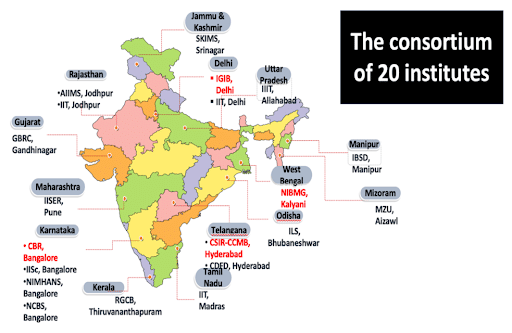
- This project, supported by the Government of India's Department of Biotechnology, involves 20 national institutions from across the country.
- This project is led by the Centre for Brain Research at the Indian Institute of Science in Bengaluru, which serves as the central coordinator for a collaboration of 20 leading institutions, each of which collects samples and conducts its own research.
- The Indian Institute of Science (IISc) in Bengaluru, as well as several Indian Institutes of Technology (IITs), are among the institutions involved.
- Investigators in hospitals will lead data collection from participants via a simple blood test, and the information will be added to biobanks.
- The investigators have expertise in areas relevant to the project, such as human genetics, computational biology, big data research, statistics, and population genetics.
- This is a fantastic collaborative venture that promotes capacity building across several institutes throughout the country.
- It will also aid in the development of national capacity in high throughput genomic sequencing and computational analysis, including AI and ML.
Specific Aims for this Project
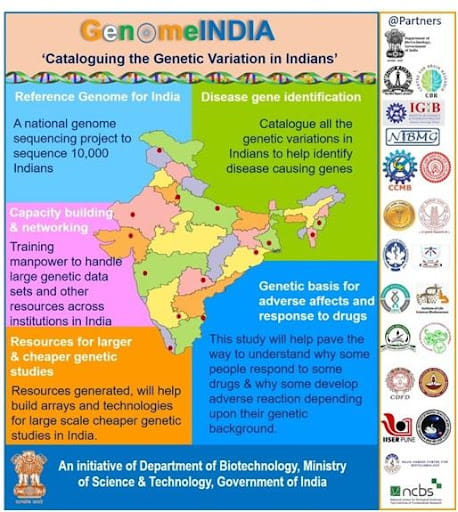
- Make an exhaustive list of genetic variations in Indians (common, low frequency, rare, single nucleotide polymorphisms or SNPs, and structural variations).
- Make an Indian reference haplotype structure. This reference panel can be used in future GWA studies to fill in missing genetic variation.
- Create low-cost genome-wide arrays for research and diagnostics.
- Create a biobank to store DNA and plasma samples for future research.
Need for Genome India Project
- The genetic makeup and environmental influences of populations around the world vary.
- As a result, it is critical to investigate the risk factors for complex genetic diseases and rare genetic variations that contribute to specific disorders in population-based studies.
- The Indian population of 1.3 billion people is made up of over 4600 population groups, several thousand of which are endogamous.
- These factors have contributed to the current Indian population's genetic diversity.
- As a result, the Indian population has distinct variations, and many disease-causing mutations are frequently amplified within some of these groups.
- As a result, findings from other populations' population-based or disease-based human genetics research cannot be extrapolated to Indians.
- As a result, the Genome India project is complex, but it is critical for understanding our country's genetic makeup.
Significance of Genome India Project
- Cataloguing Genetic Variation in Indians is a Pan-India initiative that focuses on Whole Genome Sequencing of representative populations across the country.
- The goal is to start with whole genome sequencing and then analyse data from 10,000 people representing the country's diverse population.
- This will aid in the development of an exhaustive catalogue of genetic variations in the Indian population, as well as the design of a genome-wide association chip for the Indian population, allowing for more cost-effective large-scale genetic studies.
- Furthermore, it would open new doors for the country's personalised medicine regimen, paving the way for predicting health and disease outcomes and modulating treatment protocols based on genome sequences.
- Furthermore, in its second phase, it would aid in identifying population groups that are more vulnerable to various risk factors for certain diseases, and would thus be useful in designing appropriate intervention strategies for such population groups.
Conclusion
The project's outcomes would be a valuable national resource for the country. They will help researchers all over India conduct large-scale human genetic studies in the future. The database of harmonised genetic variants will aid global variant interpretation efforts and will most likely serve as the foundational resource for next-generation basic and clinical research in India. Overall, this will be transformative for the country's healthcare scenario in the long run. However, the various risks and issues associated with gene mapping, storing, and using genetic data must be addressed, and a clear policy must be developed to ensure that this novel technology is used effectively.
| Other Relevant Links | |
|---|---|
| Science & Technology Policy in India | Scientific Policy Resolution 1958 |
| Science & Technology Policy of 1983 | Science & Technology Policy of 2003 |
| Science, Technology and Innovation Policy 2013 | New Initiatives Aligned with the National Agenda |
| India and World collaboration in science projects | National Intellectual Property Rights Policy |
FAQs
Question: What is the Genome India Project (GIP)?
Answer: The Genome India Project (GIP) is a national initiative aimed at mapping the genetic variations present in the Indian population. It seeks to build a comprehensive genomic database to enhance the understanding of Indian genetics and its applications in healthcare.
Question: What is the goal of the Genome India Project?
Answer: The goal of the Genome India Project is to collect genetic data from individuals across India to create a detailed genomic map, enabling better diagnosis, treatment, and prevention of genetic diseases, and contributing to personalized medicine.
Question: Why is the Genome India Project important for India?
Answer: The Genome India Project is crucial for understanding the genetic makeup of the diverse Indian population. It can help in identifying disease susceptibility, providing targeted treatments, and enabling advancements in genetic research and healthcare.
Question: Which institutions are involved in the Genome India Project?
Answer: The Genome India Project is being carried out by several top Indian institutions, including the Indian Institute of Technology (IIT), the Indian Institute of Science (IISc), and other premier research and academic organizations in collaboration with government bodies like the Department of Biotechnology (DBT).
Question: How will the Genome India Project benefit healthcare in India?
Answer: The project will enable personalized medicine, improve the accuracy of genetic disease diagnosis, and provide insights into how genetic factors influence disease prevalence in India. It will also help in the development of more effective therapies and targeted treatments for genetic disorders.
MCQs
1. What is the primary aim of the Genome India Project?
A) To identify new medical treatments
B) To map the genetic variations in the Indian population
C) To develop new technologies for DNA sequencing
D) To improve agricultural practices through genetic research
Answer: (B) See the Explanation
Explanation: The primary aim of the Genome India Project is to map the genetic variations in the Indian population, which will help in understanding the genetic diversity and improving healthcare and personalized medicine.
2. Which of the following is a key benefit of the Genome India Project?
A) Prevention of climate change
B) Personalization of healthcare and treatment
C) Improved agricultural yield
D) Enhanced space exploration capabilities
Answer: (B) See the Explanation
Explanation: One of the key benefits of the Genome India Project is the personalization of healthcare, which will improve disease diagnosis, treatment, and prevention strategies specific to the genetic makeup of individuals.
3. Which institutions are involved in the Genome India Project?
A) IITs and IISc
B) Only private biotechnology firms
C) Research institutions outside India
D) Indian Armed Forces
Answer: (A) See the Explanation
Explanation: The Genome India Project is a collaborative effort involving top institutions in India, such as IITs, IISc, and other leading academic and research organizations, in partnership with government agencies.
4. What will the Genome India Project contribute to in the healthcare sector?
A) Building a national health insurance program
B) Creation of a detailed genetic database for personalized medicine
C) Development of a national drug manufacturing unit
D) Improvement in water purification methods
Answer: (B) See the Explanation
Explanation: The Genome India Project will create a detailed genetic database that will facilitate personalized medicine by providing insights into genetic predispositions and targeted treatment options.
5. How will the Genome India Project help in genetic disease management?
A) By enhancing gene editing capabilities
B) By improving the knowledge of genetic diseases in the Indian context
C) By eliminating the need for vaccination
D) By reducing environmental pollution
Answer: (B) See the Explanation
Explanation: The Genome India Project will improve the understanding of genetic diseases, especially those prevalent in the Indian population, leading to better diagnosis, prevention, and treatment strategies.
GS Mains Questions and Model Answers
Q1: Discuss the significance of the Genome India Project in advancing personalized medicine and its potential impact on healthcare in India.
Answer: The Genome India Project holds great significance in advancing personalized medicine by enabling tailored healthcare interventions based on an individual's genetic makeup. With a focus on mapping the genetic diversity of India’s population, the project will allow doctors to prescribe precise treatments based on genetic profiles, improving the effectiveness of therapies and reducing adverse drug reactions. The database generated will also contribute to early detection of genetic diseases and facilitate the development of preventive measures, contributing to better public health outcomes and reducing the burden of genetic disorders in India.
Q2: Analyze the challenges faced by the Genome India Project in terms of data privacy and security, and suggest measures to address them.
Answer: The Genome India Project faces significant challenges related to data privacy and security, as the genetic data being collected is sensitive and personal. The risks of data misuse, unauthorized access, and breach of confidentiality are concerning. To address these challenges, the government and involved institutions must implement robust data protection measures, including encryption, secure storage, and access controls. Additionally, clear policies regarding the consent and usage of genetic data must be established, ensuring transparency and accountability. Regular audits and compliance with international data privacy standards can further mitigate security risks.
Q3: Evaluate the role of government bodies in facilitating the successful implementation of the Genome India Project and its integration into the broader healthcare system.
Answer: Government bodies play a crucial role in facilitating the successful implementation of the Genome India Project by providing funding, policy support, and creating an enabling regulatory framework. The involvement of the Department of Biotechnology (DBT) and other government agencies ensures alignment with national healthcare goals. To integrate the project into the broader healthcare system, the government must ensure that the genetic data collected is used effectively in clinical settings. This includes training healthcare providers, updating healthcare policies, and integrating genetic testing into routine medical practices, while also ensuring accessibility and affordability for the public.
Previous Year Questions on Genome India Project
1. UPSC CSE Mains 2020 (GS Paper 3):
Question: "Discuss the potential applications of genomics in healthcare and its role in personalized medicine, with reference to the Genome India Project."
Answer: The Genome India Project holds the potential to revolutionize healthcare by advancing personalized medicine. With its aim to map the genetic makeup of India’s diverse population, it will enable the identification of genetic risk factors for various diseases, allowing for targeted prevention and treatment strategies. Personalized medicine can improve the effectiveness of therapies, reduce side effects, and ensure that healthcare interventions are more precise. Furthermore, the project will help in early diagnosis and management of genetic disorders, leading to better health outcomes and a more efficient healthcare system.
2. UPSC CSE Mains 2021 (GS Paper 2):
Question: "Evaluate the ethical and social implications of genomic data collection in India, with particular reference to the Genome India Project."
Answer: The ethical and social implications of genomic data collection are profound. Issues related to privacy, consent, and potential misuse of genetic information are significant concerns. The Genome India Project must ensure that participants' data is protected through robust privacy safeguards, and that informed consent is obtained. Additionally, the project must address the potential for genetic discrimination, especially in employment and insurance sectors. Socially, there is a need to ensure equitable access to the benefits of genomic research and avoid exacerbating health disparities. Transparent policies, community engagement, and strong ethical guidelines are essential to mitigate these concerns.
Download the PREPP App and attempt FREE IAS Exam Mock Tests and get complete study material!

Full Test - 04: UPSC CSE Prelims CSAT (Paper-II)
Full Test - 03: UPSC CSE Prelims CSAT (Paper-II)
UPSC CSE Prelims 2026 GS Paper 1 Question Paper (24-May-2026)
UPSC CSE Prelims 2026 CSAT Paper 2 Question Paper (24-May-2026)

17 February 2025 | The Hindu Must Read Articles | Current Affairs

16 February 2026 | The Hindu Must Read Articles | Current Affairs

13 February 2026 | The Hindu Must Read Articles | Current Affairs









Comments