Blockchain Technology – Science & Technology Notes
Blockchain technology is a sophisticated database mechanism that enables the transparent sharing of information within a business network. Data is stored in blocks that are linked together in a chain in a blockchain database. Because you cannot delete or modify the chain without network consensus, the data is chronologically consistent. As a result, blockchain technology can be used to create an immutable ledger for tracking orders, payments, accounts, and other transactions. The system includes mechanisms for preventing unauthorised transaction entries and ensuring consistency in the shared view of these transactions. In this article, we will discuss in detail regarding Blockchain Technology which will be helpful for UPSC exam preparation.
Table of Contents
- Blockchain Technology – Background
- Blockchain Technology
- Why is Blockchain Important?
- Key Components of Blockchain Technology
- How Does Blockchain Technology Work?
- Types of Blockchain
- Applications of Blockchain Technology
- Advantages of Blockchain Technology
- Disadvantages of Blockchain Technology
- Conclusion
- FAQs
- MCQs
Blockchain Technology – Background
- David Chaum, an American computer scientist and cryptographer, proposed a blockchain-like protocol in his 1982 dissertation.
- Stuart Haber and W. Scott Stornetta worked on expanding the description of a chain of blocks secured by cryptography in 1991. Some people began working on developing digital currencies at this point.
- Satoshi Nakamoto, whose true identity is still unknown, first proposed the concept of blockchains in 2008.
- The design evolved and improved over time, with Nakamoto employing a Hashcash-like method.
- It eventually became a key component of bitcoin, a popular type of cryptocurrency, serving as a public ledger for all network transactions.
- The size of Bitcoin blockchain files, which contained all transactions and records on the network, continued to grow significantly.
- It had reached 20 gigabytes by August 2014, and it was expected to surpass 200 gigabytes by early 2020.
What is Blockchain Technology?
- Blockchain is a method of recording information that makes it impossible or difficult to change, hack, or manipulate the system.
- A blockchain is a distributed ledger that duplicates and distributes transactions across the blockchain's network of computers.
- Blockchain technology is a structure that stores public transactional records, also known as blocks, in several databases, referred to as the "chain," in a network connected by peer-to-peer nodes. This type of storage is commonly referred to as a 'digital ledger.'
- Every transaction in this ledger is authorised by the owner's digital signature, which authenticates the transaction and prevents it from being tampered with. As a result, the information contained in the digital ledger is extremely secure.
- In a nutshell, the digital ledger is similar to a Google spreadsheet shared among multiple computers on a network, where transactional records are stored based on actual purchases. The intriguing aspect is that anyone can see the data, but they cannot corrupt it.
- Blockchain is a type of distributed ledger technology in which transactions are recorded with an immutable cryptographic signature known as a hash.
- This means that if one block in a chain was changed, it would be obvious that it had been tampered with.
Why is Blockchain Important?
- Traditional database technologies present a number of challenges when it comes to recording financial transactions.
- Take, for example, the sale of a home. Ownership of the property is transferred to the buyer once the money is exchanged.
- Both the buyer and the seller can independently record monetary transactions, but neither source can be trusted.
- The seller can easily claim they have not received the money when they have, and the buyer can equally claim they have paid when they have not.
- To avoid potential legal issues, transactions must be supervised and validated by a trusted third party.
- The presence of this central authority complicates the transaction and creates a single point of failure. Both parties could suffer if the central database was compromised.
- Blockchain addresses such concerns by establishing a decentralised, tamper-proof system for recording transactions.
- In the case of a property transaction, blockchain creates separate ledgers for the buyer and seller.
- All transactions must be approved by both parties and are automatically updated in real time in both of their ledgers.
- Any tampering with historical transactions will taint the entire ledger.
- These characteristics of blockchain technology have led to its application in a variety of industries, including the creation of digital currency such as Bitcoin.
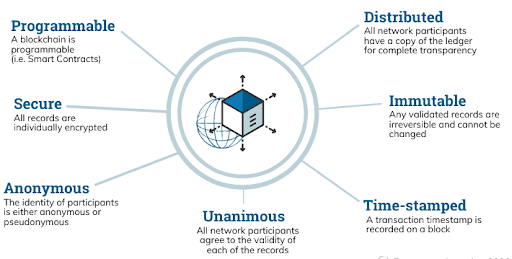
Properties of Blockchain
Key Components of Blockchain Technology
Distributed Ledger
- A distributed ledger is the blockchain network's shared database that stores transactions, similar to a shared file that everyone on the team can edit.
- Anyone with editing rights in most shared text editors can delete the entire file.
- However, distributed ledger technologies have strict rules governing who can and cannot edit. Once an entry has been recorded, it cannot be deleted.
Smart Contracts
- Smart contracts are used by businesses to self-manage business contracts without the assistance of a third party.
- They are programmes that are stored on the blockchain system and are executed automatically when certain conditions are met.
- They perform if-then checks to ensure that transactions are completed confidently.
- A logistics company, for example, could have a smart contract that automatically makes payment once goods arrive at the port.
Public Key Cryptography
- Public key cryptography is a security feature used to uniquely identify blockchain network participants.
- For network members, this mechanism generates two sets of keys.
- One key is a public key that everyone in the network shares. The other is a private key that each member has.
- The private and public keys work together to unlock the ledger's data.
Structure and Design of Blockchain
- At its core, a blockchain is a distributed, immutable, and decentralised ledger comprised of a chain of blocks, each of which contains a set of data.
- The blocks are cryptographically linked together to form a chronological chain of information.
- A blockchain's structure is designed to ensure data security through its consensus mechanism, which includes a network of nodes that agree on the validity of transactions before adding them to the blockchain.
Blocks
A blockchain block is made up of three main components:
- The header includes metadata such as a timestamp with a random number used in the mining process and the hash of the previous block.
- The data section contains the block's main and current information, such as transactions and smart contracts.
- Finally, the hash is a one-of-a-kind cryptographic value that serves as a representation of the entire block and is used for verification.
Block Time
- The time it takes to generate a new block in a blockchain is referred to as block time.
- Block times vary between blockchains and can range from a few seconds to minutes or even hours.
- Shorter block times can result in faster transaction confirmations, but longer block times may increase the timing for transaction confirmations while decreasing the chances of conflicts.
Hard Forks
- A hard fork in a blockchain is a permanent divergence in the history of the blockchain that results in two separate chains.
- It can happen if there is a fundamental change in a blockchain's protocol and all nodes do not agree on the update.
- Hard forks can result in the creation of new cryptocurrencies or the division of existing ones, and they require consensus among network participants to resolve.
Decentralisation
- The key feature of blockchain technology is decentralisation.
- There is no single central authority that can control the network in a decentralised blockchain.
- Decentralisation distributes decision-making power among a network of nodes who collectively validate and agree on transactions to be added to the blockchain.
- Blockchain technology's decentralised nature promotes transparency, trust, and security. It also reduces the risk of relying on a single point of failure and reduces the possibility of data manipulation.
Finality
- The irreversible confirmation of transactions in a blockchain is referred to as finality.
- When a transaction is added to a block and confirmed by the network, the block becomes immutable and cannot be reversed.
- This feature protects the data's integrity and prevents double spending, resulting in a high level of security and trust in Blockchain Types & Sustainability.
Openness
- Blockchain technology's openness makes the blockchain available to anyone who wishes to participate in the network.
- This implies that it is open to all and that anyone, as long as they understand the consensus rules, can join the network, validate transactions, and add new blocks to the blockchain.
- Because it allows for participation from a wide range of stakeholders, openness fosters inclusivity, transparency, and innovation.
Public Blockchain
- This is a type of blockchain that is accessible to the general public and allows anyone to join the network to perform transactions and participate in the consensus process. Because all transactions are publicly recorded, public blockchains are transparent.
How Does Blockchain Technology Work?
- Blockchain is a combination of three key technologies:
- Cryptographic keys
- A peer-to-peer network (P2P) with a shared ledger
- A computing method for storing network transactions and records
- Cryptography keys are made up of two keys: private key and public key.
- These keys aid in the completion of successful transactions between two parties.
- Each person possesses these two keys, which they use to generate a secure digital identity reference.
- The most important aspect of Blockchain technology is its secure identity. This identity is known as a 'digital signature' in the world of cryptocurrency and is used for authorising and controlling transactions.
- The digital signature is integrated into the peer-to-peer network; a large number of individuals acting as authorities use the digital signature to reach agreement on transactions and other issues.
- When they approve a transaction, it is validated mathematically, resulting in a successful secured transaction between the two network-connected parties.
- To summarise, Blockchain users use cryptography keys to perform various types of digital interactions across the peer-to-peer network.
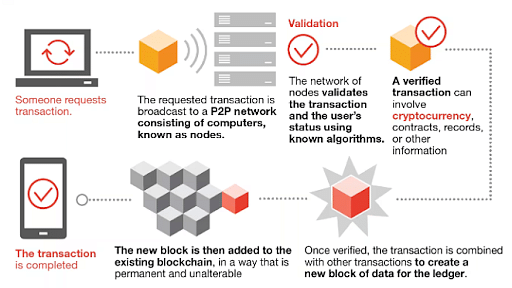
Working of Blockchain Technology
Types of Blockchain
Private Blockchain Networks
- Private blockchains run on closed networks and are best suited to private businesses and organisations.
- Companies can use private blockchains to tailor their accessibility and authorization preferences, network parameters, and other critical security features.
- A private blockchain network is managed by a single authority.
Public Blockchain Networks
- Bitcoin and other cryptocurrencies arose from public blockchains, which also aided in the spread of distributed ledger technology (DLT).
- Additionally, public blockchains aid in the elimination of certain challenges and issues, such as security flaws and centralization.
- DLT distributes data across a peer-to-peer network rather than storing it in a single location.
- A consensus algorithm is used to verify the authenticity of information; proof of stake (PoS) and proof of work (PoW) are two commonly used consensus methods.
Permissioned Blockchain Networks
- Permissioned blockchain networks, also sometimes known as hybrid blockchains, are private blockchains that grant special access to authorised individuals.
- Organisations typically set up these types of blockchains to get the best of both worlds, and it allows for better structure when determining who can participate in the network and which transactions can be made.
Consortium Blockchains
- Consortium blockchains, like permissioned blockchains, have both public and private components; however, multiple organisations will manage a single consortium blockchain network.
- Although these blockchains are more difficult to set up at first, once operational, they can provide greater security.
- Furthermore, consortium blockchains are ideal for collaboration among multiple organisations.
Hybrid Blockchains
- Hybrid blockchains are a mix of public and private blockchains.
- Some parts of a hybrid blockchain are public and transparent, while others are private and only accessible to authorised and specific participants.
- As a result, hybrid blockchains are ideal for use in situations requiring a balance of transparency and privacy.
- In supply chain management, for example, multiple parties can access certain information, but sensitive data can be kept private.
Sidechains
- Sidechains are separate blockchains that run alongside the main blockchain, providing additional functionality and scalability.
- Sidechains allow developers to experiment with new features and applications without jeopardising the integrity of the main blockchain.
- Sidechains, for example, can be used to build decentralised applications and implement specific consensus mechanisms.
- Sidechains can also be used to handle main blockchain transactions in order to reduce congestion and increase scalability.
Blockchain Layers
- The concept of building multiple layers of blockchains on top of each other is referred to as blockchain layers.
- Each layer can have its own consensus mechanism, rules, and functionality that interacts with the others.
- Because transactions can be processed in parallel across different layers, scalability is increased.
- The Lightning Network, for example, is a second layer solution built on top of the Bitcoin blockchain that enables faster and cheaper transactions by establishing payment channels between users.
Applications of Blockchain Technology
Smart contracts
- Any industry that relies heavily on contracts, such as insurance, financial institutions, real estate, construction, entertainment, and law, would benefit from blockchain's unrivalled method of updating, managing, tracking, and securing contracts.
- Blockchain technology is also used in smart contracts, which are embedded with if/then statements and can be executed without the involvement of an intermediary.
Supply chain management
- Blockchain is ideal for managing the process whenever money changes hands or the status of an asset changes.
Asset protection
- Whether you're a musician looking to ensure you receive royalties when your music is played or a property owner, blockchain technology can help you protect your assets by creating an irrefutable record of real-time ownership.
Personal Identification
- Governments manage massive amounts of personal data, including birth and death certificates, marriage certificates, passports, and census data.
- Blockchain technology provides a streamlined solution for securely managing everything.
Payment processing
- Blockchain has the potential to be a game changer for any business that processes payments. It has the potential to eliminate the need for intermediaries, which are currently common in payment processing.
Crowdfunding
- A blockchain powered crowdfunding campaign, like traditional crowdfunding, seeks to secure investment for a new project from an interested community.
- However, in this case, funding is most likely to be provided in the form of bitcoin or other cryptocurrencies.
Advantages of Blockchain Technology
Greater Trust
- As a member of a members-only network using blockchain, you can be confident that you are receiving accurate and timely data, and that your confidential blockchain records will be shared only with network members to whom you have specifically granted access.
Greater Security
- All network members must agree on data accuracy, and all validated transactions are immutable because they are permanently recorded. A transaction cannot be deleted by anyone, not even the system administrator.
Efficient Transactions
- Time-consuming record reconciliations are eliminated with a distributed ledger shared among network members
- A set of rules, known as a smart contract, can also be stored on the blockchain and executed automatically to speed up transactions.
Accuracy of the Chain
- Thousands of computers and devices on the blockchain network approve transactions. This eliminates almost all people from the verification process, resulting in less human error and a more accurate record of data.
- Even if a computer on the network made a computational error, it would only affect one copy of the blockchain and would not be accepted by the rest of the network.
Cost Reductions
- Blockchain eliminates the need for third-party verification, as well as the costs associated with it.
- Businesses, for example, pay a small fee to accept credit card payments because banks and payment-processing companies must process those transactions.
- Bitcoin, on the other hand, lacks a centralised authority and has low transaction fees.
Decentralization
- Blockchain does not keep any of its data in a centralised location. Rather, the blockchain is replicated and distributed across a network of computers.
- Every computer on the network updates its blockchain whenever a new block is added to the blockchain.
- Blockchain becomes more difficult to tamper with by disseminating that information across a network rather than storing it in a single central database.
Faster Auditing
- Enterprises must be able to generate, exchange, archive, and reconstruct electronic transactions in a secure and auditable manner.
- Because blockchain records are chronologically immutable, all records are always ordered by time. This data transparency speeds up audit processing significantly.
Universal Banking
- Perhaps the most significant aspect of blockchain and cryptocurrency is the ability to be used by anyone, regardless of ethnicity, gender, location, or cultural background.
- Globally, 2 billion people do not have a bank account. Because anyone can use the blockchain to store money, it's an excellent way to bank the unbanked and protect against the theft that can occur when cash is kept in physical locations.
Disadvantages of Blockchain Technology
Technology Cost
- Bitcoin mining utilises a network of high-speed computers that consume a significant amount of energy.
- According to the University of Cambridge Electricity Consumption Index, if Bitcoin's proof-of-work system were a country, it would be the 34th largest consumer of electricity, trailing Pakistan but ahead of Kazakhstan.
Private Key Issue
- Individual private keys are used to create blockchain addresses. That is, each person with authorised access has his or her own private key with which to carry out their operations.
- The field of cryptography is concerned with public-key blockchain processes.
- This public key address is shared with individuals, who access it using their private keys, as previously stated.
- If the individual misplaces their private key, the process fails. They have no control over their money or future transaction procedures.
Scalability Issue
- The Bitcoin blockchain can handle approximately seven new transactions per second.
- Visa, on the other hand, claims to be able to process 24,000 transactions per second. This creates a scalability issue for the Bitcoin system.
Highly Volatile
- In 2021, the popularity of cryptocurrency skyrocketed, with Bitcoin reaching a record spot price of nearly $65,000.
- However, by 2022, the price of Bitcoin and many other cryptocurrencies had fallen by more than half.
Illegal Activity
- Criminal enterprises use cryptocurrencies such as Bitcoin as payment because of the privacy it provides, as well as to target Bitcoin holders for scams.
- Customers of Silk Road, a black-market online shopping network for illegal drugs and other illicit services that was shut down by the FBI in 2013, for example, used Bitcoin.
- Meanwhile, Bitcoin investment scams have increased in tandem with the currency's recent historic rise.
Crypto Use is Niche
- Many exchanges, brokerages, and payment apps now sell Bitcoin, and many companies accept Bitcoin as payment, including PayPal and Microsoft, however, payment with Bitcoin remains the exception rather than the rule.
- Furthermore, selling Bitcoin for cash app purchases such as PayPal requires users to pay capital gains taxes on the Bitcoin sold, in addition to any state and local taxes paid on the product or service.
Conclusion
With many practical applications for the technology already in place and being researched, blockchain is finally making a name for itself, thanks in large part to Bitcoin and cryptocurrency. As a buzzword on the lips of every investor in the country, blockchain has the potential to make business and government operations more accurate, efficient, secure, and cost-effective by eliminating middlemen.
| Other Relevant Links | |
|---|---|
| Science & Technology Policy in India | Scientific Policy Resolution 1958 |
| Science & Technology Policy of 1983 | Science & Technology Policy of 2003 |
| Science, Technology and Innovation Policy 2013 | New Initiatives Aligned with the National Agenda |
| India and World collaboration in science projects | National Intellectual Property Rights Policy |
FAQs
Question: What is blockchain technology?
Answer: Blockchain technology is a decentralized digital ledger that securely records transactions across multiple computers. It stores data in blocks linked in a chain, ensuring tamper-resistance and transparency. Blockchain underpins cryptocurrencies like Bitcoin and has applications in finance, supply chain, healthcare, and voting systems.
Question: How does blockchain work?
Answer: Blockchain records transactions in blocks, linked sequentially. It operates through these steps:
- Transaction initiation (e.g., cryptocurrency transfer).
- Verification by miners or validators.
- Formation of a block with verified transactions.
- Addition of the block to the blockchain, ensuring permanence and visibility.
This decentralized network secures and maintains the integrity of the data.
Question: What are the key features of blockchain technology?
Answer: Key features include:
- Decentralization: Operates on a peer-to-peer network without central control.
- Transparency: Transactions are visible to all participants.
- Immutability: Data cannot be altered once added.
- Security: Cryptographic encryption protects data.
- Consensus Mechanisms: Validation through methods like Proof of Work (PoW) or Proof of Stake (PoS).
Question: What are the uses of blockchain technology?
Answer: Blockchain applications include:
- Cryptocurrencies: Basis for digital currencies like Bitcoin and Ethereum.
- Supply Chain: Enhances transparency and traceability of goods.
- Smart Contracts: Automates agreements through self-executing code.
- Healthcare: Secures and shares medical records.
- Voting Systems: Provides transparent and tamper-proof voting mechanisms.
Question: What are the challenges of blockchain technology?
Answer: Blockchain faces these challenges:
- Scalability: Slower processing as network size increases.
- Energy Consumption: High computational power required for mining.
- Regulation: Lack of clear legal frameworks globally.
- Security Risks: Vulnerabilities like 51% attacks and smart contract bugs.
MCQs
- What is the primary feature of blockchain technology?
A) Centralized control
B) Transparency and decentralization
C) High energy consumption
D) Limited applicability to only cryptocurrencies
Answer: (B) See the Explanation
Blockchain ensures decentralization and transparency, enabling secure and tamper-proof transactions.
- In blockchain, what ensures that a transaction is valid?
A) A single administrator
B) Consensus mechanisms like Proof of Work (PoW)
C) User permissions
D) A government regulatory body
Answer: (B) See the Explanation
Consensus mechanisms like Proof of Work (PoW) validate transactions, ensuring the integrity of the network.
- What is the main benefit of using blockchain in supply chain management?
A) Faster shipping of goods
B) Transparency and traceability
C) Reduced packaging costs
D) Centralized database for easy access
Answer: (B) See the Explanation
Blockchain improves supply chain management by ensuring transparency and tracking goods from origin to destination.
- What is a smart contract in blockchain?
A) A contract that uses physical signatures for validation
B) A contract that is self-executing with terms written into code
C) A contract requiring manual approval from all parties
D) A contract stored on paper for record-keeping
Answer: (B) See the Explanation
A smart contract automates the execution of agreements using predefined code, eliminating intermediaries.
- Which of the following is a limitation of blockchain technology?
A) Centralized control
B) Low energy consumption
C) Scalability issues
D) High cost of user adoption
Answer: (C) See the Explanation
Blockchain scalability remains a challenge as larger networks increase transaction costs and processing times.
GS Mains Questions and Model Answer
Q1: Discuss the potential of blockchain technology in transforming the financial sector.
Answer: Blockchain technology offers transformative potential in the financial sector by:
- Eliminating intermediaries through decentralized transactions, reducing costs.
- Enhancing security through cryptographic encryption, reducing fraud.
- Enabling faster cross-border payments, bypassing traditional banking systems.
- Streamlining processes with smart contracts for loans, insurance, and payments.
Despite challenges like regulatory uncertainty and scalability, blockchain could significantly enhance financial transparency and efficiency.
Q2: How does blockchain technology address the issue of data privacy and security?
Answer: Blockchain ensures data privacy and security through:
- Decentralization, making data difficult to alter without consensus.
- Cryptographic encryption, securing transactions against unauthorized access.
- Immutability, ensuring records cannot be altered once validated.
- Privacy-preserving mechanisms like zero-knowledge proofs.
This makes blockchain ideal for applications requiring high data integrity, such as healthcare and financial systems.
Q3: Evaluate the challenges faced by blockchain technology and its future in India.
Answer: Challenges of blockchain in India include:
- Regulatory uncertainty: Lack of clear policies around blockchain and cryptocurrency.
- Scalability: Slower transaction speeds as networks grow.
- Energy consumption: High power needs for mining operations.
- Lack of awareness: Limited adoption due to a lack of technical expertise and infrastructure.
However, blockchain's future in India is promising, with potential applications in digital governance, financial inclusion, and supply chain management, supported by government and private sector initiatives.
Previous Year Questions on Blockchain Technology
1. UPSC CSE 2021
Question: Discuss the potential of blockchain technology in reshaping industries like finance, healthcare, and supply chain.
Answer: Blockchain offers transformative benefits in these industries by enhancing transparency, security, and efficiency, especially in finance for secure transactions, in healthcare for secure record management, and in supply chain for tracking goods.
2. UPSC CSE 2020
Question: Explain the concept of blockchain technology and discuss its limitations.
Answer: Blockchain is a decentralized ledger ensuring secure and immutable transactions. Limitations include scalability, energy consumption, and regulatory challenges, which hinder widespread adoption.
Download the PREPP App and attempt FREE IAS Exam Mock Tests and get complete study material!

Full Test - 04: UPSC CSE Prelims CSAT (Paper-II)
Full Test - 03: UPSC CSE Prelims CSAT (Paper-II)
UPSC CSE Prelims 2026 GS Paper 1 Question Paper (24-May-2026)
UPSC CSE Prelims 2026 CSAT Paper 2 Question Paper (24-May-2026)

17 February 2025 | The Hindu Must Read Articles | Current Affairs

16 February 2026 | The Hindu Must Read Articles | Current Affairs

13 February 2026 | The Hindu Must Read Articles | Current Affairs









Comments