No Rights For AI: Copyright Law Was Not Meant To Cover Nonhuman Actors, Rules US District Judge
Relevance: GS 3 - Issues Relating to Intellectual Property Rights; Science and Technology- developments and their applications and effects in everyday life.
(Source: Indian Express, 08/21/23)
Click here for Daily Current Affairs
Why in the news?
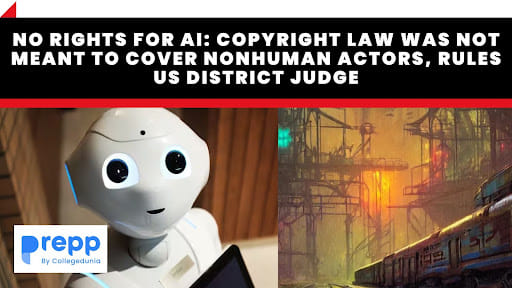
Recently, US District Judge Beryl A. Howell ruled that AI-generated artwork is not eligible for copyright protection. The ruling was in response to Stephen Thaler's attempt to challenge the government's refusal to register works produced by AI.
Table of Contents
What did the court say?
- The court in its judgment said that no work has ever been granted a copyright without a “guiding human hand.”Moreover, the purpose of copyright law is to encourage “human individuals to engage in” creation.
- Judge Howell noted that copyrights and patents were initially established as forms of property that the government safeguarded and were intended to benefit the public good by motivating individuals to create and innovate.
- In March 2023, the US government established that the majority of works generated by AI lack copyright protection. However, it clarified that certain AI-assisted creations might qualify if a human plays a "sufficiently creative" role in choosing or organizing the elements.
- The government indicated that an application for copyright could be supported if a human's choices or arrangements substantially contribute to an original work's creative outcome.
What is the Significance of the Judgment?
- Establishes legal precedent: This ruling establishes a legal precedent that AI-generated works, created without direct human involvement in the creative process, are not eligible for copyright protection. It clarifies the boundary between human and machine-generated creativity in the eyes of the law.
- Differentiates human creativity: The ruling reaffirms that copyright law fundamentally values and protects human creativity. It underscores that copyright is a mechanism designed to incentivize and reward human artistic expression and innovation.
- Guidance: The ruling contributes to the ongoing discussion about regulating AI and its creations. It highlights the need to address legal aspects of AI-generated content, particularly in cases where humans' creative input is minimal or absent.
- Limitations on AI's Rights: The decision prevents AI systems from holding copyright, which could have implications for how AI-generated content is monetized or controlled. It reinforces the notion that copyright is a right attributed to human creators.
- Impact on Industries: This ruling impacts industries that involve AI-generated content, such as art, literature, music, and more. It may influence how businesses approach AI-generated content and licensing agreements.
- Balancing innovation and regulation: The ruling highlights the need to strike a balance between encouraging AI innovation and ensuring that legal frameworks adapt to the evolving landscape of technology.
- Ethical concerns: Beyond legal implications, the ruling sparks ethical discussions about the role of AI in creative processes and the extent to which humans should retain control over intellectual property rights.
*To get more information click on this link Artificial intelligence
FAQs
Question: What is Artificial Intelligence?
Answer:
Artificial intelligence is the simulation of human intelligence processes by machines, especially computer systems. Specific applications of AI include expert systems, natural language processing, speech recognition and machine vision.
Question: What are intellectual property rights?
Answer:
Intellectual property rights are the rights given to persons over the creations of their minds. They usually give the creator an exclusive right over the use of his/her creation for a certain period of time.
Question: What is a copyright?
Answer:
Copyright is a type of intellectual property that protects original works of authorship as soon as an author fixes the work in a tangible form of expression. In copyright law, there are a lot of different types of works, including paintings, photographs, illustrations, musical compositions, sound recordings, computer programs, books, poems, blog posts, movies, architectural works, plays, and so on.
UPSC Mains Practice Question:
|
MCQ
Question: With the present state of development, Artificial Intelligence can effectively do which of the following? (UPSC-2020)
(1) Bring down electricity consumption in industrial units
(2) Create meaningful short stories and songs
(3) Disease diagnosis
(4) Text-to-speech conversion
(5) Wireless transmission of electrical energy
Select the correct answer using the code given below:
(a) 1, 2, 3, and 5 only
(b) 1, 3, and 4 only
(c) 2, 4, and 5 only
(d) 1, 2, 3, 4 and 5
Answer: (d) See the Explanation
- The correct answer, according to the UPSC answer key, is option B. But this question was posed in the year 2020. However, in the current state of development, Artificial Intelligence can perform almost all of the aforementioned activities/tasks.
- Artificial Intelligence (AI) is any machine that exhibits human-like characteristics such as learning and problem-solving. It is a broad field of computer science concerned with creating intelligent machines capable of performing tasks that normally require human intelligence.
- It is an interdisciplinary science with many approaches, but advances in machine learning and deep learning are causing a paradigm shift in almost every sector of the technology industry. Artificial intelligence has the potential to reduce energy waste, lower energy costs, and enable and accelerate the use of clean renewable energy sources in global power grids. Hence, statement 1 is correct.
- Artificial intelligence, like humans, can hold meaningful conversations and write songs and stories. Hence, statement 2 is correct.
- Artificial intelligence is just as good as healthcare professionals at diagnosing a disease based on a medical image. AI-powered software can detect whether a patient has a disease even before symptoms appear. Google's latest research shows that a neural network can be trained to detect signs of lung cancer earlier and more accurately than trained radiologists. Hence, statement 3 is correct.
- Speech recognition with Google Assistant Deep neural networks are used by AI to learn how to understand spoken commands and questions, as well as for text-to-speech conversion. Hence, statement 4 is correct.
- Online prediction of receiver positions is required in wireless power transfer to efficiently charge the power receivers. AI has a very high prediction accuracy. Hence, statement 5 is correct.
Therefore, option (d) is the correct answer.
Download the PREPP App and attempt FREE IAS Exam Mock Tests and get complete study material!

Full Test - 04: UPSC CSE Prelims CSAT (Paper-II)
Full Test - 03: UPSC CSE Prelims CSAT (Paper-II)
UPSC CSE Prelims 2026 GS Paper 1 Question Paper (24-May-2026)
UPSC CSE Prelims 2026 CSAT Paper 2 Question Paper (24-May-2026)

17 February 2025 | The Hindu Must Read Articles | Current Affairs

16 February 2026 | The Hindu Must Read Articles | Current Affairs

13 February 2026 | The Hindu Must Read Articles | Current Affairs









Comments