Digital Innovations In Healthcare Must Be For Public Good: PM Modi
Relevance: GS 2- Issues relating to development and management of Social Sector/Services relating to Health, Important International institutions, agencies and fora- their structure, mandate.
(Source: The Hindu, 08/18/2023)
Click here for Daily Current Affairs
Why in the news?
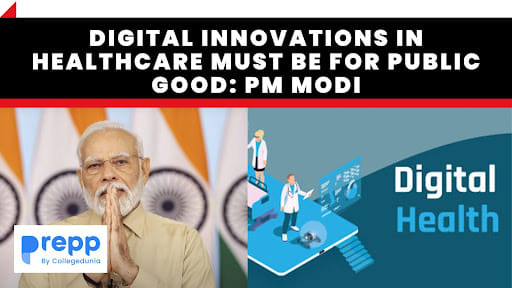
- Recently, the Prime Minister of India stated at the meeting of the G-20 health ministers in Gandhinagar that digital innovations in healthcare must be open to all.
- India and the WHO have announced the new Global Global Initiative on Digital Health which will help countries of the global south bridge the gap in terms of health-care delivery.
Table of Contents
What has the Prime Minister said about digital healthcare?
The Prime Minister urged the Health Ministers of the G-20 countries to avoid duplication in funding and to support equitable access to technology.
Pandemic preparedness
- The Covid-19 pandemic had highlighted the centrality of health in global decision making
- It helped prove the value of international cooperation in areas such as medicine and vaccine delivery and repatriation.
Resilience is key
- He urged the world to be ready to prevent, prepare, and respond to the next global pandemic.
- This was especially important as a health disaster in one part of the world could affect all other parts of the world in a very short time, due to the interconnected nature of the modern world.
- He justified the need for increased resilience in healthcare systems by citing the example of Antimicrobial resistance which has become a major global public health concern.
- India has on its way to achieving the goal of eliminating tuberculosis in the country ahead of 2030.
Holistic approach
- India has adopted a holistic and inclusive approach to healthcare.
- This included the expansion of healthcare infrastructure, promotion of traditional medicine, and affordable healthcare for all.
- He stated that there is an organic link between health and the environment.
- Environmental factors such as clean air, safe drinking water, adequate nutrition, and secure shelter are major factors that influence public health.
- He also said that it is necessary to maintain a state of harmony and balance between the mind and body.
- Initiatives:
- India has partnered with the WHO to establish a Global Centre for Traditional Medicine in Jamnagar, Gujarat.
- India is also hosting the WHO Global Summit on Traditional Medicine which will help build a global repository of traditional medicine and harness the true potential of traditional medicine.
- The G-20 Health Minister’s Summit also aims to set up a Climate and Health Initiative (CHI) in India, in collaboration with the Asian Development Bank.
Global Initiative on Digital Health
- It is a WHO-managed network of stakeholders that aims to promote data convergence, enhance the interface of health platforms, and encourage investments in the digital health sector on a global scale.
- Aims:
- Assess and prioritize the needs of member states
- Evaluate the availability of country-level digital health resources
- Identify under-funded priorities.
- Technical and financial support to the objectives of the Global Strategy on Digital Health 2020-2025.
- Capacity building to encourage, develop, maintain and adapt digital health technologies to emerging concerns.
- It is designed to improve healthcare services worldwide through digital solutions and thus achieve the goal of Universal Health Coverage.
- The digital platform will include an investment tracker, an ask tracker, and a library of existing digital health platforms.
- The global platform for data sharing will share analyses and enable the interoperability of data without sharing any data about the users.
Why is digital health important?
- Digital health can help prevent disease and develop individualized treatment/medicine for patients.
- Digital health is associated with increased efficiency and improved medical outcomes.
- It is much more cost effective than traditional healthcare. As a result, patients can monitor and manage any chronic conditions better.
- They provide healthcare professionals with an extensive view of patient health by improving access to health data and patient autonomy.
- Therefore, digital health makes healthcare more accessible, affordable, effective, and personalized for patients.
Antimicrobial resistance
|
(*Click this link to read prelims specific weekly current affairs articles)
FAQs
Question: What is digital health?
Answer:
Digital health uses digital care programs to enhance the efficiency of healthcare delivery. It makes medicine more personalized and precise to improve effectiveness. It uses modern technology to facilitate proper understanding of health conditions and the development of treatment methods.
Question: What is traditional medicine?
Answer:
Traditional medicine refers to medical practices based on knowledge, beliefs, and experiences of cultures and traditions which have been used in the diagnosis and treatment of diseases. Examples include Ayurveda, Yoga, Siddha, Homeopathy, etc.
MCQs
Question: Which of the following are the reasons for the occurrence of multi-drug resistance in microbial pathogens in India?
- Genetic predisposition of some people
- Taking incorrect doses of antibiotics to cure diseases
- Using antibiotics in livestock farming
- Multiple chronic diseases in some people
Select the correct answer using the code given below. (UPSC CSE 2019)
(a) 1 and 2
(b) 2 and 3 only
(c) 1, 3 and 4
(d) 2, 3 and 4
Answer: (b) See the Explanation
- Multidrug resistance refers to the resistance displayed by microorganisms to more than one drug.
- Genetic predispositions result in the inheritance of genetic illnesses in children from parents. It does not contribute to multi-drug resistance.
- Incorrect use of antibiotics, use of antibiotics in livestock farming, poor sanitation, poor infection control, and unhygienic handling of food lead to increased multi-drug resistance.
Therefore, option (b) is the correct answer.
Question: Consider the following statements:
- The Global Initiative for Digital Health is managed by the G-20.
- It aims to strengthen international cooperation in digital health.
Which of the above statements is/are correct?
(a) Only 1
(b) Only 2
(c) Both 1 and 2
(d) None of the above
Answer: (b) See the Explanation
- The Global Initiative for Digital Health is a WHO-managed network of stakeholders organized to facilitate the implementation of the Global Strategy on Digital Health 2020-2025. Hence statement 1 is incorrect.
- It will act as a platform to work collectively to promote country capacity and strengthen international cooperation in digital health. Hence statement 2 is correct.
Therefore, option (b) is the correct answer.
Download the PREPP App and attempt FREE IAS Exam Mock Tests and get complete study material!

Full Test - 04: UPSC CSE Prelims CSAT (Paper-II)
Full Test - 03: UPSC CSE Prelims CSAT (Paper-II)
UPSC CSE Prelims 2026 GS Paper 1 Question Paper (24-May-2026)
UPSC CSE Prelims 2026 CSAT Paper 2 Question Paper (24-May-2026)

17 February 2025 | The Hindu Must Read Articles | Current Affairs

16 February 2026 | The Hindu Must Read Articles | Current Affairs

13 February 2026 | The Hindu Must Read Articles | Current Affairs









Comments