NDMA starts testing cell broadcast technology
Relevance: GS3: Science and Technology- developments and their applications and effects in everyday life, Indigenization of technology and development of new technology, Disaster management.
Click here for Daily Current Affairs
Why in the news?
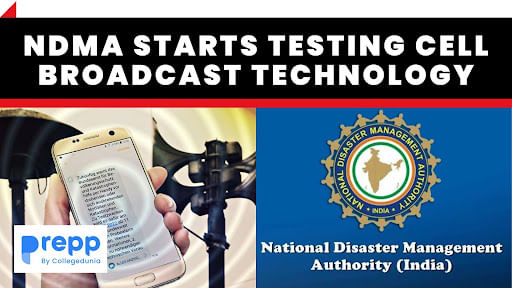
- The National Disaster Management Authority (NDMA) has started testing Cell broadcast technology developed by CDoT, which will alert people to natural calamities and in emergency situations.
- Thousands of smartphone subscribers received a surprise emergency message on their mobile phone screens that read ‘Emergency alert: Severe’.
Table of Contents
What is Cell broadcast technology?
- Cell broadcast technology is a method of sending messages to multiple mobile users in a defined area at the same time.
- It is a type of emergency warning system that enables government agencies and authorised organisations to broadcast critical messages to a large number of people in a specific place, such as during catastrophes or disasters.
- The cell broadcast technology is under development in India.
- The National Disaster Management Authority (NDMA) has begun testing the emergency cell broadcast technology created by the Centre for Development of Telematics (C-DOT) to inform people during emergency situations.
- The NDMA will use it to deliver alerts straight to mobile phone displays in the event of an emergency. It is currently being tested on Jio and BSNL networks.
- Message received by subscribers is - "This is a SAMPLE TESTING MESSAGE sent by the Department of Telecommunication, Government of India, via Cell Broadcasting System. Please disregard this message as no action is necessary on your part“.
- Its goal is to improve public safety and deliver timely warnings during emergencies.
- The technology is only accessible from a foreign provider, but C-DOT is developing it in-house.
- This method is now in use in developed countries. For example, the United States has an Emergency Alert System (EAS), which allows authorised officials to broadcast emergency alerts and warning messages to the public through cable, satellite, television, AM/FM, and satellite radio.
National Disaster Management Authority (NDMA)
|
(*Click this link to read prelims specific weekly current affairs articles)
FAQs
Question: What is Cell broadcast technology?
Answer:
Cell Broadcast is a mobile technique that cell towers utilise to send text-based communications to all mobile devices within a particular geographic region. It is a type of emergency warning system that enables government agencies and authorised organisations to transmit critical messages to a large number of individuals in a specific place, such as during an emergency or catastrophe.
Question: What is the National Disaster Management Authority?
Answer:
The National Disaster Management Authority (NDMA) is India's foremost statutory disaster management institution. In accordance with the Disaster Management Act of 2005, the NDMA was formally constituted on September 27, 2006, with the Prime Minister as Chairperson and nine other members, one of whom was designated Vice-Chairperson. Its primary purpose is to coordinate responses to natural or man-made disasters while also building capacity in disaster resiliency and crisis response.
Question: What is an Emergency Alert System?
Answer:
An Emergency Alert System (EAS) is a communication method designed to quickly transmit crucial and critical information to the public in the event of an emergency, a disaster, or other urgent circumstance. Government agencies, such as federal, state, or municipal authorities, as well as broadcasters and other media outlets, often operate the system.
UPSC Mains Practice Question:
|
Download the PREPP App and attempt FREE IAS Exam Mock Tests and get complete study material!

Full Test - 04: UPSC CSE Prelims CSAT (Paper-II)
Full Test - 03: UPSC CSE Prelims CSAT (Paper-II)
UPSC CSE Prelims 2026 GS Paper 1 Question Paper (24-May-2026)
UPSC CSE Prelims 2026 CSAT Paper 2 Question Paper (24-May-2026)

17 February 2025 | The Hindu Must Read Articles | Current Affairs

16 February 2026 | The Hindu Must Read Articles | Current Affairs

13 February 2026 | The Hindu Must Read Articles | Current Affairs









Comments