Now, Drones To Monitor Progress, Quality of Assets Produced At MGNREGS Worksites
Relevance: GS2: Government policies and interventions for development in various sectors, GS3: Science and Technology- developments and their applications and effects in everyday life,
(Source: The Hindu, 08/18/23)
Click here for Daily Current Affairs
Why in the news?
- Recently, the standard operating procedure (SOP) released by the Union Ministry of Rural Development has stated that drones will be used to monitor the progress and quality of assets under the MGNREGA scheme.
- In 2023-24, the MGNREGA scheme has generated around 149.73 crore person days and employed 27.03 crore workers of which 14.43 crore are active workers.
Table of Contents
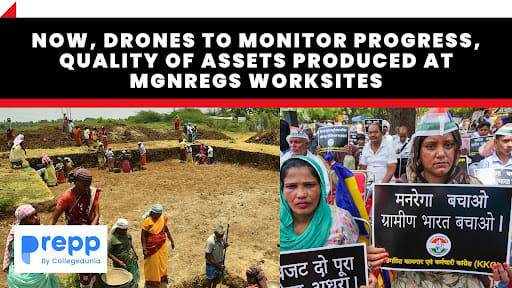
Monitoring of MGNREGA scheme
- According to the standard operating procedure (SOP) issued by the Ministry, the drones will be utilized to conduct four types of monitoring:
- Surveying ongoing works
- Inspecting completed works
- Impact assessment
- Special inspection in case of complaints.
Why is surveillance necessary?
- According to the authorities, multiple allegations have been received concerning corruption in MGNREGA activities.
- These include the substitution of labor by machines, distribution of salaries without completing work, or work being done that is not on the approved list, etc.
- The drones will allow the authorities to tackle such instances of corruption through real-time monitoring and evidence-gathering.
Tech-based surveillance
- The introduction of drones is the second major technological intervention by the government to monitor MGNREGA workers.
- Previously, the Union government had mandated that a specifically-created mobile application must be used to record worksite attendance be recorded from May 2022 onwards.
Who will use the drones?
- According to the SOP, the ombudsperson in each district will use the drone technology facilities to complete the virtual verification of the work done under the scheme.
- This will enable efficient monitoring and redressal of grievances.
- The ombudsperson is responsible for recording suo-moto complaints and disposing of them within 30 days.
- The state governments have been directed to make the necessary services available to the ombudspersons.
No extra funds
- No additional funding will be provided by the Union government for the deployment of the drones.
- The states will have to meet the relevant expenses by drawing funds from the administrative head, which is equivalent to around 10% of a State's MGNREGA budget.
- The Ministry has recommended that the states engage drone-specialist firms instead of purchasing drones.
- A centralized dashboard must be created to store the video and photographic data collected by the drone so that it can be used for analysis and reporting.
MGNREGA scheme
- The Mahatma Gandhi National Rural Employment Guarantee Act (MGNREGA) Scheme was established in 2005 by the Union Ministry of Rural Development.
- It is one of the world's largest employment guarantee initiatives.
- Aim: Provide 100 days of employment to adult members of rural families who are prepared to perform public work-related unskilled manual labor.
- It aims to proactively enhance the economic security of economically weak rural families.
- Reduce rural-to-urban migration in search of employment.
Concerns
- Inadequate and delayed Fund Disbursement: Although MGNREGA stipulates that wages must be paid within 15 days, most states have failed to do so.
- As a result, the system has become a supply-based initiative, which has lowered people’s interest.
- Caste-based Segregation: While 46% of payments to Scheduled Caste workers and 37% of payments to Scheduled Tribes workers were completed within the required seven-day timeframe, only 26% of payments to non-SC/ST workers were completed in the same period.
- The caste-based segregation impacted impoverished states such as Madhya Pradesh, Jharkhand, Odisha, and West Bengal the most.
- Ineffectiveness of PRI: The Panchayati Raj Institutions (PRI) have been unable to execute MGNREGA effectively and efficiently due to the lack of autonomy.
- Incomplete work: Projects under the MGNREGA scheme have not been completed on schedule and inspection of projects has also been irregular.
- The scheme has also faced problems with the quality of employment and asset development.
- Fabrication: The efficiency of the scheme has been adversely impacted by the creation of phony job cards, the inclusion of bogus names, missing entries, and delays in generating work card entries.
- As a result, workers do not receive their entitled benefits effectively and funds do not reach the beneficiaries.
To know more about the MGNREGA, click the link.
(*Click this link to read prelims specific weekly current affairs articles)
FAQs
Question: What is standard operating procedure (SOP)?
Answer:
A standard operating procedure (SOP) is a series of step-by-step instructions created by an organization to assist personnel in performing everyday tasks. SOPs strive for efficiency, quality output, and consistency of performance while eliminating misunderstanding and noncompliance with industry laws.
Question: What is the MGNREGA scheme?
Answer:
The Ministry of Rural Development started MGNREGA, one of the world's largest labor guarantee initiatives, in 2005. The scheme's major goal is to provide 100 days of employment to adult members of each rural family who are prepared to conduct public work-related unskilled manual labor each fiscal year. There are 15.4 crore active employees under the MGNREGA as of 2022-23.
Question: What are the four types of monitoring under the MGNREGA scheme by using drones?
Answer:
Drones will be used by the Union Ministry of Rural Development to monitor the status and quality of assets created at work sites as part of the MGNREGA plan. The drones will be used for four sorts of surveillance, according to a standard operating procedure (SOP) recently established by the Ministry:
- Examining the active projects
- Examining the completed works
- Impact evaluation
- In the event of a complaint, a special inspection will be conducted.
UPSC Mains Practice Question:
|
MCQ
Question: Among the following who are eligible to benefit from the “Mahatma Gandhi National Rural Employment Guarantee Act”? (UPSC 2011)
(a) Adult members of only the scheduled caste and scheduled tribe households
(b) Adult members of below poverty line (BPL) households
(c) Adult members of households of all backward communities
(d) Adult members of any rural household
Answer: (d) See the Explanation
- The Mahatma Gandhi National Rural Employment Guarantee (MGNREGA), the world's largest job guarantee initiative, was adopted in 2005 with the primary goal of ensuring 100 days of paid employment per year.
- It tries to address the causes of chronic poverty through the 'works' (projects) conducted.
- The Ministry of Rural Development (MRD), Government of India, oversees the scheme's implementation in collaboration with state governments.
- The following are the qualifying requirements for obtaining MGNREGA benefits:
- Must be an Indian citizen.
- Any citizen above the age of 18 at the time of application.
- The applicants must come from a rural family.
- Applicants must be willing to volunteer for unskilled labor jobs.
- Households are eligible for unemployment benefits if employment is not found within 15 days of applying.
- It emphasizes on enhancing the decentralization process by providing Panchayati Raj Institutions (PRIs) a substantial role in planning and implementing these initiatives.
Therefore, option (d) is the correct answer.
Download the PREPP App and attempt FREE IAS Exam Mock Tests and get complete study material!

Full Test - 04: UPSC CSE Prelims CSAT (Paper-II)
Full Test - 03: UPSC CSE Prelims CSAT (Paper-II)
UPSC CSE Prelims 2026 GS Paper 1 Question Paper (24-May-2026)
UPSC CSE Prelims 2026 CSAT Paper 2 Question Paper (24-May-2026)

17 February 2025 | The Hindu Must Read Articles | Current Affairs

16 February 2026 | The Hindu Must Read Articles | Current Affairs

13 February 2026 | The Hindu Must Read Articles | Current Affairs









Comments