The Gaps In The Births And Deaths Registration (Amendment) Act
Relevance: GS 2 - Government policies and interventions for development in various sectors and issues arising out of their design and implementation; Functions and responsibilities of the Union and the States, issues and challenges pertaining to the federal structure
(Source: The Hindu, 08/18/2023)
Click here for Daily Current Affairs
Why in the news?
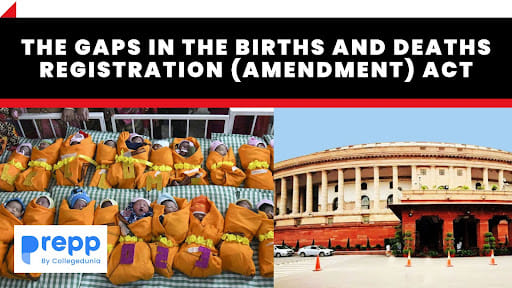
- This article discusses the Births and Deaths Registration (Amendment Act) 2023 and some of the practical difficulties associated with it.
- The President of India has recently provided his assent to the Births and Deaths Registration (Amendment Act) 2023 passed by Parliament.
- One of the major objectives in the Bill’s ‘Statement of Objects and Reasons’ is to create a National and State level database of registered births and deaths which would help update other databases and ensure efficient and transparent delivery of public services and social benefits.
Table of Contents
Building databases
- According to the amendment, it is mandatory that the Registrar General of India maintain a national-level database of births and deaths.
- Similarly, Chief Registrars of births and deaths in each state must also maintain state-level databases using the portal approved by the Registrar General.
- These databases will provide information that can be used to update various national-level databases like the National Population Register, Aadhaar, electoral rolls, ration cards, passports, etc.
Aadhaar Integration
- The amendment mandates the collection of the Aadhaar number of the parents when recording births but does not include any provisions for recording the Aadhaar number of the deceased.
- Without proper updation of the Aadhaar details of the deceased, it would be difficult to achieve the national goal of efficient service delivery.
- It also raises concerns about the effectiveness of updating the databases with deceased individuals' information.
Central vs. State Databases
- The Amendment has assigned the additional duty of maintaining the central database to the Registrar General of India.
- Previously, the state governments were responsible for registration with the Registrar General of India performing the coordination and unification of the registration system.
- The Chief Registrars, who are the executive authorities for matters related to the registration of births and deaths in the States, need to maintain a database for efficient delivery of services of providing birth and death certificates.
- Experts have questioned the need for a national-level database when there are state-level databases as it would primarily aggregate state-level databases.
- Instead, alternatives for efficient sharing of data should be adopted such as a system in which the required data flow to the central databases occurs on a daily or real-time basis from the State-level database based on standards specified by the Registrar General of India.
- This central database can be made available to authorities dealing with the maintenance and preparation of various national databases.
- Challenges: While birth and death registers are public information and the RBD Act only needs an enabling provision to share information, other databases will require the amendment of laws or executive orders under which they are maintained.
- The amendment specifies that the central database will be shared with various authorities responsible for databases related to population registers, electoral rolls, Aadhaar, passports, etc.
- However, it only lists specific databases and allows future additions by the government which raises concerns about misuse of data and overriding the role of Parliament.
Certificate of Cause of Death
- The amendment introduces a requirement for a cause-of-death certificate for deaths occurring in medical institutions.
- All medical institutions must provide a certificate as to the cause of death to the Registrar and a copy of the same to the nearest relatives.
- However, for deaths that occur outside a hospital, the certificate has to be issued by the medical practitioner who attended the patient most recently.
Concerns
- The medical practitioner might not have made a definite diagnosis before the death.
- If the deceased was attended by an AYUSH practitioner, the cause of death recorded may not be usable for the cause of death statistics as they may not be classifiable under the International Classification of Diseases and WHO guidelines.
- The deceased may have died due to a cause unrelated to his treatment, which makes it difficult for the medical practitioner to provide such a report.
- While Section 17 of the Act prohibited the inclusion of the cause of death in any certificate issued under the Act, it now states that the cause of death certificate should be given to the relative of the deceased.
Birth and Death Certificates
- The amendment provides for the birth certificate to be treated as sufficient proof for various purposes like school admission, passport issuance, and obtaining an Aadhaar number.
- Although this is a progressive step, its implementation might not have required an amendment to the RBD Act itself.
- IT could also have been implemented through executive orders similar to how the compulsory birth certificate requirement for people born after January 26th, 1989 was removed by the government in 2016.
- The amendment could have included a provision to register a ‘presumed death’ when it can be reasonably assumed that the person would have died during a natural calamity or accident.
- At present, it takes around seven years for the family to procure such certificates.
Other provisions in the Amended Act
- It proposes to facilitate the registration process for various categories of children like adopted, orphan, abandoned, surrendered, surrogate child, and child to a single parent or unwed mother.
- The bill proposes the appointment of Special "Sub-Registrars" to expedite the registration of deaths and certificate issuance during disasters or epidemics.
Conclusion
- The proposed amendments to the Registration of Births and Deaths Act, 1969, promise efficient service delivery.
- However, a judicious blend of modernization and data privacy is required to ensure that the government’s objectives are met while the individual’s information is safeguarded.
(*Click this link to read prelims specific weekly current affairs articles)
FAQs
Question: What is the National Population Register?
Answer:
The National Population Register (NPR) is a register that includes information on people who usually live in a town, village, ward, or other region that is demarcated within a ward of a town or city. It aims to compile an extensive database of the country’s typical residents.
Question: What is the Registrar General of India?
Answer:
The Office of the Registrar General of India was established by the Union Ministry of Home Affairs in 1961. It is responsible for arranging, conducting, and analyzing the results of the demographic surveys of India including the Census of India and Linguistic Survey of India.
UPSC Mains Practice Question:
|
MCQs
Question: Consider the following statements:
- The National Population Register is prepared under the Citizenship Act of 1955 and the Citizenship Rules 2003.
- It is mandatory for all usual citizens of the country.
- A usual citizen is one who resides in his place of birth.
How many of the above statements is/are correct?
(a) Only 1
(b) Only 2
(c) All 3
(d) None of the above
Answer: (b) See the Explanation
- The National Population Register is a database of all usual residents of the country.
- It is prepared under the provisions of the Citizenship Act of 1955 and the Citizenship Rules 2003. Hence statement 1 is correct.
- The NPR is mandatory for all the usual citizens of the country. Hence statement 2 is correct.
- A usual resident for the purposes of NPR is a person who has resided in a place for six months or more and intends to reside there for another six months or more. Hence statement 3 is incorrect.
Therefore, option (b) is the correct answer.
Download the PREPP App and attempt FREE IAS Exam Mock Tests and get complete study material!

Full Test - 04: UPSC CSE Prelims CSAT (Paper-II)
Full Test - 03: UPSC CSE Prelims CSAT (Paper-II)
UPSC CSE Prelims 2026 GS Paper 1 Question Paper (24-May-2026)
UPSC CSE Prelims 2026 CSAT Paper 2 Question Paper (24-May-2026)

17 February 2025 | The Hindu Must Read Articles | Current Affairs

16 February 2026 | The Hindu Must Read Articles | Current Affairs

13 February 2026 | The Hindu Must Read Articles | Current Affairs









Comments