A ‘Fab’ Way To Conduct India-Japan Tech Diplomacy
Relevance: GS2 - Bilateral, regional and global groupings and agreements involving India and/or affecting India’s interests GS3 - Science and Technology- developments and their applications and effects in everyday life. Achievements of Indians in science & technology; indigenization of technology and developing new technology. Awareness in the fields of IT, Computers
(Source: The Hindu, 08/19/2023)
Click here for Daily Current Affairs
Why in the news?
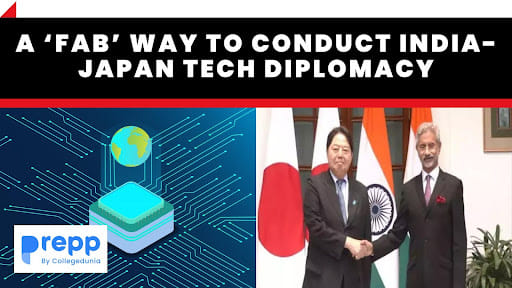
- Recently, India and Japan agreed to work together to create a resilient supply chain for semiconductors and develop the semiconductor ecosystem.
- Previously, India had agreed to a technology partnership with the U.S.A. which included the long-term strategic development of complementary semiconductor ecosystems.
- This has coincided with countries like the U.S.A., Japan, and the Netherlands imposing restrictions on the exports of semiconductor manufacturing materials to China.
Table of Contents
What are the areas of focus of the India-Japan tech partnership?
- The Indo-Japan partnership will focus on five areas:
- Semiconductor design,
- Semiconductor manufacturing,
- Equipment research,
- Semiconductor supply chain resilience
- Talent development.
- The partnership is expected to enable government-to-government and industry-to-industry collaborations in semiconductors.
- It is necessary to boost both the available talent pool in the semiconductor industry and the number of fabs.
- The partnership aims to facilitate technology transfer and encourage research, and innovation.
- This will enable the two countries to emerge as leaders in the semiconductor industry.
- The partnership will contribute to addressing dynamic and emerging challenges such as semiconductor miniaturization, AI integration, and quantum computing.
An alignment of policies
- India and Japan have aligned their policies to support semiconductor manufacturing and research.
- India’s Make in India and Japan’s Society 5.0 aim to achieve technological self-reliance and foster innovation-driven growth.
- The two countries have signed bilateral agreements to facilitate technology transfer, research, and reciprocal trade in semiconductor-related products.
Harnessing Synergies
- India and Japan have recognized the importance of semiconductors in driving innovation, economic growth, and national security.
- Japan has an advanced semiconductor industry and has been a global leader in semiconductor manufacturing.
- On the other hand, India has a growing IT sector and subsequently rising demand for semiconductors.
- Therefore, the partnership leverages Japan's technological prowess and India's innovation and design capacities to create a mutually beneficial relationship.
Supply Chain Disruptions and Geopolitical Tensions
- Geopolitical tensions and supply chain disruptions, particularly in the Indo-Pacific have led to countries attempting to diversify their supply chains and collaborate with other countries.
- Joint research initiatives allow countries to pool resources and expertise to tackle complex challenges in semiconductor design, manufacturing processes, and materials science.
- This would encourage the innovation and development of cutting-edge solutions, while also focusing on human resource development through skill exchange programs and training.
The American partnership
- India and the U.S.A. have set up a technology partnership to cover investment, innovation, and workforce development.
- India is also set to sign an agreement with Georgia Tech University, following investments by Micron Technology and Applied Materials to establish a semiconductor unit and a research and development center.
- The U.S.A. recently introduced the CHIPS and Science Act (2022), which imposes strategic curbs on the expansion of semiconductor manufacturing in countries that could pose a direct threat to the U.S.A. such as China.
- Similarly, Japan and the Netherlands have restricted exports of semiconductor manufacturing materials to China.
- There is a synergy among like-minded partners in the Indo-Pacific such as India, the U.S.A., Japan, and Australia (QUAD members) to invest in critical technologies due to geostrategic and national security concerns associated with them.
Opportunity
- Although the tighter export controls on China’s chip manufacturing abilities are likely to impact the sales of Japanese chip companies, Japan has supported the move because of the geopolitical concerns associated with China’s expanding capabilities.
- India’s partnership with the leaders of the semiconductor industry could significantly diversify the semiconductor industry and provide an alternative to China.
Conclusion
- The agreements between India and its QUAD partners indicate confidence in India’s manufacturing and innovation capabilities.
- India can utilize Japan’s technological skills and enhance its own innovation and design capacities to emerge as a leader in the global technological industry.
- This will allow India to cement its status in a future that will be characterized by advanced electronics, enhanced connectivity, and technological excellence.
(*Click this link to read prelims specific weekly current affairs articles)
FAQs
Question: What are semiconductors?
Answer:
Semiconductors are materials that have a conductivity between that of conductors and insulators. They can be pure elements like silicon or germanium or compounds like gallium, arsenide, and cadmium selenide. They are the basic building blocks of all modern electronics and ICT products.
Question: What is a fab?
Answer:
A Fab or fabrication refers to the factory that manufactures semiconductor chips.
Question: What is the QUAD?
Answer:
The QUAD is a grouping of four democracies –India, Australia, the US, and Japan that aims to ensure and support unhindered maritime trade and security in the region and a “free, open, and prosperous” Indo-Pacific region.
UPSC Mains Practice Question:
|
MCQs
Question: Consider the following countries
- Australia
- Canada
- China
- India
- Japan
- USA
Which of the above are among the 'free-trade partners' of ASEAN? (UPSC CSE 2018)
(a) 1, 2, 4 and 5
(b) 3, 4, 5 and 6
(c) 1, 3, 4 and 5
(d) 2, 3, 4 and 6
Answer: (c) See the Explanation
ASEAN has five free trade agreements with six countries - China, Japan, India, the Republic of Korea, Australia, and New Zealand.
Therefore, option (c) is the correct answer.
Question: Which of the following countries has introduced Society 5.0?
(a) U.S.A
(b) Netherlands
(c) Japan
(d) China
Answer: (c) See the Explanation
- Japan has recently unveiled its plans for Society 5.0 which is the country’s blueprint for a smarter society.
- It is a human-centered and technology-based society that aims to achieve a high degree of convergence between cyberspace and physical space.
Therefore, option (c) is the correct answer.
Download the PREPP App and attempt FREE IAS Exam Mock Tests and get complete study material!

Full Test - 04: UPSC CSE Prelims CSAT (Paper-II)
Full Test - 03: UPSC CSE Prelims CSAT (Paper-II)
UPSC CSE Prelims 2026 GS Paper 1 Question Paper (24-May-2026)
UPSC CSE Prelims 2026 CSAT Paper 2 Question Paper (24-May-2026)

17 February 2025 | The Hindu Must Read Articles | Current Affairs

16 February 2026 | The Hindu Must Read Articles | Current Affairs

13 February 2026 | The Hindu Must Read Articles | Current Affairs









Comments