The Katchatheevu Controversy
Relevance: GS2 - India and its neighbourhood- relations
(Source: The Hindu, 08/21/23)
Click here for Daily Current Affairs
Why in the news?
- Recently, Tamil Nadu Chief Minister M.K.Stalin, revived the debate over Katchatheevu, an uninhabited and barren 285-acre islet about 14 nautical miles off Rameswaram.
- Stalin emphasized that the islet's return could bring a lasting resolution to the challenges faced by the state's fishermen.
Table of Contents
- When did Katchatheevu become a part of Sri Lanka?
- How important has Kachatheevu been to the fisherfolk?
- What triggered the negotiations between India and Sri Lanka?
- How was the 1974 agreement received?
- What has been the stand of the Union government on the issue?
- Where is the island of Katchatheevu?
- FAQs
- MCQs
When did Katchatheevu become a part of Sri Lanka?
- In 1974, Indira Gandhi ceded the island of Katchatheevu to Sri Lanka in an attempt to settle the maritime border issue through the 'Indo-Sri Lankan Maritime Agreement'.
- Indian fishermen retained limited access, but fishing rights were unclear.
- Sri Lanka interpreted Indian fishermens’ right to access Katchatheevu to be limited to “rest, drying nets and for visit to the Catholic shrine without visa”.
How important has Kachatheevu been to the fisherfolk?
- Fisherfolk of the two countries have been traditionally using the islet for fishing.
- The supplemental pact in March 1976 made it clear that fishing vessels and fishermen of the two countries “shall not engage” in fishing in the historic waters, territorial sea, and exclusive zone or exclusive economic zone of either of the countries “without the express permission of Sri Lanka or India.”
- This further added uncertainty and has led to ongoing tensions and disputes, affecting Indian fishermen relying on the area for livelihood.
What triggered the negotiations between India and Sri Lanka?
- Srilanka: Sri Lanka claimed sovereignty over Kachatheevu by citing Portuguese occupation from 1505-1658 CE.
- India: India argued that it was part of the Ramnad zamin, with historical ties.
- The former Raja Ramanatha Sethupathi's 1968 interview supported India's claim, stating Kachatheevu was under zamin jurisdiction "from time immemorial." Taxes were collected until 1947 when the state took over via Zamindari Abolition Act.
How was the 1974 agreement received?
- The current demand for the retrieval of Katchatheevu originates from the opposition to the 1974 pact.
- During debates in Parliament that July, opposition parties like DMK, AIADMK, Jan Sangh, Swatantra, and Socialist Party walked out.
- Atal Bihari Vajpayee, Jan Sangh's leader, argued the transfer was done without transparency.
- However, in 1974, External Affairs Minister Swaran Singh defended India’s decision in Lok Sabha, citing exhaustive research on historical records.
- M. Karunanidhi, then Chief Minister, had earlier urged Indira Gandhi in 1973 to retain Katchatheevu, stating it was India's, not just Tamil Nadu's.
- In the last 15 years, both Jayalalithaa and Karunanidhi had approached the Supreme Court on the matter.
What has been the stand of the Union government on the issue?
- In August 2013, the Indian government stated to the Supreme Court that there was no basis for the retrieval of Kachchatheevu from Sri Lanka, as no Indian territory had been ceded.
- It explained that the islet had been a historical dispute between British India and Ceylon (now Sri Lanka) and that the 1974 and 1976 agreements settled the matter by defining boundaries.
- In December 2022, the government reiterated that Katchatheevu is situated on the Sri Lankan side of the India-Sri Lanka Maritime Boundary Line, referring to the two agreements.
- It added that the matter was sub-judice in the Supreme Court.
Where is the island of Katchatheevu?
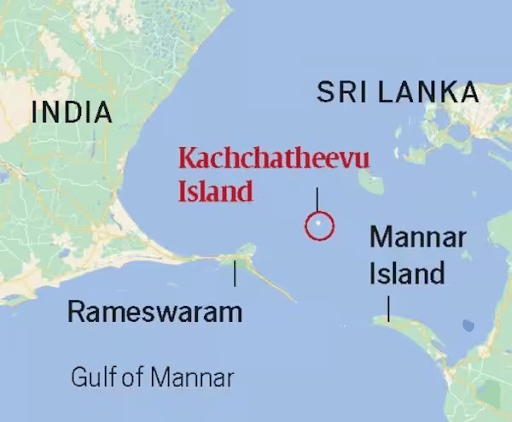
- Katchatheevu is a 285-acre uninhabited speck in the Palk Strait, between India and Sri Lanka. It is no more than 1.6 km in length and slightly over 300 m wide at its broadest point.
- It lies northeast of Rameswaram, about 33 km from the Indian coast. It is about 62 km southwest of Jaffna, at the northern tip of Sri Lanka, and 24 km away from the inhabited Delft Island, belonging to Sri Lanka.
- The only structure on the island is an early 20th century Catholic shrine – St Anthony’s church.
- Every year, during an annual festival, Christian priests from both India and Sri Lanka jointly conduct a service on Katchatheevu, attended by devotees from both countries
- Katchatheevu is not suited for permanent settlement as there is no source of drinking water on the island.
(*Click this link to read prelims specific weekly current affairs articles)
FAQs
Question: What is Palk Strait?
Answer:
The Palk Strait is a strait between the Tamil Nadu state of India and the Jaffna District of the Northern Province of the island nation of Sri Lanka. It connects the Bay of Bengal in the northeast with Palk Bay in the southwest.
Question: What is a Permanent Settlement System?
Answer:
In 1793, Lord Cornwallis started the Permanent Settlement of Land Revenue. The Permanent Settlement was called by different names such as Istamrari, Jagirdari, Malguzari, Bishvedari and Zamindari. This system was most prevalent in Bengal, Bihar, and Orissa and later it was introduced in Varanasi and Madras.
Question: What is an exclusive economic zone?
Answer:
An “exclusive economic zone,” or “EEZ” is an area of the ocean, generally extending 200 nautical miles (230 miles) beyond a nation's territorial sea, within which a coastal nation has jurisdiction over both living and nonliving resources.
MCQ
Question: With reference to Katchatheevu,consider the following statements:
- Katchatheevu is an uninhabited speck in the Palk Strait, between India and Sri Lanka.
- It lies northeast of Rameswaram, about 33 km from the Indian coast.
Which of the above statements is/are correct?
(a) 1 only
(b) 2 only
(c) Both 1 and 2
(d) Neither 1 nor 2
Answer: (c) See the Explanation
- Katchatheevu is a 285-acre uninhabited speck in the Palk Strait, between India and Sri Lanka. Hence, statement 1 is correct
- It is no more than 1.6 km in length and slightly over 300 m wide at its broadest point.Hence, statement 2 is correct
- Therefore, option (c) is the correct answer.
Download the PREPP App and attempt FREE IAS Exam Mock Tests and get complete study material!

Full Test - 04: UPSC CSE Prelims CSAT (Paper-II)
Full Test - 03: UPSC CSE Prelims CSAT (Paper-II)
UPSC CSE Prelims 2026 GS Paper 1 Question Paper (24-May-2026)
UPSC CSE Prelims 2026 CSAT Paper 2 Question Paper (24-May-2026)

17 February 2025 | The Hindu Must Read Articles | Current Affairs

16 February 2026 | The Hindu Must Read Articles | Current Affairs

13 February 2026 | The Hindu Must Read Articles | Current Affairs









Comments