Russia’s Luna-25 spacecraft crashes into the Moon: Harsh Realities Of Space That Chandrayaan 3 Is Built To Brave
(Source: The Hindu, The Hindu, 08/14/2023)
Click here for Daily Current Affairs
Why in the news?
- Recently, ISRO announced that the Chandrayaan-3 mission is expected to begin its powered descent on August 23rd, 2023.
- ISRO has stated that Chandrayaan-3 has been prepared to handle all the potential vagaries of space such as vacuum, extreme temperatures, and radiation in order to ensure the success of the mission.
- Russia’s Luna-25 mission crashed into the lunar surface after it spun into an uncontrolled orbit.
Table of Contents
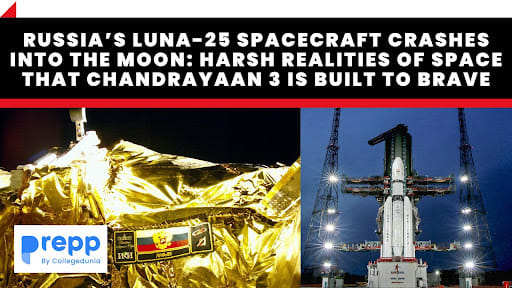
Luna-25
- Luna-25 was Russia’s first lunar mission since 1976.
- It was a pilotless spacecraft that aimed to become the first to land on the south pole of the moon.
- It was launched from the Vostochny Cosmodrome, in the Russian Far East on August 10th, 2023.
- It aimed to find evidence of the presence of water and precious minerals.
- Initially, Luna-25 was supposed to carry a lunar rover, but this was dropped to reduce the weight of the craft and improve reliability.
- The mission was part of Russia’s efforts to prove that it is a state capable of delivering a payload to the moon, thus ensuring Russia’s guaranteed access to the moon’s surface.
- Russia is only one of three countries including the U.S.A. and China to complete a moon landing, but the sanctions imposed on it due to the war in Ukraine have affected its space programme and restricted its access to Western technology.
Status
- The Russian space agency, Roscosmos, has announced that contact has been lost with the Luna-25 spacecraft following some unforeseen difficulties.
- It moved into an unpredictable orbit and collided with the surface of the moon.
Chandrayaan-3
- India launched the Chandrayaan-3 on July 14th with the aim of completing a soft landing on the south pole of the moon.
- It is preparing to descend over the lunar surface on August 23 after building up momentum around the earth and slingshotting itself to the moon over the last month.
To know more about Chandrayaan-3 click the link.
What are the harsh realities of space faced by space missions?
- Unlike instruments on the ground, satellites, space stations, and moon-bound spacecraft like Chandrayaan 3 do not possess any ‘natural’ protection against the effects of space.
- This leaves these space missions vulnerable to a variety of issues, impacting their success and the quality of the data obtained.
The solar wind
- One of the major challenges faced by space missions is the effect of the sun.
- The extremely hot surface of the sun emits a stream of energetic charged particles, like protons and electrons, which move extremely fast, called the solar wind.
- These charged particles are deflected and guided toward the earth’s magnetic poles as a result of their interactions with the Earth’s magnetic field.
- These particles collide with the atoms of nitrogen of oxygen found in the earth’s upper atmosphere.
- When the atoms absorb an electron, they gain excess energy which is released as photons or light of some frequencies.
- Oxygen causes the light to be green and orange while nitrogen causes it to be blue. The northern lights are produced as a result of these interactions.
- The Earth’s magnetic field also protects the life and objects it hosts from the wrath of the solar wind.
- However, the Earth also has its own van Allen radiation belts – particles from the solar wind that are now trapped along the planet’s magnetic field.
Particles that sway polls
- The equipment on spacecraft has to be configured to be able to withstand the impact of solar wind.
- This could lead to a complete malfunction of critical systems, as on Canada’s Anik E2 satellite in 1982.
- The effects of the solar wind are generally categorized as Displacement Damage and Single-event transients.
- Displacement damage: When the impact of a charged particle in the solar wind is so strong that it displaces an atom in an electronic chip, the result is termed displacement damage.
- It is permanent and results in the decay of the chip’s performance over time.
- Single-event transients: This involves signals being transmitted by the spacecraft to fluctuate which results in the corruption of the encoded message.
- Eg: In a famous example of such signal corruption, votes ended up being miscounted in an election in Belgium in 2003. A single-event transient flipped a bit in a voting machine from ‘0’ to ‘1’, resulting in one candidate receiving 4,096 votes more in the poll.
A hairy environ
- Spacecraft could experience enormous temperature fluctuations.
- Chandrayaan 3 is expected to have to work in environments between -200°C and 200°C, depending on the satellite’s position relative to the moon and the sun.
- This could result in the breaking of wires, soldering failure, and cracking of chips.
- Inefficient solar cells: The solar cell that powers the spacecraft could become inefficient due to the support materials on the panel made of copper which become more active and seep through the cell.
- Outgassing: Air molecules are released by some materials when placed in a vacuum, particularly in the presence of temperature fluctuations.
- Eg: Outgassed air molecules can deposit themselves on a camera lens, resulting in bad photos. They can be lodged between electrical contacts leading to electrical failures.
- Spacecrafts also face other problems that have not been completely understood by scientists.
- Eg: One possible explanation for the formation of whiskers or electrically conductive protrusions on some metals in a vacuum is that they are the result of built-up stress in the metal.
- The whiskers can result in the shorting of the circuit leading to the failure of the satellite.
- Therefore, experts must exercise care in the selection and application of metal coating to ensure the missions are successful.
Multiple protections
- Scientists and engineers use advanced engineering techniques to design and manufacture the electronics on spacecraft, which are commonly called radiation-hardened electronics.
- They consider radiation levels, and possible damage, and include multiple levels of protection in the software and hardware components.
- Eg: Triple modular redundancy - Three copies of the same signal can be transmitted, which means that if one of the bits is corrupted, the other two bits can outvote it.
- These safeguards have to be built in a way that also coordinates with instruments used to protect against other problems.
- Eg: The protection of rocket components to withstand the intense vibrations felt during launch.
Conclusion
- Space missions must be based on the most resilient, sophisticated, and smart solutions which allow them to perform their functions efficiently in the harshest environments.
- Chandrayaan 3 represents the collective achievements of the world in which knowledge has been attained and technology developed to ensure the success of future space missions.
(*Click this link to read prelims specific weekly current affairs articles)
FAQs
Question: What is solar wind?
Answer:
The solar wind is a stream of energized, charged particles, primarily electrons, and protons, flowing outward from the Sun at speeds as high as 900 km/s and at a temperature of 1 million degrees (Celsius).
Question: What is a van Allen radiation belt?
Answer:
A Van Allen radiation belt is a zone of energetic charged particles, most of which originate from the solar wind. These particles are captured by and held around a planet by its magnetosphere.
UPSC Mains Practice Question:
|
MCQs
Question: Electrically charged particles from space traveling at speeds of several hundred km/sec can severely harm living beings if they reach the surface of the earth. What prevents them from reaching the surface of the earth? (UPSC CSE 2012)
(a) The Earth's magnetic field diverts them toward its poles
(b) Ozone layer around the Earth reflects them back to outer space
(c) Moisture in the upper layers of the atmosphere prevents them from reaching the surface of the Earth
(d) None of the statements (a),(b), and (c) is correct.
Answer: (a) See the Explanation
The Earth’s magnetic field diverts electrically charged particles from space from reaching the surface of the Earth.
Therefore, option (a) is the correct answer.
Question: Consider the following statements about the Mangalyaan mission launched by ISRO.
- It is also called the Mars Orbiter Mission
- It made India the second country to have a spacecraft orbit Mars after the USA.
- It made India the only country to be successful in making its spacecraft orbit Mars in its very first attempt
Which of the statement(s) given above is/are correct? (UPSC CSE 2016)
(a) 1 only
(b) 2 and 3 only
(c) 1 and 3 only
(d) 1, 2 and 3
Answer: (c) See the Explanation
- India’s Mars Orbiter Mission is also known as the Mangalyaan Misson. Hence statement 1 is correct.
- It was launched in 2013 by ISRO to trace the presence of methane in Mars’ atmosphere.
- India became the fourth country to successfully send an orbiter mission to Mars after U.S.A., Russia, and China. Hence statement 2 is incorrect.
- India became the only country to successfully complete an orbit of Mars on its first attempt. Hence statement 3 is correct.
Therefore, option (c) is the correct answer.
Download the PREPP App and attempt FREE IAS Exam Mock Tests and get complete study material!

Full Test - 04: UPSC CSE Prelims CSAT (Paper-II)
Full Test - 03: UPSC CSE Prelims CSAT (Paper-II)
UPSC CSE Prelims 2026 GS Paper 1 Question Paper (24-May-2026)
UPSC CSE Prelims 2026 CSAT Paper 2 Question Paper (24-May-2026)

17 February 2025 | The Hindu Must Read Articles | Current Affairs

16 February 2026 | The Hindu Must Read Articles | Current Affairs

13 February 2026 | The Hindu Must Read Articles | Current Affairs









Comments