Supreme Court Judgment Delivered Four Decades Ago Counters President’s Rule in J&K
Relevance: GS 2 - Indian Constitution; issues and challenges pertaining to the federal structure,
(Source: The Hindu, 08/21/23)
Click here for Daily Current Affairs
Why in the news?
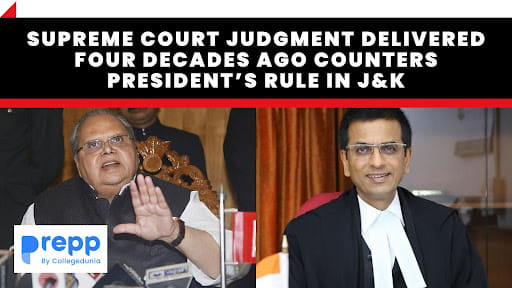
- Recently, a 1971 judgment was produced before a five-judge Bench headed by Chief Justice of India (CJI) D.Y. Chandrachud hearing the challenge to the repeal of Article 370 from the Indian Constitution.
- The 1971 verdict involves former Tamil Nadu Chief Minister M. Karunanidhi.
Table of Contents
What is the Thiru K.N. Rajagopal versus M Karunanidhi case?
- The reference of Thiru K.N. Rajagopal versus M Karunanidhi judgment by a Constitution Bench of the Supreme Court in 1971 given by Chief Justice S.M. Sikri, presented a significant challenge to the government's assertion that the "breakdown of constitutional machinery" in Jammu and Kashmir justified the President's rule under Article 356 and led to the abrogation of Article 370.
- The 1971 judgment holds that once a Governor dissolves a State’s legislative Assembly and assumes powers of the State, there is no question of the President taking over by claiming “failure of constitutional machinery” under Article 356 of the Constitution.
Arguments by petitioners
- The petitioner side contended that it was ‘absurd’ for the President to claim there was a ‘breakdown of constitutional machinery’ when the reins of the State was with the very Governor he had appointed.
- The Governor is not elected but he is appointed by the President under Article 155.
- The petitioner further referenced the Constitution Bench judgment in the S.R. Bommai case, which affirmed that a State, as a "constitutional entity," should survive Article 356.
- The petitioners contended that the purpose of Article 356 was to restore normalcy to a State, not to eliminate it.
Jammu and Kashmir
- November 21, 2018: In Jammu and Kashmir (J&K), the state's legislative assembly was dissolved by the Governor on November 21, 2018, as per Section 53(2) of the J&K Constitution.
- December 19, 2018: Subsequently, a proclamation of President's rule under Article 356 was issued on December 19, 2018.
- Parliament endorsed this proclamation on January 3, 2019. The President's rule in J&K was extended for six months, starting from July 3, 2019.
- On August 5, 2019, the President issued the Constitution (Application to Jammu and Kashmir) Order which inserted a new provision, Article 367(4), in the Indian Constitution. This replaced the expression ‘Constituent Assembly of the State’ in the proviso to Article 370(3) with ‘Legislative Assembly of the State’.
- The same day saw Parliament abrogate Article 370 and pass the Bill to reorganize the State of Jammu and Kashmir. The next day saw the President declare that Article 370 has ceased to apply.
What is a Constitution Bench?
When does the SC set up a Constitution Bench?
|
(*Click this link to read prelims specific weekly current affairs articles)
FAQs
Question: What is the recommendation of the Sarkaria Commission on Concurrent List?
Answer:
The centre should loosen its control over the subjects of the concurrent list and consult the State Government before enacting any laws on such subjects.
Question: What is Article 355?
Answer:
According to Article 355, the Center is responsible for ensuring that each state's government follows the norms of the Constitution. If the state's constitutional machinery fails, the Center assumes this duty and, under Article 356, takes control of the state's government.
Question: What is President’s rule?
Answer:
President’s Rule is explained under Article 356 of the Indian Constitution. Under this Article, the President may issue a proclamation to impose an emergency in a state if he is satisfied on receipt of a report from the Governor of the State, or otherwise, that a situation has arisen under which the Government of the State cannot be carried on smoothly. In such a situation, the proclamation of emergency by the President is called a ‘proclamation on account of the failure (or breakdown) of constitutional machinery in the State.’ It is also known as a state Emergency’ or ‘Constitutional Emergency’.
UPSC Mains Practice Question:
|
MCQ
Question: Which one of the following suggested that the Governor should be an eminent person from outside the State and should be a detached figure without intense political links or should not have taken part in politics in the recent past? (UPSC-2019)
(a) First Administrative Reforms Commission (1966)
(b) Rajamannar Committee (1969)
(c) Sarkaria Commission (1983)
(d) National Commission to Review the Working of the Constitution (2000)
Answer: (c) See the Explanation
- The Sarkaria Commission has suggested the following additional criteria for selecting a person to the office of the Governor.
- A politician belonging to the ruling party at the Centre should not be appointed as Governor of a State being run by some other party or by a combination of other parties.
- He must be appointed after consultation with the Chief Minister of the State concerned.
- He should be an eminent person in some walk of life.
- He should be from outside the State and a detached figure not too connected with the local politics of the State.
- Therefore, option (c) is the correct answer.
Download the PREPP App and attempt FREE IAS Exam Mock Tests and get complete study material!

Full Test - 04: UPSC CSE Prelims CSAT (Paper-II)
Full Test - 03: UPSC CSE Prelims CSAT (Paper-II)
UPSC CSE Prelims 2026 GS Paper 1 Question Paper (24-May-2026)
UPSC CSE Prelims 2026 CSAT Paper 2 Question Paper (24-May-2026)

17 February 2025 | The Hindu Must Read Articles | Current Affairs

16 February 2026 | The Hindu Must Read Articles | Current Affairs

13 February 2026 | The Hindu Must Read Articles | Current Affairs









Comments