Cereals - Agriculture Notes
Cereals are any grass grown for the edible components of its grain (botanically, a sort of fruit known as a caryopsis), which consists of the endosperm, germ, and bran. India is the world's second-largest producer of rice, wheat, and other cereals. The global demand for cereals is creating an ideal environment for Indian cereal exports. Wheat, paddy, sorghum, millet (Bajra), barley, and maize are among the most important cereals. In this article, we will discuss Cereals which will be helpful for UPSC exam preparation.
| To Read update on this topic: |
|
Table of Contents |
What are Cereals?
- A cereal is any grass grown for the edible components of its grain.
- These are produced in large quantities and provide more food to the world than any other crop.
- As a result, these are referred to as staple crops.
- Cereals are high in vitamins, proteins, carbohydrates, minerals, fats, and oil.
- They are made up of bran, germ, and endosperm. When the bran and germ are removed, the endosperm is referred to as carbohydrate.
- Cereals, in their unprocessed whole grain form, are high in vitamins, minerals, carbs, fats, oils, and protein.
- When the bran and germ are removed, the remaining endosperm contains mainly carbohydrates.
|
|
|
|---|---|
| Spices and Condiments | Cotton |
| Millets | Stem Fibres |
| Grain Legumes | Narcotics |
| Sugar Crops | Forage Crops |
| Starch Crops | Grasses |
| Fibre Crops | Plantation Crops |
Cereal Examples
- Wheat
- Maize
- Rice
- Barley
- Oats
- Rye
- Sorghum
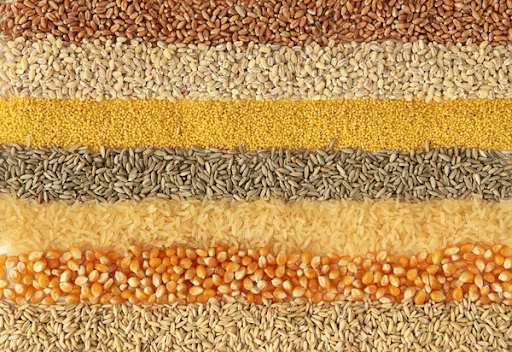
Cereals
Cultivation of Cereals
Planting
- Warm-season cereals are grown in tropical lowlands all year and in temperate climates during the frost-free season.
- Rice is typically grown in flooded fields, though some strains are grown on dry land. Other warm-climate cereals, such as sorghum, are adapted to arid conditions.
- Cool-season cereals thrive in temperate climates. The majority of a species' varieties are either winter or spring varieties.
- Winter varieties are sown in the autumn, germinate and grow vegetatively, and then go dormant during the winter.
- They begin to grow again in the spring and reach maturity in the late spring or early summer.
- This cultivation system conserves water and frees up land for another crop early in the growing season.
- Winter varieties do not flower until the spring because they require vernalization, or exposure to low temperatures for a genetically determined period of time.
- Farmers grow spring varieties where winters are too warm for vernalization or where the crop's hardiness (which varies by species and variety) is exceeded.
- Spring cereals are planted in early spring and mature later that summer, without vernalization. Spring cereals typically require more irrigation and yield less than winter cereals.
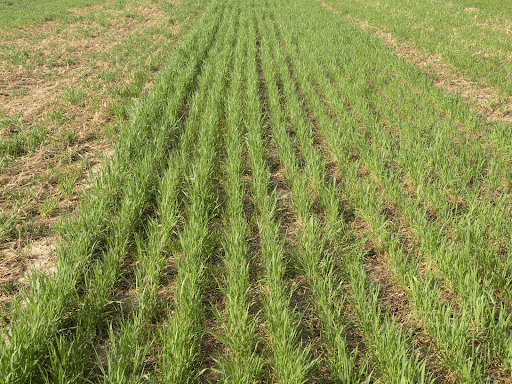
Cereal planting
Harvesting
- The cereal plants' life cycle is complete once they have produced seeds.
- Plants die, turning brown and dry. Harvesting can begin as soon as the parent plants and seed kernels are reasonably dry.
- Cereal crops are universally machine-harvested in developed countries, typically using a combine harvester, which cuts, threshes, and winds the grain in a single pass across the field.
- Harvesting methods in developing countries range from combines to hand tools like the scythe or grain cradle, depending on labour costs.
- If a crop is harvested in humid conditions, the grain may not dry sufficiently in the field to prevent spoilage during storage.
- In this case, the grain is transported to a dehydrating facility where it is dried using artificial heat.
- Farmers in North America commonly deliver newly harvested grain to a grain elevator, which is a large storage facility that consolidates the crops of many farmers.
- The farmer has the option of selling the grain at the time of delivery or keeping ownership of a share of the grain in the pool for future sale.
- Small grain pests, rodents, and birds should be kept out of storage areas.
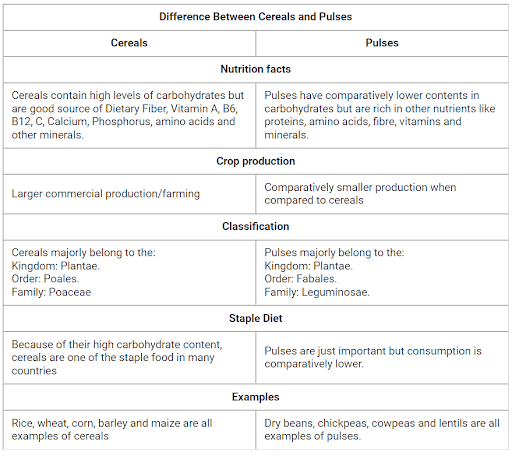
Difference between Cereals and Pulses
Cereals Production in India
- Cereals account for approximately 54% of total production in India.
- In terms of cereal production, India ranks third in the world, accounting for approximately 11% of total global production. In India, cereals are divided into coarse grains and fine grains.
Rice
- Rice is grown in areas with high humidity.
- It is best suited to deep clayey and loamy soil. This crop requires 150-300 cm of rain per year.
- West Bengal, Punjab, Uttar Pradesh, Andhra Pradesh, and Bihar are the top rice-producing states.
- Rice is the most common food consumed by the majority of Indians. India is the world's second-largest producer.
Wheat
- It is sown in temperatures ranging from 10 to 26 degrees Celsius. This crop requires 75-100 cm of rainfall.
- Wheat production thrives in fertile loamy and clayey soil with high fertility.
- The top wheat-producing states are Uttar Pradesh, Punjab, Madhya Pradesh, Rajasthan, and Haryana.
Maize
- This crop requires old alluvial soils from Karnataka, Maharashtra, Tamil Nadu, Telangana, and Madhya Pradesh.
- Maize thrives in temperatures ranging from 21 to 27 degrees. In terms of maize production, India ranks seventh worldwide.
Pulses
- Pulses are grown in sand and loamy soil with 25-60 cm of rainfall. India is the world's largest pulse producer.
- It is the primary protein source for Indian consumers.
- This crop yields a high-quality product, and India is a leading producer of it.
- Madhya Pradesh, Maharashtra, Uttar Pradesh, Rajasthan, and Andhra Pradesh were the largest contributors to this production.
Benefits of Cereals
- Greater flexibility and colonization success in all habitats.
- The ease with which it can be grown.
- Tillering produces more branches, resulting in a better yield per unit area.
- Because grains are compact and dry, they may be readily handled, transported, and stored without spoiling.
- Energy-giving food with high caloric content.
- Cereals include carbs, proteins, fiber, as well as a variety of vitamins and minerals.
Cereal Exports of India
- India is the world's largest producer and exporter of cereal products.
- Wheat, paddy, sorghum, millet (Bajra), barley, and maize are the major cereals.
- Previously, in 2008, India prohibited the export of rice, wheat, and other grains to meet domestic demand.
- Due to high demand in the global market and the country's surplus production, India permitted only limited amounts of the commodity to be exported.
- Rice (including Basmati and Non Basmati) accounts for 95.7% of India's total cereals exports in 2019-20. Other cereals, including wheat, account for only 4.3% of total cereal exports from India in 2019-20.
- Wheat's top export destinations for 2019-20 are Nepal, Bangladesh, the United Arab Emirates, and Somalia.
- Nepal, Benin, the United Arab Emirates, and Somalia are the top non-Basmati rice export destinations for 2019-20.
- Iran, Saudi Arabia, Iraq, and the United Arab Emirates are the top Basmati rice export destinations for 2019-20.
Conclusion
Cereals are the Gramineae grass family's edible seeds or grains. Rye, oats, barley, maize, triticale, millet, and sorghum are among the cereals farmed in many nations. Cereals are often regarded as nutritious staple foods in both industrialized and developing countries. Grains, often known as cereals, are the world's most essential staple food. It is believed to give 48% of human calories, or dietary energy. Grains are also used to feed cattle and to manufacture some cooking oils, fuels, cosmetics, and alcoholic beverages.
FAQs
Question: What are the major cereals grown in India?
Answer: The major cereals grown in India are rice, wheat, maize, barley, and millets. Rice is the staple food of the majority of the population, especially in the southern and eastern regions. Wheat is widely grown in the northern and central regions. Maize, barley, and millets are also cultivated in various regions but have a lesser contribution compared to rice and wheat.
Question: What is the significance of cereals in the Indian economy?
Answer: Cereals are a staple food in India and play a crucial role in the economy. They are the primary source of food and nutrition for the majority of the population. The production of cereals also contributes significantly to India's agricultural GDP, providing employment to millions, especially in rural areas. Cereals like rice and wheat are key commodities in both domestic markets and international trade.
Question: How does the climatic condition affect cereal production in India?
Answer: The production of cereals in India is highly influenced by climatic conditions. Rice, for example, requires a humid and warm climate with abundant rainfall, which is why it is primarily grown in the coastal and tropical regions. Wheat, on the other hand, requires a temperate climate with a cool winter and moderate rainfall. Millets and maize are more drought-resistant and are often cultivated in arid and semi-arid regions. The monsoon's irregularities and changing climatic conditions significantly affect cereal yields.
Question: What are the challenges in cereal cultivation in India?
Answer: Cereal cultivation in India faces several challenges including climate change, water scarcity, pest attacks, and land degradation. The over-reliance on traditional irrigation methods, coupled with a growing population, puts pressure on water resources. The overuse of chemical fertilizers and pesticides has also led to soil degradation, which in turn affects cereal production. The changing monsoon patterns and erratic weather conditions further complicate these challenges.
Question: How is modern technology being used to improve cereal production in India?
Answer: Modern technology, including precision farming, genetically modified seeds, and improved irrigation techniques, is helping improve cereal production in India. The introduction of drought-resistant and high-yielding varieties of cereals has increased productivity. Use of soil moisture sensors and weather forecasting tools aids farmers in better planning for sowing and harvesting. Additionally, advancements in mechanization have reduced labor costs and increased efficiency in cereal farming.
MCQs
1. Which of the following is the most widely grown cereal in India?
A) Wheat
B) Rice
C) Barley
D) Maize
Answer: (B) See the Explanation
Explanation: Rice is the most widely grown cereal in India, primarily in the eastern, southern, and coastal regions due to the warm and humid climate it requires.
2. What climatic condition is required for growing wheat in India?
A) Tropical climate with high humidity
B) Cool climate with moderate rainfall
C) Warm climate with abundant rainfall
D) Arid and dry conditions
Answer: (B) See the Explanation
Explanation: Wheat requires a temperate climate with cool winters and moderate rainfall, which is why it is mostly grown in the northern and central parts of India.
3. Which of the following cereals is grown mainly in arid and semi-arid regions of India?
A) Rice
B) Maize
C) Wheat
D) Millets
Answer: (D) See the Explanation
Explanation: Millets are drought-resistant and are often cultivated in arid and semi-arid regions of India, where water availability is limited.
4. Which state in India is the largest producer of rice?
A) Uttar Pradesh
B) Punjab
C) West Bengal
D) Odisha
Answer: (C) See the Explanation
Explanation: West Bengal is the largest producer of rice in India, primarily because of its favorable climate and extensive irrigation systems.
5. Which technology is being used in India to improve cereal production?
A) Solar irrigation
B) Precision farming
C) Crop rotation
D) Crop diversification
Answer: (B) See the Explanation
Explanation: Precision farming is being widely used in India to optimize inputs such as water, fertilizers, and pesticides, thus improving cereal production efficiency and sustainability.
GS Mains Questions and Model Answers
Q1: Discuss the challenges of cereal production in India and suggest possible solutions.
Answer: Cereal production in India faces multiple challenges, including water scarcity, pest outbreaks, soil degradation, and changing climatic conditions. The overuse of chemical fertilizers and water-intensive crops like rice has led to a depletion of soil fertility and water resources. Climate change further exacerbates these challenges with erratic monsoon patterns and extreme weather events. Solutions include promoting sustainable farming practices, such as organic farming and crop diversification, increasing water-use efficiency through drip irrigation, and utilizing climate-resilient crop varieties to mitigate climate impacts.
Q2: Analyze the role of cereals in India's agricultural economy and its contribution to food security.
Answer: Cereals form the backbone of India’s agricultural economy, providing the primary source of food and nutrition for the population. Rice and wheat are staples, contributing to both domestic consumption and exports. Cereal production ensures food security by feeding millions and providing livelihoods to farmers. The government’s procurement policies, such as the Minimum Support Price (MSP), also contribute to food security by stabilizing prices and encouraging production. However, achieving food security requires addressing issues like underproduction in certain regions and the rising demand due to population growth.
Q3: How can modern agricultural technologies improve cereal yields in India?
Answer: Modern agricultural technologies such as precision farming, genetically modified crops, and satellite-based weather forecasting can significantly improve cereal yields in India. Precision farming optimizes input use, reducing waste and enhancing productivity. Genetically modified crops, like drought-resistant varieties, can help mitigate the adverse effects of climate change. Additionally, the use of remote sensing technologies and weather forecasting tools helps farmers make informed decisions about sowing and harvesting, ultimately improving yield and reducing crop failure.
Previous Year Questions on Cereal Production
1. UPSC CSE Prelims 2020:
Question: Which of the following cereals is considered the staple food of the majority of India’s population?
A) Barley
B) Rice
C) Maize
D) Oats
Answer: (B)
Explanation: Rice is considered the staple food for a majority of India’s population, especially in southern, eastern, and coastal regions.
2. UPSC CSE Mains 2018 (GS Paper 1):
Question: "Discuss the impact of climate change on the cereal production in India and suggest measures to mitigate its effects."
Answer: Climate change has significantly affected cereal production in India by causing irregular rainfall, droughts, and unpredictable weather patterns. Crops like rice, which depend on a stable monsoon, are particularly vulnerable. To mitigate these effects, India can adopt drought-resistant crop varieties, promote water-efficient irrigation systems like drip irrigation, and shift to climate-resilient farming techniques such as agroforestry and rainwater harvesting to safeguard against water scarcity and weather unpredictability.
Download the PREPP App and attempt FREE IAS Exam Mock Tests and get complete study material!

Full Test - 04: UPSC CSE Prelims CSAT (Paper-II)
Full Test - 03: UPSC CSE Prelims CSAT (Paper-II)
UPSC CSE Prelims 2026 CSAT Paper 2 Question Paper (24-May-2026)
UPSC CSE Prelims 2026 GS Paper 1 Question Paper (24-May-2026)

17 February 2025 | The Hindu Must Read Articles | Current Affairs

16 February 2026 | The Hindu Must Read Articles | Current Affairs

13 February 2026 | The Hindu Must Read Articles | Current Affairs









Comments