India’s Great Grain Mystery: Cereal Gap
Relevance: GS3 - Major crops-cropping patterns in various parts of the country, Issues related to direct and indirect farm subsidies and minimum support prices; Public Distribution System GS2 - Issues relating to poverty and hunger.
(Source: Indian Express, 01/09/2024)
Click here for Daily Current Affairs
Why in the news?
- According to the official Foodgrains Bulletin, cereal production in India reached 304 million tonnes in 2022-23.
- However, aggregate household consumption of cereals by India’s 140 crore population is less than 200 million tonnes, indicating a huge gap between production and consumption of cereals.
- This article also discusses the need to implement measures to ensure demand and for alternate measures like crop diversification.
Table of Contents
What is the cereal gap?
- The cereal gap refers to the disparity between production and consumption of cereals (rice and wheat) in India.
- Production: As per the Foodgrain Bulletin, production of cereals rose to 304 million tonnes in 2022-23 (exceeding 300 million tonnes for the first time).
- The average production for 2020-21 to 2022-23 was around 292 million tonnes.
- Consumption: Aggregate household consumption of cereals by the Indian population was estimated to be less than 180-200 million tonnes.
- Per capita cereal consumption (PCCC) of Indian households was 11.6 kg/month - India Human Development Survey (IHDS-2) and 10.7 kg/month - National Sample Survey.
- In 2011-12, these values were 11.8 kg and 11.6 kg per month respectively.
Has the PCCC been declining?
- According to experts, the PCCC has been declining steadily since the late 1970s.
- As per NSS data, monthly PCCC declined from 15.3 kg (1977-78) to 11.3 kg in 2011-12 in rural areas.
- However, survey data on cereal consumption beyond 2011-12 at the national level is not available.
- According to a state-level report for Maharashtra, PCCC in the state continued to decline between 2011-12 and 2017-18.
Factors
- Poverty: The decline in the PCCC is generally attributed to the rise in poverty.
- However, this is considered to be a misunderstanding for the following reasons.
- There is clear evidence of slow and steady poverty decline in India from the 1970s until 2011-12.
- The decline in PCCC was mainly among the better-off sections of society, who were not affected by poverty.
- Other factors: Experts claim that the decline in PCCC was driven by urbanization, rising education levels, diversification of food intake, and poor physical activity.
- Increased industrial use of cereals, for products like beer and biscuits could be a reason for them not being properly accounted for in consumption estimates.
- Cereal exports have reached record levels in recent years (23 million tonnes in 2020-21 and 32 million tonnes in 2021-22).
How was the cereal gap accounted for?
- In the Government of India’s annual Economic Survey, the calculation of net production from gross production involves the deduction of 12.5% for seed, feed, and wastage (SFW).
- “Net availability” is then calculated by adding net imports and deducting changes in public stocks.
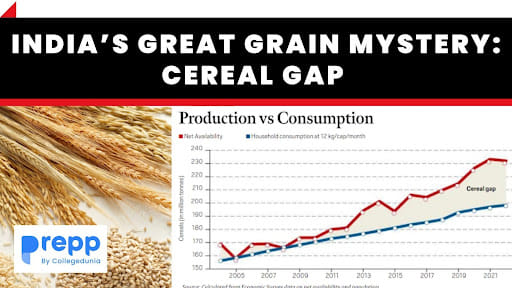
- While net availability per capita more or less matched the IHDS and NSS consumption estimates in 2004-05 and 2011-12, a large gap has emerged between net availability and household consumption in recent years.
- If 12 kg is assumed to be the upper bound for monthly PCCC from 2011-12 onwards, and this is combined with population estimates, a gap is evident in net availability and household consumption in the last 12 years.
- 36 million tonnes (2020-2021) and 33 million tonnes (2021-2022) respectively.
- However, if the 12 kg assumption was replaced with the 10.7 kg (as per NSS estimate), then the cereal gap was more than 50 million tonnes since 2019-20. T
Challenges
- Insufficient data: The lack of official data on the consumption of cereals makes it harder for stakeholders to assess and counter the disparity between consumption and production of cereals.
- Inaccurate calculation: Over the last few years, the SFW allowance in the Economic Survey has dropped from 12.5% to 10%, when it should have been increased.
- Traditional calculation: Seed (5%), feed (5%), and wastage (2.5%).
- According to experts, the feed allowance must be increased from 5% to 10% of gross production which would help reduce the cereal gap by 15 million tonnes or so.
Implications
- Price stability: The gap between demand and availability could impact the prices of these commodities in the market.
- Household expenses: The gap could affect household expenses as a large portion of it is spent on food.
- If people transition to other food products from cereals, the higher prices could affect household expenses.
- Nutrition: Cereals and grains form a significant part of the diet of a common Indian.
- The cereal gap could lead to poor nutrition and subsequently health concerns affecting productivity and public welfare.
- Policy dilemma: The government will have to develop a delicate balance between supporting production (farmers' incomes) and consumption (prices) as the surplus availability could be an indicator of overinvestment.
Way forward
- Cereal production has grown by nearly 3% every year over the last 10 years. It may be necessary to diversify agricultural production from traditional crops like rice and wheat.
- Cereals are not traded in a competitive market that clears through price adjustment, so market reforms are necessary.
- Since there is a clear policy to ensure remunerative prices for Indian farmers, policies should be implemented to ensure demand at appropriate prices.
Conclusion
India's cereal gap highlights a significant disparity between production and consumption, necessitating urgent measures for accurate data collection and policy adjustments. Addressing challenges such as insufficient data, inaccurate calculations, and the need for crop diversification is crucial to ensure food security, poverty reduction, and effective agricultural policies.
To learn more about cereals, click the link.
(*Click this link to read prelims specific weekly current affairs articles)
FAQs
Question: What are cereals?
Answer:
Cereals are any grass grown for the edible components of its grain which consists of the endosperm, germ, and bran. India is the world's second-largest producer of rice, wheat, and other cereals.
Question: What is urbanization?
Answer:
Urbanization refers to the population shift from rural to urban areas, the corresponding decrease in the proportion of people living in rural areas, and how societies adapt to this change.
UPSC Mains Practice Question:
|
MCQs
Question: Consider the following statements [2020-I]
- In the case of all cereals, pulses and oil seeds, the procurement at Minimum Support Price (MSP) is unlimited in any State/UT of India.
- In the case of cereals and pulses, the MSP is fixed in any State/UT at a level to which the market price will never rise.
Which of the statements given above is/are correct?
(a) 1 only
(b) 2 only
(c) Both 1 and 2
(d) Neither 1 nor 2
Answer: (d) See the Explanation
- The procurement of commodities at MSP is not unlimited in any State/UT of India.
- The government of India sets MSP for various crops every year, and the procurement is done up to a certain limit based on the production in that particular year.
- This limit is set by the government and varies from year to year. Moreover, the procurement is done only for the crops that are covered under the MSP regime. Hence statement 1 is incorrect.
- The MSP is not fixed at a level to which the market price will never rise.
- The MSP is fixed based on the cost of production, demand and supply, and other factors.
- The MSP is not a fixed price, and it is revised every year based on the prevailing market conditions.
- The market price of the crops can go higher than the MSP if the demand is high, and the supply is low. Hence statement 2 is incorrect.
Therefore, option (d) is the correct answer.
Question: India has experienced persistent and high food inflation in the recent past. What could be the reasons? (2011)
- Due to a gradual switchover to the cultivation of commercial crops, the area under the cultivation of food grains has steadily decreased in the last five years by about 30%.
- As a consequence of increasing incomes, the consumption patterns of the people have undergone a significant change.
- The food supply chain has structural constraints.
Which of the statements given above are correct?
(a) 1 and 2 only
(b) 2 and 3 only
(c) 1 and 3 only
(d) 1 2 and 3
Answer: (d) See the Explanation
- Food inflation refers to the increase in the price of food items over a period of time.
- There are several reasons for persistent food inflation in India.
- Decrease in the cultivation of food grains has resulted in a decrease in the supply of food grains, which in turn has led to an increase in their prices. Hence statement 1 is correct.
- Increasing incomes have led to changes in consumption patterns, with people opting for more expensive and diverse food items, contributing to the rise in food inflation. Hence statement 2 is correct.
- Structural constraints in the food supply chain such as inadequate storage facilities, inefficient transportation, and lack of proper distribution networks lead to wastage of food items, delays in reaching the market, and increased costs.
- This contributes to an increase in the prices of food items. Hence statement 3 is correct.
Therefore, option (d) is the correct answer.
Download the PREPP App and attempt FREE IAS Exam Mock Tests and get complete study material!

Full Test - 04: UPSC CSE Prelims CSAT (Paper-II)
Full Test - 03: UPSC CSE Prelims CSAT (Paper-II)
UPSC CSE Prelims 2026 CSAT Paper 2 Question Paper (24-May-2026)
UPSC CSE Prelims 2026 GS Paper 1 Question Paper (24-May-2026)

17 February 2025 | The Hindu Must Read Articles | Current Affairs

16 February 2026 | The Hindu Must Read Articles | Current Affairs

13 February 2026 | The Hindu Must Read Articles | Current Affairs









Comments