Sugar Crops - Agriculture Notes
Sugar Crops are those that are grown primarily for the production of sugar and, secondarily, for the production of alcohol (food and nonfood) and ethanol. Sugar beets and sugarcane are the two main sugar crops. Both crops are the primary sources of sucrose for human consumption; approximately 80% is obtained from sugarcane, which is primarily grown in tropical and subtropical countries, and the remaining 20% is obtained from sugar beet, which is primarily grown in northern hemisphere countries with moderate climates. Sugar cane, sugar beet, and sugar sorghum are the most common sugar crops. In this article, we will discuss Sugar Crops which will be helpful for UPSC exam preparation.
|
Table of Contents |
About Sugar
- Sugar and sugarcane both originated in India.
- After cotton, sugar is India's second largest agro-based industry.
- After Brazil, India is the world's second-largest producer of sugar.
- The annual output of the Indian sugar industry is currently worth approximately Rs.80,000 crores.
- India is not only self-sufficient in sugar production and meeting its sugar demands, but it also produces a surplus that is exported, contributing to India's economic growth.
- The sugar industry in India is dominated by both the public and private sectors.
- Sugar production employs a large portion of India's rural population, making it a major employment sector in rural India.
- Sugarcane is used in a variety of industries, ranging from the production of sugar to the production of ethanol, paper, and electricity.
- Various byproducts of the sugar industry support numerous supplementary industries that help the Indian economy grow.
|
|
|
|---|---|
| Cereals | Cotton |
| Millets | Stem Fibres |
| Grain Legumes | Narcotics |
| Spices and Condiments | Forage Crops |
| Starch Crops | Grasses |
| Fibre Crops | Plantation Crops |
Common sugar crops
Sugarcane
- Sugarcane is a species of tall, perennial grass (in the genus Saccharum, tribe Andropogoneae) used for sugar production.
- The plants grow to be 2-6 m (6-20 ft) tall, with stout, jointed, fibrous stalks rich in sucrose that accumulates in the stalk internodes.
- Sugarcanes are a member of the grass family Poaceae, which also includes maize, wheat, rice, and sorghum, as well as many forage crops.
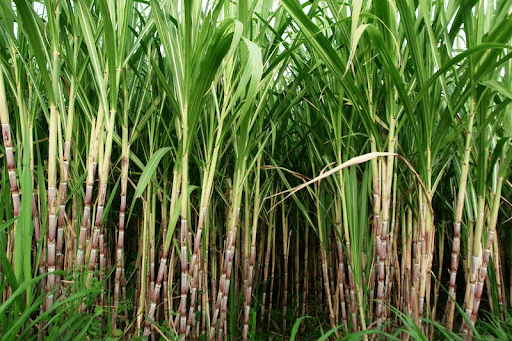
Sugarcane
Sugar beet
- A sugar beet is a plant with a high concentration of sucrose in its root that is grown commercially for sugar production.
- It is known in plant breeding as the Altissima cultivar group of common beets (Beta vulgaris).
- It belongs to the subspecies Beta vulgaris subsp. vulgaris, along with other beet cultivars such as beetroot and chard. The sea beet is its closest wild relative.
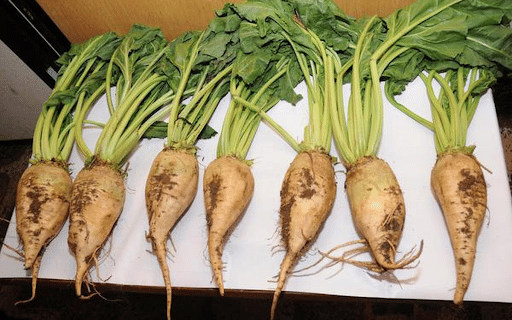
Sugar beet
Sweet sorghum
- Sweet sorghum refers to any of the many varieties of sorghum grass with high sugar content stalks.
- Sweet sorghum grows best in drier, warmer climates than many other crops and is primarily grown for forage, silage, and syrup production.
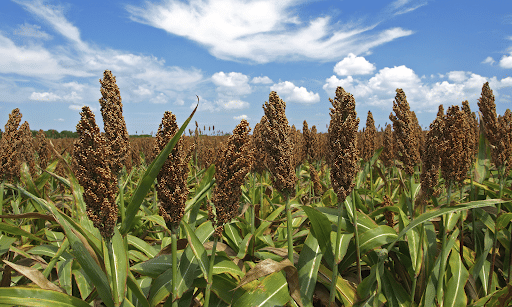
Sweet sorghum
Geographical distribution
- Sugarcane is grown throughout India, with the exception of cold hilly areas such as Kashmir, Himachal Pradesh, and Arunachal Pradesh.
- However, sugarcane is primarily grown in two distinct agro-climatic zones in India. These are India's tropical and subtropical zones.
- The tropical sugarcane-producing region includes Maharashtra, Andhra Pradesh, Tamil Nadu, Karnataka, Gujarat, Madhya Pradesh, Goa, Pondicherry, and Kerala.
- This region accounts for approximately 45% of India's total sugarcane producing area and produces 55% of total sugarcane production.
- Maharashtra is the region's leading producer of sugarcane.
- The subtropical sugarcane-producing region includes states such as Uttar Pradesh, Bihar, Haryana, and Punjab.
- The subtropical region accounts for 45% of total sugarcane production and 55% of total sugarcane producing area.
- Uttar Pradesh (UP) is the region's leading sugar producer.
Sugar Production - Significance
- By reducing oil imports and blending ethanol with gasoline as part of the Ethanol Blended with Petrol initiative, the government hopes to lower its import bill for crude oil.
- Currently, imports provide 85% of India's crude oil needs.
- Additionally, the government is encouraging sugar mills to divert excess sugarcane to ethanol that is blended with gasoline in order to reduce pollution and make India Atma Nirbhar in the petroleum sector.
- This blend not only serves as a green fuel but also helps to save money on foreign exchange due to the import of crude oil.
- About 35 LMT of sugar is anticipated to be diverted during the current sugar season (2021–2022), and by 2025–2026, more than 60 LMT of sugar is intended to be diverted to ethanol, which would address the issue of excess sugarcane as well as delayed payment because farmers would receive timely payments.
- The government has set a goal of 10% fuel grade ethanol mix with gasoline by 2022 and 20% blend by 2025.
Sugar industry challenges
- Low productivity per unit area
- In comparison to major sugar-producing regions around the world, India's sugarcane yield per hectare is extremely low.
- This results in low overall production and a scarcity of sugarcane for sugar mills.
- Short crushing season
- Sugar production in India is a seasonal phenomenon, with a crushing period ranging from 4 to 7 months per year. During this time, the mills and workers continue to operate.
- However, they remain idle for the remainder of the time.
- Variable production trends
- Sugarcane cultivation in India must compete with the cultivation of other food and cash crops. As a result, there is a scarcity of land suitable for sugarcane cultivation.
- Overall sugarcane production eventually fluctuates and does not remain constant.
- High manufacturing costs
- Several factors contribute to the high cost of sugar production, including inefficient technology, an uneconomic manufacturing process, and a high excise duty.
- As a result, India's sugar production costs more than other sugar-producing countries.
- Small and inefficient mills with old and obsolete machinery make large-scale production uneconomic.
- Certain government policies, such as minimum distance criteria between mills, Cane Area Reservation, dual cane pricing by the Centre and States, levying sugar obligations on mills, the regulated release mechanism, export and import regulations, and mandatory packaging of sugar in jute bags, pose significant challenges to this sector in India.
- Other issues include low rates of return, regional imbalances in distribution, low per capita consumption, and so on.
Difference Between Northern and Peninsular India's Sugar Industry
- The sugar industry is shifting from north India to peninsular India as a result of better conditions in peninsular India.
- Peninsular India has a tropical climate, which results in a higher yield per unit area than north India.
- The sucrose content of tropical sugarcane varieties grown in the south is also higher.
- The crushing season is also much longer in the south than in the north. Crushing season, for example, lasts nearly four months in the north from November to February, whereas it lasts nearly 7-8 months in the south, beginning in October and lasting until May and June.
- The cooperative sugar mills are better managed in the south than in the north.
- The majority of mills in the south are new and equipped with modern machinery.
Conclusion
The sugar industry is the country's second most important agro-based business. A high level of government support has ensured that India will retain this position for a long time. Although many countries consider it a violation of WTO obligations, given India's population needs, the sugar industry must receive the necessary government support at various levels. In addition, adopting appropriate capital-intensive techniques, making suitable seeds, fertilizers, and pesticides available, educating farmers on recent cultivation and farm management techniques, adopting technology in sugar production, and reforming government policies may help in the long run.
FAQs
Question: What are sugar crops and why are they important?
Answer: Sugar crops, such as sugarcane and sugar beet, are plants cultivated for their sugar content. They are crucial for the production of sugar, a key agricultural commodity used in various industries, including food processing, pharmaceuticals, and bioenergy. They are also economically significant for many countries and provide livelihoods to millions of farmers.
Question: What are the major sugar crops grown in India?
Answer: The major sugar crops in India are sugarcane and sugar beet. Sugarcane is the predominant crop, grown in states like Uttar Pradesh, Maharashtra, and Karnataka. While sugar beet is grown in cooler regions, sugarcane remains the main source of sugar production in India.
Question: How does climate affect sugar crop production?
Answer: Climate plays a significant role in the cultivation of sugar crops. Sugarcane requires a tropical or subtropical climate with abundant sunlight and rainfall, while sugar beet thrives in cooler climates. Extreme temperatures, drought, or excessive rainfall can negatively impact yields, highlighting the importance of climate-sensitive farming practices.
Question: What are the major challenges faced by sugar crop farmers in India?
Answer: Major challenges include water scarcity, inadequate irrigation facilities, fluctuating sugar prices, pest and disease outbreaks, and dependence on monsoon rainfall. The increasing cost of cultivation and lack of modern farming techniques also pose significant hurdles for sugarcane farmers in India.
Question: How can the government support sugar crop farmers?
Answer: The government can support sugar crop farmers through subsidies on fertilizers, irrigation systems, and seeds, as well as by offering better price support through Minimum Support Prices (MSP). Investments in modern farming technologies, water management, and providing loans at lower interest rates can also benefit farmers.
MCQs
1. Which of the following is the main sugar crop grown in India?
A. Sugar beet
B. Sugarcane
C. Corn
D. Wheat
Answer: (B) See the Explanation
India predominantly grows sugarcane, which accounts for the majority of sugar production. While sugar beet is grown in some cooler regions, sugarcane is the principal sugar crop cultivated in India due to its adaptability to tropical and subtropical climates.
2. What is the primary environmental factor affecting sugarcane production?
A. Temperature
B. Soil acidity
C. Wind speed
D. Soil texture
Answer: (A) See the Explanation
Temperature is the primary environmental factor influencing sugarcane production. Sugarcane thrives in tropical and subtropical climates, requiring high temperatures and abundant sunlight for optimal growth. Extremely low temperatures or frost can damage crops and reduce yields.
3. Which of the following states in India is the largest producer of sugarcane?
A. Maharashtra
B. Punjab
C. Uttar Pradesh
D. Karnataka
Answer: (C) See the Explanation
Uttar Pradesh is the largest producer of sugarcane in India. It is followed by Maharashtra and Karnataka, which also have large sugarcane production areas, but Uttar Pradesh leads the country in both area under cultivation and total sugarcane output.
4. What is the role of irrigation in sugarcane cultivation?
A. It reduces water wastage
B. It improves soil texture
C. It ensures adequate water supply for optimal growth
D. It decreases crop yield
Answer: (C) See the Explanation
Irrigation plays a crucial role in sugarcane cultivation as the crop requires a steady supply of water. Proper irrigation ensures that sugarcane gets the necessary water for optimal growth, especially in regions with irregular rainfall or during dry spells.
5. What is a significant challenge faced by sugarcane farmers in India?
A. High sugar prices
B. Water scarcity
C. Low crop yields
D. Excessive rainfall
Answer: (B) See the Explanation
Water scarcity is a significant challenge for sugarcane farmers in India. The crop requires large amounts of water, and inadequate irrigation facilities combined with irregular rainfall can lead to reduced yields and increased production costs.
GS Mains Questions and Model Answers
1. Discuss the importance of sugarcane cultivation in the Indian economy.
Answer: Sugarcane cultivation is vital to the Indian economy as it is one of the major agricultural products, contributing to the livelihood of millions of farmers. India is the second-largest producer of sugarcane globally. It supports various industries, including sugar production, ethanol production, and biofuel production. Additionally, sugarcane cultivation is a significant source of employment, especially in rural areas. The government provides various subsidies and minimum support prices to ensure that sugarcane farmers are supported. The industry also plays an important role in rural development through ancillary businesses like sugar mills, ethanol plants, and distilleries.
2. What are the environmental concerns associated with sugarcane farming in India, and how can they be addressed?
Answer: Sugarcane farming in India is associated with several environmental concerns, including high water usage, soil degradation, and pesticide use. The crop requires vast amounts of water, often exacerbating the issue of water scarcity in regions already suffering from drought. Additionally, excessive use of fertilizers and pesticides contributes to soil degradation and water contamination. To address these concerns, sustainable farming practices, such as drip irrigation, organic farming, and integrated pest management, can be promoted. The adoption of water-efficient irrigation techniques and crop diversification can also help reduce environmental impact.
3. Analyze the challenges and opportunities in the Indian sugar industry and suggest policy interventions to improve the sector.
Answer: The Indian sugar industry faces several challenges, including fluctuating sugar prices, water scarcity, and inefficient milling processes. Moreover, the sector is heavily dependent on seasonal factors like rainfall, which can disrupt production. However, the industry also offers opportunities, such as the potential for ethanol production and export. To improve the sector, policy interventions should include better water management systems, subsidies for modern irrigation infrastructure, and financial support for research into drought-resistant sugarcane varieties. Additionally, promoting the use of biofuels and facilitating market reforms for fair price support can boost the sugar industry’s overall growth and sustainability.
Previous Year Questions on Sugar Crops
UPSC CSE Prelims 2019
Question: What is the main factor responsible for the high water consumption in sugarcane cultivation?
A. Fertilizer use
B. Soil type
C. Crop cycle duration
D. Irrigation practices
Answer: D
Explanation: The high water consumption in sugarcane cultivation is primarily due to the crop’s long growing season and the substantial water required for its growth. Additionally, inefficient irrigation practices exacerbate water wastage, leading to increased water consumption.
Download the PREPP App and attempt FREE IAS Exam Mock Tests and get complete study material!

Full Test - 04: UPSC CSE Prelims CSAT (Paper-II)
Full Test - 03: UPSC CSE Prelims CSAT (Paper-II)
UPSC CSE Prelims 2026 GS Paper 1 Question Paper (24-May-2026)
UPSC CSE Prelims 2026 CSAT Paper 2 Question Paper (24-May-2026)

17 February 2025 | The Hindu Must Read Articles | Current Affairs

16 February 2026 | The Hindu Must Read Articles | Current Affairs

13 February 2026 | The Hindu Must Read Articles | Current Affairs









Comments