Plantation Crops - Agriculture Notes
Plantation crops refer to crops that are grown on a large scale in a contiguous area and are owned and managed by an individual or a company. Tea, coffee, rubber, cocoa, coconut, arecanut, oil palm, palmyrah, and cashew are among the crops grown. These are high-value commercial crops with greater economic importance, and they play an important role in improving the Indian economy, particularly in terms of export potential, job creation, and poverty alleviation, particularly in the rural sector. The Ministry of Agriculture is in charge of coconut, cashewnut, cocoa, arecanut, oil palm, and palmyrah, while the Ministry of Commerce is in charge of tea, coffee, and rubber. In this article, we will discuss Plantation Crops which will be helpful for UPSC exam preparation.
|
Table of Contents |
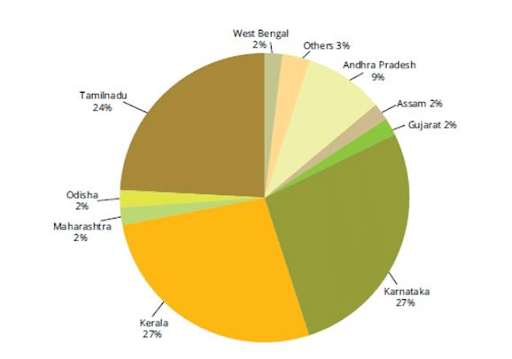
Leading Plantation Crops Producing States
What is a Plantation Crop?
- A plantation is a large farm or estate, usually in a tropical or subtropical country, where crops that are not consumed for food are grown for sale in distant markets rather than for local consumption.
- Cotton, coffee, tobacco, sugar cane, sisal, and a variety of oil seeds and rubber trees are examples of such crops.
- Plantations are not usually used to describe farms that grow alfalfa, Lespedeza, clover, and other forage crops.
- The term "plantation" has traditionally referred to the planting of trees for lumber rather than large orchards.
- A plantation is always a monoculture over a large area and does not include extensive naturally occurring stands of economically valuable plants.
|
|
|
|---|---|
| Cereals | Spices and Condiments |
| Millets | Cotton |
| Grain Legumes | Stem Fibres |
| Sugar Crops | Narcotics |
| Starch Crops | Forage Crops |
| Fibre Crops | Grasses |
Characteristics of Plantation Crops
- They are grown in large, continuous fields.
- These crops have a high market demand and good prices.
- They are also known as cash crops.
- They are perennial in nature.
- Only after processing are these crops consumed.
- These crops provide a high return on investment (ROI).
- They contribute to the national economy.
Major Plantation Crops
Tea
- Temperature: 20-30°C
- Rainfall: 150-300 cm.
- Soil Type: Deep, fertile, well-drained soil rich in humus and organic matter.
- Top Tea Producing States: Assam > West Bengal > Tamil Nadu
- India is the world's second-largest producer of tea.
- The British introduced it to the eastern hill slopes of India.
- The slopes of the eastern hills have a humid climate and evenly distributed rainfall without water logging, making them ideal for tea terrace farming.
- Tea is a labour-intensive industry. It necessitates a large supply of cheap, skilled labour.
- To preserve the freshness of the tea, it is processed within the tea garden.
- Tea Development and Promotion Schemes, Wage Compensation Schemes, and Tea Boutiques are a few of the government tea schemes.
Coffee
- Temperature: 15-28°C
- Rainfall: 150-250 cm
- Soil Type: Well-drained, deep friable loamy soil.
- Top Coffee Producing States: Karnataka > Kerala > Tamil Nadu
- India is the seventh largest producer.
- Coffee was first introduced on the Baba Budan Hills after it was brought from Yemen.
- Hills with a well-defined shade canopy comprised of evergreen leguminous trees provide the ideal conditions for coffee cultivation, which is why it is primarily concentrated in hilly regions.
- The Arabica coffee variety from India is well-known throughout the world.
- The government has launched a number of Integrated Coffee Development Projects and schemes to support coffee production.
Rubber
- Temperature: above 25°C in a humid and moist climate.
- Rainfall: Over 200 cm.
- Soil type: Rich, well-drained alluvial soil.
- Kerala is the leading producer of rubber, followed by Tamil Nadu and Karnataka.
- It is an equatorial crop, but it is also grown in tropical and subtropical areas under special conditions.
- Rubber is a vital raw material in industry.
- Government-led rubber initiatives include the Rubber Plantation Development Scheme and the Rubber Group Planting Scheme.
Arecanut
- Arecanut, also known as betelnut, is a valuable cash crop in India's Western Ghats, East Coast, and North Eastern regions.
- The Areca palm is a tall stemmed erect palm that can grow to various heights depending on the environment.
- It is a tropical tree that thrives in areas with temperatures ranging from 15 to 350 degrees Celsius and annual rainfall ranging from 200 to 300 centimetres.
- Arecanut is an important part of Indian religious, social, and cultural celebrations, as well as economic life.
- Arecanut is also used in veterinary and ayurvedic medicine.
- It is a tough nut that is chewed with betel leaves.
- Its stem is used in construction, and its leaves are used for thatching.
- Although arecanut production is concentrated in a few states, the commercial product is widely distributed throughout the country.
- India is the world's largest producer and consumer of arecanut.
- Karnataka is the most important arecanut producing state, followed by Kerala and Assam.
- It is grown in Tamil Nadu, Meghalaya, West Bengal, Maharashtra, and Goa on a small scale.
Cashew
- Cashew has risen to prominence in the Indian economy. Cashew cultivation is primarily limited to peninsular India.
- Along the West Coast, major cashew producing states include Karnataka, Kerala, and Maharashtra, while on the East Coast, major cashew producing states include Odisha, Andhra Pradesh, and Tamil Nadu.
- It is also grown in Goa, Andaman and Nicobar Islands, Madhya Pradesh, Manipur, Meghalaya, Assam, and Tripura to a lesser extent.
- Cashew area, production, and productivity have increased as a result of superior clone identification, standardisation of vegetative propagation techniques, and near self sufficiency in quality planting material.
Cocoa
- Although cocoa was introduced in India in the early half of the last century, commercial cultivation began only in 1970.
- In Kerala and Karnataka, cocoa is grown as a companion crop in irrigated coconut and arecanut gardens.
- Cocoa is grown in some areas of Tamil Nadu and Andhra Pradesh as well.
Coconut
- It is a tropical crop grown in temperatures ranging from 25 to 350 degrees Celsius with fairly evenly distributed rainfall of 125 to 130 centimetres.
- India, after the Philippines and Indonesia, is the world's third largest producer of coconuts.
- The coconut palm is one of the most beautiful and useful trees in the world, and it is grown in more than 90 tropical countries.
- It provides food, drink, and shelter, as well as raw materials to a variety of industries that are inextricably linked with domestic and economic life.
- It is used to extract oil from copra.
- The tree's juice is used to make gur, sugar, toddy, and vinegar.
- All of the plant parts of this wonder palm are beneficial to humans in some way. As a result, the palm has come to be known as Kalpvriksh (Tree of heaven).
- Coconut is primarily grown along India's coastlines.
- Major coconut growing states include Kerala, Tamil Nadu, Karnataka, and Andhra Pradesh, Odisha, Maharashtra, Goa, Assam, Puducherry, Lakshadweep, and the Andaman and Nicobar Islands.
- Gujarat, Madhya Pradesh, Bihar, and the North Eastern region have also gained traction in its cultivation.
Importance of Plantation Crops
- High-value crops: They are commercial crops grown for their high-value products. They are in high demand in the market and are sold at high prices.
- International Demand: These are exported by many countries around the world. These products are in high demand on international markets.
- Industrial Importance: Plantation crops are consumed after processing. Industry performs the processing function, which allows for industrial development. For example, many tea industries are springing up to produce tea from tea leaves.
- Employment Creation: These crops require labour throughout the season. Many people will be able to find work as a result of this. In Kerela, for example, coconut farming employs 78 man days per hectare per year.
- Furthermore, the industries required for the processing of these crops provide employment for thousands of people.
- Prevents Soil Erosion: Crops grown on hillsides and slopes, such as tea, help to prevent soil erosion. They also serve as cover crops, preventing rain from washing away the soil.
Plantation Crops - Providing Gainful Employment
- Floriculture has enormous potential for generating profitable self-employment among small and marginal farmers who can act as intermediaries for floriculture products such as cut flowers, pot plants, and cut foliage, which are in high demand worldwide.
- Most plantation crops, such as tea and coffee, are labour intensive, with workers involved in planting, plucking, and other tasks until the product reaches the market.
- Indian agriculture is characterized primarily by disguised unemployment. Plantation crops such as rubber and horticulture can reduce it because more workers are required in those sectors.
- Plantation crops serve as an intermediary raw material for processed foods. For instance, tomato for ketchup. As a result, it has the potential to create jobs in those industries as well.
- Because the skills required in plantation are low, it can employ unskilled and semi-skilled labourers.
- Furthermore, the wage rate is lower compared to other agricultural allied sectors, so it remains labour intensive.
Conclusion
Plantation crops are critical to the nation and agriculture. Farming of these plants should be expanded, which will increase the country's independence and exports. Plantation agriculture is critical for an agrarian country like India, but unsustainable plantations will result in a disaster for the environment. As a result, the government should address the ills of plantations while also promoting sustainable practises in plantations while keeping the threat of global warming in mind.
FAQs
Q1: What are plantation crops?
Answer: Plantation crops are long-duration crops grown on large estates primarily for export, such as tea, coffee, rubber, and spices.
Q2: Which regions in India are known for plantation crops?
Answer: Plantation crops are mainly cultivated in the southern states, including Kerala, Tamil Nadu, Karnataka, and parts of North-Eastern India.
Q3: What are some examples of plantation crops?
Answer: Common plantation crops include tea, coffee, rubber, coconut, and spices.
Q4: What are the economic benefits of plantation crops?
Answer: Plantation crops contribute significantly to India’s export earnings and provide employment in rural areas.
Q5: How do plantation crops impact the environment?
Answer: Plantation cropping can lead to deforestation, soil erosion, and biodiversity loss if not managed sustainably.
MCQs
- Which of the following is NOT a plantation crop?
a) Tea
b) Rice
c) Coffee
d) Rubber
Answer: (B) See the Explanation
- Where are the majority of India’s tea plantations located?
a) Rajasthan
b) Tamil Nadu
c) Assam
d) Gujarat
Answer: (C) See the Explanation
- Which state is known for extensive rubber cultivation?
a) Punjab
b) Kerala
c) Maharashtra
d) Bihar
Answer: (B) See the Explanation
- What is the primary use of plantation crops?
a) Domestic consumption
b) Export and industrial use
c) Subsistence farming
d) Crop rotation
Answer: (B) See the Explanation
- Which plantation crop was historically linked to British colonialism in India?
a) Rice
b) Wheat
c) Tea
d) Maize
Answer: (C) See the Explanation
GS Mains Questions and Model Answers
Q1: Discuss the economic significance of plantation crops in India.
Answer: Plantation crops play a vital role in India’s economy by contributing to export revenue and providing rural employment. Crops like tea, coffee, rubber, and spices meet global demands and form a significant portion of India’s agricultural exports. They also support various agro-industries, fostering economic growth. However, their dependence on export markets makes them vulnerable to global price fluctuations, necessitating sustainable practices to stabilize income and preserve the environment.
Q2: Evaluate the environmental challenges posed by plantation crops and suggest sustainable practices.
Answer: Plantation crops often lead to deforestation, soil degradation, and loss of biodiversity. The monoculture nature of plantations exhausts soil nutrients, requiring chemical inputs that can harm ecosystems. To mitigate these effects, sustainable practices such as agroforestry, organic farming, and responsible water management should be adopted. Encouraging crop diversification and eco-certification can also help balance economic benefits with environmental sustainability, ensuring long-term viability.
Q3: Examine the role of the government in supporting plantation crop farmers in India.
Answer: The government aids plantation crop farmers through subsidies, research, and development programs to enhance crop productivity. The Tea Board, Coffee Board, and Rubber Board provide technical support, market information, and financial assistance. Policies promoting sustainable practices and fair wages protect both farmers and the environment. However, addressing challenges like market volatility and encouraging value addition are essential to uplift farmers economically and ensure global competitiveness.
Previous Year Questions on Plantation Crops
1. UPSC CSE Prelims 2019
Question: Which of the following crops are classified as plantation crops?
Answer: Tea, coffee, rubber, and coconut are classified as plantation crops. These crops require large estates and are primarily cultivated for export and industrial uses, unlike food crops meant for subsistence or domestic markets. Plantation crops have significant economic value in India, especially in the southern and northeastern regions, contributing to employment and foreign exchange earnings. However, they also require substantial water and labor inputs, and their monoculture can pose ecological challenges if not managed sustainably.
2. UPSC CSE Mains 2020
Question: What are the challenges faced by plantation crop farmers in India, and how can policy measures help address them?
Answer: Plantation crop farmers face issues like market volatility, climate change, and high input costs. Global price fluctuations affect income stability, especially since many plantation crops are export-oriented. Climate change impacts crop yields due to altered rainfall patterns and increased pest prevalence. Policies promoting crop insurance, sustainable practices, and subsidies for eco-friendly inputs can help mitigate these challenges. Enhanced research on crop resilience, better access to international markets, and value-added processing are essential for strengthening this sector’s future.
Download the PREPP App and attempt FREE IAS Exam Mock Tests and get complete study material!

Full Test - 04: UPSC CSE Prelims CSAT (Paper-II)
Full Test - 03: UPSC CSE Prelims CSAT (Paper-II)
UPSC CSE Prelims 2026 GS Paper 1 Question Paper (24-May-2026)
UPSC CSE Prelims 2026 CSAT Paper 2 Question Paper (24-May-2026)

17 February 2025 | The Hindu Must Read Articles | Current Affairs

16 February 2026 | The Hindu Must Read Articles | Current Affairs

13 February 2026 | The Hindu Must Read Articles | Current Affairs









Comments