Cotton - Fibre Crop - Agriculture Notes
Cotton is one of the most important cash and fibre crops in India. It also contributes significantly to the country's industrial and agricultural economies. It provides the cotton textile industry with its primary raw material, cotton fibre. Cotton provides a direct source of income for 6 million farmers in India, and the cotton trade and processing employs between 40 and 50 million people. In this article, we will discuss Cotton - Fibre Crop which will be helpful for UPSC exam preparation.
| Read update on this topic: |
|
Table of Contents |
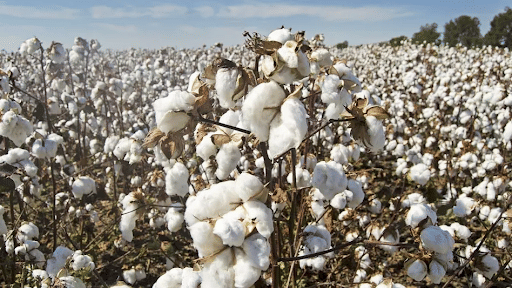
Cotton Crop
What is Cotton Crop?
- Cotton crops produce a soft, fluffy, stable fibre that is widely used in the textile industry.
- The fibre is almost entirely composed of cellulose, with only minor amounts of waxes, fats, and water.
- Cotton is a water-hungry crop that consumes approximately 6% of the irrigation water available.
- It is grown extensively in Maharashtra, Gujarat, Karnataka, Madhya Pradesh, Punjab, Rajasthan, Haryana, Tamil Nadu, and Uttar Pradesh in India.
- Gujarat is the leading cotton producer, followed by Maharashtra and Punjab.
- It is an important Kharif crop in Punjab.
|
|
|
|---|---|
| Cereals | Spices and Condiments |
| Millets | Stem Fibres |
| Grain Legumes | Narcotics |
| Sugar Crops | Forage Crops |
| Starch Crops | Grasses |
| Fibre Crops | Plantation Crops |
Cotton Cultivation
- Cotton is grown in tropical and subtropical climates. A minimum temperature of 15 degree C is required for better germination in field conditions.
- The optimum temperature for vegetative growth is 21-27 degree C, and it can tolerate temperatures up to 43 degree C, but temperatures below 21 degree C are harmful to the crop.
- Warm days and cool nights with large diurnal variations during the fruiting period promote good boll and fibre development.
- Cotton is grown on a variety of soils, ranging from well-drained deep alluvial soils in the north to black clayey soils of varying depth in the central region and black and mixed black and red soils in the south zone.
- Cotton is semi-tolerant of salinity and sensitive to water logging, so it prefers well-drained soils.
Cotton - Crop Season
- Cotton planting time varies greatly from field to field, but it is usually in April or May in northern India and later in the south (monsoon based in the southern zone).
- Cotton is a Kharif crop in most of the country, including Punjab, Haryana, Rajasthan, Uttar Pradesh, Madhya Pradesh, Gujarat, Maharashtra, and parts of Andhra Pradesh and Karnataka.
- Irrigated crops are planted from March to May, and rain-fed crops are planted in June and July, when the monsoon season begins.
- In Tamil Nadu, the majority of irrigated and rain-fed crops are planted in September and October. Rain-fed crops can be planted until November in the southern districts.
- Desi cotton is typically planted in August or September in parts of Karnataka and Andhra Pradesh.
- Cotton is sown in rice fields in Andhra Pradesh and Tamil Nadu from the middle of December to the middle of January.
- Deep ploughing is recommended once every four years to destroy perennial weeds in the central and southern zones of India, where cotton is a rainfed crop.
- Prior to the onset of pre-monsoon rains, the field is prepared by repeated harrowing with a blade harrow. In drylands, sowing is done on ridges and furrows to conserve moisture and control weeds.
- Cotton is commonly flood-irrigated, despite the fact that furrow or alternate furrow irrigation is more effective and saves water.
- Drip irrigation is becoming increasingly popular, particularly in hybrids for the central and southern zones.
- Cotton should be irrigated at 50-70% of available soil moisture. Irrigation is commonly applied to sandy loam soils in northern zone 3-5.
- 4-13 light irrigations may be performed on red sandy loam soils in Tamil Nadu with low water retention capacity.
Classification of Cotton
- Gossypium hirsutum: It is upland cotton native to Central America, Mexico, and the Caribbean.
- Gossypium barbadense: A tropical South American cotton with extra-long staples.
- Gossypium arboreum: Tree cotton native to India and Pakistan.
- Gossypium herbaceum: Levant cotton, native to southern Africa and the Arabian Peninsula.
Constraints in Cotton Cultivation
- Cotton is rainfed in nearly 65 per cent of the country, primarily in the Central and Southern states.
- Cotton crops are highly susceptible to pests and diseases.
- Cotton price volatility, insufficient market infrastructure, and cotton export policy.
Types of Cotton
Long Staple Cotton
- It has the longest fibre, ranging in length from 24 to 27 mm. The fibre is long, fine, and shiny. It is used to make fine and superior quality cloth. Notably, it earns the highest price.
- Since the American Revolution, there has been rapid progress in the production of long staple cotton.
- Long staple cotton accounts for roughly half of total cotton production in India.
- It is primarily grown in Punjab, Haryana, Maharashtra, Tamil Nadu, Madhya Pradesh, Gujarat, and Andhra Pradesh.
Medium Staple Cotton
- Cotton with a medium staple length has fibres that range in length from 20 mm to 24 mm.
- Medium staple cotton accounts for roughly 44% of total cotton production in India.
- Its main producers are Rajasthan, Punjab, Tamil Nadu, Madhya Pradesh, Uttar Pradesh, Karnataka, and Maharashtra.
Short Staple Cotton
- This is inferior cotton with fibres less than 20 mm long. It is used to make less expensive cloth.
- Short staple cotton accounts for approximately 6% of total production.
- Its primary producers are Uttar Pradesh, Andhra Pradesh, Rajasthan, Haryana, and Punjab.
Cotton Cultivation in India
In India, there are ten major cotton-growing states. They are divided into three zones:
North Zone
- Punjab
- Haryana
- Rajasthan
Central Zone
- Madhya Pradesh
- Maharashtra
- Gujarat
South Zone
- Andhra Pradesh
- Telangana
- Karnataka
- Tamil Nadu
Other states include Orissa, Uttar Pradesh, West Bengal, and Tripura.
Schemes for Cotton Development
MM-II of TMC
- During the year 2000, the Government of India launched a Centrally Sponsored Scheme of Technology Mission on Cotton (TMC).
- TMC's Mini Mission-II (MM-II) focused on cotton development, with the goal of increasing cotton production and productivity.
- From 2000-01 to 2013-14, the Department of Agriculture, Cooperation, and Farmers Welfare (DAC&FW) implemented TMC MM-II in 13 states: Andhra Pradesh, Gujarat, Haryana, Karnataka, Madhya Pradesh, Maharashtra, Orissa, Punjab, Rajasthan, Tamil Nadu, Uttar Pradesh, West Bengal, and Tripura.
- The components were funded 75:25 by the central and state governments, respectively.
- However, the Central Government bore the entire cost of some of the components implemented by ICAR/other central agencies.
- The scheme provided assistance for technology transfer through field demonstrations, training of farmers and extension workers, and the supply of critical inputs such as certified seeds, pheromone traps, bio-agents, and water-saving devices such as sprinklers and drip irrigation systems, among other things.
National Food Security Mission - Commercial Crops (Cotton) Programme
- Cotton Development Programme (NFSM-CC) is being implemented in 15 states to increase production and productivity beginning in 2014-15.
- The 15 states include Assam, Andhra Pradesh, Gujarat, Haryana, Karnataka, Madhya Pradesh, Maharashtra, Orissa, Punjab, Rajasthan, Telangana, Tamil Nadu, Tripura, Uttar Pradesh, and West Bengal,.
- The emphasis of this scheme is on technology transfer through frontline demonstrations and training in order to benefit farmers.
- NFSM is being implemented on a sharing basis between the Government of India and the states on a 60:40 basis for general category states and a 90:10 basis for North East and hilly states.
Cotton Development under Rashtriya Krishi VikasYojana (RKVY)
Under RKVY, no funds are specifically designated for cotton. However, the States can carry out cotton programmes under RKVY with the approval of the State Level Sanctioning Committee (SLSC), which is chaired by the State Chief Secretary.
Conclusion
Cotton is India's most important fibre and cash crop, and it has a significant impact on the agricultural and industrial economies. Cotton is the most common and profitable crop that is not used to make food. Its production provides a living for over 250 million people worldwide and employs nearly 7% of all workers in developing countries. Cotton is used to make roughly half of all clothing.
FAQs
Question: What are the main characteristics of the cotton plant?
Answer: Cotton is a tropical plant known for its soft, fluffy fiber that grows around the seeds of the cotton plant. It requires a warm climate, well-drained soil, and a long growing season. Cotton plants are typically sensitive to frost and require temperatures between 20°C and 30°C to thrive. The cotton fiber is used for manufacturing textiles, and the seeds are processed to extract cottonseed oil. Cotton is known for its high water requirement, but it is a staple crop in many regions around the world.
Question: How is cotton cultivated?
Answer: Cotton cultivation involves a series of steps starting with the selection of seeds. The fields are prepared by plowing and harrowing the soil to ensure proper aeration. Cotton seeds are sown in rows with a spacing of about 30 cm. The crop requires consistent watering, particularly during the flowering and boll formation stages. Weed management is essential for cotton crops, and pesticides are often used to protect them from pests like the cotton bollworm. Cotton is harvested when the bolls open and the fibers are fully matured.
Question: What are the major regions for cotton cultivation in India?
Answer: Cotton is cultivated in several states in India, with Maharashtra, Gujarat, Andhra Pradesh, and Telangana being the leading producers. The Deccan Plateau and the southern parts of the country offer favorable growing conditions for cotton, thanks to their warm climate and adequate rainfall. The states of Madhya Pradesh, Rajasthan, and Haryana also contribute significantly to cotton production. The major cotton-growing regions in India are often referred to as the 'cotton belt.'
Question: What challenges does cotton farming face?
Answer: Cotton farming faces numerous challenges, including the overuse of water resources, pest infestations, and the need for significant use of chemical fertilizers and pesticides. Cotton plants are particularly susceptible to pests like the cotton bollworm, which can reduce yields significantly. Additionally, cotton farming requires high input costs for irrigation and crop protection. Climate change has also made cotton farming more unpredictable, with increasing temperatures and variable rainfall patterns affecting the crop cycle.
Question: How does cotton contribute to the Indian economy?
Answer: Cotton is one of the most important cash crops in India, contributing significantly to both the economy and employment. India is one of the largest producers and exporters of cotton in the world. Cotton farming provides livelihoods to millions of farmers, and the cotton textile industry is a major contributor to India's export earnings. Cotton is used extensively in the garment industry, making it a key component of India's textile exports, which are vital for economic growth and employment generation in rural areas.
MCQs
1. Which of the following is the main characteristic of cotton?
A) It is a drought-tolerant crop
B) It requires a cold climate to grow
C) Cotton fiber grows around the seeds of the plant
D) It is a forest plant
Answer: (C) See the Explanation
Explanation: Cotton is a tropical plant, and its fibers grow around the seeds of the plant, which is a unique characteristic of the cotton plant.
2. What is the major cotton-producing state in India?
A) Uttar Pradesh
B) Maharashtra
C) Bihar
D) West Bengal
Answer: (B) See the Explanation
Explanation: Maharashtra is the leading cotton-producing state in India, followed by Gujarat and Andhra Pradesh. These states are part of the cotton belt in India.
3. Which factor is most critical for cotton cultivation?
A) High altitude
B) Warm climate and water availability
C) Cold temperatures
D) Frequent rainfall
Answer: (B) See the Explanation
Explanation: Cotton requires a warm climate and consistent water supply, particularly during its flowering and boll formation stages. A warm climate between 20°C and 30°C is optimal for cotton growth.
4. Which pest is most commonly associated with cotton crops?
A) Rice weevil
B) Cotton bollworm
C) Aphid
D) Grasshopper
Answer: (B) See the Explanation
Explanation: The cotton bollworm is one of the most damaging pests to cotton crops. It attacks the cotton bolls, reducing yields and affecting the quality of the fiber.
5. What is a major concern in cotton farming?
A) Over-farming of soil
B) Excessive rainfall
C) Pests and overuse of chemicals
D) Shortage of labor
Answer: (C) See the Explanation
Explanation: Cotton farming faces significant challenges due to pests like the cotton bollworm and the overuse of chemical fertilizers and pesticides, which can harm the environment and reduce soil fertility over time.
GS Mains Questions and Model Answers
Q1: Analyze the economic significance of cotton cultivation in India and its contribution to the global textile market.
Answer: Cotton is one of the most important agricultural commodities in India, contributing significantly to the country's GDP and export earnings. India is one of the largest producers of cotton in the world, and the cotton textile industry forms a crucial part of India's industrial output. The textile sector provides employment to millions of people, particularly in rural areas. Cotton also holds a significant place in India's agricultural exports, making it a key player in the global textile market. Additionally, cotton supports various ancillary industries, including oil extraction from cottonseed. However, the sector faces challenges such as fluctuating global prices, the overuse of water, and pest infestations that impact cotton yields.
Q2: Discuss the environmental challenges faced by cotton farmers in India. How can these challenges be mitigated?
Answer: Cotton farming in India faces significant environmental challenges, including excessive water consumption, pesticide use, and soil degradation. Cotton is a water-intensive crop, which leads to over-extraction of groundwater, particularly in regions like Maharashtra and Punjab. The use of chemical pesticides and fertilizers poses a risk to the environment by polluting water bodies and harming biodiversity. To mitigate these challenges, there is a growing emphasis on adopting sustainable practices such as organic farming, the use of integrated pest management (IPM), and water conservation techniques like drip irrigation. Additionally, genetically modified (GM) cotton varieties with pest resistance could reduce chemical pesticide usage, promoting a more sustainable approach to cotton farming.
Q3: Evaluate the role of the Indian government in promoting cotton farming and addressing the challenges faced by cotton farmers.
Answer: The Indian government plays a pivotal role in supporting cotton farming through various schemes and policies aimed at improving productivity, quality, and sustainability. Programs like the National Mission on Cotton and the Technology Mission on Cotton aim to improve cotton yield through better seeds, integrated pest management, and mechanization. The government has also introduced minimum support prices (MSP) to ensure a fair price for cotton farmers and protect them from market volatility. Additionally, the government is promoting sustainable practices, such as organic farming, and providing subsidies for drip irrigation systems to address water scarcity. However, challenges remain, including inadequate infrastructure, insufficient credit facilities, and the need for better market linkages.
Previous Year Questions on Cotton
1. UPSC CSE Prelims 2021:
Question: Which of the following is a major cash crop of India?
A) Rice
B) Cotton
C) Wheat
D) Maize
Answer: (B)
Explanation: Cotton is one of the major cash crops of India, crucial for both domestic consumption and export in the textile industry.
2. UPSC CSE Mains 2019 (GS Paper 3):
Question: Discuss the challenges and opportunities in the cotton farming sector of India. How can government policies support sustainable growth in this sector?
Answer: Cotton farming in India faces multiple challenges, such as water scarcity, pest infestations, and fluctuating global market prices. However, opportunities exist in the form of organic cotton farming, improved irrigation techniques, and the use of biotechnology to develop pest-resistant crops. Government policies that focus on improving infrastructure, offering subsidies for water-saving technologies, and providing MSP support are essential for the sustainable growth of the cotton sector.
Download the PREPP App and attempt FREE IAS Exam Mock Tests and get complete study material!

Full Test - 04: UPSC CSE Prelims CSAT (Paper-II)
Full Test - 03: UPSC CSE Prelims CSAT (Paper-II)
UPSC CSE Prelims 2026 GS Paper 1 Question Paper (24-May-2026)
UPSC CSE Prelims 2026 CSAT Paper 2 Question Paper (24-May-2026)

17 February 2025 | The Hindu Must Read Articles | Current Affairs

16 February 2026 | The Hindu Must Read Articles | Current Affairs

13 February 2026 | The Hindu Must Read Articles | Current Affairs









Comments