Public Accounts Committee - Indian Polity Notes
Public Accounts Committee is the committee of elected members of Parliament, consisting of not more than 22 members,15 elected by Lok Sabha ie. the lower house and 7 by Rajya Sabha ie. the upper house of the Parliament. Addressing a function to mark the centennial celebrations of Public Accounts Committee (PAC), Rajya Sabha’s former Chairman M Venkaiah Naidu said the PAC can be redesignated as Public Accounts and Audit Committee as audit review is also its core function. This article explains the role of the Public Accounts Committee, its composition and the Functions which is an important topic for UPSC IAS examination.
Table of Contents
Historical Background of Public Accounts Committee
- Committee on Public Accounts was first set up in 1921 under the provisions of the Government of India Act 1919.
- The Finance Member of the Executive Council used to be the Chairman of the Committee.
- It underwent a radical change with the adoption of the Constitution of India on 26 January 1950, when the Committee became a Parliamentary Committee functioning under the control of the Speaker with a Chairman appointed by the Speaker from among the Members elected to the Committee.
- Ceasing the tradition of appointing the Finance Minister as chairman of the committee. Also, he ceased to be a Member of the Committee as per the Rules of Procedure and Conduct of Business in Lok Sabha.
|
“In a developing country like India, constructive suggestions of the PAC have not only promoted optimal use of financial resources but have also helped in improving government policies and programmes” Om Birla (Honourable Speaker of the Lok Sabha) |
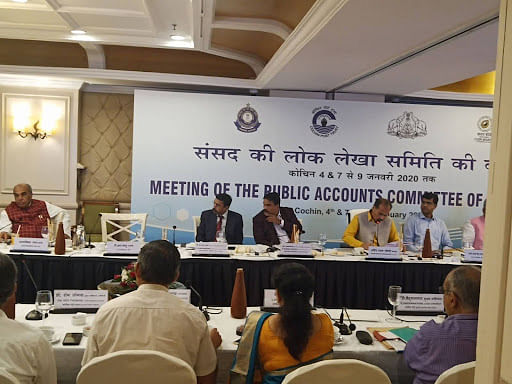
Public Accounts Committee
| Details | Description |
|---|---|
| Composition |
|
| Election |
|
| Tenure |
|
| Appointment |
|
| Relation with CAG |
|
Public Accounts Committee - Functions
The functions of the Committee are enshrined in Rule 308 of the Rules of Procedure and Conduct of Business in Lok Sabha.
- The function of the committee is to examine the annual audit reports of the Comptroller and Auditor General of India (CAG) laid before the parliament by the president.
- The CAG submits three reports to the President
- Audit report on appropriation accounts
- Audit report on finance accounts
- Audit report on public undertakings
- It examines the appropriation accounts and the finance accounts of the Union government and any other account laid before the Lok Sabha.
- In scrutinising the Appropriation Accounts and the Report of the Comptroller & Auditor General of India the Committee has to satisfy itself the following three conditions.
- The disbursed money should be legally available for the applied service or purpose.
- The expenditure conforms to the authority which governs it
- Every re-appropriation has been made in accordance with the rules.
- To examine the accounts of state corporations, trading concerns and manufacturing projects and the CAG audit reports on them.
- To examine the accounts of autonomous and semi-autonomous bodies.
- To examine the money spent on any service throughout a fiscal year in excess of the amount granted by the Lok Sabha for that purpose.
Public Accounts Committee - Limitations
- It is not concerned with policy issues in the broader sense.
- It undertakes a post-mortem analysis of accounting (indicating previous expenditure).
- It has no authority to intervene in day-to-day administration.
- Its suggestions are only advisory and do not bind the ministries.
- It does not have the authority to prohibit departmental spending.
- It is not an executive body, it cannot issue an order. Only Parliament has the authority to make final decisions based on its findings.
Way forward
- The All India Conference of Chairpersons of Parliamentary PACs and State/UT Legislatures recommended that the PAC be consulted on the selection of the CAG and that it be given authority to investigate Public-Private Partnership projects.
- The report suggested, that experts' assistance should be used for technical issues.
- To prevent political wrangling, PAC’s main focus should be on policy administration rather than policy itself.
- Former Chairman of Rajya Sabha M Venkaiah Naidu suggested that PAC should be redesignated as Public Accounts and Audit Committee as audit review is also its core function.
Conclusion
Without Parliamentary committees, a Parliamentary democracy would be rendered incomplete. It is through the PAC that citizens keep a check on government finances. In Parliamentary democracy, accountability is central to governance. Therefore rightly referred to as “the mother of all parliamentary committees”.
FAQs
Q1: What is the Public Accounts Committee (PAC)?
Answer: The Public Accounts Committee (PAC) is a parliamentary committee in India responsible for examining the government's expenditure and ensuring accountability in the use of public funds.
Q2: How is the PAC constituted?
Answer: The PAC is constituted every year by the Lok Sabha, consisting of 22 members, including 15 from the Lok Sabha and 7 from the Rajya Sabha, elected by the respective houses.
Q3: What are the main functions of the PAC?
Answer: The main functions of the PAC include auditing the government's accounts, examining the reports of the Comptroller and Auditor General (CAG), and ensuring that public funds are used efficiently and effectively.
Q4: Who chairs the Public Accounts Committee?
Answer: The PAC is chaired by a member of the opposition, which ensures impartiality and promotes accountability in the examination of the government's financial activities.
Q5: What is the significance of the PAC in Indian governance?
Answer: The PAC plays a crucial role in promoting transparency and accountability in government expenditure, thus contributing to good governance and the effective utilization of public resources.
MCQs
- What is the primary role of the Public Accounts Committee (PAC) in India?
A) To formulate policies for public spending
B) To audit the accounts of the government
C) To provide legal advice to the government
D) To oversee elections
Answer: (B) See the Explanation
- How many members are there in the Public Accounts Committee?
A) 15
B) 22
C) 30
D) 10
Answer: (B) See the Explanation
- Who elects the members of the Public Accounts Committee?
A) The President of India
B) The Prime Minister
C) The members of the Lok Sabha and Rajya Sabha
D) The Chief Justice of India
Answer: (C) See the Explanation
- Who typically chairs the Public Accounts Committee?
A) A member of the ruling party
B) A member of the opposition
C) The Speaker of the Lok Sabha
D) The Minister of Finance
Answer: (B) See the Explanation
- Which of the following reports does the PAC primarily examine?
A) Economic Survey
B) Annual Budget
C) Reports of the Comptroller and Auditor General (CAG)
D) Election Commission Reports
Answer: (C) See the Explanation
GS Mains Questions and Model Answers
Q1. Discuss the significance of the Public Accounts Committee in promoting accountability in government expenditure.
Answer: The Public Accounts Committee (PAC) plays a pivotal role in promoting accountability in government expenditure through its systematic examination of the financial operations of the government. By reviewing the reports of the Comptroller and Auditor General (CAG), the PAC assesses whether public funds are utilized efficiently and effectively. The transparency provided by the PAC's workings helps to expose irregularities and mismanagement in government spending, thereby ensuring that taxpayers' money is used for its intended purposes. Additionally, the PAC's composition, with an opposition member as chair, enhances its credibility and impartiality. The committee’s recommendations are significant as they not only hold the executive accountable but also help in formulating policies that promote fiscal discipline and responsible governance. The PAC's efforts in scrutinizing government accounts foster trust among the citizens and contribute to the broader objectives of good governance and financial prudence.
Q2. Analyze the challenges faced by the Public Accounts Committee in performing its functions effectively.
Answer: The Public Accounts Committee (PAC) encounters several challenges in its pursuit of effective oversight and accountability in government expenditure. One significant challenge is the vastness and complexity of government accounts, making thorough examination a daunting task. Limited timeframes for reviewing extensive financial documents can lead to insufficient scrutiny of critical issues. Furthermore, the PAC often operates with a lack of adequate resources and support, which can hinder its capacity to conduct comprehensive audits. Political dynamics within Parliament may also affect the PAC's functioning, as party loyalties can influence the impartiality of its members. Additionally, there is a challenge in ensuring that the government acts on the PAC's recommendations, as there is no binding authority to enforce compliance. These challenges underscore the need for reforms to enhance the effectiveness and impact of the PAC in promoting financial accountability.
Q3. Evaluate the role of the Public Accounts Committee in the context of Indian democracy and governance.
Answer: The Public Accounts Committee (PAC) serves a crucial role in the framework of Indian democracy and governance by ensuring transparency and accountability in the financial dealings of the government. As a parliamentary committee, the PAC embodies the principles of democratic oversight, allowing elected representatives to scrutinize government expenditure on behalf of the public. This mechanism reinforces the idea that the government is accountable to the electorate, fostering trust and confidence in democratic institutions. The PAC's examination of the Comptroller and Auditor General's (CAG) reports sheds light on the efficiency and effectiveness of public spending, thereby promoting responsible governance. By highlighting discrepancies and encouraging corrective measures, the PAC contributes to improved fiscal management and policy formulation. In a broader sense, the PAC's work aligns with the democratic ethos of accountability, ensuring that government actions reflect the needs and interests of the populace, thus enhancing the quality of governance in India.
Previous Year Questions on Public Accounts Committee
1. UPSC CSE 2020
Question. Examine the role of the Public Accounts Committee in ensuring financial accountability in the Indian government.
Answer: The Public Accounts Committee (PAC) plays a vital role in ensuring financial accountability in the Indian government by meticulously reviewing and auditing government expenditures as reported by the Comptroller and Auditor General (CAG). Established under the provisions of the Constitution, the PAC acts as a watchdog of public finances, scrutinizing the government's financial statements and ensuring compliance with fiscal regulations. Its significance lies in its ability to hold the executive accountable for its financial decisions, thereby promoting transparency in governance. The committee's recommendations often lead to reforms aimed at improving the efficiency of public expenditure and minimizing waste. Through public hearings and discussions, the PAC engages with various stakeholders, including government officials and experts, to address issues highlighted in the audit reports. This participatory approach not only reinforces accountability but also fosters a culture of responsible financial management within the government. Ultimately, the PAC's diligent oversight contributes to strengthening the foundations of democracy in India by ensuring that public funds are utilized effectively for the welfare of the citizens.
2. UPSC CSE 2018
Question. Discuss the challenges faced by the Public Accounts Committee in promoting transparency and accountability in financial matters.
Answer: The Public Accounts Committee (PAC) faces several challenges in its efforts to promote transparency and accountability in financial matters within the Indian government. One significant challenge is the sheer volume and complexity of government accounts, making thorough examinations time-consuming and difficult. Limited resources and support for research and analysis further exacerbate this issue, hindering the PAC's ability to conduct comprehensive audits. Additionally, the political dynamics within the Parliament can create tensions, as party allegiances may influence the objectivity of the committee members, compromising the integrity of its findings. The lack of enforceable authority to compel the government to implement the PAC's recommendations poses another challenge, often leading to a gap between the committee's findings and actual governmental actions. Moreover, the increasing complexity of financial transactions and schemes makes it challenging for the PAC to keep pace with the evolving fiscal landscape. Addressing these challenges is crucial for enhancing the effectiveness of the PAC and ensuring that it can fulfill its mandate of safeguarding public funds and promoting responsible governance.
*email: contactus@prepp.in
Download the PREPP App and attempt FREE IAS Exam Mock Tests and get complete study material!

Full Test - 04: UPSC CSE Prelims CSAT (Paper-II)
Full Test - 03: UPSC CSE Prelims CSAT (Paper-II)
UPSC CSE Prelims 2026 GS Paper 1 Question Paper (24-May-2026)
UPSC CSE Prelims 2026 CSAT Paper 2 Question Paper (24-May-2026)

17 February 2025 | The Hindu Must Read Articles | Current Affairs

16 February 2026 | The Hindu Must Read Articles | Current Affairs

13 February 2026 | The Hindu Must Read Articles | Current Affairs









Comments